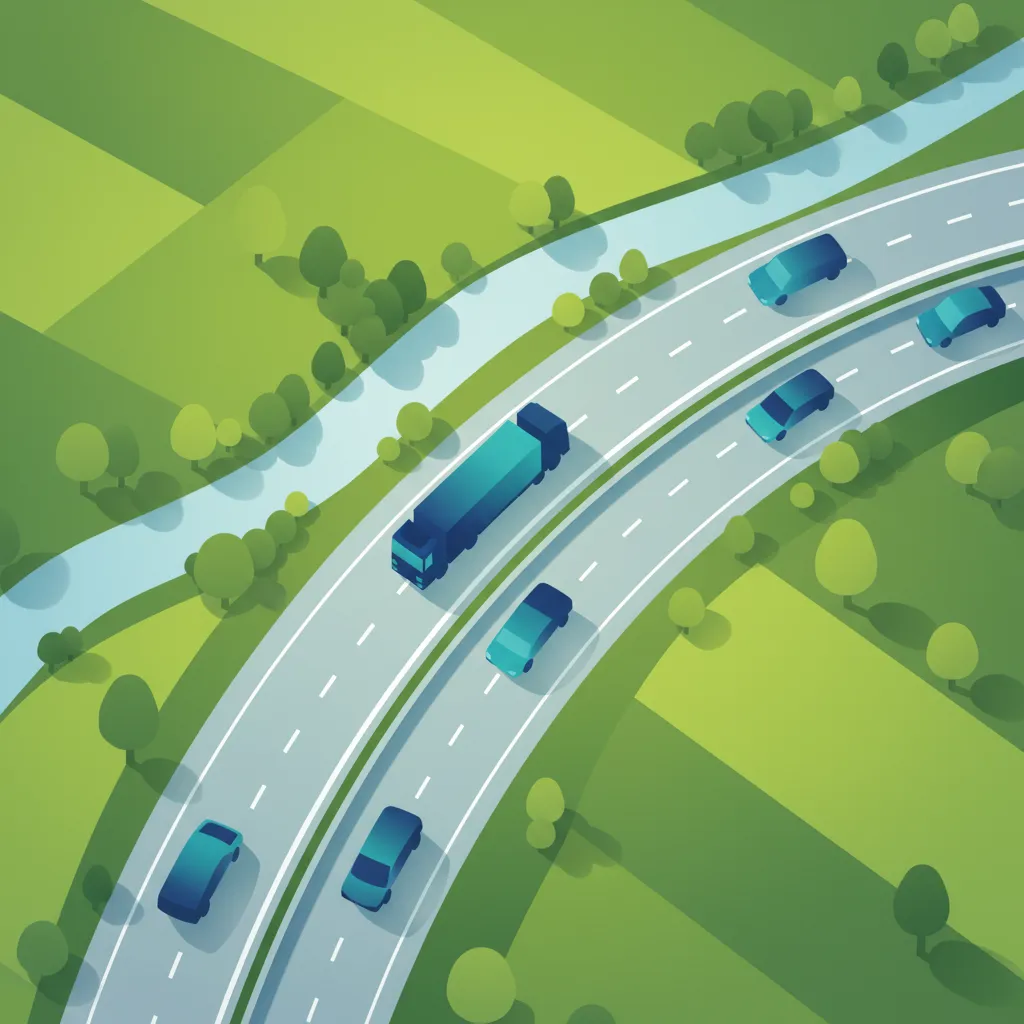
Merging traffic involves safely integrating your vehicle from an acceleration lane or a side road into an existing stream of traffic. This requires careful observation, precise speed adjustment, and effective communication with other drivers. In the Netherlands, successful merging is fundamental for safe and efficient driving, particularly on higher-speed roads like 'autowegen' and 'snelwegen'.
Theory topic content overview
Read the full theory topic guide for Merging Traffic Rules with structured, easy-to-scan content built for learners in the Netherlands. This detailed section explains the exact rule, meaning, traffic context, comparison points, and exam logic behind this Dutch driving theory topic so you can study faster, understand the concept more clearly, and avoid common interpretation mistakes on the theory test.
Merging traffic, known in Dutch as invoegen, is the process of safely integrating your vehicle from one traffic lane or road into an existing, continuous flow of traffic on another. This critical manoeuvre occurs in various scenarios, most commonly when:
snelweg) or an 'autoweg' from an acceleration lane (invoegstrook).The fundamental goal of merging is to achieve a smooth and safe transition without causing other drivers to brake sharply, swerve, or otherwise react suddenly. It relies heavily on observation, speed adjustment, and a spirit of cooperation between drivers.
Understanding invoegen is not just an exam requirement; it's a daily necessity for safe driving in the Netherlands. The dense road network, high traffic volumes, and frequent changes in speed limits on motorways (snelwegen) mean that merging situations are constant.
In the Netherlands, successful merging requires a systematic approach, combining legal obligations with practical best practices.
Invoegende Driver)When you are the driver merging into a main traffic stream, your primary responsibility is to do so safely and without disrupting the flow of existing traffic.
invoegstrook), immediately check your mirrors (rear-view and side mirrors) and look over your shoulder into your blind spot (dode hoek) to assess the traffic situation on the main road.hoofdrijbaan) must give way (voorrang verlenen) to traffic already on that road. This is a fundamental rule for invoegen.While the merging driver yields, drivers already on the main road also have a crucial role in facilitating a smooth merge and preventing accidents.
Several factors influence the safety and ease of merging:
invoegstrook) directly impacts how much time a merging driver has to match speed and find a gap. Shorter lanes require quicker, more decisive action.To fully understand merging traffic, it's useful to distinguish it from similar manoeuvres:
Rijbaan Wisselen)Invoegstrook): Designed for drivers to build up speed to match main traffic. The merging driver gives way.zipper merge (or ritsen in Dutch) is encouraged. This means drivers from both lanes proceed alternately, taking turns to enter the single lane, promoting fairness and efficiency. The "give way" rule is less absolute here; rather, it becomes a cooperative alternating process.Weefvakken)Unique to Dutch motorways are weefvakken – combined acceleration and deceleration lanes. These are common where an exit immediately follows an entrance. In a weefvak scenario, the general rule of thumb, often highlighted in CBR materials, is that the exiting driver usually has priority over the entering (merging) driver. This is because exiting drivers often need to reduce speed and position themselves earlier, and they have less opportunity to adjust than an entering driver who still has some lane length. However, ultimately, safe passage depends on mutual cooperation and clear signalling.
Snelweg) at Peak HourYou are on an invoegstrook joining a busy A2 motorway. The main lanes are flowing at about 90 km/h, slightly below the 100 km/h limit due to volume.
Action: Accelerate briskly to 90 km/h. Check your mirrors and blind spot. Signal left. Look for a suitable gap in the traffic. If traffic is very dense and no immediate gap appears, you may need to reduce your acceleration slightly while still moving forward, waiting for an opportunity. Crucially, do not stop on the invoegstrook unless it's unavoidable (e.g., traffic on the main road has stopped). Main road drivers should create space if safe, but you must yield if they do not.
You are approaching a road sign indicating that two lanes are merging into one. Traffic is moderate.
Action: This is a classic zipper merge (ritsen) scenario. Maintain your speed. Observe which lane is ending and which vehicles are in adjacent positions. The principle is one car from your lane, then one car from the other lane, and so on. Signal your intention to move over early if your lane is ending. Cooperate with the driver next to you, making eye contact if possible, to smoothly alternate.
Dode Hoek): Relying only on mirrors can lead to merging into a vehicle that is in your blind spot. A thorough over-the-shoulder check is essential.invoegstrook can cause you to run out of lane, creating a dangerous situation where you might have to stop or force your way in.Weefvakken: Misunderstanding priority in a weefvak (weaving lane) can lead to conflict between exiting and entering vehicles. Remember, exiting drivers generally have precedence.The Netherlands places a strong emphasis on smooth traffic flow and cooperative driving, especially on its extensive motorway network. The term invoegen encapsulates this need for efficient and safe integration. CBR theory questions frequently involve video scenarios of merging situations, testing not just your knowledge of the rule (merging driver yields) but also your judgment of speed, gap selection, and the importance of checking the dode hoek.
Special considerations for the Dutch context:
invoegstrook.Ritsen (Zipper Merge): This concept is actively promoted for road narrowings to maintain flow, reflecting the Dutch focus on efficiency and shared responsibility.InvoegenTo successfully merge in the Netherlands, remember these three core principles:
dode hoek), signal your intentions early, and act decisively.Merging traffic (invoegen) in the Netherlands requires the merging driver to observe, signal, match speed, find a safe gap, and yield to main road traffic. Speed adjustment is the most critical step—accelerate to match the flow before the acceleration lane ends. The merging driver always gives way to traffic already on the hoofdrjbaan, while main road drivers should maintain speed and facilitate the merge when safe. Key distinctions include merging from an acceleration lane (merger yields) versus road narrowings (zipper merge applies), and weefvakken where exiting drivers generally have priority over entering drivers.
A short set of high-value points that capture the most important ideas from this theory explanation.
The merging driver always gives way (voorrang verlenen) to traffic already on the main road, not the other way around.
Speed matching is critical: accelerate to match the speed of main road traffic before reaching the end of the acceleration lane.
Mirrors alone are insufficient; a shoulder check into the blind spot (dode hoek) is non-negotiable before merging.
In weaving sections (weefvakken), exiting drivers generally have priority over entering drivers.
At road narrowings, a zipper merge (ritsen) applies where drivers from both lanes take turns alternately.
On Dutch motorways, reach 100 km/h on the invoegstrook before merging unless traffic flows slower.
Invoegen = merging; ritsen = zipper merge; dode hoek = blind spot; weefvakken = combined entry/exit lanes.
Main road drivers should maintain speed and create space when safe, but are not obligated to yield.
Never stop on an acceleration lane unless absolutely unavoidable; always keep moving forward.
In weefvakken, the exiting driver usually has priority over the merging (invoegende) driver.
Failing to accelerate enough on the invoegstrook, forcing main road traffic to brake.
Skipping the shoulder check into the dode hoek, relying only on mirrors.
Hesitating at the end of the acceleration lane and running out of lane.
Believing main road drivers are obligated to make space for merging vehicles.
Misunderstanding priority rules in weefvakken by assuming the merging driver always has right of way.
Start with a short, direct summary of Merging Traffic Rules before reading the full explanation below.
Merging traffic means combining two separate streams of vehicles into a single lane. When merging, drivers entering the main roadway must observe existing traffic, adjust their speed to match, and find a safe gap to join without disrupting flow. This often requires the merging driver to give way to traffic already on the main road, while main road drivers should facilitate the merge by maintaining speed and creating space.
Review the most important terms, rule signals, and traffic concepts linked to Merging Traffic Rules.
Explore related theory topic pages connected to Merging Traffic Rules and continue with the next useful rule explanation.
See the common search queries learners use when trying to understand Merging Traffic Rules in the Netherlands.

Ready to deepen your understanding? Browse our comprehensive library of Dutch driving theory topics, rules, and concepts. Each section offers detailed explanations to help you solidify your knowledge and prepare thoroughly for your upcoming CBR driving theory examination.
Explore Driving Theory TopicsTheory topic content overview
A short set of high-value points that capture the most important ideas from this theory explanation.
The merging driver always gives way (voorrang verlenen) to traffic already on the main road, not the other way around.
Speed matching is critical: accelerate to match the speed of main road traffic before reaching the end of the acceleration lane.
Mirrors alone are insufficient; a shoulder check into the blind spot (dode hoek) is non-negotiable before merging.
In weaving sections (weefvakken), exiting drivers generally have priority over entering drivers.
At road narrowings, a zipper merge (ritsen) applies where drivers from both lanes take turns alternately.
On Dutch motorways, reach 100 km/h on the invoegstrook before merging unless traffic flows slower.
Invoegen = merging; ritsen = zipper merge; dode hoek = blind spot; weefvakken = combined entry/exit lanes.
Main road drivers should maintain speed and create space when safe, but are not obligated to yield.
Never stop on an acceleration lane unless absolutely unavoidable; always keep moving forward.
In weefvakken, the exiting driver usually has priority over the merging (invoegende) driver.
Failing to accelerate enough on the invoegstrook, forcing main road traffic to brake.
Skipping the shoulder check into the dode hoek, relying only on mirrors.
Hesitating at the end of the acceleration lane and running out of lane.
Believing main road drivers are obligated to make space for merging vehicles.
Misunderstanding priority rules in weefvakken by assuming the merging driver always has right of way.
Start with a short, direct summary of Merging Traffic Rules before reading the full explanation below.
Merging traffic means combining two separate streams of vehicles into a single lane. When merging, drivers entering the main roadway must observe existing traffic, adjust their speed to match, and find a safe gap to join without disrupting flow. This often requires the merging driver to give way to traffic already on the main road, while main road drivers should facilitate the merge by maintaining speed and creating space.
Review the most important terms, rule signals, and traffic concepts linked to Merging Traffic Rules.
Explore related theory topic pages connected to Merging Traffic Rules and continue with the next useful rule explanation.
See the common search queries learners use when trying to understand Merging Traffic Rules in the Netherlands.
Ready to deepen your understanding? Browse our comprehensive library of Dutch driving theory topics, rules, and concepts. Each section offers detailed explanations to help you solidify your knowledge and prepare thoroughly for your upcoming CBR driving theory examination.
Explore Driving Theory TopicsUse this exam-focused revision tip to understand how Merging Traffic Rules is likely to appear in theory questions for learners in the Netherlands. This section helps you identify the most testable part of the rule, avoid common traps, and remember the concept more effectively during Dutch driving theory exam preparation.
In CBR theory exams, pay close attention to questions involving merging scenarios. These often test your understanding of priority (merging traffic gives way), appropriate speed adjustments, and the importance of checking blind spots. Incorrect speed or failure to yield is a common mistake that leads to lost points.
Read direct answers to the most common learner questions about Merging Traffic Rules in the Netherlands. This FAQ focuses on rule confusion, practical meaning, comparison with similar concepts, and the exact uncertainties that appear most often in Dutch driving theory revision and exam preparation.
Merging traffic refers to the process where vehicles from one lane or road combine into another, forming a single traffic stream. This commonly occurs at motorway entries, where an acceleration lane meets the main carriageway.
Generally, drivers already on the main road have priority over vehicles that are merging onto it. The merging driver must adjust their speed and find a safe gap to enter the main traffic flow without forcing other vehicles to brake or swerve.
The 'zipper merge' is a technique where drivers use both merging lanes up to the merge point, then alternate taking turns, like a zipper. While not a strict legal rule, it is often promoted for smooth traffic flow and congestion reduction in busy merging situations.
When merging onto a motorway, you should accelerate on the acceleration lane to match the speed of the traffic already on the motorway. This allows you to integrate smoothly into the flow without creating a hazard.
Crucial observations include checking your mirrors (rearview and side) and performing a shoulder check to identify your blind spot. Continuously assess the speed and position of vehicles on the main road to find a safe gap.
While typically you should not break up a convoy, Dutch rules state that if it's impossible to merge in front of or behind a military convoy or funeral procession on an 'autoweg' or motorway, you are allowed to merge between the vehicles. You must still follow all normal traffic rules.
A weaving lane is a single lane used for both merging onto and exiting a main roadway, often seen on motorways. In these situations, it is often advisable for the exiting driver to take precedence over the inserting driver, as they usually maintain a higher speed.
Leverage the targeted practice search to find questions that challenge your understanding of specific Dutch traffic rules or road signs. Focus your study efforts on areas where you need improvement and build a solid foundation for passing your CBR driving theory exam with confidence.