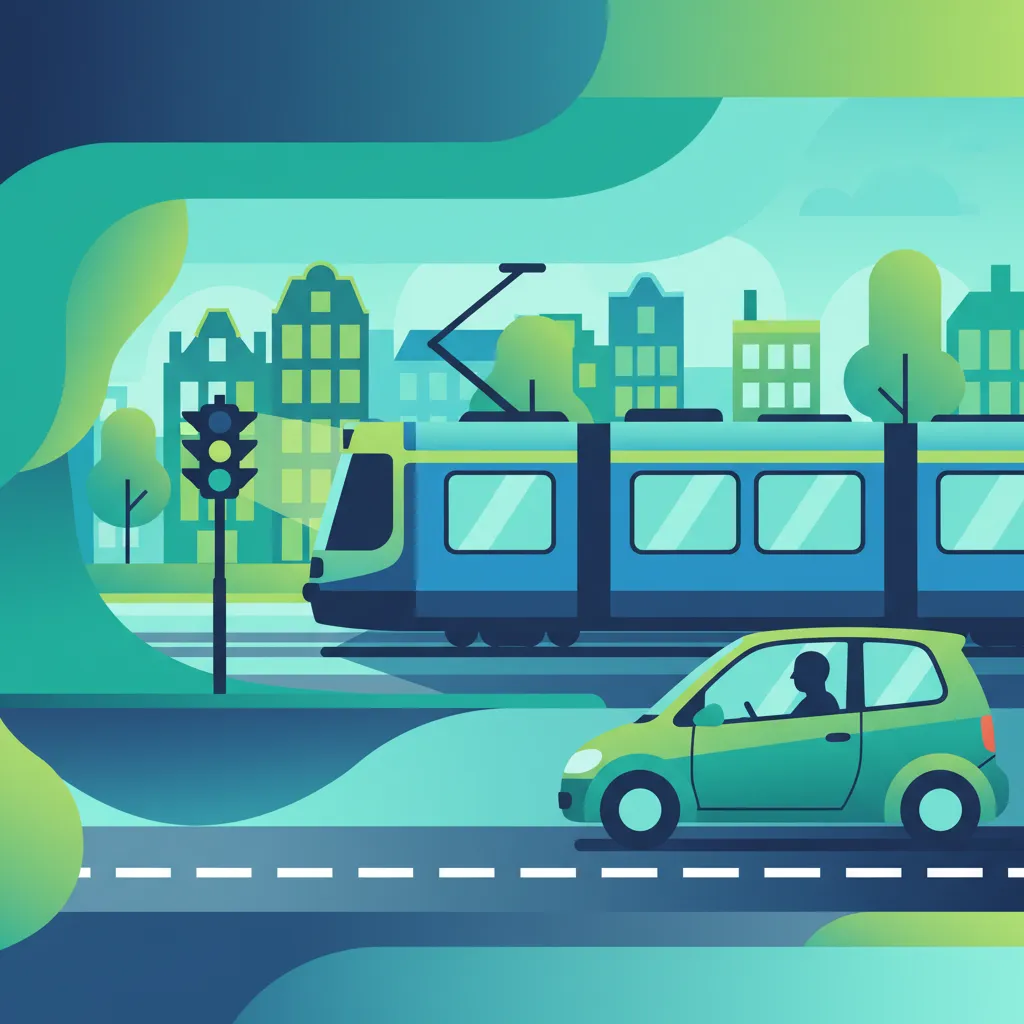
In the Netherlands, trams are an integral part of urban traffic, but they operate under special priority rules. Due to their fixed tracks and limited braking capabilities, drivers must understand when to yield to trams, particularly at intersections and during turning maneuvers. This page clarifies these essential rules to ensure safe interaction and preparation for your CBR exam.
Theory topic content overview
Read the full theory topic guide for Tram Priority with structured, easy-to-scan content built for learners in the Netherlands. This detailed section explains the exact rule, meaning, traffic context, comparison points, and exam logic behind this Dutch driving theory topic so you can study faster, understand the concept more clearly, and avoid common interpretation mistakes on the theory test.
Trams are a unique and vital part of urban landscapes across the Netherlands, from Amsterdam's bustling canals to The Hague's modern avenues. Unlike other road users, trams operate on fixed tracks and possess limited manoeuvrability and long braking distances. Due to these characteristics, Dutch traffic law (RVV 1990) grants trams special priority rules that often override standard right-of-way principles. Understanding these specific tram priority rules in the Netherlands is essential for safe driving and passing your CBR theory exam.
This page will clarify when and why trams have priority, the key exceptions, and what Dutch drivers must know to interact safely with trams.
Tram priority refers to the special right-of-way that trams are given in certain traffic situations within the Netherlands. This means that, under specific conditions, other road users (including cars, motorcycles, and cyclists) are legally obliged to yield to a tram, even if they might normally have priority according to general traffic rules.
The fundamental reason for this special status lies in the tram's nature:
Ignoring or misunderstanding Dutch tram priority rules can lead to dangerous situations, collisions, and costly mistakes on the road. For anyone preparing for their CBR driving theory exam, tram scenarios are frequently tested and are a common source of confusion.
Beyond the exam, mastering these rules ensures:
The special rules for tram right-of-way in the Netherlands primarily apply in three crucial scenarios, often overriding the basic rules that straight-ahead traffic has priority over turning traffic and traffic from the right has priority at equal intersections.
gelijkwaardige kruisingen)At an equal intersection – meaning an intersection without any traffic signs (like yield signs or stop signs) or traffic lights to regulate priority – the tram always has priority, regardless of the direction it approaches from. This is a critical departure from the standard "priority from the right" rule.
When a tram is turning, it has priority over all other road users who want to continue straight on the same road. This rule applies even if the tram is turning across your path. This is a common exam question and a crucial distinction from general turning rules for other vehicles.
If a tram wants to turn left and you want to turn right on the same road, the tram still has priority. While normally a right-turning vehicle might have priority over a left-turning vehicle from the same road, this is another instance where tram priority overrides the standard rule.
While trams enjoy significant priority, it's crucial to understand that their priority is not absolute. They are still subject to certain traffic rules and signs, just like any other road user. This is a frequent area of misunderstanding and a common CBR theory exam trap.
Trams are not exempt from regulated priority. If a tram encounters:
Traffic Lights: They must obey red and green lights.
Stop Signs: They must come to a complete stop and yield.
Yield Signs / "Shark Teeth" (haaietanden): They must yield to crossing traffic, indicated by these triangular markings on the road.
Scenario: You are on a priority road clearly marked by a yellow diamond sign. A tram approaches an intersection from a side road, where "shark teeth" are painted on the asphalt. In this case, the tram must yield to you, even though it's a tram.
Key Takeaway: Regulated priority (signs, lights) always takes precedence over the tram's special priority rules.
Voorrangsvoertuigen)This is perhaps the most important distinction for Dutch driving theory. A tram is not a voorrangsvoertuig (emergency vehicle) like a police car, ambulance, or fire engine with active blue lights and sirens. While trams have special priority rules, they do not have the same legal status that allows emergency vehicles to disregard certain rules for urgent tasks.
Trams, like all other vehicles, must yield to pedestrians who are already crossing or clearly intending to cross at a designated pedestrian crossing (zebrapad).
Let's look at how tram priority plays out in typical Dutch urban environments:
Scenario A: Unmarked Intersection in Utrecht You are driving your car in Utrecht and approach an intersection with no signs or traffic lights. A tram is coming from your right. According to the standard "priority from the right" rule, the tram should have priority. However, if a tram is coming from your left, where you would normally have priority, you still must yield to the tram because it's an equal intersection. Always be prepared to stop for trams at unmarked crossings.
Scenario B: Turning in Rotterdam You are driving in Rotterdam and want to go straight through an intersection. A tram in front of you puts on its left indicator, planning to turn left. Even though you're going straight, the turning tram has priority. You must stop and allow the tram to complete its turn before proceeding.
Scenario C: Yielding to "Shark Teeth" in The Hague You are on a street in The Hague that has "shark teeth" markings (yield triangles) painted on the road, indicating you must yield. A tram approaches from your left on a road that does not have "shark teeth" or a stop sign. In this situation, the tram must yield to you because the road markings regulate priority. This highlights that regulated priority overrides the tram's general special status.
Learners often struggle with tram priority rules on the CBR exam because they contradict general priority principles. Be aware of these common pitfalls:
When driving in the Netherlands, especially in urban areas with trams:
Mastering these Dutch tram priority rules will not only prepare you thoroughly for your CBR theory exam but also make you a safer, more confident driver on the roads of the Netherlands.
Dutch traffic law grants trams special priority because they operate on fixed tracks and cannot swerve or stop quickly. At equal (unmarked) intersections, trams always have priority regardless of direction. When a tram is turning, it takes precedence over all traffic continuing straight on the same road, even if you are going straight and the tram is turning left across your path. However, trams are not emergency vehicles and must obey traffic signs (including stop signs and 'shark teeth' yield triangles) and traffic lights; regulated priority always overrides tram priority. Drivers must anticipate tram movements, yield when uncertain, and never block tram tracks.
A short set of high-value points that capture the most important ideas from this theory explanation.
Trams in the Netherlands have special priority rules under RVV 1990 that override standard right-of-way principles due to their fixed tracks and limited braking capabilities
At equal (unmarked) intersections with no traffic signs or signals, trams always have priority regardless of approach direction
A turning tram has priority over all traffic continuing straight on the same road, reversing the normal rule that straight-ahead traffic takes precedence
When a tram turns left and you want to turn right on the same road, the tram still has priority
Trams are NOT emergency vehicles (voorrangsvoertuigen) and cannot disregard traffic signs or signals like police or ambulance with blue lights
Fixed tracks mean trams cannot swerve, and long braking distances mean they need priority to maintain safe stopping distances
Without signs or lights, the tram always goes first at intersections
A turning tram takes priority over your straight-through movement even when the tram is turning across your path
Traffic signs (stop, yield/shark teeth) and traffic signals always override the tram's special priority
Pedestrian crossings (zebrapad) must still be respected by trams
Assuming a tram from the left must yield at an unmarked intersection, when in fact the tram always has priority at equal intersections
Forgetting that a turning tram has priority over straight-through traffic and proceeding anyway
Treating trams like emergency vehicles that can ignore all traffic rules, when trams must obey signs and signals
Failing to anticipate tram movements and signals in busy urban areas, leading to last-minute braking
Blocking tram tracks by stopping on rails at red lights or in congestion, obstructing the tram's predetermined path
Start with a short, direct summary of Tram Priority before reading the full explanation below.
Trams in the Netherlands often have special priority over other road users at intersections and when turning, even if standard rules might suggest otherwise. This is due to their fixed routes and long stopping distances. However, trams must still yield to traffic signs like 'stop' signs or 'shark teeth' (yield triangles). Drivers must always be aware and anticipate tram movements for safety.
Review the most important terms, rule signals, and traffic concepts linked to Tram Priority.
Explore related theory topic pages connected to Tram Priority and continue with the next useful rule explanation.
See the common search queries learners use when trying to understand Tram Priority in the Netherlands.

Ready to deepen your understanding? Browse our comprehensive library of Dutch driving theory topics, rules, and concepts. Each section offers detailed explanations to help you solidify your knowledge and prepare thoroughly for your upcoming CBR driving theory examination.
Explore Driving Theory TopicsTheory topic content overview
A short set of high-value points that capture the most important ideas from this theory explanation.
Trams in the Netherlands have special priority rules under RVV 1990 that override standard right-of-way principles due to their fixed tracks and limited braking capabilities
At equal (unmarked) intersections with no traffic signs or signals, trams always have priority regardless of approach direction
A turning tram has priority over all traffic continuing straight on the same road, reversing the normal rule that straight-ahead traffic takes precedence
When a tram turns left and you want to turn right on the same road, the tram still has priority
Trams are NOT emergency vehicles (voorrangsvoertuigen) and cannot disregard traffic signs or signals like police or ambulance with blue lights
Fixed tracks mean trams cannot swerve, and long braking distances mean they need priority to maintain safe stopping distances
Without signs or lights, the tram always goes first at intersections
A turning tram takes priority over your straight-through movement even when the tram is turning across your path
Traffic signs (stop, yield/shark teeth) and traffic signals always override the tram's special priority
Pedestrian crossings (zebrapad) must still be respected by trams
Assuming a tram from the left must yield at an unmarked intersection, when in fact the tram always has priority at equal intersections
Forgetting that a turning tram has priority over straight-through traffic and proceeding anyway
Treating trams like emergency vehicles that can ignore all traffic rules, when trams must obey signs and signals
Failing to anticipate tram movements and signals in busy urban areas, leading to last-minute braking
Blocking tram tracks by stopping on rails at red lights or in congestion, obstructing the tram's predetermined path
Start with a short, direct summary of Tram Priority before reading the full explanation below.
Trams in the Netherlands often have special priority over other road users at intersections and when turning, even if standard rules might suggest otherwise. This is due to their fixed routes and long stopping distances. However, trams must still yield to traffic signs like 'stop' signs or 'shark teeth' (yield triangles). Drivers must always be aware and anticipate tram movements for safety.
Review the most important terms, rule signals, and traffic concepts linked to Tram Priority.
Explore related theory topic pages connected to Tram Priority and continue with the next useful rule explanation.
See the common search queries learners use when trying to understand Tram Priority in the Netherlands.
Ready to deepen your understanding? Browse our comprehensive library of Dutch driving theory topics, rules, and concepts. Each section offers detailed explanations to help you solidify your knowledge and prepare thoroughly for your upcoming CBR driving theory examination.
Explore Driving Theory TopicsUse this exam-focused revision tip to understand how Tram Priority is likely to appear in theory questions for learners in the Netherlands. This section helps you identify the most testable part of the rule, avoid common traps, and remember the concept more effectively during Dutch driving theory exam preparation.
Remember that while a tram is NOT considered an emergency vehicle (like police or ambulance with flashing lights and sirens), it DOES have special priority in many situations in the Netherlands. Don't confuse its special status with that of an emergency vehicle; understand the specific scenarios where you must yield, especially at unmarked intersections or when a tram is turning. This is a common trap on the CBR exam.
Read direct answers to the most common learner questions about Tram Priority in the Netherlands. This FAQ focuses on rule confusion, practical meaning, comparison with similar concepts, and the exact uncertainties that appear most often in Dutch driving theory revision and exam preparation.
No, a tram does not always have priority. While trams have special priority at equal (unmarked) intersections and when turning, they must still obey traffic signs and signals like 'shark teeth' (yield triangles) and 'stop' signs.
No, a tram is not considered a priority vehicle like a police car, ambulance, or fire truck. Priority vehicles use blue lights and sirens. Trams have special right-of-way rules due to their operational limitations, but they are not emergency vehicles.
At an equal intersection (without traffic signs or lights), the tram always has priority, regardless of its direction of approach. You must yield to the tram.
Yes, when a tram is turning, it has priority over other road users who wish to continue straight on the same road. This rule applies even if you are going straight and the tram is turning in front of you.
If a tram wants to turn left and you want to turn right on the same road, the tram has priority. This means you must wait and let the tram complete its turn.
Yes, tram drivers must adhere to traffic signs and road markings. If a tram approaches 'shark teeth' (yield triangles) or a 'stop' sign, it must yield to crossing drivers, just like any other vehicle.
Leverage the targeted practice search to find questions that challenge your understanding of specific Dutch traffic rules or road signs. Focus your study efforts on areas where you need improvement and build a solid foundation for passing your CBR driving theory exam with confidence.