
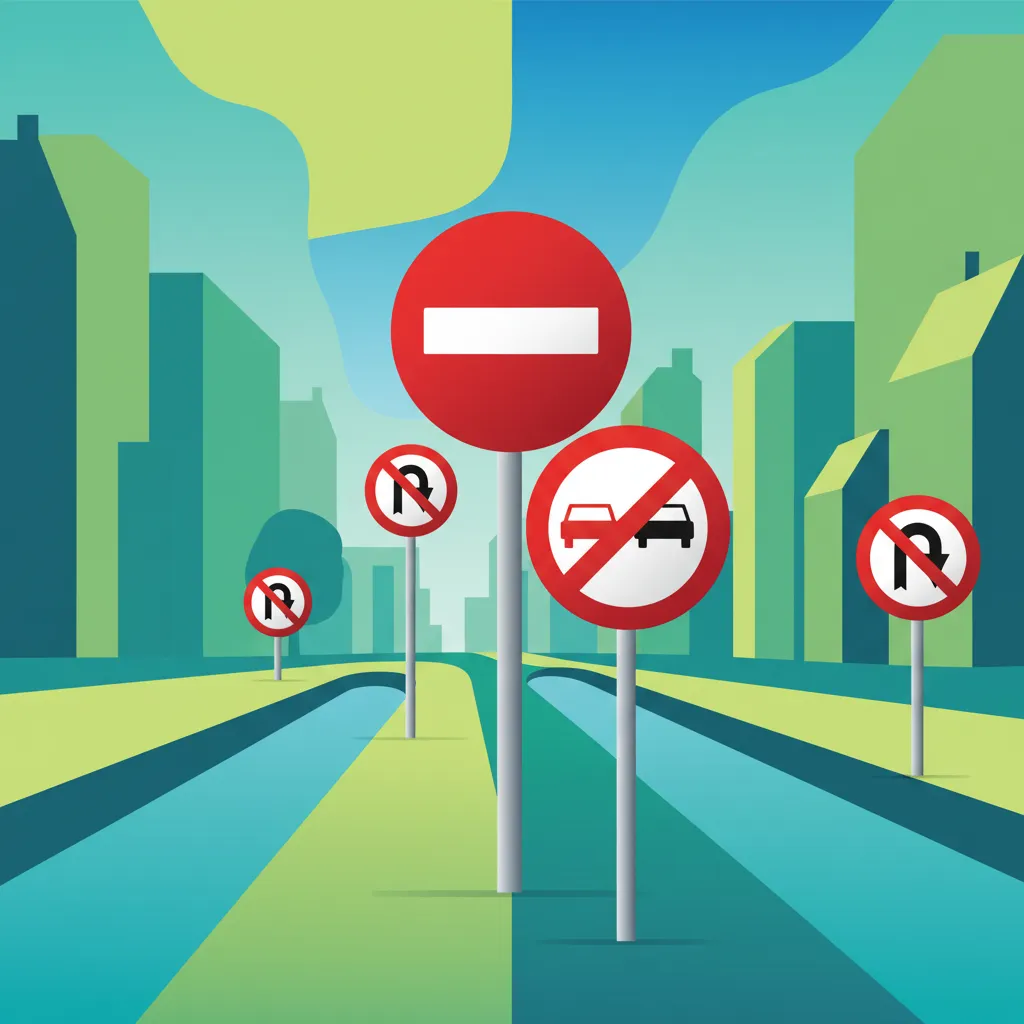
Prohibition signs are a fundamental category of traffic signs in the Netherlands, designed to clearly indicate actions that road users are not permitted to take. Recognizable by their distinctive shapes and colors, they enforce legal restrictions necessary for preventing dangerous situations and maintaining orderly traffic. Mastering their interpretation is essential for every driver, both for passing the CBR theory exam and for safe, compliant driving on Dutch roads.
Theory topic content overview
Read the full theory topic guide for Prohibition Signs Explained with structured, easy-to-scan content built for learners in the Netherlands. This detailed section explains the exact rule, meaning, traffic context, comparison points, and exam logic behind this Dutch driving theory topic so you can study faster, understand the concept more clearly, and avoid common interpretation mistakes on the theory test.
Prohibition signs (in Dutch, generally referred to as verbodsborden or geslotenverklaringen for specific closures) are a critical category of traffic signs in the Netherlands. Their fundamental purpose is to clearly communicate actions that road users are legally forbidden to perform. They act as direct commands from the traffic authority, establishing restrictions to maintain safety, regulate traffic flow, and prevent dangerous situations.
You can usually recognise prohibition signs by their distinctive appearance: they are round with a red border. Inside this border, a symbol or number indicates the specific restriction. This visual language is instantly recognisable and demands immediate attention from drivers.
For anyone learning to drive in the Netherlands, a thorough understanding of prohibition signs is paramount for several reasons:
When you encounter a prohibition sign on Dutch roads, your driving behaviour must immediately adapt to the indicated restriction. The process is straightforward:
Prohibition signs in the Netherlands fall into several categories, often designated by letters in the official sign system. Understanding these categories helps to contextualise their purpose:
(A01) 80 means a maximum speed of 80 km/h.(C01) Red circle with white horizontal bar: Closed to all vehicles, horse riders, and handlers of horses and livestock in both directions. (Pedestrians are usually allowed).(C02) Red circle with white vertical bar: Closed to vehicles, horse riders, and handlers of horses and livestock from this direction (one-way street from the other side).(C03) Red circle with a car symbol: Closed to motor vehicles with more than two wheels. Crucially, this means cars, trucks, and buses are forbidden, but motorbikes, mopeds, and bicycles are allowed.(C04) Red circle with a motorbike symbol: Closed to motorcycles.(F01) Red circle with two cars (one red, one black) side-by-side: Prohibition for motor vehicles to overtake each other. Remember: a moped is not considered a motor vehicle here, so you can overtake a moped.(F03) Red circle with a truck and a car: Prohibition for lorries (trucks) to overtake motor vehicles.(F05) Red circle with an arrow pointing left and a cross: No left turn.(F06) Red circle with an arrow pointing right and a cross: No right turn.(F07) Red circle with an arrow making a U-turn and a cross: No U-turn.(F08) Red circle with a 'P' and a diagonal line: No parking (you may stop briefly for loading/unloading or picking up/dropping off passengers).(F09) Red circle with a cross: No stopping (you cannot stop for any reason, even briefly).To avoid mistakes, especially in the CBR theory exam, it's vital to distinguish between similar-looking signs and their precise meanings in the Dutch context:
verbod stil te staan) allows you to stop briefly for immediate loading/unloading or passenger pick-up/drop-off. Your vehicle must not be left unattended.verbod stil te staan en te parkeren) means you cannot stop for any reason, not even briefly, unless forced by traffic or an emergency.Let's look at how prohibition signs play out in typical Dutch driving situations:
C03 sign (Closed to motor vehicles with more than two wheels).
F01 sign (Prohibition for motor vehicles to overtake each other).
F02 sign (End of prohibition to overtake) or you pass a junction. However, you could overtake a moped or bicycle, as they are not "motor vehicles" in this context.F08 sign (No Parking).
F09 (No Stopping) sign, you couldn't even stop briefly.Learners frequently make mistakes with prohibition signs on the CBR theory exam:
onderbord that specifies times, distances, or exceptions.The most important thing to remember about Dutch prohibition signs is the "Red Circle Rule": A red circle always means "do not do this," or "you are not allowed to."
Beyond that, always apply this sequence when encountering such a sign:
By diligently following this mental model, you'll be well-prepared for your CBR theory exam and contribute to safer, more orderly traffic on all Dutch roads.
Dutch prohibition signs are round with a red border and legally forbid specific actions; they fall into three main categories: Category A for speed limits, Category C for road closures to specific vehicle types, and Category F for directional and behavioral prohibitions. The critical distinction between No Parking (allows brief passenger stops) and No Stopping (no pause whatsoever) frequently appears on the CBR exam and must be mastered. Always check supplementary plates for time frames, distances, and exceptions, and remember that 'motor vehicle' excludes mopeds and bicycles, meaning these often can pass where cars cannot. The universal red circle rule - that a red border always means prohibition - serves as the primary memory anchor for all Dutch prohibition signs.
A short set of high-value points that capture the most important ideas from this theory explanation.
Dutch prohibition signs (verbodsborden) are round with a red border and indicate legally forbidden actions
Category C signs (geslotenverklaringen) close roads to specific vehicle types, but mopeds and bicycles are often still allowed
Category F signs cover turning, overtaking, and stopping restrictions with distinct symbols for each prohibition
Supplementary plates (onderborden) below the main sign specify times, distances, or exceptions that are essential to read
A red circle always means 'do not do this' - this is the fundamental rule for interpreting Dutch prohibition signs
No Parking (F08) allows brief stops for loading/unloading passengers; No Stopping (F09) prohibits any pause, even briefly
Motor vehicles (motorvoertuigen) include cars, trucks, buses, and motorcycles, but exclude mopeds and bicycles
The F01 overtaking prohibition applies only to motor vehicles - you may still overtake mopeds and bicycles
Prohibition signs remain in force until lifted by an 'end of prohibition' sign or a junction (unless repeated)
A red circle with a vertical bar (C02) closes a road only from the direction you are approaching
Confusing motor vehicles with all vehicles and incorrectly assuming motorcycles cannot pass a C03 sign
Ignoring supplementary plates that specify time restrictions, distances, or exceptions like 'except residents'
Assuming a parking prohibition ends immediately when it may extend over a long zone until an end sign
Treating No Parking and No Stopping as the same restriction, which costs exam points
Overlooking that category F turning prohibition signs (left, right, U-turn) all use similar red circle format with different arrows
Start with a short, direct summary of Prohibition Signs Explained before reading the full explanation below.
Prohibition signs are traffic signs that indicate a specific action is forbidden. In the Netherlands, they are typically round with a red border, often containing a symbol or number that specifies the restriction, such as 'no entry' or 'no overtaking.' They are legally binding and crucial for preventing accidents and ensuring predictable traffic behavior.
Review the most important terms, rule signals, and traffic concepts linked to Prohibition Signs Explained.
Explore related theory topic pages connected to Prohibition Signs Explained and continue with the next useful rule explanation.
See the common search queries learners use when trying to understand Prohibition Signs Explained in the Netherlands.

Ready to deepen your understanding? Browse our comprehensive library of Dutch driving theory topics, rules, and concepts. Each section offers detailed explanations to help you solidify your knowledge and prepare thoroughly for your upcoming CBR driving theory examination.
Explore Driving Theory TopicsTheory topic content overview
A short set of high-value points that capture the most important ideas from this theory explanation.
Dutch prohibition signs (verbodsborden) are round with a red border and indicate legally forbidden actions
Category C signs (geslotenverklaringen) close roads to specific vehicle types, but mopeds and bicycles are often still allowed
Category F signs cover turning, overtaking, and stopping restrictions with distinct symbols for each prohibition
Supplementary plates (onderborden) below the main sign specify times, distances, or exceptions that are essential to read
A red circle always means 'do not do this' - this is the fundamental rule for interpreting Dutch prohibition signs
No Parking (F08) allows brief stops for loading/unloading passengers; No Stopping (F09) prohibits any pause, even briefly
Motor vehicles (motorvoertuigen) include cars, trucks, buses, and motorcycles, but exclude mopeds and bicycles
The F01 overtaking prohibition applies only to motor vehicles - you may still overtake mopeds and bicycles
Prohibition signs remain in force until lifted by an 'end of prohibition' sign or a junction (unless repeated)
A red circle with a vertical bar (C02) closes a road only from the direction you are approaching
Confusing motor vehicles with all vehicles and incorrectly assuming motorcycles cannot pass a C03 sign
Ignoring supplementary plates that specify time restrictions, distances, or exceptions like 'except residents'
Assuming a parking prohibition ends immediately when it may extend over a long zone until an end sign
Treating No Parking and No Stopping as the same restriction, which costs exam points
Overlooking that category F turning prohibition signs (left, right, U-turn) all use similar red circle format with different arrows
Start with a short, direct summary of Prohibition Signs Explained before reading the full explanation below.
Prohibition signs are traffic signs that indicate a specific action is forbidden. In the Netherlands, they are typically round with a red border, often containing a symbol or number that specifies the restriction, such as 'no entry' or 'no overtaking.' They are legally binding and crucial for preventing accidents and ensuring predictable traffic behavior.
Review the most important terms, rule signals, and traffic concepts linked to Prohibition Signs Explained.
Explore related theory topic pages connected to Prohibition Signs Explained and continue with the next useful rule explanation.
See the common search queries learners use when trying to understand Prohibition Signs Explained in the Netherlands.
Ready to deepen your understanding? Browse our comprehensive library of Dutch driving theory topics, rules, and concepts. Each section offers detailed explanations to help you solidify your knowledge and prepare thoroughly for your upcoming CBR driving theory examination.
Explore Driving Theory TopicsUse this exam-focused revision tip to understand how Prohibition Signs Explained is likely to appear in theory questions for learners in the Netherlands. This section helps you identify the most testable part of the rule, avoid common traps, and remember the concept more effectively during Dutch driving theory exam preparation.
Pay close attention to the specific symbols on prohibition signs, as many look similar but apply to different vehicle types or actions. For instance, distinguish 'closed to all vehicles' from 'closed to motor vehicles' for your CBR exam. Always assume the most restrictive interpretation if unsure, and remember a red circle usually means 'do not do this'.
Read direct answers to the most common learner questions about Prohibition Signs Explained in the Netherlands. This FAQ focuses on rule confusion, practical meaning, comparison with similar concepts, and the exact uncertainties that appear most often in Dutch driving theory revision and exam preparation.
Prohibition signs in the Netherlands are most often circular with a red border, often featuring a black symbol on a white background, or a red diagonal line through a symbol. This distinctive design immediately signals a restriction or forbidden action.
Prohibition signs forbid a wide range of actions, including 'no entry' (C1), 'no overtaking' (F1), 'no U-turn' (F9), 'no parking' (E1), or restricting access for specific vehicle types like lorries or motor vehicles with trailers.
Prohibition signs (verbodsborden) forbid actions and are typically round with a red border. Obligation signs (gebodsborden) command actions, often indicating a mandatory direction or path, and are typically round and blue.
Prohibition signs are always legally binding when present. Some apply continuously, while others might be temporary (e.g., during roadworks) or accompanied by supplementary plates indicating specific times, dates, or conditions under which the prohibition applies.
Ignoring a prohibition sign can lead to dangerous traffic situations, accidents, and legal consequences, including fines and penalty points, in the Netherlands. It also demonstrates a lack of understanding of fundamental traffic rules, which is critical for your driving license.
Unless a symbol on the sign or an accompanying supplementary plate specifies otherwise (e.g., 'Closed to motor vehicles'), a prohibition typically applies to all road users it is relevant for. Specific signs may target particular vehicle types like lorries or motorbikes.
Leverage the targeted practice search to find questions that challenge your understanding of specific Dutch traffic rules or road signs. Focus your study efforts on areas where you need improvement and build a solid foundation for passing your CBR driving theory exam with confidence.