
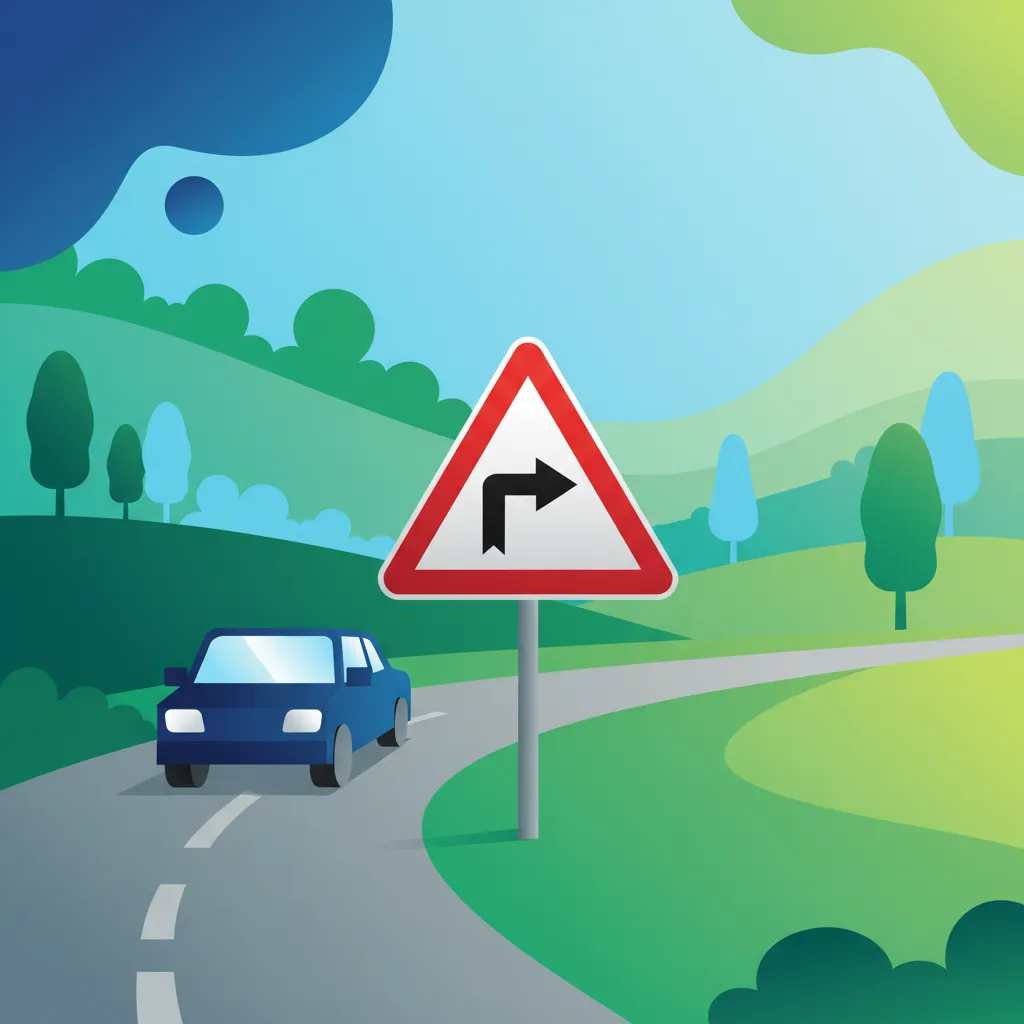
Warning signs are a fundamental part of road safety in the Netherlands, designed to prepare drivers for potential dangers or unusual conditions ahead. Unlike regulatory signs that enforce rules, warning signs serve to inform, giving you valuable time to react. Recognizing their distinct shape and understanding their message is key to proactive driving and a core component of Dutch driving theory.
Theory topic content overview
Read the full theory topic guide for Warning Signs with structured, easy-to-scan content built for learners in the Netherlands. This detailed section explains the exact rule, meaning, traffic context, comparison points, and exam logic behind this Dutch driving theory topic so you can study faster, understand the concept more clearly, and avoid common interpretation mistakes on the theory test.
Warning signs, known in Dutch traffic as waarschuwingsborden, are triangular road signs designed to alert drivers to potential hazards or unusual road conditions ahead. Unlike regulatory signs that dictate rules or prohibitions, warning signs serve a crucial informational role: they give you advance notice, providing valuable time to anticipate and react safely.
Recognising these distinctive signs and understanding their message is fundamental for road safety in the Netherlands and a core component of your CBR driving theory exam. They empower you to be a proactive driver, rather than merely a reactive one.
Waarschuwingsborden are Critical for Safety and Your CBR ExamMastering warning signs is essential for several reasons:
gevaarherkenning (hazard perception) in the Dutch theory test.Warning signs are strategically placed a sufficient distance before the actual hazard. This allows drivers time to:
The exact distance a warning sign is placed before a hazard can vary depending on the expected speed limit and the nature of the hazard. On faster roads, signs are placed further in advance.
In the Netherlands, warning signs are primarily categorized under Category J of the official traffic sign system. They share several defining characteristics:
Common examples of Dutch J-category warning signs include:
voetgangersoversteekplaats)verkeersdrempel)Sometimes, an onderbord (sub-plate) will be placed below a warning sign. This onderbord provides additional information, such as the distance to the hazard ("over 200m") or specific conditions under which the warning applies ("bij regen" - when wet).
Understanding what warning signs are not is as important as knowing what they are, especially in the context of the CBR exam.
This is the most critical distinction for Dutch learners:
waarschuwingsborden): Always triangular with the point facing upwards (e.g., dangerous bend, children). They advise caution about a hazard.voorrangsborden): While some are triangular, the most notable is the downward-pointing triangle (B6 - Haaietanden / Give Way). This sign is a priority sign, not a warning sign, and explicitly means "give way to traffic on the intersecting road". Do not confuse these. A stopbord (Stop sign, B7) is also a priority sign, not a warning sign.gebodsborden / verbodsborden): Command you to do something or prohibit something. They are legally binding. (E.g., round blue signs for mandatory directions, round white signs with a red border for speed limits).informatieborden): Provide general guidance, directions, or information (e.g., rectangular blue signs for motorways or parking).onderbord saying "bij regen" (when wet). Even if the road looks dry, you should mentally prepare for potentially slippery conditions. If it's raining or has recently rained, drastically reduce your speed, increase your following distance, and ensure all steering and braking inputs are smooth to prevent skidding.Many learners, especially those preparing for the CBR theory exam, make specific errors when it comes to warning signs:
Haaietanden (Give Way) sign as a general warning sign for hazards, rather than a specific command to yield priority.The consistent design of waarschuwingsborden in the Netherlands (upward-pointing red-bordered triangles) makes them instantly recognizable. This uniformity is a key element of the Dutch traffic sign system and is heavily emphasized in CBR theory materials. The CBR exam focuses not just on identifying the sign, but on the appropriate action a driver should take in response to the warning. Questions often involve scenarios where you must decide the safest speed, road position, or observation strategy based on a warning sign. Always remember that these signs are about preparing for potential danger, which is the essence of gevaarherkenning.
Warning signs are your allies in safe driving. In the Netherlands, they are a clear directive to anticipate and adapt. When you see a triangular sign with a red border and an upward-pointing tip, your mental checklist should be: "What danger is ahead? How far is it? What adjustments do I need to make to my speed, position, and attention now to ensure a safe passage?" Proactive thinking, informed by these crucial waarschuwingsborden, is the hallmark of a skilled and safe driver.
Warning signs in Dutch traffic are distinctive upward-pointing red-bordered triangles containing black pictograms that alert drivers to upcoming hazards and are categorized under J in the official Dutch sign system. Their core purpose is to give drivers advance warning so they can anticipate dangers such as curves, intersections, level crossings, or vulnerable road users and adjust their speed, position, and attention accordingly. A critical distinction for the CBR exam is that downward-pointing triangles are priority signs (Give Way), not warning signs. The signs work best when drivers interpret the pictogram, assess conditions using any onderbord information, and make early, proactive adjustments rather than reacting at the last moment.
A short set of high-value points that capture the most important ideas from this theory explanation.
Warning signs (waarschuwingsborden) are upward-pointing white triangles with red borders and black pictograms that alert drivers to upcoming hazards
Warning signs give drivers time to anticipate and react safely before reaching a hazard, which is central to gevaarherkenning (hazard perception)
In Dutch traffic, warning signs fall under Category J and include specific codes such as J1 (curve), J2 (dangerous intersection), J20 (skidding), and J21 (children)
The appropriate reaction to a warning sign is to adjust your speed, road position, and attention before reaching the hazard, not after
Warning signs inform but do not command; they advise caution rather than legally requiring specific actions like regulatory signs do
Warning signs always point upwards (red-bordered triangle); a downward-pointing triangle is the Give Way priority sign (B6/Haaietanden), not a warning sign
Common J-category warning signs include J14-J15 (level crossings), J22 (pedestrian crossing), J25 (loose chippings), and J38 (speed bump)
An onderbord (sub-plate) below a warning sign provides additional information such as distance or conditions like 'bij regen' (when wet)
Warning signs are placed further in advance on faster roads to allow adequate reaction time
The CBR exam tests both sign recognition and the appropriate driver reaction for each warning sign scenario
Confusing the downward-pointing Give Way triangle (B6) with a general warning sign, leading to misinterpretation of priority rules
Seeing a warning sign but failing to adjust driving behaviour until the hazard is already visible, making safe reaction difficult
Assuming a warning sign alone is sufficient without combining it with real-time observation of actual road conditions
Misinterpreting specific pictograms, particularly J2 (dangerous intersection) which indicates equal roads with priority to the right
Reacting too late by waiting until the hazard is visible before adjusting speed or attention, defeating the purpose of advance warning
Start with a short, direct summary of Warning Signs before reading the full explanation below.
Warning signs in Dutch traffic are typically white triangular signs with a red border and a black pictogram, pointing upwards. Their primary function is to alert drivers to upcoming hazards or changes in road conditions that require caution, such as sharp bends, dangerous intersections, or pedestrian crossings. They give drivers time to adjust speed and attention before reaching the potential danger.
Review the most important terms, rule signals, and traffic concepts linked to Warning Signs.
Explore related theory topic pages connected to Warning Signs and continue with the next useful rule explanation.
See the common search queries learners use when trying to understand Warning Signs in the Netherlands.

Ready to deepen your understanding? Browse our comprehensive library of Dutch driving theory topics, rules, and concepts. Each section offers detailed explanations to help you solidify your knowledge and prepare thoroughly for your upcoming CBR driving theory examination.
Explore Driving Theory TopicsTheory topic content overview
A short set of high-value points that capture the most important ideas from this theory explanation.
Warning signs (waarschuwingsborden) are upward-pointing white triangles with red borders and black pictograms that alert drivers to upcoming hazards
Warning signs give drivers time to anticipate and react safely before reaching a hazard, which is central to gevaarherkenning (hazard perception)
In Dutch traffic, warning signs fall under Category J and include specific codes such as J1 (curve), J2 (dangerous intersection), J20 (skidding), and J21 (children)
The appropriate reaction to a warning sign is to adjust your speed, road position, and attention before reaching the hazard, not after
Warning signs inform but do not command; they advise caution rather than legally requiring specific actions like regulatory signs do
Warning signs always point upwards (red-bordered triangle); a downward-pointing triangle is the Give Way priority sign (B6/Haaietanden), not a warning sign
Common J-category warning signs include J14-J15 (level crossings), J22 (pedestrian crossing), J25 (loose chippings), and J38 (speed bump)
An onderbord (sub-plate) below a warning sign provides additional information such as distance or conditions like 'bij regen' (when wet)
Warning signs are placed further in advance on faster roads to allow adequate reaction time
The CBR exam tests both sign recognition and the appropriate driver reaction for each warning sign scenario
Confusing the downward-pointing Give Way triangle (B6) with a general warning sign, leading to misinterpretation of priority rules
Seeing a warning sign but failing to adjust driving behaviour until the hazard is already visible, making safe reaction difficult
Assuming a warning sign alone is sufficient without combining it with real-time observation of actual road conditions
Misinterpreting specific pictograms, particularly J2 (dangerous intersection) which indicates equal roads with priority to the right
Reacting too late by waiting until the hazard is visible before adjusting speed or attention, defeating the purpose of advance warning
Start with a short, direct summary of Warning Signs before reading the full explanation below.
Warning signs in Dutch traffic are typically white triangular signs with a red border and a black pictogram, pointing upwards. Their primary function is to alert drivers to upcoming hazards or changes in road conditions that require caution, such as sharp bends, dangerous intersections, or pedestrian crossings. They give drivers time to adjust speed and attention before reaching the potential danger.
Review the most important terms, rule signals, and traffic concepts linked to Warning Signs.
Explore related theory topic pages connected to Warning Signs and continue with the next useful rule explanation.
See the common search queries learners use when trying to understand Warning Signs in the Netherlands.
Ready to deepen your understanding? Browse our comprehensive library of Dutch driving theory topics, rules, and concepts. Each section offers detailed explanations to help you solidify your knowledge and prepare thoroughly for your upcoming CBR driving theory examination.
Explore Driving Theory TopicsUse this exam-focused revision tip to understand how Warning Signs is likely to appear in theory questions for learners in the Netherlands. This section helps you identify the most testable part of the rule, avoid common traps, and remember the concept more effectively during Dutch driving theory exam preparation.
Pay close attention to the pictograms on warning signs, as they directly indicate the hazard. The CBR exam often tests your understanding of what each specific warning sign means and how you should react. Remember that a downward-pointing triangle is a priority sign, not a warning sign for hazards.
Read direct answers to the most common learner questions about Warning Signs in the Netherlands. This FAQ focuses on rule confusion, practical meaning, comparison with similar concepts, and the exact uncertainties that appear most often in Dutch driving theory revision and exam preparation.
The primary purpose of a warning sign is to alert drivers to potential hazards or unusual road conditions ahead, allowing them sufficient time to react and adjust their driving safely.
In the Netherlands, most warning signs are white equilateral triangles with a red border and a black pictogram depicting the specific hazard, with the point of the triangle facing upwards.
Warning signs alert you to potential dangers (informational), while regulatory signs impose specific rules or prohibitions that must be followed (mandatory or prohibitive).
Recognizing warning signs is crucial for the CBR exam as it tests your hazard perception and ability to anticipate and respond to dangerous situations, which is a key aspect of safe driving in the Netherlands.
Upon seeing a warning sign, a driver should immediately assess the indicated hazard, reduce speed if necessary, increase vigilance, and prepare to take appropriate action to ensure safety.
Yes, some triangular signs, particularly those indicating a dangerous intersection (J8) or a main road, can also alert you to upcoming priority situations where extra caution is needed, even if they don't explicitly grant or deny priority themselves.
A 'slippery road' warning sign (J20) indicates that the road surface ahead may be slippery, regardless of current weather conditions, due to factors like ice, water, gravel, or oil. You should reduce speed and drive with extra caution.
Leverage the targeted practice search to find questions that challenge your understanding of specific Dutch traffic rules or road signs. Focus your study efforts on areas where you need improvement and build a solid foundation for passing your CBR driving theory exam with confidence.