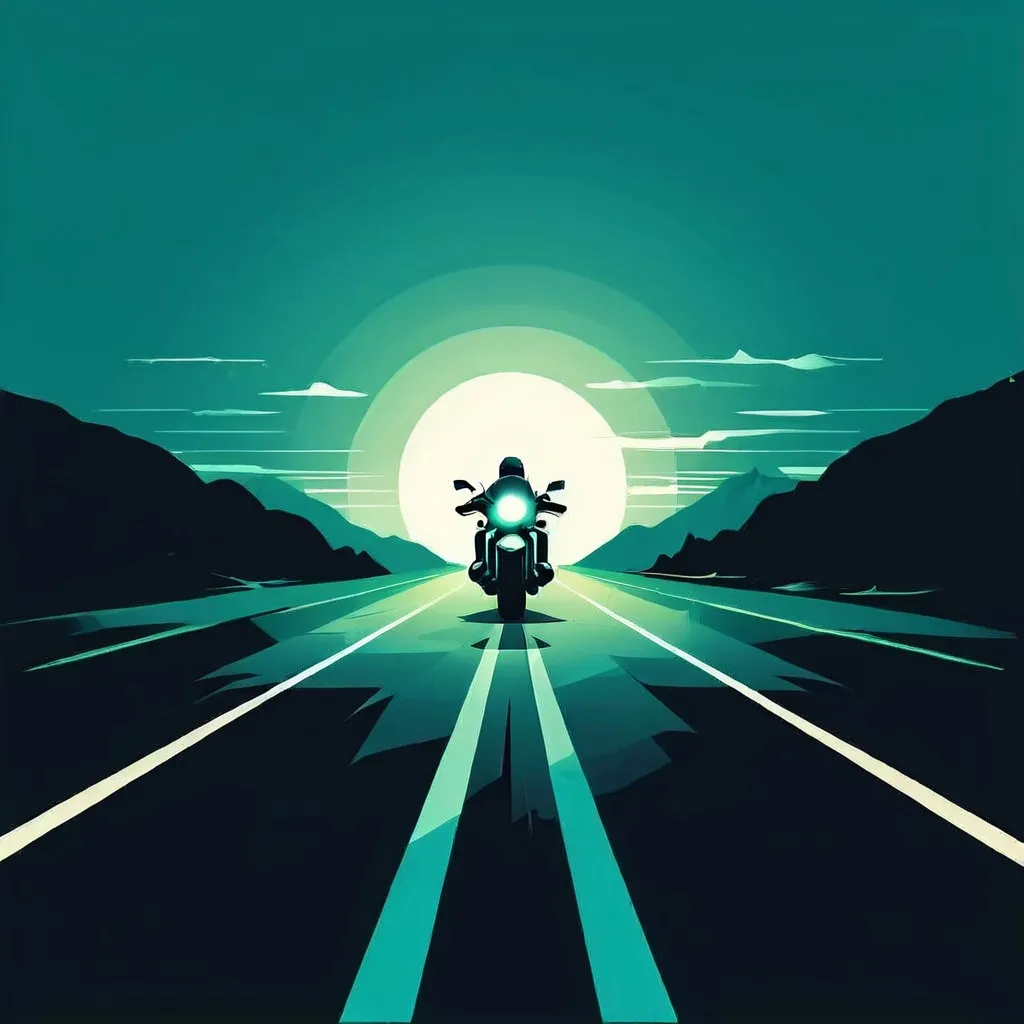
Riding a motorcycle after dark presents unique challenges that demand careful attention to visibility. This article delves into the fundamental principle that your speed must never exceed the distance your headlights illuminate, preventing dangerous situations caused by outriding your vision. We will cover how to manage glare, combat fatigue, and anticipate hazards like animal crossings, all vital knowledge for safe riding and success in the Dutch theory exam.
Article content overview
Riding a motorcycle after dark presents a unique set of challenges that significantly differ from daytime navigation. The primary concern revolves around visibility, not just for others to see you, but crucially, for you to see the road ahead. A fundamental principle of safe night riding, and a key concept tested in the Dutch CBR motorcycle theory exam, is that your riding speed must always be within the range illuminated by your headlights. Exceeding this limit, often referred to as 'outriding your headlights,' creates a dangerous situation where you cannot react in time to hazards that appear beyond your illuminated path. This article will delve into the critical relationship between headlight illumination range and safe stopping distances, explore other significant hazards like glare and fatigue, and provide essential knowledge for safe night riding in the Netherlands.
Motorcycle headlights are designed to illuminate a certain distance in front of the vehicle, providing the rider with visual information about the road surface, potential obstacles, and other road users. This illuminated area is your visual horizon, and your safe stopping distance at night cannot exceed this range. If you are travelling at a speed where your stopping distance is greater than the distance your headlights reach, you are effectively riding blind for a portion of the journey. This means that by the time you see a hazard, such as a stationary object, a pothole, or an animal, you may have already travelled too far to stop safely.
The stopping distance is a combination of your reaction time (the time it takes to perceive a hazard and apply the brakes) and the actual braking distance (the distance the motorcycle travels once the brakes are applied). At night, the reaction time component becomes critically dependent on how quickly you can perceive the hazard, which is directly limited by your headlight's reach. Therefore, to maintain safety, you must constantly adjust your speed downwards if your stopping distance would exceed the illuminated area. This principle applies universally, but it is particularly vital for motorcyclists who are more vulnerable and have less margin for error than other road users.
This occurs when a vehicle's speed is such that its stopping distance exceeds the distance illuminated by its headlights. At night, this is a significant safety hazard as the driver cannot react to unseen obstacles within their safe braking range.
Beyond the fundamental limitation of headlight reach, several other factors can compromise your visibility and the ability to perceive hazards accurately during night riding. These elements demand increased vigilance and proactive adaptation to ensure safety on Dutch roads. Understanding and mitigating these challenges are central to both safe riding and success in the CBR theory exam.
Oncoming traffic, especially vehicles with bright or improperly aimed headlights, can cause significant glare. This glare can temporarily blind you, reducing your ability to see the road ahead, any potential hazards, or the edges of the road. It is imperative to anticipate the effects of glare. When faced with oncoming headlights, try to focus on the right-hand edge of your own lane or the road's edge rather than looking directly at the oncoming lights. If you find yourself severely dazzled, it is safer to slow down considerably or even pull over to the side of the road if possible, until your vision has fully recovered.
Always ensure your own motorcycle's headlights are clean and correctly adjusted. This not only helps you see better but also reduces the likelihood of dazzling other road users.
Night riding can be more mentally taxing than daytime riding due to the reduced visual input and the constant effort required to maintain focus. Fatigue can set in more rapidly, leading to slower reaction times, impaired judgment, and an increased susceptibility to the effects of glare. Recognising the signs of fatigue is crucial. If you feel drowsy or your concentration is wavering, it is essential to take a break. Pull over in a safe, well-lit location, stretch your legs, and perhaps have a non-alcoholic beverage. Never push through significant fatigue, as the risks involved are substantial.
While this article focuses on nighttime, it's important to note that conditions with low sun, often during dawn and dusk, can create similar visibility issues to night riding due to glare and reduced contrast. In the Netherlands, artificial lighting can vary significantly. While urban areas are generally well-lit, rural roads may have little to no street lighting. In unlit areas, your headlight's range becomes the sole determinant of your safe speed. You must rely entirely on your headlight's illumination, further emphasizing the need to ride within its limits.
The dark conceals many potential hazards that are easily visible during the day. Potholes, debris on the road, faded road markings, and the edges of the tarmac can all become unseen dangers. Furthermore, in the Netherlands, cyclists and pedestrians are common on roads, especially in rural areas. Their reflective gear might offer some visibility, but they can still be difficult to spot in the dark, particularly if they are poorly lit or on unlit paths. Always be prepared for unexpected encounters with other road users who may not be as visible as you expect.
The Dutch road network, while generally well-maintained, presents specific challenges for night riders. Being aware of these and adopting a defensive riding strategy is key to mitigating risks and demonstrating safe practice, which is a core component of the CBR motorcycle theory exam.
A particularly concerning hazard at night, especially on roads outside built-up areas, is the increased risk of encountering wildlife. Animals like deer, foxes, or wild boar can suddenly appear on the road, often attracted by the warmth of the tarmac or searching for food. Their behaviour can be unpredictable. The CBR exam specifically highlights the danger of large game crossing the road during twilight and dark hours.
If you see an animal near the road, it is wise to assume it might cross. Slow down immediately and be prepared to brake or take evasive action if necessary. Swerving to avoid an animal can sometimes be more dangerous than braking, especially at higher speeds, as it could lead to a loss of control or a collision with another vehicle or obstacle. Your primary reaction should be to reduce speed and maintain stability.
The way artificial lighting casts shadows at night can be deceptive. Shadows can obscure potholes, uneven surfaces, or even create the illusion of obstacles where none exist. It's important to develop the skill of interpreting road shadows correctly. Rely on your direct illumination rather than judging depth or surface condition solely from shadows.
Overtaking other vehicles at night requires extreme caution. Judging the speed and distance of oncoming traffic is more difficult due to the limited visibility. Always ensure you have a clear and ample gap for overtaking, and that you can see far enough ahead to complete the manoeuvre safely. If there is any doubt, it is always better to wait for a more opportune moment.
The CBR motorcycle theory exam extensively covers safety aspects, including night riding. Questions will often test your understanding of the relationship between speed, visibility, and stopping distances, as well as your knowledge of specific hazards like glare, fatigue, and animal crossings. Mastering these concepts is not just about passing the exam; it's about ensuring your own safety and that of others on the road.
Common exam questions often present scenarios where you must choose the correct speed based on limited visibility or identify the primary danger in a given night-riding situation. Always consider the headlight illumination range as the ultimate speed governor.
Understanding the principles of safe night riding is crucial for your safety and for passing the CBR motorcycle theory exam. To solidify your knowledge, engage with practice questions that cover these critical aspects of motorcycling in the Netherlands.
Safe night motorcycle riding depends on aligning your speed with how far your headlight illuminates the road ahead. If your stopping distance exceeds your illumination range, you cannot react in time to hazards. Beyond this core principle, riders must manage glare by focusing on the road edge, recognize and counter fatigue through regular breaks, and anticipate hazards such as wildlife crossings and poorly lit cyclists. In the Netherlands, rural roads often lack lighting, making headlight range the absolute limit for safe speed. These concepts are tested in the CBR motorcycle theory exam and form the foundation of responsible night riding.
A short set of high-value points that capture the most important ideas from this article.
Your speed must never exceed the distance your headlights illuminate — if your stopping distance exceeds your illumination range, you cannot react to unseen hazards in time.
Stopping distance equals reaction time plus braking distance, both critically dependent on how far ahead you can see at night.
In unlit areas, your headlight range becomes the sole determinant of your safe speed — you must rely entirely on your own visibility.
When you see an animal near the road, always assume it will cross and slow down immediately to give yourself more reaction time.
Swerving to avoid an animal is often more dangerous than braking — reducing speed and maintaining stability is the safer response.
'Outriding your headlights' means riding at a speed where your stopping distance exceeds the distance your headlights illuminate.
To manage glare from oncoming traffic, focus on the right-hand edge of your lane or the road edge rather than looking directly at the lights.
Fatigue sets in faster during night riding due to reduced visual input and increased mental effort — recognize warning signs and take breaks.
Urban Dutch roads are generally well-lit, but rural roads may have little to no artificial lighting, requiring extra caution.
The CBR exam tests scenarios where you must choose correct speed based on limited visibility — always treat headlight range as your ultimate speed governor.
Riding at a speed where your stopping distance exceeds how far your headlights illuminate, effectively riding blind.
Looking directly at oncoming headlights when experiencing glare instead of focusing on the road edge.
Continuing to ride when fatigued, assuming you can push through the tiredness safely.
Swerving sharply to avoid an animal at high speed, which can cause loss of control or collision with other hazards.
Misjudging overtaking gaps at night because judging speed and distance of oncoming traffic is more difficult in limited visibility.
Article content overview
A short set of high-value points that capture the most important ideas from this article.
Your speed must never exceed the distance your headlights illuminate — if your stopping distance exceeds your illumination range, you cannot react to unseen hazards in time.
Stopping distance equals reaction time plus braking distance, both critically dependent on how far ahead you can see at night.
In unlit areas, your headlight range becomes the sole determinant of your safe speed — you must rely entirely on your own visibility.
When you see an animal near the road, always assume it will cross and slow down immediately to give yourself more reaction time.
Swerving to avoid an animal is often more dangerous than braking — reducing speed and maintaining stability is the safer response.
'Outriding your headlights' means riding at a speed where your stopping distance exceeds the distance your headlights illuminate.
To manage glare from oncoming traffic, focus on the right-hand edge of your lane or the road edge rather than looking directly at the lights.
Fatigue sets in faster during night riding due to reduced visual input and increased mental effort — recognize warning signs and take breaks.
Urban Dutch roads are generally well-lit, but rural roads may have little to no artificial lighting, requiring extra caution.
The CBR exam tests scenarios where you must choose correct speed based on limited visibility — always treat headlight range as your ultimate speed governor.
Riding at a speed where your stopping distance exceeds how far your headlights illuminate, effectively riding blind.
Looking directly at oncoming headlights when experiencing glare instead of focusing on the road edge.
Continuing to ride when fatigued, assuming you can push through the tiredness safely.
Swerving sharply to avoid an animal at high speed, which can cause loss of control or collision with other hazards.
Misjudging overtaking gaps at night because judging speed and distance of oncoming traffic is more difficult in limited visibility.
Explore related topics, search based questions, and concepts that learners often look up when studying Night Motorcycle Riding Safety. These themes reflect real search intent and help you understand how this topic connects to wider driving theory knowledge in the Netherlands.
Find clear and practical answers to common questions learners often have about Night Motorcycle Riding Safety. This section helps explain difficult points, remove confusion, and reinforce the key driving theory concepts that matter for learners in the Netherlands.
Riding faster than your headlights means you cannot see hazards (like obstacles or animals) in time to react and stop safely, as the light hasn't reached them yet.
Fatigue impairs concentration, slows reaction times, and reduces your ability to perceive hazards, making night riding significantly more dangerous.
You must immediately dip your headlights when encountering oncoming traffic or if you are following another vehicle closely, as per Dutch traffic regulations.
Yes, beyond general risks like reduced visibility and fatigue, Dutch roads may have specific hazards like animal crossings, especially on less lit rural routes.
Ensure your motorcycle lights are clean and functioning correctly, use high beams when appropriate and safe, and wear reflective gear. Always adjust your speed to your headlight's illumination range.
Start your targeted search now to explore a vast library of official Dutch driving theory articles and guides. Reinforce your understanding of specific traffic rules or road signs to ensure you are fully prepared for your upcoming CBR theory exam. Discover comprehensive explanations tailored for success.