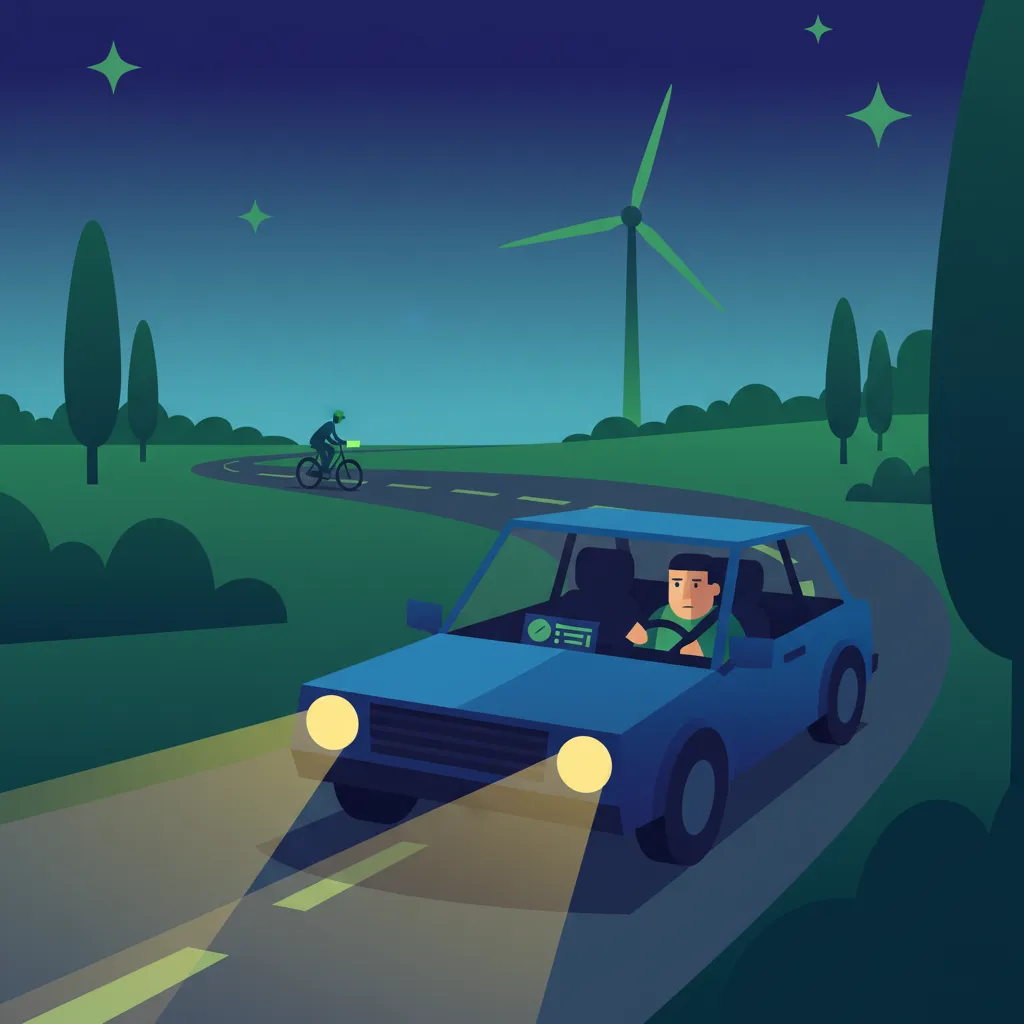
Driving after sunset significantly changes the road environment. With reduced light, our perception is altered, making it harder to judge distances, identify hazards, and react quickly. In the Netherlands, specific rules and practical adaptations are essential to navigate these conditions safely, ensuring you and other road users remain protected.
Theory topic content overview
Read the full theory topic guide for Night Driving Safety with structured, easy-to-scan content built for learners in the Netherlands. This detailed section explains the exact rule, meaning, traffic context, comparison points, and exam logic behind this Dutch driving theory topic so you can study faster, understand the concept more clearly, and avoid common interpretation mistakes on the theory test.
Driving after sunset, defined as the period between zonsondergang (sunset) and zonsopkomst (sunrise) in Dutch traffic law, fundamentally alters the driving experience. The most significant change is the drastic reduction in visibility. Your ability to see and be seen is severely limited, impacting reaction times and the ability to detect hazards. This requires a conscious shift in driving behaviour and a meticulous application of vehicle lighting rules to ensure safety on Dutch roads.
In the Netherlands, with its extensive network of unlit rural roads, numerous cyclists (often poorly lit themselves), and diverse wildlife, understanding the specific challenges of rijden in het donker (driving in the dark) is crucial for both your CBR theory exam and practical road safety.
Driving at night introduces several distinct challenges that demand a driver's full attention and adaptation:
groot wild in Dutch contexts) become extremely difficult to spot until very close. Road markings and signs are also harder to interpret quickly.Verblinding): Oncoming traffic's headlights can temporarily blind or disorient you, reducing your perception of the road ahead and your ability to judge distances accurately. Even the taillights of a preceding vehicle can cause discomfort.Vermoeidheid): Darkness and the strain of intense concentration can increase fatigue, leading to slower reaction times, reduced focus, and impaired judgment. This is particularly dangerous on longer journeys during the night.Dimlicht vs. GrootlichtCorrect use of your vehicle's lighting is paramount for seeing and being seen when driving at night in the Netherlands.
Dimlicht)Dipped headlights project a white or yellow light that illuminates a significant portion of the road ahead without dazzling oncoming traffic.
zonsondergang (sunset) to zonsopkomst (sunrise) – this is the fundamental rule for night driving.Dimlicht is always permitted and mandatory at night or in poor visibility.Grootlicht)Full-beam headlights provide a much longer and brighter beam of light, significantly extending your visual range.
's nachts).buiten de bebouwde kom), especially on unlit roads where dimlicht does not provide sufficient visibility.dimlicht.Grootlicht dimmen):
grootlicht to dimlicht when you encounter oncoming traffic.grootlicht if you are following another vehicle and could dazzle the driver through their rear-view mirror.grootlicht if the road is sufficiently lit by streetlights.Grootlicht: You may use a brief flash of grootlicht as a warning signal (lichtsignaal) only to avert imminent danger, for example, to warn an oncoming driver who has their grootlicht on and is blinding you, or to signal to a driver who has no lights on at all in the dark. It is not permitted to warn of police checks or to signal you want to pass.Beyond proper lighting, active adaptation is critical for safe night driving in the Netherlands:
Snelheid aanpassen): This is the most vital adjustment. Your speed must always be such that you can stop safely within the distance you can clearly see with your headlights. On unlit Dutch roads, this often means driving significantly slower than the daytime speed limit.Volgafstand vergroten): Allow a much larger gap between your vehicle and the one in front. This gives you more time to react to sudden braking or hazards ahead that become visible only at the last moment.Observeren en Anticiperen):
berm) for pedestrians, cyclists, or wildlife (wild).wegberm) to maintain orientation.fietspad), consider positioning your vehicle slightly closer to the middle of the road (provided it's safe to do so and doesn't impede oncoming traffic). This creates a larger safety margin between your vehicle and any poorly lit pedestrians or cyclists who might be walking or cycling along the verge.Learners often make specific errors when driving in darkness, which can be critical for the CBR theory exam:
Grootlicht Promptly: Not switching from full-beam to dipped headlights when encountering oncoming traffic or following another vehicle. This blinds other drivers and is illegal.fietsers) and pedestrians (voetgangers) on roads, particularly outside urban areas.dimlicht at sunset or assuming automatic headlights are always sufficient without checking.Driving at night in the Netherlands demands a proactive and adaptable approach. Remember the core principles: See and Be Seen. Always adjust your speed to match your visibility range, diligently use your dimlicht and grootlicht according to the conditions, and remain highly vigilant for the unique hazards that darkness conceals. Mastering these adjustments is not just about passing your CBR exam; it's about ensuring your safety and the safety of all road users under challenging conditions.
Night driving in the Netherlands fundamentally changes the driving experience by severely limiting visibility and reaction time, requiring drivers to adapt their speed, observation habits, and lighting use. The mandatory use of dipped headlights (dimlicht) from sunset to sunrise is a core legal requirement, while full-beam headlights (grootlicht) must be switched off for oncoming traffic or when following another vehicle. Drivers must adjust their speed to match their headlight range rather than the posted limit, maintain a greater following distance, and stay highly vigilant for unlit hazards like cyclists and wildlife that become difficult to spot until very close. Proper headlight use, regular cleaning of lights and windscreens, and managing fatigue are essential for both passing the CBR theory exam and ensuring road safety during darkness.
A short set of high-value points that capture the most important ideas from this theory explanation.
Night driving drastically reduces visibility, altering perception of distance, speed, and hazard detection, which requires conscious behavioral adaptation
Dipped headlights (dimlicht) are mandatory from sunset to sunrise and during any poor visibility conditions in the Netherlands
Full-beam headlights (grootlicht) must be immediately switched to dimlicht when encountering oncoming traffic or following another vehicle
Your speed must always allow you to stop safely within the distance your headlights illuminate—not within the posted speed limit
Unlit hazards such as cyclists, pedestrians, and wildlife become extremely difficult to spot until very close and require heightened vigilance
Dimlicht (dipped headlights) are always permitted and mandatory at night; grootlicht (full-beam) must be dimmed for oncoming traffic and when following vehicles
In Dutch traffic law, night driving is defined as the period between zonsondergang (sunset) and zonsopkomst (sunrise)
Grootlicht may only be used at night outside built-up areas on unlit roads where dimlicht provides insufficient visibility
Fatigue from darkness and intense concentration impairs judgment—pull over safely to rest if tired
A dirty windscreen or headlights significantly reduces their effectiveness and must be kept clean
Driving at the daytime speed limit instead of adjusting speed to match headlight range and visibility conditions
Failing to dim grootlicht promptly when approaching oncoming traffic, which blinds other drivers and is illegal
Underestimating the danger posed by poorly lit cyclists and pedestrians on roads, especially outside urban areas
Pushing through fatigue instead of taking breaks, severely impairing reaction time and judgment
Forgetting to turn on dimlicht at sunset or relying solely on automatic headlights without checking
Start with a short, direct summary of Night Driving Safety before reading the full explanation below.
Driving at night requires significant adjustments due to reduced visibility, increased glare from other vehicles, and the difficulty in spotting unlit objects, pedestrians, or wildlife. Drivers in the Netherlands must adapt their speed, maintain a greater following distance, and use vehicle lighting correctly (dimlicht, grootlicht) to see and be seen. Staying alert and managing fatigue are also critical to safely overcome these challenges.
Review the most important terms, rule signals, and traffic concepts linked to Night Driving Safety.
Explore related theory topic pages connected to Night Driving Safety and continue with the next useful rule explanation.
See the common search queries learners use when trying to understand Night Driving Safety in the Netherlands.

Ready to deepen your understanding? Browse our comprehensive library of Dutch driving theory topics, rules, and concepts. Each section offers detailed explanations to help you solidify your knowledge and prepare thoroughly for your upcoming CBR driving theory examination.
Explore Driving Theory TopicsTheory topic content overview
A short set of high-value points that capture the most important ideas from this theory explanation.
Night driving drastically reduces visibility, altering perception of distance, speed, and hazard detection, which requires conscious behavioral adaptation
Dipped headlights (dimlicht) are mandatory from sunset to sunrise and during any poor visibility conditions in the Netherlands
Full-beam headlights (grootlicht) must be immediately switched to dimlicht when encountering oncoming traffic or following another vehicle
Your speed must always allow you to stop safely within the distance your headlights illuminate—not within the posted speed limit
Unlit hazards such as cyclists, pedestrians, and wildlife become extremely difficult to spot until very close and require heightened vigilance
Dimlicht (dipped headlights) are always permitted and mandatory at night; grootlicht (full-beam) must be dimmed for oncoming traffic and when following vehicles
In Dutch traffic law, night driving is defined as the period between zonsondergang (sunset) and zonsopkomst (sunrise)
Grootlicht may only be used at night outside built-up areas on unlit roads where dimlicht provides insufficient visibility
Fatigue from darkness and intense concentration impairs judgment—pull over safely to rest if tired
A dirty windscreen or headlights significantly reduces their effectiveness and must be kept clean
Driving at the daytime speed limit instead of adjusting speed to match headlight range and visibility conditions
Failing to dim grootlicht promptly when approaching oncoming traffic, which blinds other drivers and is illegal
Underestimating the danger posed by poorly lit cyclists and pedestrians on roads, especially outside urban areas
Pushing through fatigue instead of taking breaks, severely impairing reaction time and judgment
Forgetting to turn on dimlicht at sunset or relying solely on automatic headlights without checking
Start with a short, direct summary of Night Driving Safety before reading the full explanation below.
Driving at night requires significant adjustments due to reduced visibility, increased glare from other vehicles, and the difficulty in spotting unlit objects, pedestrians, or wildlife. Drivers in the Netherlands must adapt their speed, maintain a greater following distance, and use vehicle lighting correctly (dimlicht, grootlicht) to see and be seen. Staying alert and managing fatigue are also critical to safely overcome these challenges.
Review the most important terms, rule signals, and traffic concepts linked to Night Driving Safety.
Explore related theory topic pages connected to Night Driving Safety and continue with the next useful rule explanation.
See the common search queries learners use when trying to understand Night Driving Safety in the Netherlands.
Ready to deepen your understanding? Browse our comprehensive library of Dutch driving theory topics, rules, and concepts. Each section offers detailed explanations to help you solidify your knowledge and prepare thoroughly for your upcoming CBR driving theory examination.
Explore Driving Theory TopicsUse this exam-focused revision tip to understand how Night Driving Safety is likely to appear in theory questions for learners in the Netherlands. This section helps you identify the most testable part of the rule, avoid common traps, and remember the concept more effectively during Dutch driving theory exam preparation.
For your CBR theory exam, remember that the most critical rules for night driving revolve around visibility. Always reduce your speed to match your headlight range and be ready to dim your full-beam headlights (grootlicht) immediately for oncoming or preceding traffic. The mandatory use of dipped headlights (dimlicht) from sunset to sunrise is a common exam question.
Read direct answers to the most common learner questions about Night Driving Safety in the Netherlands. This FAQ focuses on rule confusion, practical meaning, comparison with similar concepts, and the exact uncertainties that appear most often in Dutch driving theory revision and exam preparation.
The primary risks include severely reduced visibility, making it difficult to spot obstacles, pedestrians, cyclists, and wildlife. Glare from oncoming headlights can also temporarily blind drivers, and fatigue is more common during nighttime hours.
In the Netherlands, it is mandatory to use dipped headlights (dimlicht) at night, which is defined as the period between sunset and sunrise. This also applies during the day in poor visibility, for instance, in heavy rain or fog, and when entering tunnels.
To minimize glare, avoid looking directly into oncoming headlights. Instead, focus your gaze slightly towards the right edge of the road or the right-hand shoulder. This helps preserve your night vision and maintain awareness of your lane position.
You must adjust your speed to ensure you can stop within the distance illuminated by your headlights. At night, your field of vision is restricted, so driving too fast means you might not see and react to a hazard in time to prevent a collision.
'Dimlicht' (dipped headlights) provides sufficient illumination without blinding oncoming traffic and is mandatory at night. 'Grootlicht' (full-beam headlights) offers maximum illumination but must only be used outside built-up areas when there's no oncoming traffic or vehicles in front to avoid dazzling other road users.
Fatigue significantly reduces reaction time, concentration, and judgment, which are already compromised by darkness. If you feel tired, pull over in a safe place, rest, or switch drivers. Short breaks and fresh air can also help on longer journeys.
Be extra vigilant for pedestrians and cyclists, especially on unlit roads, as they are much harder to see. Slow down, increase your scanning, and be prepared to react to sudden appearances. Assume that not all vulnerable road users will be well-lit.
Leverage the targeted practice search to find questions that challenge your understanding of specific Dutch traffic rules or road signs. Focus your study efforts on areas where you need improvement and build a solid foundation for passing your CBR driving theory exam with confidence.