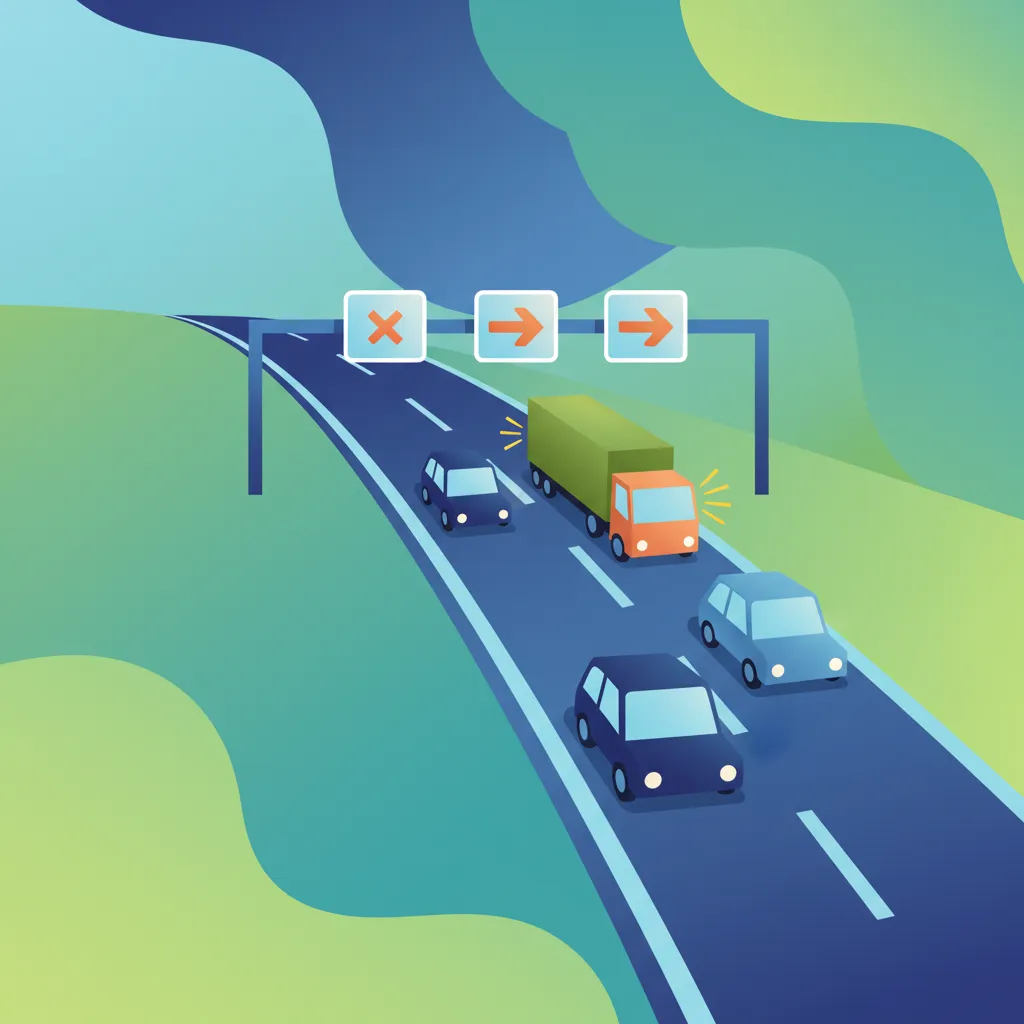
On Dutch motorways (snelwegen), understanding and applying correct lane use is vital for safe and smooth driving. This page explains the key rules, from maintaining your position in normal traffic to executing safe overtaking manoeuvres. You'll learn about specific Dutch regulations, such as those for larger vehicles or combinations, and how to navigate dynamically opened 'rush-hour lanes' (spitsstroken).
Theory topic content overview
Read the full theory topic guide for Motorway Lanes Explained with structured, easy-to-scan content built for learners in the Netherlands. This detailed section explains the exact rule, meaning, traffic context, comparison points, and exam logic behind this Dutch driving theory topic so you can study faster, understand the concept more clearly, and avoid common interpretation mistakes on the theory test.
Motorway lane use in the Netherlands, particularly on snelwegen (motorways), is governed by specific rules designed to ensure smooth traffic flow, efficiency, and safety. Mastering proper lane discipline is not only crucial for practical driving but also a frequent topic on the Dutch CBR theory exam.
Motorway lane use refers to the rules and best practices for positioning your vehicle on multi-lane high-speed roads. The core principle in the Netherlands is to keep to the rightmost available lane unless you are actively overtaking, preparing to exit, or traffic density makes it impractical. This is often referred to as 'rechts houden' (keeping right).
The purpose of this discipline is:
The Dutch road network is densely populated and highly efficient. Motorways (snelwegen) are the backbone, and correct lane use is paramount for several reasons:
Rechts Houden)In the Netherlands, the fundamental rule on multi-lane roads is that you must keep to the rightmost lane (de meest rechtse rijstrook). This applies whenever the lane is free and it is safe to do so.
Inhalen)When you need to overtake a slower vehicle on a Dutch motorway:
Every lane change, whether for overtaking, exiting, or adjusting position, demands careful execution:
Certain conditions and vehicle types have particular rules that apply to motorway lane use in the Netherlands.
This is a frequently tested rule on the CBR exam:
Spitsstroken)A unique feature of Dutch motorways are spitsstroken, or rush-hour lanes, designed to alleviate congestion during peak times.
spitsstrook can be either an extra lane added to the left side of the carriageway, or the hard shoulder (vluchtstrook) temporarily opened as an additional lane.spitsstrook is open, the speed limit for that section of the motorway may change, often to a lower speed, which will also be indicated on the matrix signs.spitsstrook, remember its original purpose for emergencies. Once the spitsstrook closes, it reverts to an emergency lane, and driving on it is prohibited except in emergencies.Rechts Inhalen)While the general rule is to overtake on the left, there are specific, limited exceptions in the Netherlands where overtaking on the right is permitted:
autoweg or for specific complex junctions), you may pass them on the right.Spitsstrook: You are driving on a three-lane motorway, and traffic ahead is building up. You notice the matrix signs above the hard shoulder activate, showing green arrows. This indicates the spitsstrook is open. You may now use this extra rightmost lane to help alleviate congestion, but be mindful of the potentially reduced speed limit also displayed.snelweg. You must remain in one of the two rightmost lanes. If you need to take an exit that requires you to briefly use the third lane from the right, you may do so for pre-sorting, but then you must return to the two rightmost lanes as soon as safe and practical.Learners often make these mistakes regarding motorway lane use:
onnodig links rijden): Remaining in the middle or left lane unnecessarily when the right lane is clear. This is inefficient, frustrates other drivers, and is a violation of Dutch traffic rules.Spitsstrook Signs: Entering a spitsstrook when a red cross is displayed, or failing to exit it when it closes. Always obey the matrix signs.To master motorway lane use in the Netherlands, remember this guiding principle: "Drive right, think ahead, and be predictable."
rechts houden): Make the rightmost available lane your default position.spitsstrook activations.spitsstroken, and the specific situations where overtaking on the right is permissible. These details are vital for both safe driving and passing your CBR theory exam.Dutch motorway lane use is governed by the fundamental principle of keeping right (rechts houden), using left lanes only for overtaking and returning to the rightmost lane afterward. Specific vehicle restrictions apply to combinations over 7 metres and lorries, limiting them to the two rightmost lanes on multi-lane carriageways. Rush-hour lanes (spitsstroken) are dynamically controlled by matrix signs and require careful attention to displayed signals. Overtaking on the right is permitted in limited circumstances such as traffic jams and when vehicles are pre-sorting left. These rules are frequently tested on the CBR theory exam and are essential for both safe driving and exam success.
A short set of high-value points that capture the most important ideas from this theory explanation.
Keep to the rightmost available lane as your default position on Dutch motorways unless actively overtaking or pre-sorting for an exit.
When overtaking, always return to the rightmost lane once you have safely passed the vehicle.
Vehicle combinations over 7 metres and lorries are restricted to the two rightmost lanes on motorways with three or more lanes.
Rush-hour lanes (spitsstroken) are dynamically opened via matrix signs—green arrow or white arrow down means open; red cross means closed.
Overtaking on the right is permitted in specific situations including traffic jams and when vehicles are pre-sorting left.
Spitsstrook open: green arrow or white arrow pointing down; Spitsstrook closed: red cross displayed.
Combinations over 7 metres and goods vehicles must use only the two rightmost lanes (exception: pre-sorting for an exit).
Always perform mirror check, blind spot check, and signal before any lane change on the motorway.
Overtaking on the right is legal in slow-moving traffic queues and jams, not just during normal driving conditions.
The hard shoulder reverts to an emergency lane when the spitsstrook closes—driving on it is then prohibited except in genuine emergencies.
Lane hogging: driving unnecessarily in the middle or left lane when the right lane is clear, which violates the rechts houden rule.
Misinterpreting spitsstroken signs: entering when a red cross is displayed or failing to exit when the spitsstrook closes.
Assuming overtaking on the right is never allowed, missing the legitimate exceptions for traffic jams and pre-sorting situations.
Forgetting that longer vehicle combinations are restricted to the two rightmost lanes on multi-lane motorways—a common CBR exam trap.
Skipping the blind spot check (shoulder check) before changing lanes, which is especially dangerous at motorway speeds.
Start with a short, direct summary of Motorway Lanes Explained before reading the full explanation below.
In the Netherlands, drivers must generally keep to the rightmost available lane, using left lanes primarily for overtaking slower traffic. After safely overtaking, you should return to the right. Special rules apply to certain vehicles, like combinations over 7 metres, which are often restricted to the two rightmost lanes. Always be aware of signs indicating temporary lane changes or the opening of 'rush-hour lanes'.
Review the most important terms, rule signals, and traffic concepts linked to Motorway Lanes Explained.
Explore related theory topic pages connected to Motorway Lanes Explained and continue with the next useful rule explanation.
See the common search queries learners use when trying to understand Motorway Lanes Explained in the Netherlands.

Ready to deepen your understanding? Browse our comprehensive library of Dutch driving theory topics, rules, and concepts. Each section offers detailed explanations to help you solidify your knowledge and prepare thoroughly for your upcoming CBR driving theory examination.
Explore Driving Theory TopicsTheory topic content overview
A short set of high-value points that capture the most important ideas from this theory explanation.
Keep to the rightmost available lane as your default position on Dutch motorways unless actively overtaking or pre-sorting for an exit.
When overtaking, always return to the rightmost lane once you have safely passed the vehicle.
Vehicle combinations over 7 metres and lorries are restricted to the two rightmost lanes on motorways with three or more lanes.
Rush-hour lanes (spitsstroken) are dynamically opened via matrix signs—green arrow or white arrow down means open; red cross means closed.
Overtaking on the right is permitted in specific situations including traffic jams and when vehicles are pre-sorting left.
Spitsstrook open: green arrow or white arrow pointing down; Spitsstrook closed: red cross displayed.
Combinations over 7 metres and goods vehicles must use only the two rightmost lanes (exception: pre-sorting for an exit).
Always perform mirror check, blind spot check, and signal before any lane change on the motorway.
Overtaking on the right is legal in slow-moving traffic queues and jams, not just during normal driving conditions.
The hard shoulder reverts to an emergency lane when the spitsstrook closes—driving on it is then prohibited except in genuine emergencies.
Lane hogging: driving unnecessarily in the middle or left lane when the right lane is clear, which violates the rechts houden rule.
Misinterpreting spitsstroken signs: entering when a red cross is displayed or failing to exit when the spitsstrook closes.
Assuming overtaking on the right is never allowed, missing the legitimate exceptions for traffic jams and pre-sorting situations.
Forgetting that longer vehicle combinations are restricted to the two rightmost lanes on multi-lane motorways—a common CBR exam trap.
Skipping the blind spot check (shoulder check) before changing lanes, which is especially dangerous at motorway speeds.
Start with a short, direct summary of Motorway Lanes Explained before reading the full explanation below.
In the Netherlands, drivers must generally keep to the rightmost available lane, using left lanes primarily for overtaking slower traffic. After safely overtaking, you should return to the right. Special rules apply to certain vehicles, like combinations over 7 metres, which are often restricted to the two rightmost lanes. Always be aware of signs indicating temporary lane changes or the opening of 'rush-hour lanes'.
Review the most important terms, rule signals, and traffic concepts linked to Motorway Lanes Explained.
Explore related theory topic pages connected to Motorway Lanes Explained and continue with the next useful rule explanation.
See the common search queries learners use when trying to understand Motorway Lanes Explained in the Netherlands.
Ready to deepen your understanding? Browse our comprehensive library of Dutch driving theory topics, rules, and concepts. Each section offers detailed explanations to help you solidify your knowledge and prepare thoroughly for your upcoming CBR driving theory examination.
Explore Driving Theory TopicsUse this exam-focused revision tip to understand how Motorway Lanes Explained is likely to appear in theory questions for learners in the Netherlands. This section helps you identify the most testable part of the rule, avoid common traps, and remember the concept more effectively during Dutch driving theory exam preparation.
Pay close attention to rules regarding the two rightmost lanes for specific vehicles, as this is a common trick question on the CBR theory exam. Always assume you must keep to the right unless actively overtaking or pre-sorting for an exit. Remember the purpose of 'rush-hour lanes' and how they are indicated.
Read direct answers to the most common learner questions about Motorway Lanes Explained in the Netherlands. This FAQ focuses on rule confusion, practical meaning, comparison with similar concepts, and the exact uncertainties that appear most often in Dutch driving theory revision and exam preparation.
You should generally drive in the rightmost available lane on a Dutch motorway (snelweg). The left lanes are primarily intended for overtaking slower vehicles.
Yes, on a three or more lane motorway, drivers of goods vehicles and those towing trailers (where the combination is longer than 7 metres) are typically restricted to using only the two innermost right-hand lanes. This rule doesn't apply when negotiating a lane change for pre-sorting.
A 'rush-hour lane' (spitsstrook) is an additional lane that can be opened during peak traffic times to improve flow. This might be an extra lane on the left or the hard shoulder in use. Signs next to the road and matrix signs above the lanes indicate if it's open or closed (red cross).
While generally forbidden, overtaking on the right is allowed in specific situations: in queuing traffic or traffic jams, when driving to the right of block markings, when a vehicle you wish to overtake has moved left to turn left and signals, or when overtaking trams, cyclists, or moped riders.
Before changing lanes, always check your mirrors (including the blind spot), signal your intention well in advance, and ensure there is sufficient space and time. Adjust your speed to match the flow of traffic in the target lane, and make the change smoothly and decisively.
Remaining unnecessarily in the left (overtaking) lane is called 'lane hogging' and is discouraged in the Netherlands. It can impede faster traffic, disrupt flow, and may result in a fine, as it is considered a traffic offense.
Leverage the targeted practice search to find questions that challenge your understanding of specific Dutch traffic rules or road signs. Focus your study efforts on areas where you need improvement and build a solid foundation for passing your CBR driving theory exam with confidence.