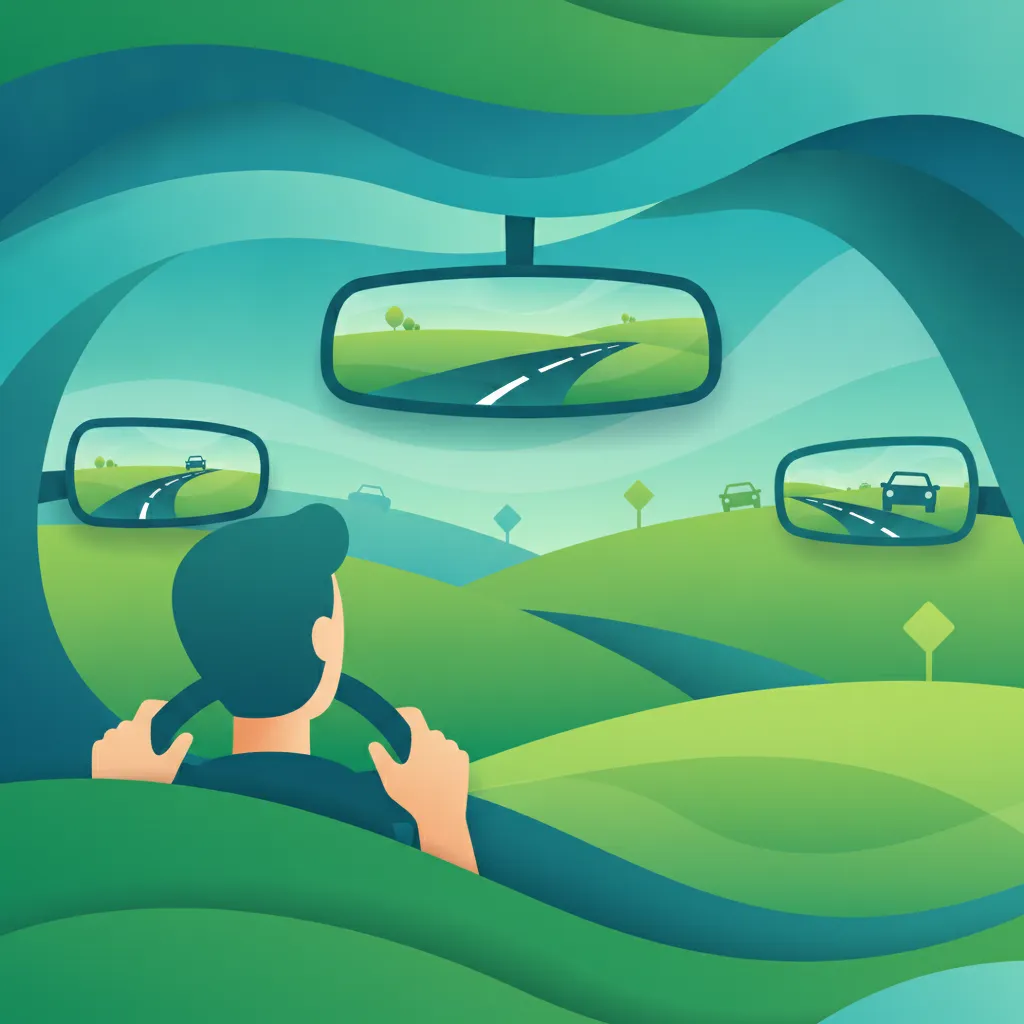
Mirror checks are a vital observation technique that allows drivers to monitor traffic behind and beside their vehicle. In Ireland, the Road Safety Authority (RSA) emphasizes consistent and timely mirror use to maintain situational awareness, anticipate potential hazards, and prevent collisions. This page will guide you through when and how to effectively use your vehicle's mirrors for safe driving on Irish roads.
Theory topic content overview
Read the full theory topic guide for Mirror Checks with structured, easy-to-scan content built for learners in Ireland. This detailed section explains the exact rule, meaning, traffic context, comparison points, and exam logic behind this Irish driving theory topic so you can study faster, understand the concept more clearly, and avoid common interpretation mistakes on the theory test.
Driving mirror checks are a fundamental observation technique for every driver on Irish roads. They involve using your vehicle's mirrors to continuously monitor the traffic situation around you, particularly to the rear and sides. This continuous awareness is vital for anticipating potential hazards, reacting safely to changing conditions, and making informed decisions, all of which are essential for your Driver Theory Test and practical driving safety in Ireland.
The Road Safety Authority (RSA) strongly emphasises consistent and timely mirror use as a cornerstone of safe driving and hazard perception. Proper mirror checks allow you to build a comprehensive picture of your surroundings, ensuring you're aware of other road users, their speed, and their intentions before you make any changes to your vehicle's speed or direction.
Mirror checks are not merely a formality; they are a critical safety habit that underpins almost every driving manoeuvre.
The Mirror-Signal-Maneuver (MSM) routine is a cornerstone of safe driving practice in Ireland, particularly before changing speed or direction. It ensures that every action you take is informed by a full understanding of your surroundings.
The RSA guidelines emphasise that mirror use should be correctly timed – not too early or too late. A check too early might mean the situation has changed by the time you act, while a check too late leaves no time to react safely.
Your vehicle provides different perspectives through its various mirrors:
It's also worth noting that in Ireland, vehicles presenting for tests with external camera mirrors instead of traditional mirrors are acceptable, provided they are working effectively and offer sufficient observation to the required areas.
Mirror checks are essential in a wide variety of driving situations. According to RSA guidelines, you should use your mirror(s) before:
Learner drivers in Ireland often make specific mistakes regarding mirror checks that can lead to test faults or unsafe situations:
Remember, in your Category B driving test, these often manifest as 'Observation' faults, highlighting the RSA's emphasis on comprehensive awareness.
Mastering mirror checks is about developing a habit of continuous, intelligent observation. For your Irish Driver Theory Test and lifelong safe driving on Irish roads, remember:
Consistent and timely mirror checks are a core skill that will empower you to navigate Irish roads confidently and safely, demonstrating competence not just to your driving tester, but to every road user around you.
Proper mirror checks are a fundamental observation skill that allows drivers to monitor traffic behind and beside their vehicle using interior rear-view and exterior side mirrors. The Mirror-Signal-Maneuver routine - mirror, signal, then maneuver - must become second nature, with a second mirror check and head check just before executing any sideways movement. No mirror can eliminate blind spots completely, making a quick head check or shoulder glance essential before changing lanes or moving off. The RSA specifically marks mirror and observation faults during driving tests, particularly for Category B, highlighting that consistent, timely mirror use is a core requirement for safe driving on Irish roads.
A short set of high-value points that capture the most important ideas from this theory explanation.
Mirror checks are essential before any change in speed or direction, not optional extras.
The Mirror-Signal-Maneuver (MSM) routine must be followed consistently for every lane change, turn, and when braking.
Blind spots exist that no mirror can cover; a head check over your shoulder is mandatory before moving sideways.
Different mirrors serve different purposes - the interior rear-view shows directly behind while side mirrors show your immediate flanks.
Mirror checks must be correctly timed - too early means the situation may have changed; too late leaves no time to react.
MSM stands for Mirror-Signal-Maneuver and is your standard routine before any lateral movement or speed change.
For Category B tests, poor external mirror use is recorded as an Observation fault by the RSA.
Cyclops mirrors are required for larger vehicles like HGVs and buses to check critical areas before moving off.
Mirrors must be clean, properly adjusted, and serviceable before driving - dirty or cracked mirrors impair observation.
A second mirror check just before executing a maneuver accounts for rapidly approaching traffic.
Checking mirrors only once too early in the maneuver sequence and failing to re-check immediately before acting.
Relying entirely on mirrors without performing a head check for blind spots, particularly missing motorcycles or cyclists.
Mirror fixation - staring in mirrors too long, causing the driver to lose awareness of the road ahead.
Driving with improperly adjusted side mirrors, creating larger-than-necessary blind spots.
Failing to check mirrors before braking, especially when approaching junctions or traffic lights, risking a rear-end collision.
Start with a short, direct summary of Mirror Checks before reading the full explanation below.
Mirror checks involve regularly observing your surroundings using the interior rear-view and exterior side mirrors to monitor traffic behind and to the sides of your vehicle. This continuous awareness is crucial before any change in speed or direction, such as braking, changing lanes, or turning, and is a core requirement for safe driving and passing the Driver Theory Test in Ireland.
Review the most important terms, rule signals, and traffic concepts linked to Mirror Checks.
Explore related theory topic pages connected to Mirror Checks and continue with the next useful rule explanation.
See the common search queries learners use when trying to understand Mirror Checks in Ireland.

After reviewing core Irish driving theory topics, test your understanding with comprehensive practice questions. Apply your knowledge of road rules, signs, and traffic laws to scenarios mirroring the official Driver Theory Test. Solidify your learning and prepare effectively for your exam.
Irish Driving Theory TopicsTheory topic content overview
A short set of high-value points that capture the most important ideas from this theory explanation.
Mirror checks are essential before any change in speed or direction, not optional extras.
The Mirror-Signal-Maneuver (MSM) routine must be followed consistently for every lane change, turn, and when braking.
Blind spots exist that no mirror can cover; a head check over your shoulder is mandatory before moving sideways.
Different mirrors serve different purposes - the interior rear-view shows directly behind while side mirrors show your immediate flanks.
Mirror checks must be correctly timed - too early means the situation may have changed; too late leaves no time to react.
MSM stands for Mirror-Signal-Maneuver and is your standard routine before any lateral movement or speed change.
For Category B tests, poor external mirror use is recorded as an Observation fault by the RSA.
Cyclops mirrors are required for larger vehicles like HGVs and buses to check critical areas before moving off.
Mirrors must be clean, properly adjusted, and serviceable before driving - dirty or cracked mirrors impair observation.
A second mirror check just before executing a maneuver accounts for rapidly approaching traffic.
Checking mirrors only once too early in the maneuver sequence and failing to re-check immediately before acting.
Relying entirely on mirrors without performing a head check for blind spots, particularly missing motorcycles or cyclists.
Mirror fixation - staring in mirrors too long, causing the driver to lose awareness of the road ahead.
Driving with improperly adjusted side mirrors, creating larger-than-necessary blind spots.
Failing to check mirrors before braking, especially when approaching junctions or traffic lights, risking a rear-end collision.
Start with a short, direct summary of Mirror Checks before reading the full explanation below.
Mirror checks involve regularly observing your surroundings using the interior rear-view and exterior side mirrors to monitor traffic behind and to the sides of your vehicle. This continuous awareness is crucial before any change in speed or direction, such as braking, changing lanes, or turning, and is a core requirement for safe driving and passing the Driver Theory Test in Ireland.
Review the most important terms, rule signals, and traffic concepts linked to Mirror Checks.
Explore related theory topic pages connected to Mirror Checks and continue with the next useful rule explanation.
See the common search queries learners use when trying to understand Mirror Checks in Ireland.
After reviewing core Irish driving theory topics, test your understanding with comprehensive practice questions. Apply your knowledge of road rules, signs, and traffic laws to scenarios mirroring the official Driver Theory Test. Solidify your learning and prepare effectively for your exam.
Irish Driving Theory TopicsUse this exam-focused revision tip to understand how Mirror Checks is likely to appear in theory questions for learners in Ireland. This section helps you identify the most testable part of the rule, avoid common traps, and remember the concept more effectively during Irish driving theory exam preparation.
For your Irish Driver Theory Test, remember that consistent and timely mirror checks are not just about seeing; they are about understanding and reacting to traffic. Always integrate mirror checks into your 'Mirror-Signal-Maneuver' routine. Be aware that for car tests (Category B), poor external mirror use is often marked as an 'Observation' fault, highlighting its importance in hazard perception.
Read direct answers to the most common learner questions about Mirror Checks in Ireland. This FAQ focuses on rule confusion, practical meaning, comparison with similar concepts, and the exact uncertainties that appear most often in Irish driving theory revision and exam preparation.
Mirror checks are crucial in Ireland for maintaining constant awareness of other road users, predicting their actions, and safely executing maneuvers. They are a fundamental part of the RSA's 'Rules of the Road' and heavily assessed in the Driver Theory Test.
You should check your mirrors regularly, even when driving straight, to stay updated on surrounding traffic. Critical times for mirror checks include before braking, accelerating, changing lanes, turning, overtaking, or merging into traffic.
The 'mirror-signal-maneuver' (MSM) routine is a sequence of actions emphasized by the RSA. It means you must check your mirrors (M) to assess potential hazards, signal (S) your intentions, and then execute the maneuver (M) only when safe, checking mirrors again if needed.
The interior rear-view mirror provides a view directly behind your vehicle, while side mirrors cover traffic to your immediate left and right, including adjacent lanes. Combined, they help cover a broader field of view, though blind spots remain.
Yes, improper or insufficient use of mirrors can lead to faults on your Irish driving test. For Category 'B' (car) tests, faults related to external mirror use are typically recorded as 'Observation' faults, highlighting its critical safety role.
Even on long, straight stretches of road, you should check your mirrors regularly to maintain a picture of following or overtaking traffic. This helps you anticipate situations and react safely to changes in traffic flow.
Blind spots are areas around your vehicle that cannot be seen using only your mirrors. While mirrors help minimize blind spots, you must still check them by glancing over your shoulder, especially before changing lanes or turning, to ensure the area is clear.
Use the practice question search tool to pinpoint specific topics, road signs, or rules you need to master for your official Driver Theory Test. Refine your study strategy and ensure comprehensive preparation for all aspects of the Irish driving exam. Start your focused revision now and build confidence for your learner permit test.