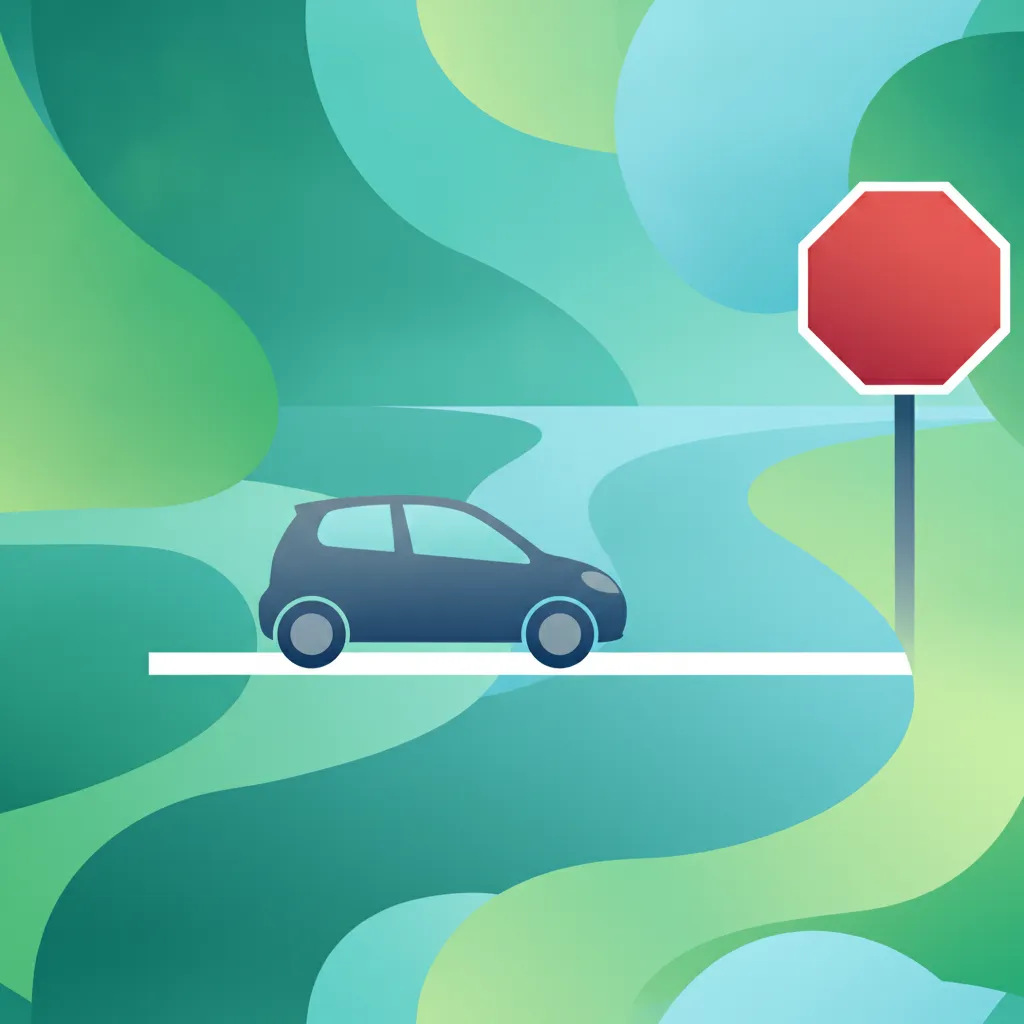
The Stop sign is a critical regulatory sign in Irish road traffic, designed to prevent accidents at junctions with limited visibility or high traffic flow. Recognisable by its distinctive red octagonal shape, it signals a non-negotiable requirement for drivers to come to a complete stop. This page outlines the specific actions you must take when encountering a Stop sign and its importance for both your Driver Theory Test and real-world safety.
Theory topic content overview
Read the full theory topic guide for Stop Sign Rules with structured, easy-to-scan content built for learners in Ireland. This detailed section explains the exact rule, meaning, traffic context, comparison points, and exam logic behind this Irish driving theory topic so you can study faster, understand the concept more clearly, and avoid common interpretation mistakes on the theory test.
The Stop sign is one of the most unambiguous and critical regulatory traffic signs encountered by drivers in Ireland. Governed by the Road Safety Authority (RSA) and outlined in the official Rules of the Road, its purpose is to mandate an absolute and complete halt of your vehicle before proceeding. This strict requirement is essential for preventing collisions at junctions where visibility may be limited or where conflicting traffic flows present a high risk.
A Stop sign in Ireland is instantly recognisable by its distinctive red octagonal shape with a white border and the word "STOP" in white. This unique shape is reserved exclusively for the Stop sign, ensuring it stands out from all other road signs. When you encounter this sign, it signals a mandatory command: you must bring your vehicle to a full and complete stop.
This rule is absolute, meaning you must stop regardless of whether you perceive the junction to be clear or not. The halt serves a crucial safety purpose, providing drivers with sufficient time to thoroughly assess the situation before entering or crossing a major road where traffic has priority.
The insistence on a complete stop is not merely a bureaucratic formality; it's a foundational principle of road safety at high-risk junctions in Ireland.
junction priority.Irish Driver Theory Test places significant emphasis on understanding and correctly applying regulatory signs, especially the Stop sign. Failing to perform a complete stop is a common mistake that can lead to lost marks and demonstrate a lack of hazard awareness.Adhering to the Stop sign rule requires a specific sequence of actions for Irish drivers:
stop line on the road, and potential hazards at the junction.stop line. If no stop line is present, you must stop before entering the intersecting road, at a point where you have the best view of traffic without obstructing it.Even if a junction appears quiet or deserted, the law requires a complete stop. This prevents complacency and ensures you are always prepared for unexpected traffic.
One of the most common points of confusion for learner drivers in Ireland is the difference between a Stop sign and a Yield sign (also known as a Give Way sign or 'Géill Slí'). Understanding this distinction is vital for both your theory test and practical driving.
The shapes themselves are your primary clue: the unique octagon for Stop, and the inverted triangle for Yield. Never confuse the two, as their requirements are fundamentally different.
Learners and even experienced drivers sometimes make errors when encountering Stop signs in Ireland:
stop line can place your vehicle in the path of crossing traffic. Stopping too far back may impair your view, forcing you to creep forward again (which often becomes a rolling stop).Consider these everyday situations for an Irish driver:
The Stop sign is a non-negotiable directive in Irish road rules. For your Driver Theory Test and for lifelong safe driving, ingrain this simple sequence: Stop completely, check thoroughly, proceed only when truly safe. This mandatory halt ensures that you, as the driver, take full responsibility for safely entering or crossing the traffic flow, protecting yourself and all other road users on Ireland's roads.
The Stop sign is a regulatory road marking in Ireland requiring drivers to bring their vehicle to a full and absolute halt at the stop line or before entering the intersecting road. This mandatory stop must occur before you assess the junction, allowing you to thoroughly check for vehicles, cyclists, and pedestrians before proceeding only when fully safe. Unlike a Yield sign, a Stop sign never allows you to proceed without stopping, regardless of how clear the road appears. The distinctive red octagonal shape distinguishes it from all other signs, and correct obedience is essential for both road safety and passing the Irish Driver Theory Test.
A short set of high-value points that capture the most important ideas from this theory explanation.
A Stop sign in Ireland requires an absolute, complete halt of your vehicle regardless of whether traffic appears to be present or not
You must stop BEFORE assessing traffic, cyclists, and pedestrians - not after
Stop at the painted stop line if present, or before entering the intersecting road at a point giving you the best view
Stop signs are placed at junctions with limited visibility or high-risk traffic flows where the mandatory pause prevents side-impact collisions
Coming to a complete stop does not give you priority - you must still wait until the way is entirely clear before proceeding
Stop sign = mandatory complete stop; Yield sign = slow and be prepared to stop, only stop if traffic requires it
Shape is your primary clue: octagon exclusively means Stop, inverted triangle means Yield
After a complete stop, look left, right, then left again, and listen for approaching traffic
Parked cars or poor visibility may require creeping forward carefully AFTER your full stop, but the initial complete halt is mandatory
You have no right of way at a Stop sign - you must always give priority to all users on the major road
Rolling stops where drivers slow significantly but never achieve a complete halt with wheels fully stopped
Stopping too far past the stop line, placing your vehicle in the path of crossing traffic
Stopping but failing to properly check for cyclists and pedestrians before proceeding
Assuming you now have priority to go because you have stopped
Disregarding the sign entirely when the junction appears quiet, leading to dangerous pull-outs
Start with a short, direct summary of Stop Sign Rules before reading the full explanation below.
In Ireland, a Stop sign requires every driver to bring their vehicle to a complete and full stop at the stop line, or before the intersection if no line is present. This complete halt must occur *before* assessing traffic, cyclists, and pedestrians. You must then only proceed when the way is entirely clear and safe, giving priority to all other road users, regardless of how quiet the junction may appear.
Review the most important terms, rule signals, and traffic concepts linked to Stop Sign Rules.
Explore related theory topic pages connected to Stop Sign Rules and continue with the next useful rule explanation.
See the common search queries learners use when trying to understand Stop Sign Rules in Ireland.

After reviewing core Irish driving theory topics, test your understanding with comprehensive practice questions. Apply your knowledge of road rules, signs, and traffic laws to scenarios mirroring the official Driver Theory Test. Solidify your learning and prepare effectively for your exam.
Irish Driving Theory TopicsTheory topic content overview
A short set of high-value points that capture the most important ideas from this theory explanation.
A Stop sign in Ireland requires an absolute, complete halt of your vehicle regardless of whether traffic appears to be present or not
You must stop BEFORE assessing traffic, cyclists, and pedestrians - not after
Stop at the painted stop line if present, or before entering the intersecting road at a point giving you the best view
Stop signs are placed at junctions with limited visibility or high-risk traffic flows where the mandatory pause prevents side-impact collisions
Coming to a complete stop does not give you priority - you must still wait until the way is entirely clear before proceeding
Stop sign = mandatory complete stop; Yield sign = slow and be prepared to stop, only stop if traffic requires it
Shape is your primary clue: octagon exclusively means Stop, inverted triangle means Yield
After a complete stop, look left, right, then left again, and listen for approaching traffic
Parked cars or poor visibility may require creeping forward carefully AFTER your full stop, but the initial complete halt is mandatory
You have no right of way at a Stop sign - you must always give priority to all users on the major road
Rolling stops where drivers slow significantly but never achieve a complete halt with wheels fully stopped
Stopping too far past the stop line, placing your vehicle in the path of crossing traffic
Stopping but failing to properly check for cyclists and pedestrians before proceeding
Assuming you now have priority to go because you have stopped
Disregarding the sign entirely when the junction appears quiet, leading to dangerous pull-outs
Start with a short, direct summary of Stop Sign Rules before reading the full explanation below.
In Ireland, a Stop sign requires every driver to bring their vehicle to a complete and full stop at the stop line, or before the intersection if no line is present. This complete halt must occur *before* assessing traffic, cyclists, and pedestrians. You must then only proceed when the way is entirely clear and safe, giving priority to all other road users, regardless of how quiet the junction may appear.
Review the most important terms, rule signals, and traffic concepts linked to Stop Sign Rules.
Explore related theory topic pages connected to Stop Sign Rules and continue with the next useful rule explanation.
See the common search queries learners use when trying to understand Stop Sign Rules in Ireland.
After reviewing core Irish driving theory topics, test your understanding with comprehensive practice questions. Apply your knowledge of road rules, signs, and traffic laws to scenarios mirroring the official Driver Theory Test. Solidify your learning and prepare effectively for your exam.
Irish Driving Theory TopicsUse this exam-focused revision tip to understand how Stop Sign Rules is likely to appear in theory questions for learners in Ireland. This section helps you identify the most testable part of the rule, avoid common traps, and remember the concept more effectively during Irish driving theory exam preparation.
Many learners lose marks on the Irish Driver Theory Test by 'rolling through' a Stop sign without coming to a full halt. Remember, the rule is an *absolute stop*, even if the junction seems clear. Make it a habit to count to two after stopping to ensure you meet the legal requirement.
Read direct answers to the most common learner questions about Stop Sign Rules in Ireland. This FAQ focuses on rule confusion, practical meaning, comparison with similar concepts, and the exact uncertainties that appear most often in Irish driving theory revision and exam preparation.
A Stop sign in Ireland means you must bring your vehicle to a complete and full stop at the stop line, or before the junction if no line is marked, before proceeding. This is a mandatory requirement, regardless of traffic conditions.
The key difference in Ireland is that a Stop sign requires a *complete halt* before proceeding, while a Yield (or 'Géill Slí') sign requires you to slow down and be prepared to stop to give way, but you do not have to stop if the road is clear.
You must stop at the solid white stop line marked on the road. If there is no stop line, you must stop at a point where you have a clear view of the approaching traffic without entering the major road or junction.
No, in Ireland, rolling through a Stop sign, even if the road appears clear, is a traffic offence and violates the mandatory complete stop rule. You must always come to a full halt.
After coming to a complete stop, you may only proceed when it is entirely safe to do so, and your movement will not cause other road users (including pedestrians and cyclists) to slow down, stop, or change direction. You must give way to all traffic on the major road.
Yes, failing to stop at a Stop sign is a serious traffic offence in Ireland and can result in penalty points on your licence and a fixed charge fine, as it is a breach of the Rules of the Road.
Use the practice question search tool to pinpoint specific topics, road signs, or rules you need to master for your official Driver Theory Test. Refine your study strategy and ensure comprehensive preparation for all aspects of the Irish driving exam. Start your focused revision now and build confidence for your learner permit test.