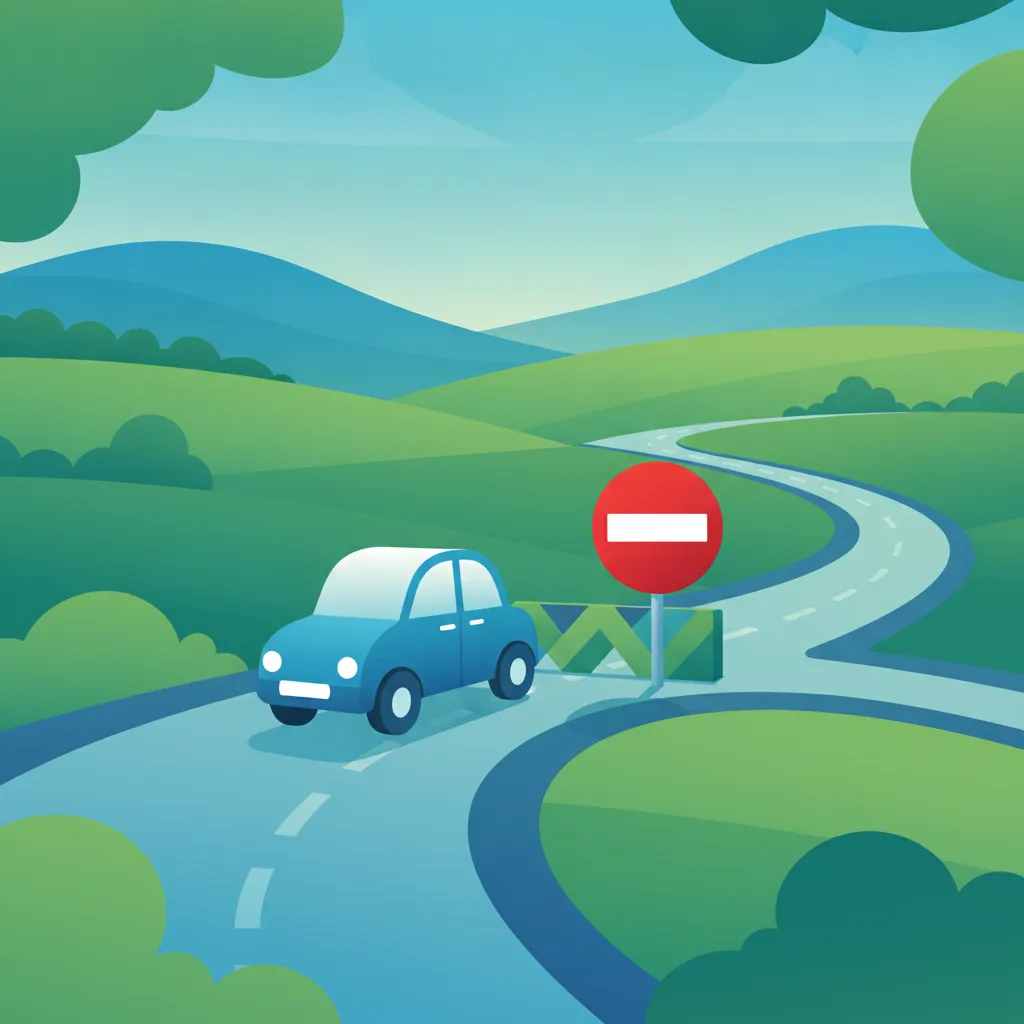
Prohibition signs are a fundamental part of the Road Safety Authority's 'Rules of the Road', explicitly informing drivers what actions are not permitted. They typically feature a red circle or border to highlight a restriction, aiming to prevent dangerous situations, maintain orderly traffic flow, and ensure the safety of all road users in Ireland.
Theory topic content overview
Read the full theory topic guide for Prohibition Road Signs with structured, easy-to-scan content built for learners in Ireland. This detailed section explains the exact rule, meaning, traffic context, comparison points, and exam logic behind this Irish driving theory topic so you can study faster, understand the concept more clearly, and avoid common interpretation mistakes on the theory test.
Prohibition signs are a critical category of regulatory road signs on Irish roads, explicitly informing drivers what actions are legally forbidden. Recognisable by their distinctive red circular shape (or red border), often with a black symbol on a white background, these signs are fundamental to maintaining safety, ensuring orderly traffic flow, and preventing collisions throughout Ireland. Obeying these signs is not just good practice; it's a legal obligation and a key part of your Driver Theory Test knowledge.
Prohibition signs are a subset of regulatory signs designed to restrict or forbid specific actions. Unlike warning signs which alert you to potential dangers, or mandatory signs which instruct you to perform an action, prohibition signs clearly state what you cannot do. They serve as legal mandates on the road, aimed at preventing hazardous situations, managing congestion, and protecting all road users, from pedestrians in urban areas to drivers on motorways.
In Ireland, these signs are part of the official Road Safety Authority (RSA) framework, detailed within the 'Rules of the Road'. Their message is always imperative: "do not do this".
The importance of prohibition signs extends beyond simply avoiding a penalty. Understanding and adhering to these signs is vital for:
No Entry), overtaking on blind bends (No Overtaking), or parking in locations that obstruct visibility or emergency services (No Parking).The 'Rules of the Road' outline numerous prohibition signs, each with a specific restriction:
No Entry sign accompanied by an information plate reading Except Trams - Ach amháin Tramanna or Except Trams and Access - Ach amháin Tramanna agus Rochtain. This means only trams (and vehicles requiring access to premises on that street) are permitted.End of all local restrictions sign.No Stopping signs and specify the times during which stopping or parking is prohibited, usually during busy periods to keep traffic moving. Look for an accompanying information plate showing the hours.Prohibition signs are typically placed at the point where the restriction begins and apply from that point onwards until an 'end of restriction' sign is encountered, or you pass the specific area the sign governs (e.g., turning off a street with a 'No Entry' sign).
Some signs have additional plates beneath them to clarify the conditions or exceptions to the prohibition. For instance, parking restriction signs might have plates indicating:
It is crucial for Irish drivers to observe these supplementary plates carefully, as they define the precise scope of the prohibition.
To avoid confusion, it's helpful to distinguish prohibition signs from other types of road signs:
Sharp Bend Ahead), but do not prohibit an action directly.No Entry). Mandatory signs (blue circle with white arrow) mandate an action (e.g., Turn Left Ahead). Both are regulatory, but their instruction is opposite.Motorway Ahead), but do not impose legal restrictions or demands.No Entry sign with an information plate "Except Trams - Ach amháin Tramanna". This means you, as a car driver, are absolutely forbidden from entering that street, regardless of whether a tram is present. You must find an alternative route.No Overtaking sign. Even if the road appears clear for a moment, the sign legally prohibits you from passing another vehicle, reinforcing the need for caution in potentially obscured areas.No Parking sign. This means you cannot leave your vehicle unattended, even for a moment. If you see a No Stopping (Clearway) sign with specific times, you cannot even pull over to drop off a passenger during those hours. You must find legal parking elsewhere.Learner drivers often make mistakes with prohibition signs due to misinterpretation or insufficient attention:
No Stopping (red cross on blue circle) is absolute; No Parking (red diagonal line on blue circle) allows for brief stopping (e.g., dropping off passengers) if you remain with the vehicle.For the Irish Driver Theory Test and for safe driving, internalise this: prohibition signs are non-negotiable legal instructions. Always look for the red circle or border, identify the symbol, and carefully read any accompanying text plates. Understand the specific action forbidden and the duration or conditions of the restriction. This disciplined approach will keep you safe, legal, and help you pass your driving test with confidence.
Prohibition signs are regulatory road signs with red circles that legally forbid specific driver actions on Irish roads. Common examples include No Entry, No Overtaking, No U-Turn, No Left/Right Turn, and various parking restrictions. The critical distinction between No Stopping (absolute prohibition) and No Parking (brief stops allowed) frequently appears in the Driver Theory Test. These signs are part of the Road Safety Authority's Rules of the Road framework and must be obeyed from the point they are encountered until an 'End of Restriction' sign or clear indication of the zone's end. Accompanying information plates are essential to understand the full scope of any prohibition, including time restrictions, vehicle exceptions, and specific conditions that apply.
A short set of high-value points that capture the most important ideas from this theory explanation.
Prohibition signs are regulatory signs with a red circle or border that legally forbid specific driver actions
No Entry signs prohibit vehicles from entering a road or lane from the direction faced, with possible tram exceptions in Irish cities
Speed limit restrictions end when you see a white circle with a black diagonal stripe through the last speed limit
Accompanying information plates below signs define precise conditions, exceptions, and time limits for restrictions
Obeying prohibition signs is a legal obligation under the Road Safety Authority Rules of the Road, not optional guidance
No Stopping (red cross on blue circle) means absolute prohibition - no stopping for any reason; No Parking (red diagonal on blue circle) allows brief stops if you stay with the vehicle
The red circle itself is the universal cue for prohibition - always treat it as a legal command to not perform the action shown
Some restrictions like No Overtaking end at an 'End of Restriction' sign, not automatically at the next junction
No Entry signs in Ireland may have plates reading 'Except Trams - Ach amháin Tramanna' meaning only trams and vehicles requiring access can enter
Weight, height, and width restrictions shown on red circles use metric units and apply to the specific dimensions of your vehicle
Failing to look for or read accompanying information plates that define time limits, vehicle exceptions, or specific zone distances
Confusing 'No Stopping' (red cross) with 'No Parking' (red diagonal line) in theory test questions and on the road
Assuming a prohibition restriction ends without seeing an explicit 'End of Restriction' sign
Missing the No Entry sign entirely or misunderstanding that the white horizontal bar inside the red circle means no entry from that direction
Underestimating that disobeying prohibition signs carries real legal penalties including fixed charges and penalty points on your licence
Start with a short, direct summary of Prohibition Road Signs before reading the full explanation below.
Prohibition signs are a type of regulatory road sign that clearly indicates actions drivers are not allowed to perform. Commonly circular with a red border, they enforce legal restrictions such as 'no entry', 'no overtaking', or specific parking bans. Obeying these signs is essential for road safety in Ireland, preventing collisions, traffic disruption, and legal penalties, and is a key part of the Driver Theory Test.
Review the most important terms, rule signals, and traffic concepts linked to Prohibition Road Signs.
Explore related theory topic pages connected to Prohibition Road Signs and continue with the next useful rule explanation.
See the common search queries learners use when trying to understand Prohibition Road Signs in Ireland.

After reviewing core Irish driving theory topics, test your understanding with comprehensive practice questions. Apply your knowledge of road rules, signs, and traffic laws to scenarios mirroring the official Driver Theory Test. Solidify your learning and prepare effectively for your exam.
Irish Driving Theory TopicsTheory topic content overview
A short set of high-value points that capture the most important ideas from this theory explanation.
Prohibition signs are regulatory signs with a red circle or border that legally forbid specific driver actions
No Entry signs prohibit vehicles from entering a road or lane from the direction faced, with possible tram exceptions in Irish cities
Speed limit restrictions end when you see a white circle with a black diagonal stripe through the last speed limit
Accompanying information plates below signs define precise conditions, exceptions, and time limits for restrictions
Obeying prohibition signs is a legal obligation under the Road Safety Authority Rules of the Road, not optional guidance
No Stopping (red cross on blue circle) means absolute prohibition - no stopping for any reason; No Parking (red diagonal on blue circle) allows brief stops if you stay with the vehicle
The red circle itself is the universal cue for prohibition - always treat it as a legal command to not perform the action shown
Some restrictions like No Overtaking end at an 'End of Restriction' sign, not automatically at the next junction
No Entry signs in Ireland may have plates reading 'Except Trams - Ach amháin Tramanna' meaning only trams and vehicles requiring access can enter
Weight, height, and width restrictions shown on red circles use metric units and apply to the specific dimensions of your vehicle
Failing to look for or read accompanying information plates that define time limits, vehicle exceptions, or specific zone distances
Confusing 'No Stopping' (red cross) with 'No Parking' (red diagonal line) in theory test questions and on the road
Assuming a prohibition restriction ends without seeing an explicit 'End of Restriction' sign
Missing the No Entry sign entirely or misunderstanding that the white horizontal bar inside the red circle means no entry from that direction
Underestimating that disobeying prohibition signs carries real legal penalties including fixed charges and penalty points on your licence
Start with a short, direct summary of Prohibition Road Signs before reading the full explanation below.
Prohibition signs are a type of regulatory road sign that clearly indicates actions drivers are not allowed to perform. Commonly circular with a red border, they enforce legal restrictions such as 'no entry', 'no overtaking', or specific parking bans. Obeying these signs is essential for road safety in Ireland, preventing collisions, traffic disruption, and legal penalties, and is a key part of the Driver Theory Test.
Review the most important terms, rule signals, and traffic concepts linked to Prohibition Road Signs.
Explore related theory topic pages connected to Prohibition Road Signs and continue with the next useful rule explanation.
See the common search queries learners use when trying to understand Prohibition Road Signs in Ireland.
After reviewing core Irish driving theory topics, test your understanding with comprehensive practice questions. Apply your knowledge of road rules, signs, and traffic laws to scenarios mirroring the official Driver Theory Test. Solidify your learning and prepare effectively for your exam.
Irish Driving Theory TopicsUse this exam-focused revision tip to understand how Prohibition Road Signs is likely to appear in theory questions for learners in Ireland. This section helps you identify the most testable part of the rule, avoid common traps, and remember the concept more effectively during Irish driving theory exam preparation.
In the Irish Driver Theory Test, don't just recognise the sign; understand the specific action it prohibits. Many questions involve scenarios where distinguishing between 'No Stopping' and 'No Parking', or recognising the end of a restriction (e.g., 'End of No Overtaking'), can be tricky. Always look for accompanying text or symbols.
Read direct answers to the most common learner questions about Prohibition Road Signs in Ireland. This FAQ focuses on rule confusion, practical meaning, comparison with similar concepts, and the exact uncertainties that appear most often in Irish driving theory revision and exam preparation.
The main purpose of a prohibition sign is to indicate that a specific action is legally forbidden for drivers, ensuring road safety and efficient traffic flow by preventing hazardous manoeuvres or situations.
Common examples in Ireland include 'No Entry', 'No Overtaking', 'No Parking', 'No Stopping', and signs prohibiting certain vehicle types or turns, all detailed in the RSA's Rules of the Road.
Prohibition signs are typically circular with a red border, often containing a black symbol on a white background that illustrates the forbidden action. This consistent design helps drivers quickly recognise them.
Ignoring a prohibition sign can lead to dangerous situations, traffic accidents, and legal consequences such as penalty points, fines, or prosecution, as they represent legally enforceable traffic regulations.
No, some prohibition signs apply continuously, while others may include supplementary plates indicating specific times, days, or conditions under which the restriction is active, such as 'No Parking' during peak hours.
A 'No Entry' sign prohibits vehicles from entering the road from that direction. A 'No Through Road' sign indicates that the road has no exit for vehicles, meaning you can enter but will need to turn around or exit the way you came.
Yes, understanding and correctly interpreting prohibition signs is a key component of the Irish Driver Theory Test, as they are essential for safe and legal driving.
Use the practice question search tool to pinpoint specific topics, road signs, or rules you need to master for your official Driver Theory Test. Refine your study strategy and ensure comprehensive preparation for all aspects of the Irish driving exam. Start your focused revision now and build confidence for your learner permit test.