Learn the essential regulations for drivers in Ireland regarding school wardens and their junior counterparts. This guide clarifies the specific signals they use, the legal requirement to stop and remain stopped, and the importance of not obstructing their view. Mastering these rules is key for both road safety and success in your Driver Theory Test.
Article content overview
Ensuring the safety of children travelling to and from school is a paramount concern on Irish roads, and school wardens play a vital role in this endeavour. As a driver preparing for your Driver Theory Test and navigating the roads of Ireland, it is crucial to understand your legal obligations when encountering these individuals and the designated crossing points they supervise. Failure to adhere to their signals can create dangerous situations for vulnerable road users and result in penalties. This article delves into the specific rules and responsibilities you must be aware of concerning school wardens, reinforcing the knowledge required for safe driving and successful completion of your theory test.
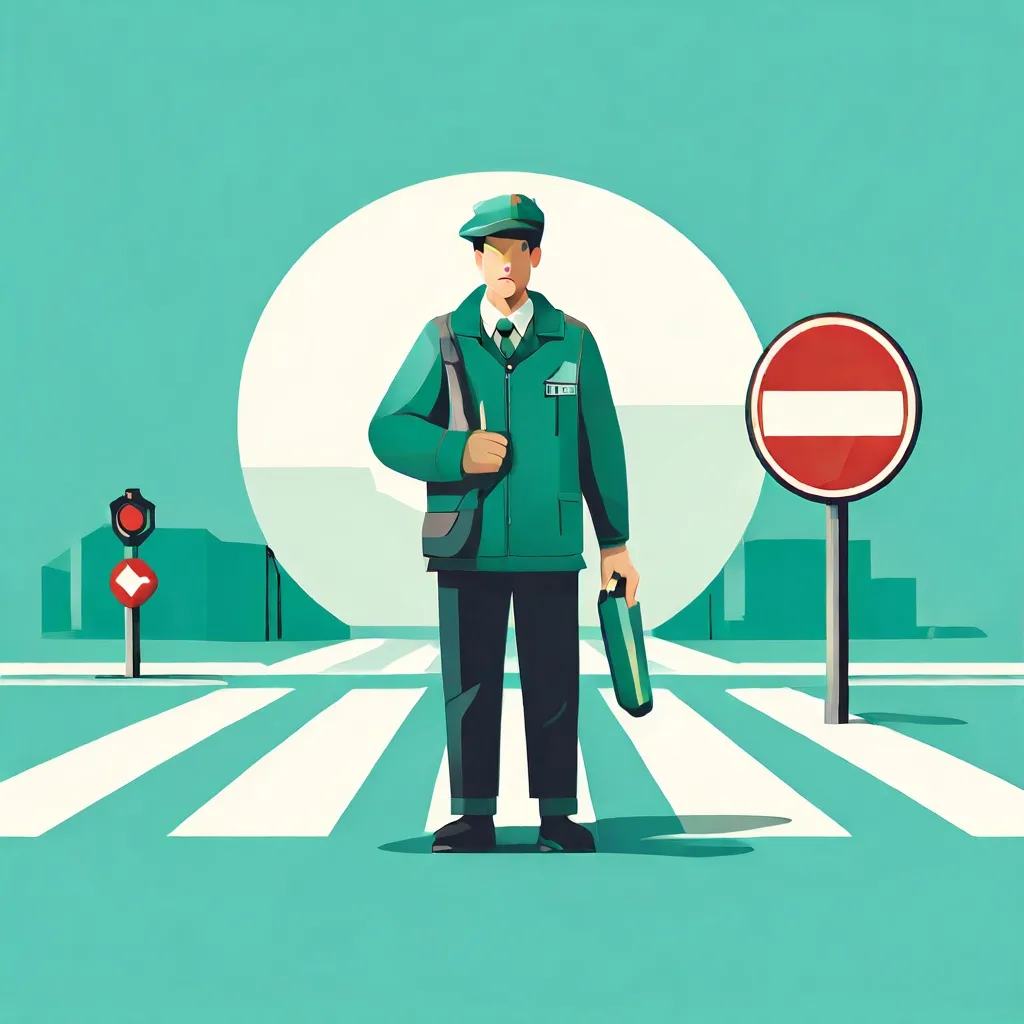
School wardens, and their junior counterparts, are designated individuals who are legally empowered to stop traffic to ensure the safe passage of children across the road. Adult school wardens are easily identifiable by their distinctive hats and high-visibility overcoats, which often include reflective material to ensure they are seen by drivers in various light conditions. They carry a special sign, typically a 'Stop' sign, which, when raised, mandates that all traffic must halt. Understanding that these wardens are authorised by law to control traffic is the first step in respecting their role and ensuring compliance with road safety regulations.
Junior school wardens, who are typically senior pupils from primary schools, operate in a similar capacity, often in teams. They also employ signals to halt traffic on both sides of the road. While they may not have the same formal attire as adult wardens, their signals to stop traffic are equally legally binding. It is imperative to treat their instructions with the same seriousness and respect as those given by adult wardens, as their primary objective is also the safety of younger children.
When a school warden, whether adult or junior, raises their 'Stop' sign, or uses another clear signal to indicate traffic should halt, you are legally required to stop your vehicle. This stopping is not merely a temporary pause; you must remain stopped until all the school children have safely crossed the road, the warden has lowered their sign or ceased their signal, and they have safely returned to the footpath. It is a common misconception to assume you can proceed once the children have passed your immediate vicinity. The warden's authority extends until they have completely withdrawn their instruction and confirmed it is safe for traffic to resume.
The RSA's Rules of the Road clearly outline that vehicles must remain stopped until the situation is fully resolved and the warden signals it is safe to proceed. This means you must be patient and observant, waiting for the all-clear from the warden. This rule is a cornerstone of protecting children in school zones and is a frequent topic in the Driver Theory Test, so understanding its nuances is vital for your exam preparation.
Remember that the responsibility to stop rests with the driver. Never attempt to judge for yourself whether it is safe to proceed. Always wait for the explicit signal from the school warden.
School wardens are typically stationed at designated school crossing places, often located outside or near schools where children frequently cross the road. These locations are chosen to provide a safer environment for young pedestrians, but they rely heavily on drivers understanding and respecting the warden's role. It is essential to be extra vigilant when driving in areas with schools, especially during typical drop-off and pick-up times.
Areas around schools are often subject to reduced speed limits, and drivers must be aware of and adhere to these restrictions. These lower speed limits are designed to give drivers more time to react to unexpected situations, such as children darting into the road, or to respond promptly to a school warden's signal. Driving at an appropriate speed in school zones significantly enhances the safety of everyone in the vicinity.
To ensure the warden's effectiveness and the safety of the crossing, drivers are prohibited from parking or stopping in a manner that obstructs the warden's view of the road or the approaching traffic. This means never parking in a way that blocks their line of sight, as they need a clear view to monitor both the children and the vehicles. Similarly, drivers must not overtake or park within areas marked by zig-zag lines on either side of a zebra crossing, which are often present near school crossings to maintain visibility and prevent obstruction. You do not have the right-of-way over other traffic until you actually step onto a crossing, and importantly, you must never step onto a crossing if it would cause a driver to brake or swerve suddenly. This principle extends to school crossings where a warden is managing the flow.
Junior school wardens are trained senior pupils who assist in managing school crossings. When they wish to stop traffic, they will give a clear signal to drivers approaching from both directions. When traffic is stopped, these junior wardens then position themselves to guide younger children across the road. It is crucial for drivers to understand that all vehicles must remain stopped until all the junior wardens have returned to the footpath, indicating that the crossing operation is complete and it is safe for traffic to resume.
A critical safety rule, particularly relevant around school areas, is never to cross in front of a stopped bus. This is especially pertinent if the bus is stopped to pick up or drop off children. Drivers must exercise extreme caution when approaching or passing bus stops, as children may be alighting or waiting to board. The rule is absolute: never cross in front of a stopped bus, regardless of whether it is a school bus or a public service bus in a school zone.
The Driver Theory Test frequently includes questions related to school wardens and school crossings to assess a learner's understanding of these critical safety protocols. Expect questions that test your knowledge of:
A common trap involves scenarios where a warden has signalled traffic to stop, but only a few children are crossing, or the warden seems to be taking a long time. The correct answer always involves waiting for the full, clear signal from the warden to proceed, reinforcing the principle that the warden, not the driver, dictates when it is safe.
Ignoring the signals of a school warden or junior school warden is a serious offence and can have severe consequences, including penalty points and fines, not to mention the grave risk of endangering a child's life.
Understanding and diligently applying these rules is not just about passing your Driver Theory Test in Ireland; it's about contributing to a safer environment for our communities and, most importantly, for the children. Always drive with care and be prepared to stop when required, especially in school zones.
School wardens in Ireland have legal authority to control traffic at crossings using a raised Stop sign or clear signal. Drivers must stop completely when signaled and remain stopped until the warden lowers their sign and returns to the footpath, not merely when children have crossed. Drivers must not obstruct the warden's view, park in zig-zag marked areas, or drive at normal speeds in school zones. Both adult and junior school wardens carry equal legal authority, and their signals are a frequent topic in the Driver Theory Test. Ignoring these signals can result in penalty points, fines, and most importantly, endanger the lives of children.
A short set of high-value points that capture the most important ideas from this article.
School wardens (adult and junior) are legally authorised to stop traffic and their signals are mandatory for all drivers
You must remain stopped until the warden lowers their sign AND has safely returned to the footpath
Never obstruct a school warden's view of the road or approaching traffic
Reduced speed limits apply in school zones, especially during drop-off and pick-up times
Never cross in front of a stopped bus in school areas, regardless of circumstances
A school warden's signal is legally binding whether given by an adult or junior warden
The stop period continues until all children AND all wardens have safely crossed and returned to the footpath
Zig-zag road markings near crossings indicate areas where parking and stopping are prohibited
Junior school wardens are senior pupils trained to manage crossings and their signals carry the same legal weight as adult wardens
You must never judge for yourself when it is safe to proceed; wait for the explicit all-clear from the warden
Assuming you can proceed once children have passed your vehicle, without waiting for the warden to lower their signal
Parking or stopping in a way that blocks the warden's line of sight to approaching traffic
Not reducing speed when approaching school zones and designated crossing points
Treating junior school warden signals as optional or less important than adult warden signals
Overtaking or moving forward prematurely when a warden is taking time to complete the crossing operation
Article content overview
A short set of high-value points that capture the most important ideas from this article.
School wardens (adult and junior) are legally authorised to stop traffic and their signals are mandatory for all drivers
You must remain stopped until the warden lowers their sign AND has safely returned to the footpath
Never obstruct a school warden's view of the road or approaching traffic
Reduced speed limits apply in school zones, especially during drop-off and pick-up times
Never cross in front of a stopped bus in school areas, regardless of circumstances
A school warden's signal is legally binding whether given by an adult or junior warden
The stop period continues until all children AND all wardens have safely crossed and returned to the footpath
Zig-zag road markings near crossings indicate areas where parking and stopping are prohibited
Junior school wardens are senior pupils trained to manage crossings and their signals carry the same legal weight as adult wardens
You must never judge for yourself when it is safe to proceed; wait for the explicit all-clear from the warden
Assuming you can proceed once children have passed your vehicle, without waiting for the warden to lower their signal
Parking or stopping in a way that blocks the warden's line of sight to approaching traffic
Not reducing speed when approaching school zones and designated crossing points
Treating junior school warden signals as optional or less important than adult warden signals
Overtaking or moving forward prematurely when a warden is taking time to complete the crossing operation
Explore related topics, search based questions, and concepts that learners often look up when studying Irish School Warden Rules. These themes reflect real search intent and help you understand how this topic connects to wider driving theory knowledge in Ireland.
Find clear and practical answers to common questions learners often have about Irish School Warden Rules. This section helps explain difficult points, remove confusion, and reinforce the key driving theory concepts that matter for learners in Ireland.
When an Irish school warden raises their 'Stop' sign, you are legally required to stop your vehicle and remain stopped until the children have crossed, the sign is lowered, and the warden has safely returned to the footpath.
Junior school wardens are senior pupils who assist adult school wardens. They signal traffic to stop and guide younger children across the road. Drivers must remain stopped until all junior wardens have returned to the footpath.
No, you must never park in a location that obstructs a school warden's view. They need a clear line of sight to the road to ensure the safety of children crossing.
The reflective material on a school warden's overcoat is for their visibility, especially in lower light conditions, to enhance their safety while they perform their duty of controlling traffic for school crossings.
Yes, all vehicles must remain stopped when signalled by junior school wardens until they have safely guided children across the road and returned to the footpath.
After searching, continue your DTT preparation by exploring related articles, practicing questions, or reviewing specific road sign categories. Deepen your understanding of Irish road rules and ensure you're fully prepared for your Driver Theory Test.