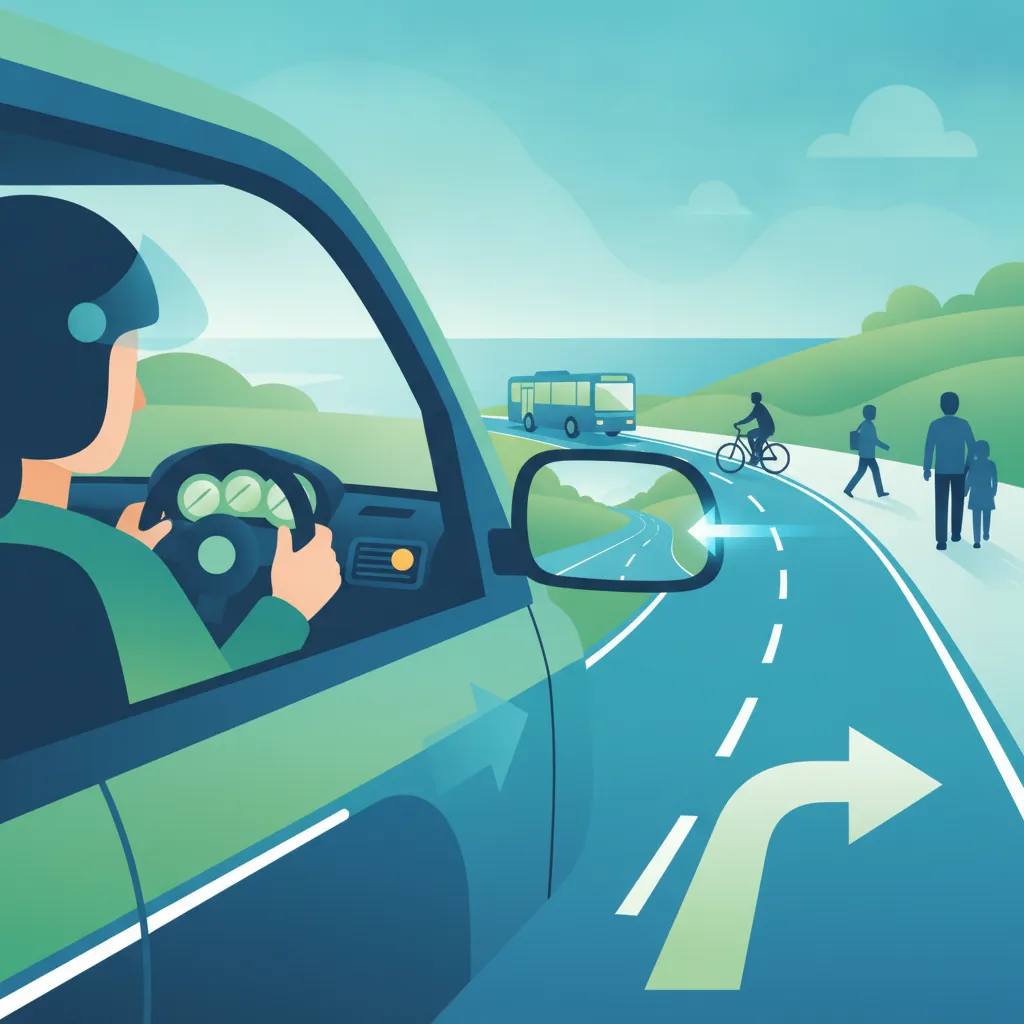
Changing direction on the road, whether turning left or right at a junction, requires careful planning and execution. In Ireland, adherence to the Rules of the Road is paramount to ensure the safety of all road users, especially vulnerable pedestrians and cyclists. This guide details the step-by-step process for safe turning, covering everything from initial observation to the final maneuver.
Theory topic content overview
Read the full theory topic guide for Safe Turning Guide with structured, easy-to-scan content built for learners in Ireland. This detailed section explains the exact rule, meaning, traffic context, comparison points, and exam logic behind this Irish driving theory topic so you can study faster, understand the concept more clearly, and avoid common interpretation mistakes on the theory test.
To perform safe turns on Irish roads, a driver must master a sequence of observations, signals, and manoeuvres that prioritise safety and smooth traffic flow. More than simply changing direction, safe turning is about anticipating potential conflicts at junctions and executing the turn in a controlled, predictable manner, adhering strictly to the Irish Rules of the Road. This fundamental skill is crucial for avoiding collisions, particularly with vulnerable road users, and is thoroughly assessed in both the Irish Driver Theory Test and the practical driving examination.
Every turn introduces a "conflict point" – a place where your vehicle's path might intersect with other road users. This is where incidents are most likely to occur if drivers fail to observe, signal, or position their vehicle correctly. In Ireland, the emphasis is heavily on proactively managing these conflict points. A safe turn means ensuring that your manoeuvre does not cause another road user to change their speed or direction suddenly to avoid you.
Mastering safe turning procedures is not just about passing your driving test; it's fundamental to daily road safety across Ireland.
The "Mirrors, Signal, Manoeuvre" (MSM) routine is the bedrock of safe driving in Ireland, especially for turns. It ensures a systematic approach:
Before you even reach the junction, scan the road ahead for signs, road markings, and potential hazards. Identify which way you need to turn and begin planning your approach.
As per the MSM routine, check your mirrors (rear-view and side mirrors) to be aware of any traffic behind you, especially fast-approaching vehicles or vulnerable road users.
Activate your indicators well in advance. The signal should be clear and given early enough to inform other road users of your intentions, but not so early that it could be misleading (e.g., signalling for a turn too soon before a previous entrance).
Your position on the road is critical for both safety and clarity to other road users.
Slow down gradually as you approach the junction. Select an appropriate gear (usually first or second) that allows you to control your speed and accelerate smoothly out of the turn. Do not coast in neutral.
Before committing to the turn, make thorough final observations.
Steer smoothly around the corner, maintaining appropriate speed. Be careful not to cut the corner (turning too early or sharply) or swing out too wide. As you complete the turn, straighten up in the new lane and accelerate smoothly to the appropriate speed for the road.
The Road Safety Authority (RSA) identifies several common faults related to turning that can lead to failure in the practical driving test:
Safe turning in Ireland boils down to a fundamental principle: anticipate, communicate, and execute with precision. Always assume there might be a vulnerable road user you haven't seen, and actively look for them. Use the MSM routine consistently, plan your turns well in advance, and adjust your speed and position according to the specific junction and road conditions. By doing so, you'll not only pass your driving tests but also contribute significantly to road safety for everyone in Ireland.
Start with a short, direct summary of Safe Turning Guide before reading the full explanation below.
To perform a safe turn in Ireland, drivers must first use the 'Mirrors, Signal, Manoeuvre' (MSM) routine. This involves checking mirrors, giving a clear signal in good time, and then positioning the vehicle correctly in the lane. Before committing to the turn, make thorough observations for other traffic and pedestrians, ensuring sufficient space and yielding right of way as necessary. Execute the turn smoothly and at an appropriate speed.
Review the most important terms, rule signals, and traffic concepts linked to Safe Turning Guide.
Explore related theory topic pages connected to Safe Turning Guide and continue with the next useful rule explanation.
See the common search queries learners use when trying to understand Safe Turning Guide in Ireland.

After reviewing core Irish driving theory topics, test your understanding with comprehensive practice questions. Apply your knowledge of road rules, signs, and traffic laws to scenarios mirroring the official Driver Theory Test. Solidify your learning and prepare effectively for your exam.
Irish Driving Theory TopicsTheory topic content overview
Start with a short, direct summary of Safe Turning Guide before reading the full explanation below.
To perform a safe turn in Ireland, drivers must first use the 'Mirrors, Signal, Manoeuvre' (MSM) routine. This involves checking mirrors, giving a clear signal in good time, and then positioning the vehicle correctly in the lane. Before committing to the turn, make thorough observations for other traffic and pedestrians, ensuring sufficient space and yielding right of way as necessary. Execute the turn smoothly and at an appropriate speed.
Review the most important terms, rule signals, and traffic concepts linked to Safe Turning Guide.
Explore related theory topic pages connected to Safe Turning Guide and continue with the next useful rule explanation.
See the common search queries learners use when trying to understand Safe Turning Guide in Ireland.
After reviewing core Irish driving theory topics, test your understanding with comprehensive practice questions. Apply your knowledge of road rules, signs, and traffic laws to scenarios mirroring the official Driver Theory Test. Solidify your learning and prepare effectively for your exam.
Irish Driving Theory TopicsUse this exam-focused revision tip to understand how Safe Turning Guide is likely to appear in theory questions for learners in Ireland. This section helps you identify the most testable part of the rule, avoid common traps, and remember the concept more effectively during Irish driving theory exam preparation.
In the Irish Driver Theory Test and practical driving exam, examiners look for smooth progress and thorough observation during turns. A common fault is 'inadequate progress' or 'lack of observation'. Always remember to check mirrors, signal, and make full observations for vulnerable road users (pedestrians, cyclists) before and during your turn.
Read direct answers to the most common learner questions about Safe Turning Guide in Ireland. This FAQ focuses on rule confusion, practical meaning, comparison with similar concepts, and the exact uncertainties that appear most often in Irish driving theory revision and exam preparation.
When turning left, check your mirrors, signal in good time, position your vehicle close to the left-hand side of the road, and be alert for cyclists or pedestrians on your left before making the turn.
Generally, oncoming traffic travelling straight ahead or turning left has priority. You must yield to them unless road markings or signals indicate otherwise, or if there's a specific 'turning back to back' arrangement in very slow traffic.
You should signal in good time to inform other road users of your intentions, but not so early that it could mislead them about your actual turning point, especially at multiple junctions or roundabouts.
Before turning, it's crucial to check your interior mirror, wing mirrors, and blind spots. Look for pedestrians crossing the road, oncoming traffic, and vehicles behind or alongside you.
Turning back to back is an alternative method for turning right at busy junctions where it's safe to pass a vehicle coming from the opposite direction, both turning right, by driving around the 'back' of each other's vehicles. This should only be done if safe and necessary.
Correct lane positioning (e.g., staying close to the left for a left turn, or near the centre for a right turn) helps prevent other vehicles from attempting unsafe overtakes and makes your intentions clearer to other road users.
Use the practice question search tool to pinpoint specific topics, road signs, or rules you need to master for your official Driver Theory Test. Refine your study strategy and ensure comprehensive preparation for all aspects of the Irish driving exam. Start your focused revision now and build confidence for your learner permit test.