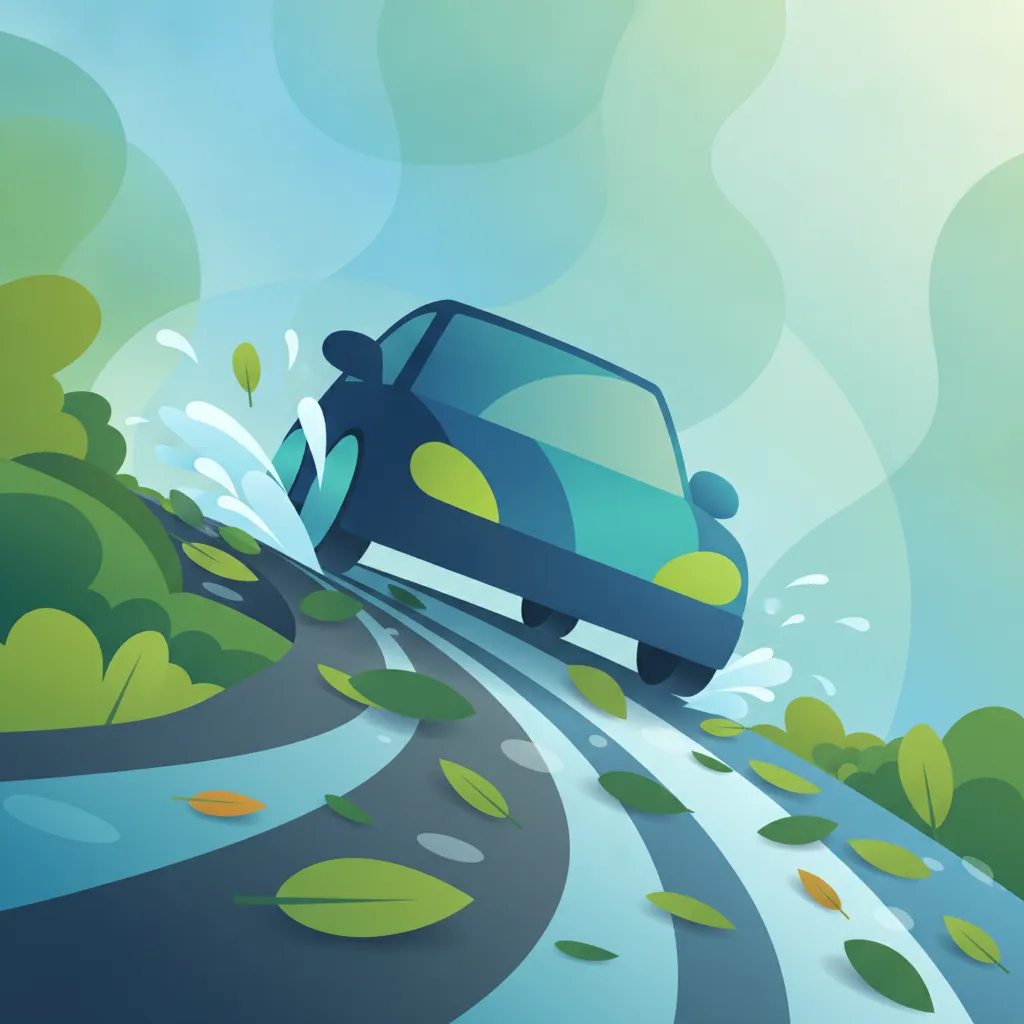
Slippery roads occur when the friction between your tires and the road surface is significantly reduced, making it harder to control your vehicle. This can be caused by various factors, including ice, snow, heavy rain, oil spills, or loose materials like gravel. Mastering how to drive effectively in these conditions is a core part of being a safe driver in Ireland.
Theory topic content overview
Read the full theory topic guide for Slippery Roads Safety with structured, easy-to-scan content built for learners in Ireland. This detailed section explains the exact rule, meaning, traffic context, comparison points, and exam logic behind this Irish driving theory topic so you can study faster, understand the concept more clearly, and avoid common interpretation mistakes on the theory test.
Slippery roads occur when the vital connection, or traction, between your vehicle's tyres and the road surface is significantly reduced. This loss of grip makes it considerably harder to control your vehicle, affecting your ability to steer, accelerate, and most critically, to brake effectively. Understanding this concept is fundamental to safe driving in Ireland, where varying weather conditions frequently lead to reduced traction.
The fundamental principle is friction. Tyres rely on friction with the road to generate grip. When this friction is compromised by external factors, the tyres can no longer effectively transmit forces from the engine or brakes to the road, leading to a potential loss of control or skidding.
Driving on slippery roads is one of the most significant hazards you'll face as a driver in Ireland, and it's a core component of the Driver Theory Test. Misjudging conditions or failing to adapt your driving style can lead to:
Ireland's climate, with its frequent rainfall and occasional frosty winters, means that drivers regularly encounter conditions that reduce road grip. The Road Safety Authority (RSA) strongly emphasises the need for drivers to adjust to these conditions to prevent serious incidents.
When the road is slippery, the forces required to keep your vehicle moving in its intended direction are compromised.
The key to maintaining control is to keep all driver inputs – braking, steering, and acceleration – as smooth and gentle as possible, allowing the tyres to maintain maximum available friction.
Several conditions commonly reduce traction on Irish roads:
To drive safely on slippery roads in Ireland, you must proactively adjust your driving according to the RSA's "Rules of the Road":
The relationship between speed, road conditions, and stopping distance is a frequent focus in the Irish Driver Theory Test. It's vital to understand the difference between thinking distance (the distance travelled while reacting) and braking distance (the distance travelled from applying the brakes to stopping). On slippery roads, your braking distance increases dramatically.
As per RSA guidance, on wet roads, your braking distance is roughly double that on dry roads. On ice or snow, this can be up to 10 times longer. This significant increase underscores why reducing speed and increasing following distance are paramount in adverse conditions. For example, if it takes 3 car lengths to stop on a dry road at a certain speed, it could take 30 car lengths on an icy road.
A skid occurs when your tyres lose traction. Understanding the types of skids and how to prevent them is essential:
If you find yourself skidding:
Irish learner drivers often make these mistakes regarding slippery roads:
The RSA's "Rules of the Road" make it clear that drivers have a responsibility to adjust their driving to suit prevailing conditions. This means actively assessing the road surface and anticipating potential reductions in traction. Always prioritise the "RSA rule first" principle: slow down early, observe all relevant road users and hazards, and only proceed with any manoeuvre when it is lawful and safe, especially on potentially slippery roads.
By understanding the physics of traction and consistently applying adaptive driving techniques, you will significantly enhance your safety and the safety of other road users in Ireland.
Start with a short, direct summary of Slippery Roads Safety before reading the full explanation below.
Slippery roads have less grip (traction), making it harder to steer, accelerate, and brake safely. To drive on them, you must significantly reduce your speed, increase your following distance, and make all steering, braking, and acceleration inputs smoothly and gently. Abrupt movements can easily lead to a loss of control and skidding.
Review the most important terms, rule signals, and traffic concepts linked to Slippery Roads Safety.
Explore related theory topic pages connected to Slippery Roads Safety and continue with the next useful rule explanation.
See the common search queries learners use when trying to understand Slippery Roads Safety in Ireland.

After reviewing core Irish driving theory topics, test your understanding with comprehensive practice questions. Apply your knowledge of road rules, signs, and traffic laws to scenarios mirroring the official Driver Theory Test. Solidify your learning and prepare effectively for your exam.
Irish Driving Theory TopicsTheory topic content overview
Start with a short, direct summary of Slippery Roads Safety before reading the full explanation below.
Slippery roads have less grip (traction), making it harder to steer, accelerate, and brake safely. To drive on them, you must significantly reduce your speed, increase your following distance, and make all steering, braking, and acceleration inputs smoothly and gently. Abrupt movements can easily lead to a loss of control and skidding.
Review the most important terms, rule signals, and traffic concepts linked to Slippery Roads Safety.
Explore related theory topic pages connected to Slippery Roads Safety and continue with the next useful rule explanation.
See the common search queries learners use when trying to understand Slippery Roads Safety in Ireland.
After reviewing core Irish driving theory topics, test your understanding with comprehensive practice questions. Apply your knowledge of road rules, signs, and traffic laws to scenarios mirroring the official Driver Theory Test. Solidify your learning and prepare effectively for your exam.
Irish Driving Theory TopicsUse this exam-focused revision tip to understand how Slippery Roads Safety is likely to appear in theory questions for learners in Ireland. This section helps you identify the most testable part of the rule, avoid common traps, and remember the concept more effectively during Irish driving theory exam preparation.
A common mistake in the Irish Driver Theory Test is underestimating the impact of slippery roads on stopping distance. Remember that on ice or snow, braking distance can increase by up to 10 times. Always choose the option that prioritises slowing down, increasing following distance, and making smooth, early observations and inputs.
Read direct answers to the most common learner questions about Slippery Roads Safety in Ireland. This FAQ focuses on rule confusion, practical meaning, comparison with similar concepts, and the exact uncertainties that appear most often in Irish driving theory revision and exam preparation.
Roads become slippery when substances like water (rain, melted snow), ice, snow, oil, diesel, fallen leaves, mud, or loose gravel reduce the friction between your tires and the road surface.
Reduced traction means your tires have less grip, making it more difficult to accelerate without spinning, steer accurately, or brake effectively without skidding. This significantly increases your stopping distance.
The Irish Road Safety Authority (RSA) advises slowing down significantly and allowing up to 10 times the normal distance for braking when driving in icy or snowy conditions. All manoeuvres should be performed gently.
To prevent skidding, reduce your speed well in advance, increase your following distance, and make all steering, braking, and acceleration inputs as smoothly and gently as possible. Avoid sudden movements.
Yes, heavy rain can make roads very slippery, especially in the initial stages when water mixes with oil and dust on the road surface, creating a greasy film. This can also lead to aquaplaning.
If your car skids, remain calm. Take your foot off the accelerator and clutch, and steer gently into the direction of the skid. Avoid braking sharply, as this can worsen the skid.
While there are no specific additional rules for learner permit holders regarding slippery roads, the RSA expects all drivers, especially new ones, to exercise extreme caution and apply safe driving practices to all adverse conditions.
Use the practice question search tool to pinpoint specific topics, road signs, or rules you need to master for your official Driver Theory Test. Refine your study strategy and ensure comprehensive preparation for all aspects of the Irish driving exam. Start your focused revision now and build confidence for your learner permit test.