Understanding how lateral wind forces and air turbulence affect your vehicle is a critical component of safe driving in the Netherlands. This guide breaks down the theory of aerodynamic instability, the dangers posed by passing heavy vehicles, and the proactive strategies required to pass the CBR theory exam and ensure passenger safety.
Article content overview
Driving on the Dutch motorway network requires more than just mastering lane discipline and speed limits. It demands a sophisticated understanding of how environmental factors and heavy traffic dynamics impact vehicle stability. For the CBR theory exam, you are expected to demonstrate knowledge of how lateral wind forces and the "wind shadow" effect can jeopardize safety, particularly for high-sided or lightweight vehicles.
The Dutch road authorities use specific signage to warn drivers of areas where strong crosswinds are prevalent. Recognizing these signs is a fundamental part of your theory preparation. The J-31 sign warns of crosswinds, indicating that you should prepare for sudden gusts that may push your vehicle laterally across your lane.
When you encounter this sign, you must proactively adjust your driving. This involves increasing your grip on the steering wheel, slowing down to reduce the force of the wind on the car's body, and being hyper-aware of your position within the lane.
Vehicle stability is heavily influenced by the height and surface area of the vehicle. High-sided vehicles, such as trucks, vans, and caravans, are disproportionately affected by crosswinds because their large side panels act like a sail, catching wind gusts and creating a destabilizing lateral force.
Lighter vehicles are also at risk because they have less inertia to counteract the push of a sudden gust. If you are driving a small, light car or towing a trailer, you must be particularly vigilant. A sudden gust of wind can force your vehicle to drift toward the central reservation or the hard shoulder, requiring active and immediate steering corrections to maintain your path.
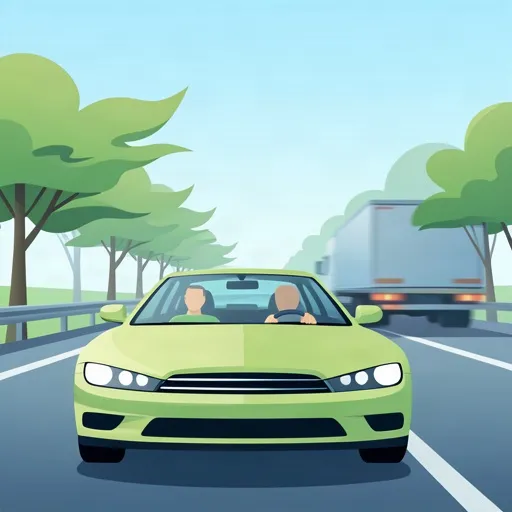
One of the most dangerous scenarios on a motorway involves the "wind shadow" effect. When you approach a large truck or bus, your vehicle is shielded from the crosswind by that larger vehicle. However, as you begin the overtaking maneuver and move out from behind it, you suddenly leave that protected area.
At the exact moment you clear the front of the heavy vehicle, you are hit by the full force of the crosswind that the truck was previously blocking. This transition can cause your car to swerve or "jolt" sideways. Successful exam candidates anticipate this by:
The CBR expects you to understand that "safe speed" is not always the legal speed limit. Under adverse weather conditions, such as heavy rain or high winds, driving at the maximum permitted speed is often unsafe.
Do not assume that the speed limit is safe in all conditions. On the theory exam, if a question mentions strong wind, your priority must always be safety and stability, which often means reducing your speed below the statutory limit to maintain full control of the vehicle.
This article covers essential theory for handling crosswinds on Dutch motorways, focusing on recognizing the J-31 crosswind warning sign, understanding why high-sided and lightweight vehicles are most vulnerable to aerodynamic instability, and mastering the wind shadow effect when overtaking trucks and buses. The wind shadow creates a sudden transition from protected air to full crosswind exposure, requiring proactive speed reduction and firm steering control. CBR exam preparation should emphasize that safe speed is context-dependent, and that anticipatory driving behavior—adjusting before hazards occur—is tested through scenarios involving adverse weather and traffic dynamics.
A short set of high-value points that capture the most important ideas from this article.
The J-31 sign warns of crosswind hazards on Dutch roads and requires proactive speed reduction and increased steering control
High-sided vehicles like trucks and vans, as well as lightweight cars, are most vulnerable to lateral wind forces due to their surface area and lower inertia
The wind shadow effect occurs when overtaking large vehicles, exposing your car to sudden full crosswind force as you clear the front
Safe speed during adverse weather is determined by vehicle stability, not necessarily the posted speed limit
Anticipatory driving means adjusting your grip, speed, and steering before encountering wind hazards, not during them
J-31 is the official Dutch crosswind warning sign indicating areas prone to strong lateral gusts
Reducing speed decreases the force of wind on your vehicle's body, improving stability
When overtaking heavy vehicles in wind, reduce speed slightly and maintain a firm two-handed grip on the steering wheel
The wind shadow effect causes a sudden steering resistance change the moment you clear the front of a large vehicle
CBR exam questions about wind will test your understanding of adaptive behavior, not just knowledge of the speed limit
Assuming the speed limit is always safe to drive in crosswind conditions without adjusting for vehicle type or wind intensity
Not preparing steering corrections before overtaking large vehicles, leading to overcorrection when hitting the wind shadow
Driving high-sided vehicles or towing trailers at the same speed as other traffic during windy conditions
Failing to recognize J-31 signs or not responding with appropriate speed and grip adjustments when encountered
Forgetting that lightweight vehicles have less inertia to counteract sudden gusts compared to heavier vehicles
Article content overview
A short set of high-value points that capture the most important ideas from this article.
The J-31 sign warns of crosswind hazards on Dutch roads and requires proactive speed reduction and increased steering control
High-sided vehicles like trucks and vans, as well as lightweight cars, are most vulnerable to lateral wind forces due to their surface area and lower inertia
The wind shadow effect occurs when overtaking large vehicles, exposing your car to sudden full crosswind force as you clear the front
Safe speed during adverse weather is determined by vehicle stability, not necessarily the posted speed limit
Anticipatory driving means adjusting your grip, speed, and steering before encountering wind hazards, not during them
J-31 is the official Dutch crosswind warning sign indicating areas prone to strong lateral gusts
Reducing speed decreases the force of wind on your vehicle's body, improving stability
When overtaking heavy vehicles in wind, reduce speed slightly and maintain a firm two-handed grip on the steering wheel
The wind shadow effect causes a sudden steering resistance change the moment you clear the front of a large vehicle
CBR exam questions about wind will test your understanding of adaptive behavior, not just knowledge of the speed limit
Assuming the speed limit is always safe to drive in crosswind conditions without adjusting for vehicle type or wind intensity
Not preparing steering corrections before overtaking large vehicles, leading to overcorrection when hitting the wind shadow
Driving high-sided vehicles or towing trailers at the same speed as other traffic during windy conditions
Failing to recognize J-31 signs or not responding with appropriate speed and grip adjustments when encountered
Forgetting that lightweight vehicles have less inertia to counteract sudden gusts compared to heavier vehicles
Explore related topics, search based questions, and concepts that learners often look up when studying Driving in Crosswinds and Turbulence. These themes reflect real search intent and help you understand how this topic connects to wider driving theory knowledge in the Netherlands.
Find clear and practical answers to common questions learners often have about Driving in Crosswinds and Turbulence. This section helps explain difficult points, remove confusion, and reinforce the key driving theory concepts that matter for learners in the Netherlands.
The J-31 sign warns drivers of areas with an increased risk of crosswinds, requiring increased vigilance and careful speed management.
Heavy vehicles can create a 'wind shadow.' When you pass one, you may suddenly leave the calm zone and face a powerful crosswind gust, potentially causing the vehicle to swerve unexpectedly.
Reduce your speed, maintain a firm grip on the steering wheel, and increase your lateral distance from other vehicles and the edge of the road to account for potential gusts.
Start your targeted search now to explore a vast library of official Dutch driving theory articles and guides. Reinforce your understanding of specific traffic rules or road signs to ensure you are fully prepared for your upcoming CBR theory exam. Discover comprehensive explanations tailored for success.