Stopping distance is the total distance your vehicle travels from the moment you identify a hazard until you come to a complete stop. This critical safety concept is comprised of two parts: reaction distance and braking distance. Understanding how speed affects each component is fundamental for safe driving and passing the Irish Driver Theory Test, as higher speeds drastically reduce your ability to react and stop in time.
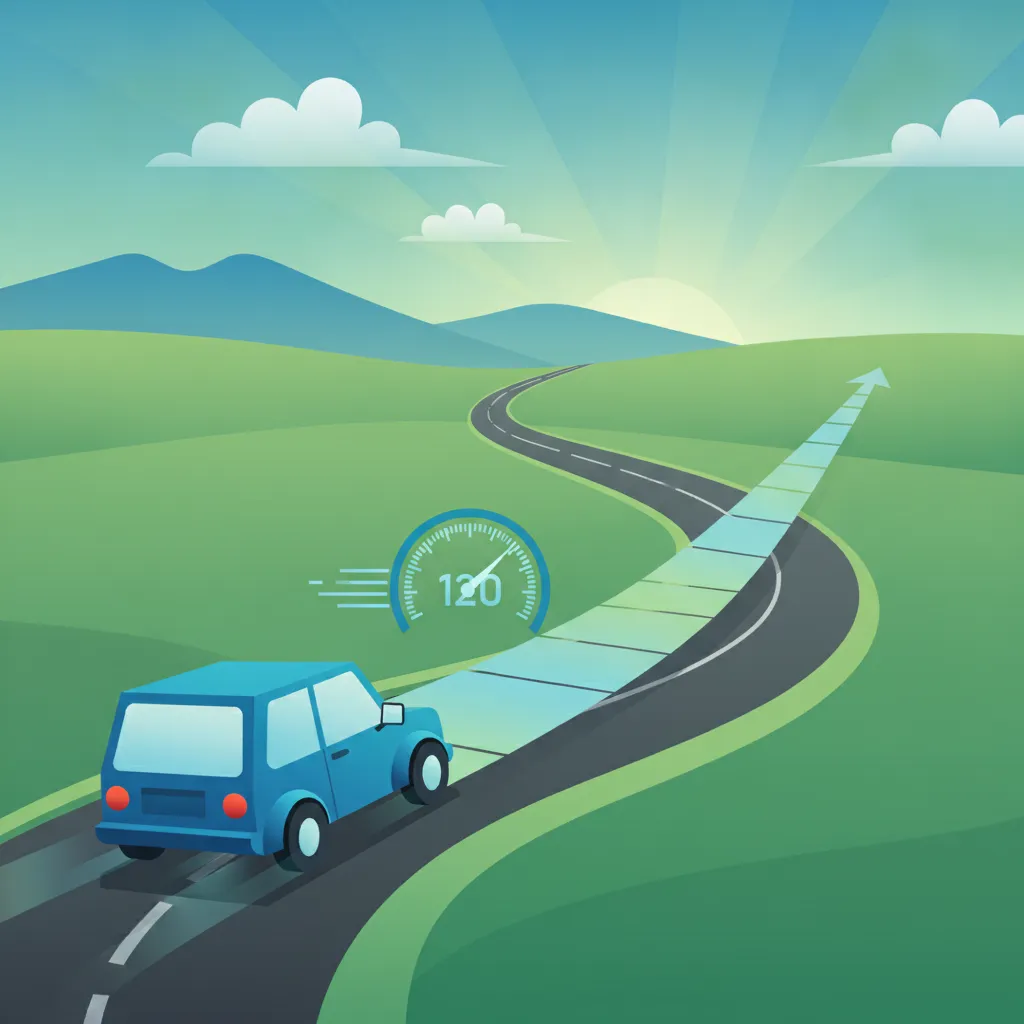
Theory topic content overview
Read the full theory topic guide for Speed & Stopping Distance with structured, easy-to-scan content built for learners in Ireland. This detailed section explains the exact rule, meaning, traffic context, comparison points, and exam logic behind this Irish driving theory topic so you can study faster, understand the concept more clearly, and avoid common interpretation mistakes on the theory test.
Understanding the link between your vehicle's speed and the distance it takes to stop is perhaps one of the most fundamental concepts for safe driving and a core part of the Irish Driver Theory Test. It's not just about knowing the legal speed limits, but critically, understanding how speed profoundly impacts your ability to react to hazards and prevent collisions on Irish roads. The faster you travel, the significantly longer it takes to bring your vehicle to a complete halt, and this relationship is often underestimated by learners and experienced drivers alike.
Total stopping distance is the entire distance your vehicle travels from the moment you first perceive a hazard until your vehicle comes to a complete standstill. This vital measure is composed of two primary elements:
The sum of these two distances gives you the total stopping distance.
The relationship between speed and stopping distance is not linear, which is a crucial point for the Irish Driver Theory Test and real-world safety. While reaction distance increases roughly proportionally with speed, the braking distance increases exponentially – specifically, approximately by the square of your speed.
This means:
Consider the RSA's example: increasing your speed from 50 km/h to 100 km/h (doubling your speed) can increase the total braking distance from at least 26 metres to at least 101 metres. This is far more than just double. This dramatic increase is due to the physics of kinetic energy, which is the energy of motion. A vehicle travelling faster has significantly more kinetic energy, requiring much more work (and thus distance) to dissipate that energy through braking.
While speed is the primary factor, several other conditions significantly influence both reaction and braking distance in Ireland:
The RSA highlights that these components are directly "down to you":
Your vehicle's condition plays a critical role in its braking capability:
Conditions on Irish roads can vary greatly:
Learners often struggle with the concept of stopping distance in the Irish Driver Theory Test, leading to common errors:
The RSA, through its Rules of the Road, consistently emphasises that drivers must always be able to stop in the clear distance they can see ahead. This principle is fundamental to defensive driving and hazard perception. It means that if visibility is poor (due to fog, a bend in the road, or darkness), your speed must be reduced accordingly, regardless of the posted speed limit. The RSA's guidance stresses that safe driving involves a constant assessment of your speed in relation to road conditions, your vehicle's capability, and your own physical state.
The core lesson of the speed and stopping distance relationship is proactive risk management. Always maintain a speed that allows you to stop safely within the visible distance ahead, even if that means driving well below the legal speed limit. This practice, central to hazard perception and safe driving in Ireland, will give you the crucial time and space needed to react to unexpected events, protect vulnerable road users, and prevent collisions. Remember, the higher your speed, the less margin for error you have.
Start with a short, direct summary of Speed & Stopping Distance before reading the full explanation below.
The relationship between speed and stopping distance is non-linear; higher speeds drastically increase the distance required to stop. Total stopping distance is the sum of reaction distance (distance traveled before braking) and braking distance (distance traveled while braking). While reaction distance increases proportionally with speed, braking distance increases roughly by the square of the speed. This means doubling your speed can lead to approximately four times the braking distance, making it a critical factor in collision avoidance and severity on Irish roads.
Review the most important terms, rule signals, and traffic concepts linked to Speed & Stopping Distance.
Explore related theory topic pages connected to Speed & Stopping Distance and continue with the next useful rule explanation.
See the common search queries learners use when trying to understand Speed & Stopping Distance in Ireland.

After reviewing core Irish driving theory topics, test your understanding with comprehensive practice questions. Apply your knowledge of road rules, signs, and traffic laws to scenarios mirroring the official Driver Theory Test. Solidify your learning and prepare effectively for your exam.
Irish Driving Theory TopicsTheory topic content overview
Start with a short, direct summary of Speed & Stopping Distance before reading the full explanation below.
The relationship between speed and stopping distance is non-linear; higher speeds drastically increase the distance required to stop. Total stopping distance is the sum of reaction distance (distance traveled before braking) and braking distance (distance traveled while braking). While reaction distance increases proportionally with speed, braking distance increases roughly by the square of the speed. This means doubling your speed can lead to approximately four times the braking distance, making it a critical factor in collision avoidance and severity on Irish roads.
Review the most important terms, rule signals, and traffic concepts linked to Speed & Stopping Distance.
Explore related theory topic pages connected to Speed & Stopping Distance and continue with the next useful rule explanation.
See the common search queries learners use when trying to understand Speed & Stopping Distance in Ireland.
After reviewing core Irish driving theory topics, test your understanding with comprehensive practice questions. Apply your knowledge of road rules, signs, and traffic laws to scenarios mirroring the official Driver Theory Test. Solidify your learning and prepare effectively for your exam.
Irish Driving Theory TopicsUse this exam-focused revision tip to understand how Speed & Stopping Distance is likely to appear in theory questions for learners in Ireland. This section helps you identify the most testable part of the rule, avoid common traps, and remember the concept more effectively during Irish driving theory exam preparation.
A common mistake in the Irish DTT is underestimating how much stopping distance increases with speed. Remember, it's not a simple addition; doubling your speed can multiply your braking distance by four. Always adjust your speed to ensure you can stop within the visible distance ahead, especially in poor conditions or heavy traffic. This multiplicative effect is key for hazard perception questions.
Read direct answers to the most common learner questions about Speed & Stopping Distance in Ireland. This FAQ focuses on rule confusion, practical meaning, comparison with similar concepts, and the exact uncertainties that appear most often in Irish driving theory revision and exam preparation.
Total stopping distance is the entire distance your vehicle travels from the moment you spot a hazard until it comes to a complete halt. It combines your reaction distance and your braking distance.
Reaction distance is the distance your vehicle travels during your perception and reaction time, before you even apply the brakes. Braking distance is the distance traveled from the moment you press the brake pedal until the vehicle stops.
Doubling your speed significantly increases stopping distance. Your reaction distance doubles, but your braking distance increases by approximately four times, meaning the total stopping distance grows disproportionately with speed.
Braking distance increases significantly because the kinetic energy of a moving vehicle is proportional to the square of its speed. More energy means more distance is needed to dissipate that energy through braking.
Beyond speed, stopping distance is influenced by your perception and reaction time, the condition of your vehicle's brakes and tyres, the road surface (e.g., wet or icy), tyre pressure, vehicle weight, and the vehicle's suspension.
Yes, it is a fundamental concept frequently tested in the Irish Driver Theory Test (DTT). Learners must understand this relationship to demonstrate good hazard perception and safe driving judgment as per RSA standards.
Maintain a safe speed appropriate for conditions, ensure your vehicle is well-maintained (especially brakes and tyres), remain alert and focused to minimize reaction time, and always keep a safe following distance.
Use the practice question search tool to pinpoint specific topics, road signs, or rules you need to master for your official Driver Theory Test. Refine your study strategy and ensure comprehensive preparation for all aspects of the Irish driving exam. Start your focused revision now and build confidence for your learner permit test.