Stopping distance is the total ground your vehicle covers from the moment you identify a hazard until you come to a complete stop. In Ireland, the Road Safety Authority (RSA) emphasises understanding its two main parts: reaction distance and braking distance. Being aware of the factors that influence these distances is vital for road safety and passing your driving theory test.
Theory topic content overview
Read the full theory topic guide for Stopping Distance Explained with structured, easy-to-scan content built for learners in Ireland. This detailed section explains the exact rule, meaning, traffic context, comparison points, and exam logic behind this Irish driving theory topic so you can study faster, understand the concept more clearly, and avoid common interpretation mistakes on the theory test.
Stopping distance is one of the most critical concepts for road safety in Ireland and a cornerstone of the Irish Driver Theory Test. It refers to the total distance your vehicle travels from the precise moment you perceive a hazard until your vehicle comes to a complete, controlled stop. Understanding this isn't just about memorising numbers; it's about grasping the physics and human factors that determine how much road you truly need to halt your vehicle safely on Irish roads.
The Road Safety Authority (RSA) in Ireland breaks down total stopping distance into two primary components: reaction distance and braking distance.
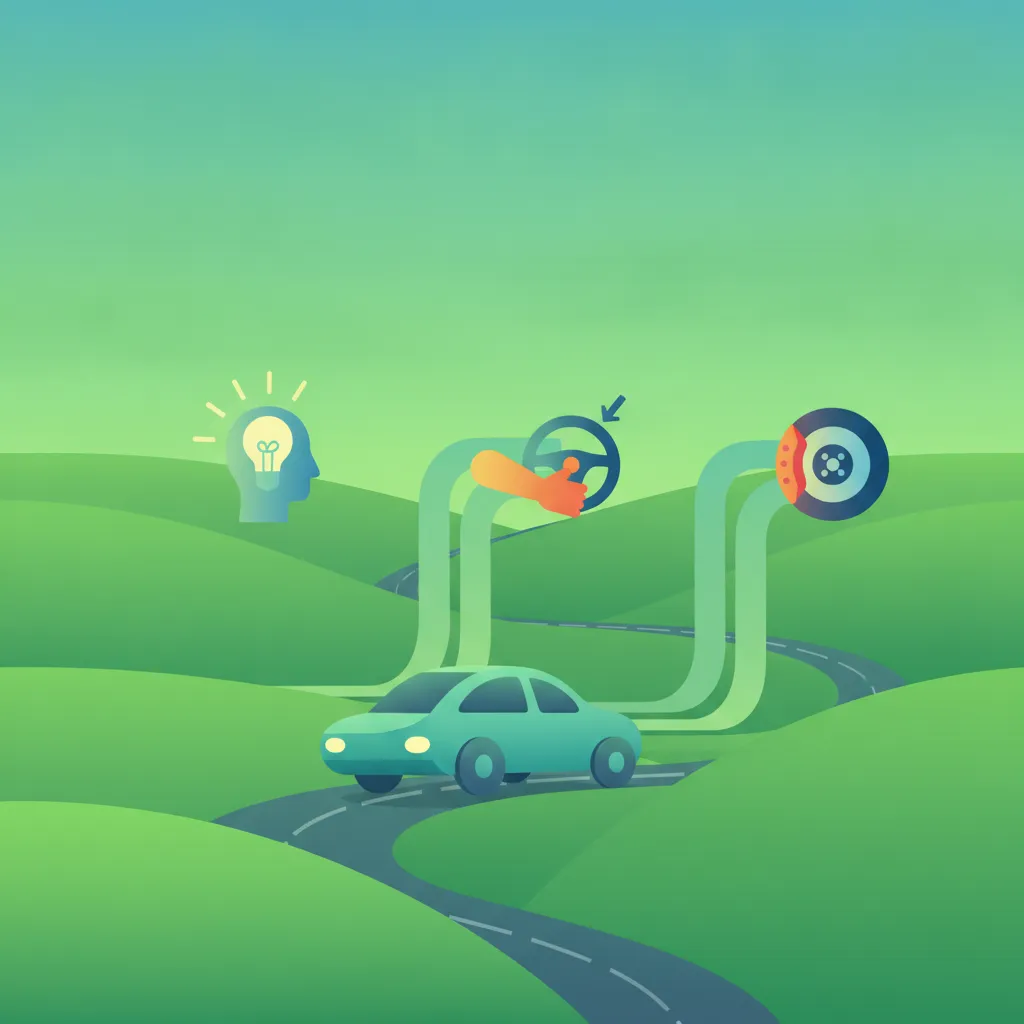
To truly understand stopping distance, especially for the Irish Driver Theory Test, we must consider the distinct stages involved:
This is the initial phase, often overlooked but crucial. It's the time it takes for your eyes to see a potential hazard and for your brain to recognise it as a threat requiring action. According to the RSA's Rules of the Road, this perception time can range from 0.25 to 0.5 seconds. During this time, your vehicle continues to travel forward, covering a certain perception distance. Factors like fatigue, distraction, poor vision, or complex traffic situations on Irish roads can significantly extend this period.
Once you've perceived and recognised the hazard, reaction time is the duration it takes for you to physically respond by moving your foot from the accelerator pedal to the brake pedal. The Rules of the Road indicate that a driver's reaction time can vary from 0.25 to 0.75 seconds, and in certain circumstances (e.g., impaired judgment), it can be as long as 1.5 seconds. The distance your vehicle covers during this period, before the brakes even begin to engage, is your reaction distance. This combines both perception and physical reaction.
This is the distance your vehicle travels from the moment you apply the brakes until it comes to a complete standstill. Unlike reaction distance, which is primarily human-dependent, braking distance is heavily influenced by physical factors such as speed, road surface, tyre condition, and the vehicle's braking system.
Total Stopping Distance = Perception Distance + Reaction Distance + Braking Distance
Misjudging stopping distance is a leading cause of collisions, particularly rear-end crashes, which are common on busy Irish motorways and urban routes. For learner drivers, a solid grasp of this concept is fundamental for:
Rules of the Road Ireland.One of the most crucial lessons from the RSA is that stopping distance does not increase linearly with speed. It rises dramatically:
This exponential relationship is why exceeding speed limits, even slightly, significantly reduces your ability to stop in time to avoid an unexpected hazard.
Beyond speed, several other factors critically impact your ability to stop, requiring Irish drivers to constantly adapt:
The Irish Driver Theory Test often probes common misunderstandings related to stopping distance:
Consider these practical examples on Irish roads:
Learners often struggle with:
The practical application of understanding stopping distance is the ability to maintain a safe following distance. The RSA strongly advises:
Always remember that these are minimums. Your own perception, vehicle condition, and the specific hazards of the road must influence your chosen following distance.
Stopping distance is a dynamic concept, not a fixed number. For safe driving in Ireland and success in your Driver Theory Test, always:
Start with a short, direct summary of Stopping Distance Explained before reading the full explanation below.
Stopping distance is the total distance a vehicle travels from a driver's perception of a hazard to the vehicle's complete stop. It comprises perception time, reaction time (distance covered before braking), and braking distance (distance covered while braking). Factors like speed, road conditions, and driver alertness significantly increase this distance, making ample following distance essential, especially in Ireland's varied weather.
Review the most important terms, rule signals, and traffic concepts linked to Stopping Distance Explained.
Explore related theory topic pages connected to Stopping Distance Explained and continue with the next useful rule explanation.
See the common search queries learners use when trying to understand Stopping Distance Explained in Ireland.

After reviewing core Irish driving theory topics, test your understanding with comprehensive practice questions. Apply your knowledge of road rules, signs, and traffic laws to scenarios mirroring the official Driver Theory Test. Solidify your learning and prepare effectively for your exam.
Irish Driving Theory TopicsTheory topic content overview
Start with a short, direct summary of Stopping Distance Explained before reading the full explanation below.
Stopping distance is the total distance a vehicle travels from a driver's perception of a hazard to the vehicle's complete stop. It comprises perception time, reaction time (distance covered before braking), and braking distance (distance covered while braking). Factors like speed, road conditions, and driver alertness significantly increase this distance, making ample following distance essential, especially in Ireland's varied weather.
Review the most important terms, rule signals, and traffic concepts linked to Stopping Distance Explained.
Explore related theory topic pages connected to Stopping Distance Explained and continue with the next useful rule explanation.
See the common search queries learners use when trying to understand Stopping Distance Explained in Ireland.
After reviewing core Irish driving theory topics, test your understanding with comprehensive practice questions. Apply your knowledge of road rules, signs, and traffic laws to scenarios mirroring the official Driver Theory Test. Solidify your learning and prepare effectively for your exam.
Irish Driving Theory TopicsUse this exam-focused revision tip to understand how Stopping Distance Explained is likely to appear in theory questions for learners in Ireland. This section helps you identify the most testable part of the rule, avoid common traps, and remember the concept more effectively during Irish driving theory exam preparation.
A common mistake in the Irish Driver Theory Test is underestimating how much speed affects stopping distance. Remember, a small increase in speed leads to a much larger increase in braking distance. Always account for both your reaction time and the vehicle's braking capability, especially in adverse Irish weather conditions like rain.
Read direct answers to the most common learner questions about Stopping Distance Explained in Ireland. This FAQ focuses on rule confusion, practical meaning, comparison with similar concepts, and the exact uncertainties that appear most often in Irish driving theory revision and exam preparation.
In Irish driving theory, stopping distance is the total distance your vehicle travels from the moment you recognise a hazard until your vehicle comes to a complete halt. It includes both reaction and braking phases.
Reaction distance is the distance your vehicle travels while you perceive the hazard and move your foot to the brake pedal. Braking distance is the distance your vehicle travels from the moment you apply the brakes until it stops.
Stopping distance increases disproportionately with speed. While reaction distance increases linearly, braking distance increases roughly with the square of your speed. Doubling your speed can multiply your braking distance by nearly four times, as highlighted in the RSA's Rules of the Road.
Factors such as fatigue, distraction (e.g., mobile phone use), alcohol or drugs, and even strong emotions can significantly lengthen a driver's perception and reaction times, increasing the overall stopping distance.
The RSA's 'Rules of the Road' provides illustrative tables for minimum stopping distances under dry and wet conditions. While specific numbers exist, the Irish Driver Theory Test primarily focuses on understanding the *factors* and *relationship* between speed and stopping distance, rather than memorising exact figures.
A solid understanding of stopping distance, its components, and influencing factors is crucial for the Irish Driver Theory Test because it underpins questions related to hazard perception, safe following distances, and adjusting speed for conditions, which are critical for safe driving.
Use the practice question search tool to pinpoint specific topics, road signs, or rules you need to master for your official Driver Theory Test. Refine your study strategy and ensure comprehensive preparation for all aspects of the Irish driving exam. Start your focused revision now and build confidence for your learner permit test.