
This lesson teaches you how to effectively manage your speed when operating a moped or light quadricycle in busy urban settings. Building on your understanding of vehicle control, you will learn to adjust your riding style based on visibility, traffic density, and road hazards. Mastering these skills is essential for passing your Category AM theory exam and staying safe on Portuguese roads.

Lesson content overview
Operating a moped or light quadricycle in a bustling urban environment requires more than simply adhering to posted speed limits. Effective speed management is a fundamental skill for all Category AM riders in Portugal, enabling safe navigation through complex and dynamic cityscapes. This lesson delves into the crucial principles that govern safe speed selection, emphasizing that the "maximum permissible speed" is rarely the "safest" speed. By understanding and applying these concepts, you will enhance your safety, reduce the risk of collisions, and contribute to smoother traffic flow for everyone.
Urban environments present a unique set of challenges due to their inherent complexity. High traffic density, frequent pedestrian activity, numerous intersections, parked vehicles, and varying road conditions all contribute to a dynamic landscape where hazards can emerge rapidly. For Category AM riders, who are more vulnerable than occupants of larger vehicles, precise speed management is not just a recommendation—it is a critical aspect of defensive riding and collision avoidance.
The core objective of astute speed management is to ensure you always have sufficient time and distance to react to unforeseen events and bring your vehicle to a complete stop safely. This proactive approach minimizes the chances of sudden braking, skidding, or striking obstacles or vulnerable road users. Ignoring these principles can lead to increased accident risk, severe injuries, and legal penalties.
One of the most critical principles in urban speed management is the concept of adequate stopping distance. This refers to the total distance your moped or light quadricycle travels from the moment you perceive a hazard to the point where your vehicle comes to a complete stop. It is comprised of two distinct components:
Perception-Reaction Distance: This is the distance your vehicle travels during the time it takes for you to:
Braking Distance: This is the distance your vehicle covers from the moment you begin applying the brakes until it completely stops. This distance is heavily influenced by:
Practical Implications: You must always ride at a speed that allows you to stop safely within the distance you can clearly see ahead. This means if you can only see 20 meters ahead, your speed must be low enough to stop your moped or light quadricycle within those 20 meters, taking into account both your reaction time and the vehicle's braking capability. This rule applies universally, regardless of the posted speed limit.
The visibility-based speed adjustment principle dictates that your speed must always be chosen such that you can stop your vehicle within the stretch of road that you can see to be clear and free of obstruction. This principle is especially vital in urban areas where lines of sight are frequently compromised.
Many elements common in urban settings can limit your forward visibility:
Adverse weather conditions further reduce your ability to see and react, compounding the need for speed reduction:
Common Misunderstanding: Many riders mistakenly believe that as long as they are within the posted speed limit, their speed is safe. This is incorrect. The maximum allowable speed sign does not account for limited visibility, dense traffic, or poor weather; these factors always necessitate a reduction in speed below the legal maximum.
Traffic density consideration involves adjusting your speed in response to the volume of vehicles, pedestrians, and cyclists around you. Urban centers are dynamic environments where the sheer number of road users can change rapidly, requiring constant vigilance and speed adaptation.
In congested city areas, maintaining lower speeds is crucial for several reasons:
Urban areas often feature significant pedestrian activity, particularly in shopping districts, near schools, or market squares.
Anticipatory driving is a proactive technique where you constantly assess the road environment and predict potential hazards, adjusting your speed before a dangerous situation fully develops. Instead of reacting sharply to sudden events, you prepare for them, making your riding smoother, safer, and more efficient.
This involves recognizing cues that indicate an upcoming change in conditions or a potential hazard:
In traffic, anticipatory driving also means maintaining a safe following distance and looking for potential gaps or conflicts further ahead, not just at the vehicle immediately in front. This allows you to adjust your speed smoothly to maintain flow rather than having to brake hard and accelerate frequently.
By embracing anticipatory driving, you transform from a reactive rider into a proactive manager of your journey, significantly reducing stress and enhancing overall safety for yourself and others.
The Portuguese Road Code (Código da Estrada) emphasizes that while speed limits set the legal maximum, the actual safe speed depends on prevailing conditions. For Category AM riders, adherence to these principles is mandatory.
Understanding the rules is the first step; applying them correctly is paramount. Here are common errors in urban speed management and how Category AM riders can avoid them:
Continuing at the Posted Limit Despite Obstructed View:
Rushing Towards a Pedestrian Crossing:
Maintaining Speed in Heavy Traffic with Insufficient Gaps:
Accelerating Through a Bend Before Checking the Line of Sight:
Failing to Anticipate a Traffic Light Change:
The "appropriate speed" is a dynamic concept, influenced by numerous contextual factors that Category AM riders must continuously assess:
Understanding the science behind speed management reinforces why these principles are so critical:
Here are a few real-world examples demonstrating how speed management principles apply to Category AM riders:
Scenario: You are approaching a residential street corner in Lisbon, and several large vehicles are parked close to the intersection, completely blocking your view of cross-traffic and the pavement beyond.
Scenario: You are riding your moped through a bustling market square in Porto on a Saturday morning. There are many shoppers, vendors, and children moving around, occasionally stepping into the vehicle path.
Scenario: It's nighttime, and you are riding your light quadricycle on a dimly lit street in a Portuguese town. The streetlights are sparse, and your dipped headlights offer limited illumination ahead. An oncoming vehicle has bright headlights that momentarily reduce your forward vision.
Mastering speed management in urban environments is one of the most vital skills for any Category AM rider in Portugal. It transcends mere compliance with speed limits, demanding a deeper understanding of road dynamics and rider responsibility.
By diligently applying these principles, Category AM riders can navigate Portugal's urban landscapes with confidence, significantly reducing collision risk, promoting smoother traffic flow, and ensuring a safer environment for everyone.
Explore all units and lessons included in this driving theory course.
Lesson content overview
Explore all units and lessons included in this driving theory course.
Explore search topics learners often look for when studying Speed Management in Urban Environments. These topics reflect common questions about road rules, driving situations, safety guidance, and lesson level theory preparation for learners in Portugal.
Browse additional driving theory lessons that cover connected traffic rules, road signs, and common driving situations related to this topic. Improve your understanding of how different rules interact across everyday traffic scenarios.
Learn how obstructed views, parked vehicles, and adverse weather in Portuguese cities necessitate lower speeds. Understand the critical 'clear distance ahead' rule for safe urban riding and collision avoidance.

This lesson provides actionable strategies for riders to increase their visibility to other motorists. It details the effectiveness of wearing brightly colored or reflective clothing and explains the correct use of vehicle lights, including daytime running lights. The content also covers how strategic lane positioning can help a rider remain conspicuous and avoid being overlooked in complex traffic situations.
This lesson introduces the core principles of defensive riding as applied to small, vulnerable vehicles. It teaches riders how to create and maintain a 'space cushion' around them, anticipate the actions of other drivers, and identify potential hazards early. Key techniques such as effective scanning, maintaining a safe following distance, and planning escape routes are explained in detail.

This lesson teaches riders how to assess and adapt to the increased risks associated with adverse weather and road conditions. It explains how rain reduces tire grip and visibility, requiring lower speeds and gentler control inputs. The content also provides advice for dealing with other challenging conditions such as strong crosswinds, fog, and road surface hazards like potholes or gravel.

This lesson specifically addresses the significant danger posed by the blind spots of larger vehicles. It identifies the 'no-zones' around trucks and buses where a moped can become invisible to the driver. The content provides clear instructions on how to manage lane position, avoid lingering in blind spots, and execute overtaking maneuvers safely to ensure visibility.

This lesson focuses on the optimal use of reflective materials and lighting systems to enhance rider safety. It explains how to apply reflective elements to clothing, helmets, and the vehicle for maximum effect in low-light conditions. Furthermore, it reviews the legal requirements and proper function of headlights, tail lights, and indicators to ensure compliance and improve detectability.

This lesson provides detailed guidance for riding in challenging weather conditions. It explains how rain affects braking distances and tire grip, and the importance of using lights correctly in fog to be seen. The content also offers practical advice on appropriate waterproof and high-visibility gear, as well as how strong winds can affect the stability of a lightweight vehicle.
This lesson explains the concept of road hierarchy in Portugal and clarifies which roads are accessible to Category AM vehicles. It focuses on the legal prohibitions against using motorways and expressways due to vehicle speed and power limitations. Understanding these operational constraints is crucial for legal compliance and safe route planning, avoiding dangerous traffic environments.
This lesson focuses on the psychological aspects of safe riding, helping riders recognize and manage high-risk behaviors. It discusses the dangers of distraction, particularly from mobile phones, and the influence of peer pressure and overconfidence. The content encourages the development of a mature risk assessment mindset and emphasizes the importance of riding only when physically and mentally fit.

This lesson addresses the specific hazards associated with riding next to rows of parked vehicles. It highlights the primary risk of car doors being opened unexpectedly ('dooring') and teaches riders to maintain a safe lateral distance. The content also explains how to anticipate other dangers, such as cars pulling out without warning or pedestrians emerging from between vehicles.

This lesson explains the function of warning signs, which are designed to alert drivers to potential dangers ahead. It covers a wide range of signs indicating hazards like sharp bends, slippery surfaces, and the presence of schools or pedestrian crossings. The content stresses the importance of adjusting speed and increasing alertness in response to these warnings to maintain safety.
Understand how to adjust your speed for dense city traffic, pedestrian activity, and vulnerable road users in Portugal. This lesson covers anticipatory driving techniques for safer urban navigation on AM vehicles.
This lesson focuses on the specific skills required for driving on high-speed motorways. It details the procedures for safely merging onto and exiting the motorway, maintaining proper lane discipline, and adhering to variable speed limits. The content also provides rules for safe overtaking and managing the vehicle's stability at high speeds.

This lesson teaches the crucial skill of selecting a safe and appropriate speed that considers the prevailing conditions. It explains why the legal speed limit is often not the safest speed in adverse weather, heavy traffic, or poor visibility. Drivers will learn to assess the environment and modify their speed to maintain control and allow for adequate stopping distance.
This lesson teaches riders how to assess and adapt to the increased risks associated with adverse weather and road conditions. It explains how rain reduces tire grip and visibility, requiring lower speeds and gentler control inputs. The content also provides advice for dealing with other challenging conditions such as strong crosswinds, fog, and road surface hazards like potholes or gravel.
This lesson explains the concept of road hierarchy in Portugal and clarifies which roads are accessible to Category AM vehicles. It focuses on the legal prohibitions against using motorways and expressways due to vehicle speed and power limitations. Understanding these operational constraints is crucial for legal compliance and safe route planning, avoiding dangerous traffic environments.

This lesson provides essential safety guidance for interacting with large vehicles like buses and trucks. It emphasizes the importance of staying out of their extensive blind spots and allowing extra space due to their long stopping distances and wide turning circles. The content also offers advice on how to safely overtake such vehicles and navigate around public transport stops.

This lesson provides a detailed explanation of traffic light signals and the correct response for each color. It covers the standard red, amber, and green sequence, as well as special signals like flashing amber lights and green filter arrows for turning. The content emphasizes the importance of anticipating signal changes and being prepared to stop safely, especially for a vulnerable rider.
This lesson focuses on safe interaction with cyclists on the road. It covers the identification of dedicated bicycle lanes and the rules regarding cyclist priority in various situations. Key topics include maintaining a safe lateral distance when overtaking cyclists and the importance of checking blind spots for them before turning or changing lanes.

This lesson provides a detailed overview of the legal requirements and safe driving practices for school zones and pedestrian crossings. It covers mandatory speed limits, the meaning of various signs and signals, and the importance of yielding to pedestrians. The content stresses heightened awareness due to the unpredictable nature of children's behavior near roads.
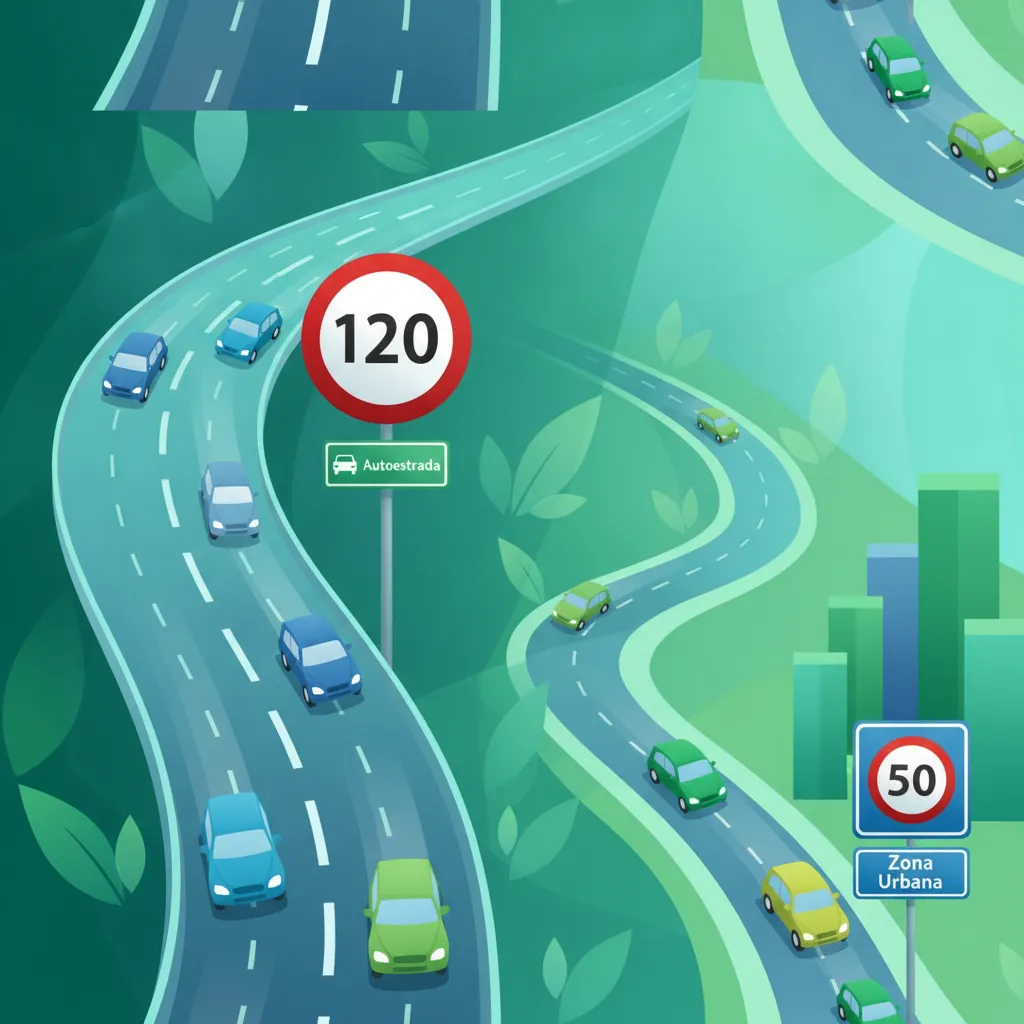
This lesson provides a clear overview of the statutory speed limits applicable on various types of roads in Portugal. It covers the default limits for built-up areas, single carriageways, dual carriageways, and motorways. Understanding these legal maximums is the first step in managing speed effectively and avoiding penalties for speeding.

This lesson addresses the specific challenges of driving alongside motorcyclists and large vehicles such as trucks and buses. It highlights the reduced visibility of motorcyclists and the extensive blind spots (no-zones) around heavy vehicles. Drivers will learn to provide extra space, anticipate wide turns, and adjust for factors like spray and wind turbulence.
Find clear answers to common questions learners have about Speed Management in Urban Environments. Learn how the lesson is structured, which driving theory objectives it supports, and how it fits into the overall learning path of units and curriculum progression in Portugal. These explanations help you understand key concepts, lesson flow, and exam focused study goals.
Yes, standard speed limits generally apply to all motor vehicles in urban areas unless specifically signed otherwise, but you must always adjust your speed based on your vehicle's stability, current traffic conditions, and your ability to stop safely.
Understanding stopping distance is critical because your reaction time and the vehicle's braking efficiency determine your safety. In the exam, you may be asked to calculate or estimate how speed affects the total distance needed to stop, which helps you understand the dangers of speeding.
Many learners assume that as long as they are at or below the posted speed limit, they are driving safely. The exam often presents scenarios where you must choose a lower speed due to rain, heavy traffic, or poor visibility to ensure safety.
High traffic density increases the risk of sudden stops, pedestrian crossings, and vehicle door openings. You must maintain a speed that allows for immediate reaction to these unpredictable events to comply with both the law and safe riding standards.
Utilize the powerful search tool to refine your Portuguese driving theory practice. Pinpoint questions related to specific traffic laws, road signs, or complex scenarios from the Código da Estrada. Begin targeted revision now to boost your understanding and confidently approach your IMT driving exam.