This lesson explores the specific challenges of night driving, focusing on visibility, lighting rules, and managing glare from oncoming vehicles. As part of our Category B course, it helps you prepare for theory exam questions on safe driving at night and builds practical awareness for real-world road conditions.
Lesson content overview
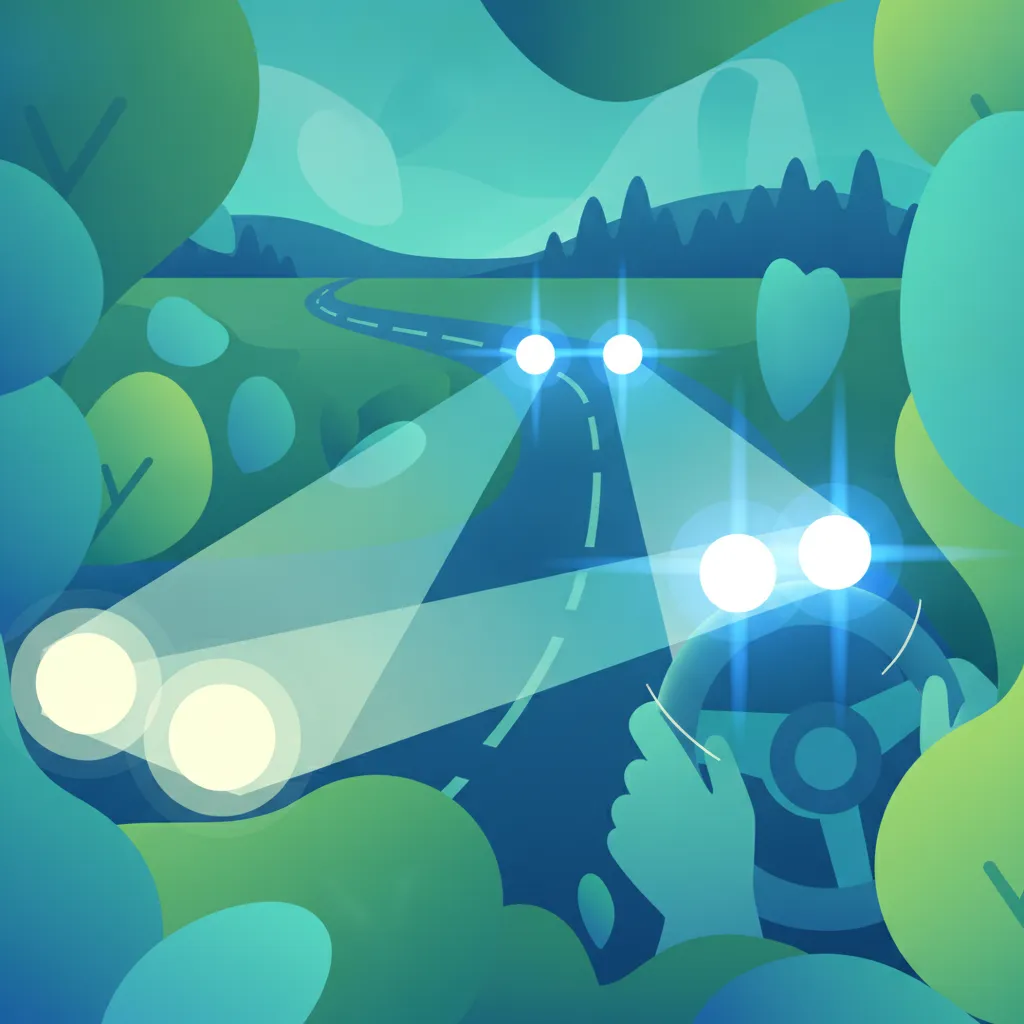
Driving after dark presents a unique set of challenges that demand heightened awareness, specific techniques, and strict adherence to regulations. Reduced visibility, the dazzling effect of other vehicles' lights, and the decreased conspicuity of hazards like pedestrians or animals all contribute to a higher risk environment. This lesson, part of your Portuguese Driving Theory – Category B Comprehensive Course, provides a comprehensive guide to navigating nocturnal roads safely, covering proper headlamp usage, effective glare management, and strategies for detecting less visible hazards. Mastering these skills is crucial for your safety and the safety of all road users.
When the sun sets, the driving environment undergoes a significant transformation. Our visual range is drastically reduced, and the absence of natural light means we rely entirely on artificial illumination, primarily our vehicle's headlights and street lighting. This shift fundamentally alters how we perceive distances, identify potential hazards, and react to changing road conditions. The human eye struggles to adapt quickly between extreme light and dark, making it vulnerable to glare and temporary blindness. Recognizing these inherent difficulties is the first step towards becoming a safer night driver.
Your vehicle's lighting system is your most critical tool for safe night driving. Understanding the difference between dipped and main beams, and knowing when to use each, is not just good practice but a legal obligation under the Código da Estrada. Proper headlamp usage ensures you illuminate the road effectively without endangering other drivers through glare.
Dipped beams, also known as low beams, are your primary headlights for general night driving. They provide a broad, relatively short-range spread of light designed to illuminate the road ahead without blinding oncoming drivers or dazzling drivers you are following. In urban areas with street lighting, or in conditions with reduced visibility such as heavy rain or fog, dipped beams are typically sufficient and, in many cases, legally mandated.
Main beams, or high beams, offer a more focused, longer-range, and brighter illumination. They are designed for use on open roads, especially rural or unlit highways, where there is no oncoming traffic and no vehicles ahead within a certain distance. The purpose of main beams is to extend your visual range, allowing you to spot hazards far sooner than with dipped beams alone.
However, the powerful light of main beams can be extremely dazzling to other drivers. Incorrect use is not only dangerous but carries legal penalties. It is essential to understand the precise conditions under which main beams are permitted.
The Código da Estrada, Portugal's road code, clearly outlines when and how to use your headlights. The core principle is to provide optimal illumination while preventing glare for other road users. This requires constant vigilance and quick decision-making.
When driving at night, your dipped beams should always be active. Main beams should only be engaged when:
Glare is one of the most significant challenges of night driving. It can temporarily impair your vision, reduce your peripheral awareness, and significantly increase your reaction time, making even minor hazards much more dangerous. Effective glare management involves both proactive measures and reactive techniques.
Glare is defined as visual impairment caused by excessive light that overwhelms the eye's adaptation to darkness. It can stem directly from the headlights of oncoming vehicles or be reflected from surfaces like wet roads, signage, or even your own windscreen. When exposed to glare, your pupils constrict rapidly, and it takes time for them to readjust to the surrounding darkness once the glare source is gone, leading to a temporary "blind spot" effect.
This is perhaps the most critical aspect of glare management. As soon as you perceive an oncoming vehicle, you must switch from your main beams to your dipped beams. The timing is crucial:
It is equally important to dip your main beams when you are following another vehicle. Maintaining main beams behind another car will dazzle the driver ahead through their rear-view mirror, making it difficult for them to see the road clearly and potentially causing them to lose control.
The rule of thumb is to switch to dipped beams as soon as you are within a distance where your main beams could reflect into the rear-view mirror of the car in front. This is generally when you are within the safe following distance, or when your headlights clearly illuminate the vehicle ahead.
Sometimes, glare can be caused or exacerbated by your own vehicle. For instance, if your headlights are misaligned, they might throw light upwards, blinding oncoming drivers even when on a dipped setting. Wet road surfaces are notorious for reflecting light, turning even dipped beams into significant glare sources for all drivers.
Tips for Self-Glare Mitigation:
Pedestrians, cyclists, and animals are significantly less visible at night, making them particularly vulnerable. They may not wear reflective clothing, and their presence can be masked by shadows, poor street lighting, or the glare from other vehicles. This demands a proactive approach from drivers, including reduced speed and heightened vigilance.
Just as you dip your lights for other drivers, it's a critical safety measure to protect pedestrians and cyclists from glare. Their eyes are just as susceptible to dazzling, and temporary visual impairment could cause them to stumble, veer into the road, or lose their balance, especially if they are already navigating uneven surfaces or traffic.
When you see pedestrians or cyclists on the side of the road, or approaching a crossing:
The reduced visibility at night means you must actively scan for hazards that would be obvious in daylight. This includes not only people and animals but also potholes, debris, parked vehicles, and road markings.
Strategies for Hazard Detection:
The Código da Estrada contains specific articles governing vehicle lighting and driver conduct at night. Compliance is mandatory and crucial for preventing accidents and avoiding penalties.
The core regulation states that main beams must be dipped when they could cause glare to oncoming traffic or to vehicles you are following. While specific distances can vary slightly based on interpretation and enforcement, the general principle is to act early to ensure safety.
In built-up areas with sufficient street lighting, main beams are generally prohibited. Dipped beams are always the default for urban driving at night.
The Código da Estrada also mandates that all vehicle lighting systems must be correctly maintained and in good working order. This includes:
A fundamental principle of Portuguese driving law is the "duty of care." This includes adjusting your speed to suit prevailing conditions, particularly when visibility is reduced. At night, even on a road where the daytime speed limit is high, you must reduce your speed if your visibility is limited by darkness, lack of streetlights, or weather conditions. Your speed should always allow you to stop safely within the distance you can see clearly ahead.
Understanding typical errors can help you avoid them:
Night driving is not a uniform experience. Various factors can drastically alter visibility and the effectiveness of your lighting.
An overloaded vehicle, or one with a heavily loaded boot, can cause the rear of the vehicle to sag and the front to lift. This upward tilt can misalign your headlights, causing them to project higher and potentially dazzle oncoming drivers, even on a dipped setting. If you frequently carry heavy loads, consider having your headlamps checked and adjusted, or ensure your vehicle's self-levelling system (if present) is functioning correctly.
Our eyes are complex instruments, but they have limitations, especially at night.
Night driving is an unavoidable part of driving for many. By diligently practicing correct headlamp usage, mastering glare management techniques, and remaining highly vigilant for less visible hazards, you can significantly enhance your safety and the safety of everyone on Portuguese roads after dark. Remember that maintaining your vehicle's lighting system is as important as knowing how to use it. Stay focused, anticipate hazards, and adapt your driving to the unique demands of the night.
Explore all units and lessons included in this driving theory course.
Lesson content overview
Explore all units and lessons included in this driving theory course.
Explore search topics learners often look for when studying Night Driving and Glare Management. These topics reflect common questions about road rules, driving situations, safety guidance, and lesson level theory preparation for learners in Portugal.
Browse additional driving theory lessons that cover connected traffic rules, road signs, and common driving situations related to this topic. Improve your understanding of how different rules interact across everyday traffic scenarios.
Understand the critical rules for using dipped and main beams at night according to the Portuguese Código da Estrada. Learn strategies to manage headlight glare and improve visibility for safer driving after dark.

Night riding presents unique visual challenges and increased fatigue. This lesson covers proper headlight usage, including high and low beam settings, along with the importance of reflective gear for visibility. It also addresses eye fatigue, glare from oncoming lights, and strategies for managing rider alertness and speed to navigate safely at night.

This lesson details the functions of the various lights on a vehicle and the regulations governing their use. It explains the appropriate conditions for using dipped headlights, main beams, and fog lights to maximize visibility without dazzling other road users. The correct use of indicators and hazard warning lights as communication tools is also thoroughly covered.

This lesson focuses on the optimal use of reflective materials and lighting systems to enhance rider safety. It explains how to apply reflective elements to clothing, helmets, and the vehicle for maximum effect in low-light conditions. Furthermore, it reviews the legal requirements and proper function of headlights, tail lights, and indicators to ensure compliance and improve detectability.

This lesson examines strategies to maximize rider visibility in various lighting conditions. It covers the proper use of daytime running lights, high-visibility clothing, and reflective strips, as well as maintaining headlight performance. Effective signaling and rider positioning are also discussed to enhance visibility to other road users.

This lesson focuses on adapting driving techniques for wet and foggy conditions, which significantly reduce visibility and tyre grip. It explains the phenomenon of aquaplaning and how to avoid it by reducing speed and ensuring proper tyre condition. The correct use of headlights, fog lights, and increasing following distances are presented as essential safety measures.
This lesson explains how adverse weather conditions like rain and fog compromise visibility and vehicle control. It provides clear guidance on reducing speed, increasing following distance, and using lights and wipers effectively. The content also covers the phenomenon of hydroplaning and how to prevent loss of traction on wet roads.
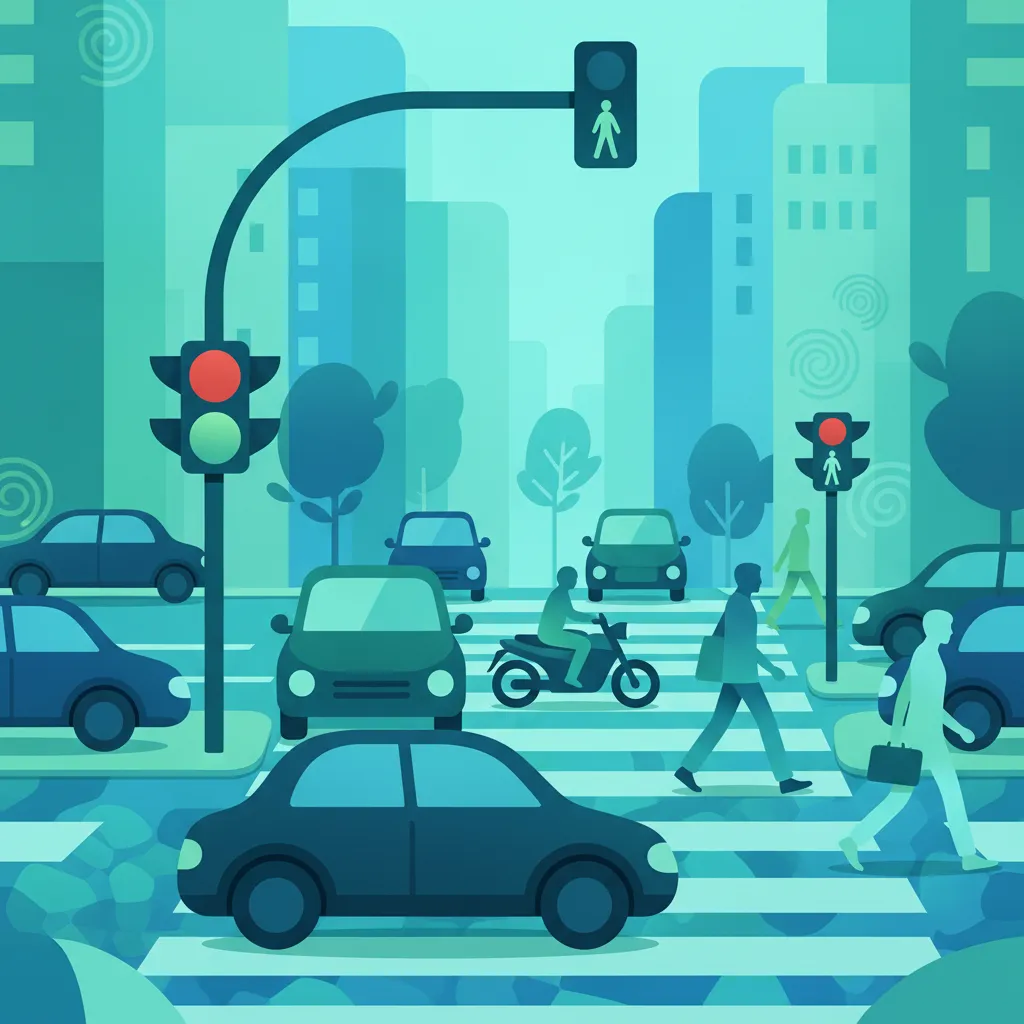
This lesson details the universal system of traffic light signals and their specific applications in Portugal. It clarifies the meaning of red, amber, and green lights, as well as flashing signals and directional arrows that control turning movements. Correctly interpreting these signals is fundamental for safely navigating controlled intersections and ensuring smooth traffic flow.
This lesson provides actionable strategies for riders to increase their visibility to other motorists. It details the effectiveness of wearing brightly colored or reflective clothing and explains the correct use of vehicle lights, including daytime running lights. The content also covers how strategic lane positioning can help a rider remain conspicuous and avoid being overlooked in complex traffic situations.
This lesson explains how to correctly set up and use the complex mirror systems on a modern HGV to minimize blind spots. It also covers the operation of technological aids like reversing cameras, proximity sensors, and blind spot information systems. Drivers learn that these systems are aids, not replacements for all-around observation.
This lesson details the rules of lane discipline and the procedures for safe overtaking. It explains how to maintain correct lane positioning and how road markings and signs define where overtaking is allowed or forbidden. The lesson emphasizes the importance of the mirror-signal-manoeuvre routine and ensuring sufficient space and visibility before attempting to pass another vehicle.
Learn how to identify and react to hidden hazards at night, including vulnerable road users like pedestrians and cyclists. Understand why reducing speed is crucial for effective hazard perception in darkness.
This lesson teaches the crucial skill of selecting a safe and appropriate speed that considers the prevailing conditions. It explains why the legal speed limit is often not the safest speed in adverse weather, heavy traffic, or poor visibility. Drivers will learn to assess the environment and modify their speed to maintain control and allow for adequate stopping distance.

This lesson provides a detailed overview of the legal requirements and safe driving practices for school zones and pedestrian crossings. It covers mandatory speed limits, the meaning of various signs and signals, and the importance of yielding to pedestrians. The content stresses heightened awareness due to the unpredictable nature of children's behavior near roads.
Night riding presents unique visual challenges and increased fatigue. This lesson covers proper headlight usage, including high and low beam settings, along with the importance of reflective gear for visibility. It also addresses eye fatigue, glare from oncoming lights, and strategies for managing rider alertness and speed to navigate safely at night.
This lesson details the functions of the various lights on a vehicle and the regulations governing their use. It explains the appropriate conditions for using dipped headlights, main beams, and fog lights to maximize visibility without dazzling other road users. The correct use of indicators and hazard warning lights as communication tools is also thoroughly covered.
This lesson focuses on adapting driving techniques for wet and foggy conditions, which significantly reduce visibility and tyre grip. It explains the phenomenon of aquaplaning and how to avoid it by reducing speed and ensuring proper tyre condition. The correct use of headlights, fog lights, and increasing following distances are presented as essential safety measures.
This lesson introduces the principles of hazard perception, a key skill for proactive and defensive driving. It teaches techniques for systematically scanning the environment, identifying potential risks before they develop into immediate dangers, and planning escape routes. By improving their ability to anticipate the actions of others, drivers can significantly reduce their risk of being involved in a collision.
Focusing on warning signs, this lesson educates riders on anticipating hazards and adjusting riding behavior accordingly. It includes signs indicating curves, slippery surfaces, pedestrian crossings, roadworks, and other potential dangers. By learning to interpret these warnings, motorcyclists can proactively adjust speed and lane position to reduce accident likelihood.
This lesson addresses the specific challenges of driving alongside motorcyclists and large vehicles such as trucks and buses. It highlights the reduced visibility of motorcyclists and the extensive blind spots (no-zones) around heavy vehicles. Drivers will learn to provide extra space, anticipate wide turns, and adjust for factors like spray and wind turbulence.
This lesson focuses on safe interaction with cyclists on the road. It covers the identification of dedicated bicycle lanes and the rules regarding cyclist priority in various situations. Key topics include maintaining a safe lateral distance when overtaking cyclists and the importance of checking blind spots for them before turning or changing lanes.

This lesson introduces warning signs, designed to alert drivers to potential hazards ahead. It details the meanings of signs indicating sharp curves, steep hills, slippery surfaces, and the possible presence of pedestrians or animals. Proper interpretation of these signs allows drivers to adjust their speed and increase their vigilance to navigate potential dangers safely.
Find clear answers to common questions learners have about Night Driving and Glare Management. Learn how the lesson is structured, which driving theory objectives it supports, and how it fits into the overall learning path of units and curriculum progression in Portugal. These explanations help you understand key concepts, lesson flow, and exam focused study goals.
You must switch to dipped headlights whenever you are likely to dazzle other drivers, including when following a vehicle closely, when an oncoming vehicle approaches, or in well-lit urban areas.
Glare causes temporary blindness and fatigue, significantly increasing your reaction time because it takes longer to identify hazards on the road. The theory exam often tests your awareness of this reduction in visual performance.
Yes, you must exercise extreme caution. Pedestrians are harder to see in low light, especially when wearing dark clothing, and you should always be prepared to slow down near crossings or unlit rural roads.
No, you must only use fog lights during periods of reduced visibility caused by fog, rain, or snow. Using them in clear conditions can dazzle other drivers and is a violation of the traffic rules.
Utilize the powerful search tool to refine your Portuguese driving theory practice. Pinpoint questions related to specific traffic laws, road signs, or complex scenarios from the Código da Estrada. Begin targeted revision now to boost your understanding and confidently approach your IMT driving exam.