
This lesson guides professional drivers on the critical safety procedures for interacting with cyclists and motorcyclists near passenger stops. It builds upon your understanding of urban traffic flow and vehicle dimensions to ensure you can protect vulnerable road users while operating a large passenger vehicle. Mastering these interactions is a core requirement for passing the Portuguese professional theory exam.
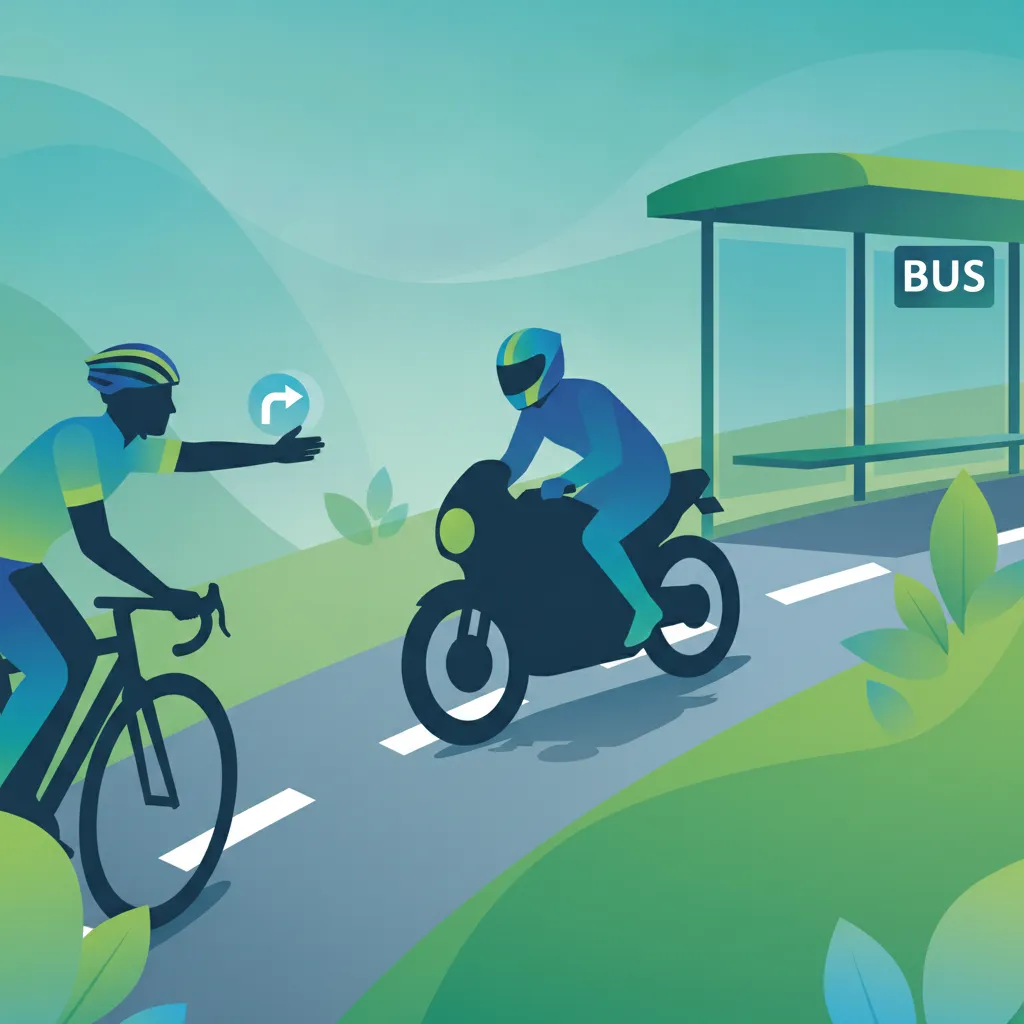
Lesson content overview
As a professional passenger vehicle driver in Portugal, operating large vehicles such as buses or coaches (Category D), your responsibility for road safety extends significantly to vulnerable road users. This lesson specifically addresses the critical interactions with cyclists and motorcyclists, particularly in dynamic environments like designated stops. These two-wheeled users present unique challenges due to their smaller size, varied speeds, and susceptibility to blind spots, demanding heightened awareness and adherence to specific safety protocols.
Understanding and applying defensive driving techniques in urban settings, especially around bus stops, is paramount. This includes mastering blind spot management, maintaining appropriate separation distances, and correctly interpreting right-of-way rules. By internalizing these principles, you contribute not only to your passengers' safety but also to the well-being of all road users, reflecting the high standards expected of professional drivers in Portugal.
Cyclists and motorcyclists, collectively known as two-wheeled road users, are inherently more vulnerable than occupants of larger vehicles. Their lack of protective enclosures means any collision can result in severe injuries or fatalities. This vulnerability is compounded by several factors, including their smaller visual profile, often inconsistent speeds, and the potential for rapid changes in direction.
Professional drivers of Category D vehicles must constantly anticipate the movements of these road users. This proactive approach is crucial, as the sheer size and weight of a bus or coach mean that even minor contact can have catastrophic consequences for a cyclist or motorcyclist. Developing a heightened sense of situational awareness and empathy for their position on the road is a cornerstone of safe driving.
Designated stops, particularly bus stops, represent specific high-risk zones for interaction between large passenger vehicles and two-wheeled users. In urban areas, these stops are often located where traffic is dense, speeds vary, and maneuvers like turning, stopping, and starting are frequent. Cyclists may use the space near the curb to bypass stationary traffic, pass buses, or even stop themselves, creating complex and unpredictable scenarios.
Public transport vehicles, by their nature, frequently decelerate, stop, and accelerate, often occupying a significant portion of the road. This dynamic movement, combined with the presence of cyclists attempting to maintain momentum or navigate around obstacles, creates a confluence of factors that necessitate extreme vigilance from the bus or coach operator. Recognizing these areas as critical points for potential conflict is the first step towards preventing incidents.
One of the most significant challenges for drivers of large vehicles, especially when interacting with cyclists and motorcyclists, is the presence of blind spots. These are areas around your vehicle that are not visible through mirrors or direct line of sight. Due to their compact size, two-wheeled users can easily disappear into these zones, making them undetectable if a driver relies solely on mirrors.
For professional Category D drivers, the blind spots of a bus or coach are extensive, covering significant areas to the front, sides, and rear. Near bus stops, these blind spots become particularly hazardous. A cyclist approaching from behind, riding alongside, or positioning themselves to pass a stationary bus can vanish from view just as a driver prepares to pull over or merge. Neglecting to thoroughly check these areas before any maneuver is a leading cause of collisions involving vulnerable road users.
Effective blind spot management is not merely a glance; it is a systematic procedure that must be ingrained into every professional driver's routine. It involves a combination of mirror usage and direct visual checks, often referred to as "shoulder checks" or "head turns."
Mirror Checks: Before any maneuver (lane change, turn, pulling over to a stop, or merging from a stop), systematically check all relevant mirrors: internal, left side, and right side. Observe for any approaching traffic, especially smaller vehicles.
Shoulder Check (Head Turn): Immediately following mirror checks, quickly and deliberately turn your head to glance over your shoulder in the direction of your intended maneuver. This directly verifies the area not covered by your mirrors. For large vehicles, this may involve checking multiple angles, particularly towards the rear-sides.
Anticipation and Repetition: Continuously scan your surroundings, especially in high-risk zones like urban intersections and bus stops. Be prepared to repeat blind spot checks if traffic conditions change or if there's any doubt about the presence of other road users.
Pre-Maneuver Assessment: Before even signaling your intention, assess potential hazards. If a cyclist or motorcyclist is approaching a blind spot area, adjust your speed or delay your maneuver until they are clearly visible and a safe path is assured.
An area around a vehicle that is not directly visible to the driver through the mirrors or by direct line of sight, typically where smaller vehicles like bicycles and motorcycles can be hidden.
When overtaking a cyclist or motorcyclist, maintaining an adequate lateral clearance is a critical safety requirement. This minimum distance ensures that the two-wheeled user has sufficient space to maintain stability, react to wind turbulence created by your larger vehicle, or make minor adjustments without being forced into an unsafe position. Insufficient clearance is a common cause of accidents and can lead to serious consequences.
In Portugal, as in many European countries, specific legal requirements govern the minimum lateral distance when overtaking cyclists and motorcyclists. This rule is designed to safeguard vulnerable road users and must be strictly adhered to by professional drivers.
The minimum lateral (side-to-side) space required between a motor vehicle and a cyclist or motorcyclist when the motor vehicle is passing them.
The standard guidance for safe overtaking distance for two-wheeled vehicles is at least 1.5 meters. This distance must be maintained from the outermost point of your vehicle to the outermost point of the cyclist or motorcyclist. While 1.5 meters is a general rule, professional drivers should always consider increasing this margin in adverse conditions, such as:
Remember, if you cannot safely maintain the required minimum distance, you must not overtake. Patience is a virtue, especially around vulnerable road users.
Bus stops are inherent areas of increased interaction and potential conflict. As a professional passenger vehicle driver, your procedures for stopping at and departing from these designated areas must prioritize safety for all, especially cyclists and motorcyclists who may be sharing the road space.
When approaching a bus stop, begin to reduce your speed well in advance. Signal your intention to pull over early, giving ample warning to all following traffic, including cyclists and motorcyclists. Before entering the stop, perform thorough mirror and blind spot checks to ensure no two-wheeled user is attempting to pass you on the side where you intend to pull over. Cyclists may ride close to the curb, sometimes intending to continue past the stationary bus or even to board.
Always activate your hazard warning lights (piscas de emergência) when stationary at a bus stop, especially if your vehicle creates an obstruction or partially blocks a lane. This clearly signals your presence and temporary stop to following traffic.
One of the most crucial rules for Category D drivers in Portugal relates to bus stop priority. When a bus or similar public transport vehicle, having stopped at a designated stop, signals its intention to re-enter the flow of traffic, other vehicles must yield. This rule grants buses priority to pull out safely.
A legal rule granting public transport vehicles (like buses or coaches) priority to re-enter the traffic flow from a designated stop, requiring other vehicles to yield.
This means that drivers approaching a bus that is signaling to pull out from a stop must reduce speed, and if necessary, stop to allow the bus to merge safely. Overtaking a bus that is actively signaling its departure from a stop is prohibited and extremely dangerous. Always check your mirrors and blind spots again before pulling out, as cyclists or motorcyclists may have maneuvered behind or alongside your stationary vehicle.
Turning is a common maneuver that significantly increases the risk of collision with cyclists and motorcyclists if not executed with extreme care. At intersections and junctions, two-wheeled road users often share the same path or occupy adjacent spaces, making thorough checks and correct yielding crucial.
When making a turn, you must yield to cyclists who are proceeding straight through the intersection or who are already in the lane you intend to turn into. This is particularly relevant for right turns where a cyclist might be riding alongside you on your right, or for left turns where a cyclist might be approaching from the opposite direction or riding on your left.
Never assume a cyclist or motorcyclist will wait for your turn. Always actively check for their presence and yield if they have the right-of-way or if proceeding would create a hazardous situation.
Before initiating any turn, follow these steps:
Portugal's traffic laws (Código da Estrada) are designed to promote safety for all road users, with particular emphasis on vulnerable groups. Adherence to these regulations is mandatory for all drivers, especially professional Category D operators.
Safe interaction with cyclists and motorcyclists is not static; it constantly adapts to changing conditions. Professional drivers must factor in various environmental and situational elements to maintain the highest safety standards.
Adverse weather conditions significantly increase the risk of incidents with two-wheeled vehicles:
While drivers are expected to follow rules, cyclists and motorcyclists, like all road users, can sometimes make unexpected moves.
Failing to adhere to safe interaction protocols with cyclists and motorcyclists can lead to severe consequences, ranging from legal penalties to tragic accidents.
Common Violations and Their Dangers:
Cause-and-Effect Relationships:
Consider the following scenarios, applying the principles learned in this lesson.
Setting: You are driving your Category D vehicle on an urban street during the day. Ahead, you see a designated bus stop. There's a cyclist riding slowly along the curb towards the bus stop, just ahead of your vehicle. You intend to stop at the bus stop.
Correct Behavior:
Incorrect Behavior:
Setting: You are behind a bus that has just finished dropping off passengers at a stop and is now signaling its intention to pull out. There is also a cyclist slowly riding on the main lane to the left of the stationary bus. You are in the left lane, intending to continue straight.
Correct Behavior:
Incorrect Behavior:
Setting: You are approaching an intersection with your Category D vehicle, intending to make a right turn. A bus stop is located immediately after the turn, and as you approach, you notice a cyclist in the bike lane to your right, who appears to be going straight through the intersection.
Correct Behavior:
Incorrect Behavior:
Effectively interacting with cyclists and motorcyclists, especially near stops, is a hallmark of a responsible professional Category D driver. This lesson has highlighted several critical principles:
By consistently applying these principles, you will enhance safety for everyone on the road and uphold the professional standards required for Category D drivers in Portugal.
Explore all units and lessons included in this driving theory course.
Lesson content overview
Explore all units and lessons included in this driving theory course.
Explore search topics learners often look for when studying Cyclist and Motorcyclist Interaction Near Stops. These topics reflect common questions about road rules, driving situations, safety guidance, and lesson level theory preparation for learners in Portugal.
Browse additional driving theory lessons that cover connected traffic rules, road signs, and common driving situations related to this topic. Improve your understanding of how different rules interact across everyday traffic scenarios.
Explore advanced strategies for professional drivers on safely interacting with cyclists and motorcyclists. Covers complex scenarios, legal requirements for blind spot checks, and maintaining safe distances on Portuguese roads.
This lesson explores the various types of pedestrian crossings found in Portuguese urban areas, such as zebra crossings. It emphasizes the rider’s responsibility to yield to pedestrians, the importance of reducing speed, and maintaining a safe passing distance. Strategies for anticipating pedestrian behavior and ensuring visibility are discussed to prevent incidents.
This lesson addresses the heightened risk of interaction with pedestrians and cyclists around bus stops. It explains right-of-way regulations and the importance of vigilance, particularly when turning or pulling away from the curb. The content provides strategies for anticipating the actions of vulnerable road users to prevent conflicts.
This lesson focuses on the heightened duty of care professional drivers have towards vulnerable road users. It covers common conflict points, such as junctions and roundabouts, and teaches techniques for anticipating the actions of pedestrians, cyclists, and motorcyclists. Giving extra space and being prepared to stop are key themes.

This lesson addresses the specific challenges of driving alongside motorcyclists and large vehicles such as trucks and buses. It highlights the reduced visibility of motorcyclists and the extensive blind spots (no-zones) around heavy vehicles. Drivers will learn to provide extra space, anticipate wide turns, and adjust for factors like spray and wind turbulence.

This lesson explores the characteristics that define vulnerable road users, including children, the elderly, and cyclists. It explains how their physical and cognitive limitations can lead to unpredictable behavior on the road. The content focuses on developing a proactive mindset to identify and mitigate risks associated with these groups.

This lesson provides essential safety guidance for interacting with large vehicles like buses and trucks. It emphasizes the importance of staying out of their extensive blind spots and allowing extra space due to their long stopping distances and wide turning circles. The content also offers advice on how to safely overtake such vehicles and navigate around public transport stops.

This lesson emphasizes the development of defensive riding strategies through continuous risk assessment and situational awareness. It teaches techniques for scanning the environment, maintaining safe following distances, and anticipating potential hazards. The importance of a proactive riding attitude and creating safety margins is highlighted to promote a habit of anticipatory riding.
This lesson teaches a systematic approach to safely navigating intersections. It covers the importance of reducing speed on approach, conducting thorough visual checks (observation), and selecting the appropriate lane for the intended direction. The content also details how to assess gaps in traffic before proceeding and correctly apply priority rules to avoid conflicts with other vehicles.
This lesson focuses on safe interaction with cyclists on the road. It covers the identification of dedicated bicycle lanes and the rules regarding cyclist priority in various situations. Key topics include maintaining a safe lateral distance when overtaking cyclists and the importance of checking blind spots for them before turning or changing lanes.
This lesson introduces the core principles of defensive riding as applied to small, vulnerable vehicles. It teaches riders how to create and maintain a 'space cushion' around them, anticipate the actions of other drivers, and identify potential hazards early. Key techniques such as effective scanning, maintaining a safe following distance, and planning escape routes are explained in detail.
Understand critical Portuguese driving laws regarding bus stop priority and safe pulling out procedures. Learn to manage blind spots effectively to prevent collisions with cyclists and other vehicles.
This lesson addresses the heightened risk of interaction with pedestrians and cyclists around bus stops. It explains right-of-way regulations and the importance of vigilance, particularly when turning or pulling away from the curb. The content provides strategies for anticipating the actions of vulnerable road users to prevent conflicts.
This lesson explains the rules and etiquette for sharing the road with public transport vehicles like buses and trams. It covers the requirement to be cautious around bus stops, especially when passengers are boarding or alighting. A key focus is the legal obligation to yield to buses indicating their intention to pull out from a designated stop into the flow of traffic.
This lesson outlines the step-by-step process for safely approaching a bus stop, emphasizing speed control and correct positioning. It covers the importance of ensuring the vehicle is fully stationary before operating the doors. The content also details the safety checks required before departing the stop and merging back into the flow of traffic.
This lesson provides essential safety guidance for interacting with large vehicles like buses and trucks. It emphasizes the importance of staying out of their extensive blind spots and allowing extra space due to their long stopping distances and wide turning circles. The content also offers advice on how to safely overtake such vehicles and navigate around public transport stops.
This lesson explains the regulations governing the use of dedicated bus lanes, including operational hours and priority rules at junctions. It clarifies which other vehicles may use these lanes and under what circumstances. The content also discusses traffic signal priority systems and the legal implications of improper bus lane usage.

This lesson examines how bus priority measures, such as dedicated lanes and signal preemption, function in urban traffic. It teaches drivers how to utilize these systems effectively to maintain schedules and improve service reliability. The content also discusses how to navigate general traffic congestion when priority systems are not available.
This lesson explains the critical need for maintaining a safe following distance to compensate for the longer stopping time of a heavy vehicle. It introduces time-based following distance rules and describes how to adapt them for different speeds, road conditions, and weather. The content highlights the dangers of tailgating and provides strategies for proactive collision avoidance.
This lesson explains how the large dimensions of passenger vehicles influence their handling and maneuverability. It details the concept of turning radius and identifies the significant blind spots around the vehicle. The content emphasizes the critical importance of correct mirror adjustment to maximize visibility and reduce operational risks.
This lesson covers the identification of official bus stop signage and the procedures for stopping at designated locations. It explains the importance of precise positioning to ensure passenger safety during boarding and alighting. The content also links the placement of bus stops to route planning and maintaining a consistent timetable.
This lesson provides a comprehensive guide to understanding and mitigating the risks posed by blind spots. It details how to correctly adjust all mirrors to maximize the field of view. The content stresses the need for a continuous, systematic pattern of mirror checks combined with direct observation before any maneuver.
Find clear answers to common questions learners have about Cyclist and Motorcyclist Interaction Near Stops. Learn how the lesson is structured, which driving theory objectives it supports, and how it fits into the overall learning path of units and curriculum progression in Portugal. These explanations help you understand key concepts, lesson flow, and exam focused study goals.
According to the Portuguese Highway Code, you must leave at least 1.5 meters of lateral distance when overtaking a cyclist to ensure their safety and maintain stability.
Cyclists often filter through traffic to the left of a stationary or slow-moving bus. Before pulling away or turning left, you must perform a thorough mirror check to ensure no two-wheeled user is positioned in this high-risk area.
Generally, if a bus is already in the flow of traffic, priority rules apply. However, if the cyclist is already alongside the vehicle while you are at a stop, you must allow them to pass safely before pulling out, regardless of who has the formal right of way.
Regularly adjust your wide-angle and curb-view mirrors before every trip. When near a stop, scan your mirrors repeatedly during the approach, while stationary, and immediately before signaling to depart.
Utilize the powerful search tool to refine your Portuguese driving theory practice. Pinpoint questions related to specific traffic laws, road signs, or complex scenarios from the Código da Estrada. Begin targeted revision now to boost your understanding and confidently approach your IMT driving exam.