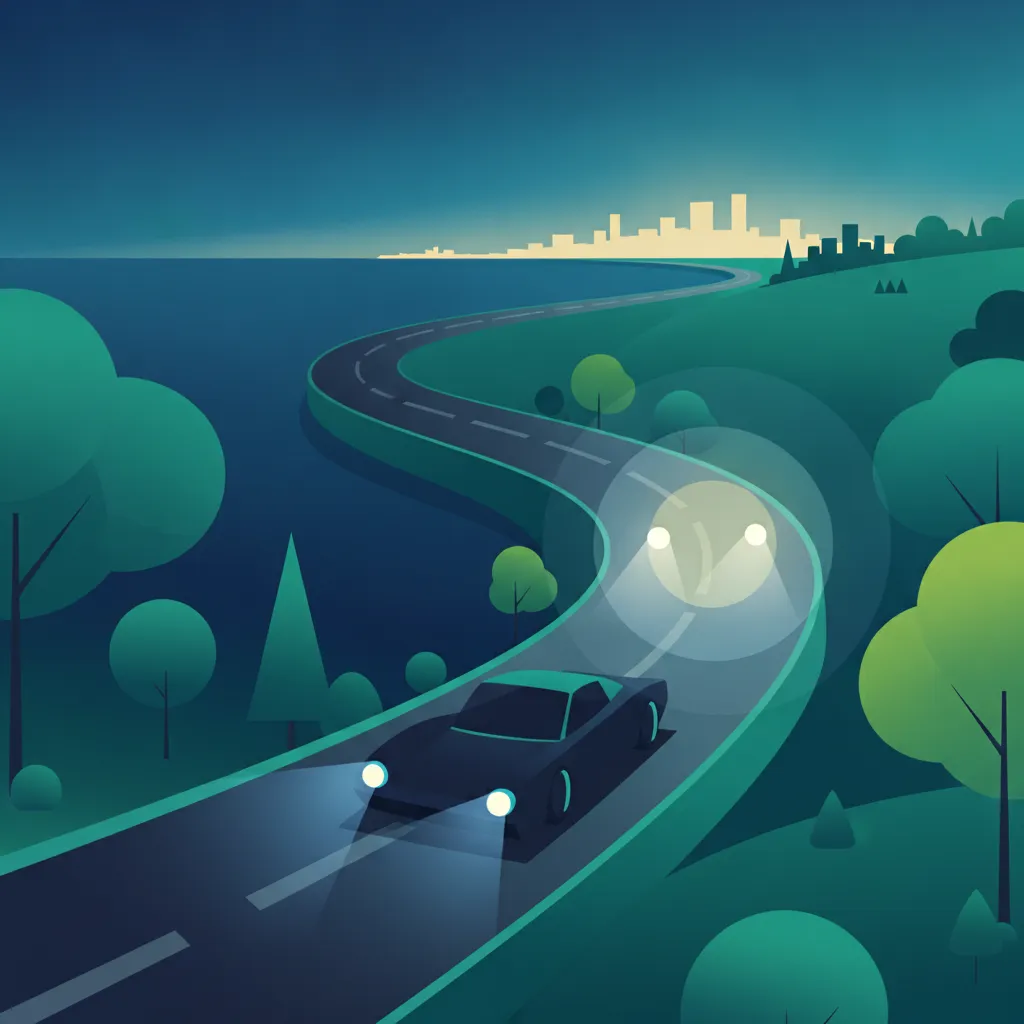
Driving at night profoundly alters the driving environment, significantly reducing visibility and impacting a driver's perception. In Portugal, understanding the specific rules for light usage, speed adaptation, and managing hazards like glare is crucial for safe navigation. This guide details how to handle these conditions effectively, ensuring you and other road users remain safe.
Theory topic content overview
Read the full theory topic guide for Night Driving Safety with structured, easy-to-scan content built for learners in Portugal. This detailed section explains the exact rule, meaning, traffic context, comparison points, and exam logic behind this Portuguese driving theory topic so you can study faster, understand the concept more clearly, and avoid common interpretation mistakes on the theory test.
Driving after sunset in Portugal presents a distinctly different environment than daytime driving. The primary challenge is a significant reduction in visibility, which directly impacts a driver's perception, reaction time, and ability to detect hazards. While road layouts and traffic rules remain consistent with the Código da Estrada, the way you apply them must adapt drastically to these altered conditions.
Unlike daylight, where you can often see far down the road and into surrounding areas, night driving limits your view to the range of your vehicle's headlights and available street lighting. This confined field of vision means potential dangers – such as pedestrians, cyclists, animals, or unlit obstacles – appear later, demanding earlier and more deliberate responses from the driver.
Understanding the specific difficulties of driving at night is crucial for road safety and for passing your IMT theory exam in Portugal. Accidents that occur during night hours, although potentially fewer in number than daytime incidents, are often more severe. This increased severity is due to:
Encandeamento): Headlights from oncoming traffic or even rear-view mirror reflections can temporarily blind or disorient drivers.For these reasons, the Código da Estrada and Portuguese driving theory place strong emphasis on adapting your driving behaviour after dark.
Successful and safe condução noturna (night driving) in Portugal hinges on three key adaptations: moderating your speed, actively managing your vision, and correctly using your vehicle's lighting system.
The most critical adjustment for driving at night in Portugal is significantly reducing your speed. The fundamental principle, often tested in the IMT exam, is that you must always be able to stop your vehicle within the distance you can clearly see ahead with your headlights.
luzes de estrada (main beam headlights) have a finite range, typically illuminating up to 100 meters. Luzes de cruzamento (dipped headlights) illuminate an even shorter distance, usually around 30-45 meters.Night driving requires a heightened sense of observation and specific techniques to protect your vision:
Código da EstradaThe proper use of vehicle lights is a core component of night driving safety and a frequent topic in the Portuguese theory test. The Código da Estrada (Articles 60º and 61º) outlines specific rules:
Luzes de Cruzamento (Dipped Headlights): These are mandatory from sunset to sunrise and in tunnels or any situation where visibility is reduced (e.g., heavy rain, fog). You must use dipped headlights when approaching or following other vehicles, both in urban and rural areas, to avoid encandeamento.Luzes de Estrada (Main Beam Headlights): These provide maximum illumination and should be used on unlit roads outside built-up areas. Crucially, you must switch from main beam to dipped headlights when:
Luzes de Presença (Parking Lights): Used when parked on unlit roads.Luzes de Nevoeiro): Only to be used in fog, heavy rain, or snow. Their incorrect use can also cause glare.The periods of aurora (dawn) and crepúsculo (dusk) are particularly hazardous transition times in Portugal, often tested in the IMT exam. During these times, light conditions change rapidly:
aurora and crepúsculo.Código da Estrada, luzes de cruzamento are mandatory during these periods. Don't wait until it's completely dark; switch your lights on as soon as visibility begins to diminish.Encandeamento (Headlight Glare)Encandeamento (headlight glare) is a temporary reduction or loss of vision caused by intense light, most commonly from the headlights of an oncoming vehicle or reflected from surfaces. This phenomenon can occur not only at night but also during the day under specific conditions, such as sun glare or reflections.
Encandeamento Affects YouWhen experiencing encandeamento in Portugal:
luzes de cruzamento when encountering other vehicles to avoid causing encandeamento for them.Beyond visibility, other factors contribute to the increased risk of condução noturna in Portugal:
Many learners make predictable mistakes when it comes to condução noturna, often leading to critical errors in the IMT theory test and unsafe practices on the road:
luzes de estrada (main beam) when meeting or following other vehicles.luzes de cruzamento (dipped beam) during aurora or crepúsculo.To ensure you're a safe night driver in Portugal and well-prepared for your IMT exam:
encandeamento.By mastering these adaptations and understanding the specific requirements of the Código da Estrada for night driving, you will significantly enhance your safety and confidence on Portuguese roads after dark.
Start with a short, direct summary of Night Driving Safety before reading the full explanation below.
Driving at night in Portugal requires drivers to significantly reduce speed to match the limited visibility, ensure proper use of 'luzes de cruzamento' (dipped headlights) and 'luzes de estrada' (main beam headlights), and increase safety distances. Drivers must actively manage glare from oncoming vehicles ('encandeamento') and be aware of increased fatigue risks. Adapt your driving to ensure you can stop within the illuminated area of your headlights.
Review the most important terms, rule signals, and traffic concepts linked to Night Driving Safety.
Explore related theory topic pages connected to Night Driving Safety and continue with the next useful rule explanation.
See the common search queries learners use when trying to understand Night Driving Safety in Portugal.

Continue your preparation for the Portuguese driving test by exploring specific theory topics in detail. Understand the Código da Estrada, review road signs, and clarify complex traffic regulations to ensure you're fully prepared for the IMT examination.
Explore Driving Theory TopicsTheory topic content overview
Start with a short, direct summary of Night Driving Safety before reading the full explanation below.
Driving at night in Portugal requires drivers to significantly reduce speed to match the limited visibility, ensure proper use of 'luzes de cruzamento' (dipped headlights) and 'luzes de estrada' (main beam headlights), and increase safety distances. Drivers must actively manage glare from oncoming vehicles ('encandeamento') and be aware of increased fatigue risks. Adapt your driving to ensure you can stop within the illuminated area of your headlights.
Review the most important terms, rule signals, and traffic concepts linked to Night Driving Safety.
Explore related theory topic pages connected to Night Driving Safety and continue with the next useful rule explanation.
See the common search queries learners use when trying to understand Night Driving Safety in Portugal.
Continue your preparation for the Portuguese driving test by exploring specific theory topics in detail. Understand the Código da Estrada, review road signs, and clarify complex traffic regulations to ensure you're fully prepared for the IMT examination.
Explore Driving Theory TopicsUse this exam-focused revision tip to understand how Night Driving Safety is likely to appear in theory questions for learners in Portugal. This section helps you identify the most testable part of the rule, avoid common traps, and remember the concept more effectively during Portuguese driving theory exam preparation.
Many Portuguese theory exam questions test your knowledge of correct light usage and speed adaptation during night driving or periods of low light like 'aurora' and 'crepúsculo'. Remember to always adjust your speed to be able to stop within the visible range of your headlights, and never use 'luzes de estrada' (main beam) when encountering or following other vehicles to avoid 'encandeamento' (glare).
Read direct answers to the most common learner questions about Night Driving Safety in Portugal. This FAQ focuses on rule confusion, practical meaning, comparison with similar concepts, and the exact uncertainties that appear most often in Portuguese driving theory revision and exam preparation.
Night driving significantly reduces visibility, making it harder to spot pedestrians, cyclists, and obstacles. This increases reaction times and the severity of accidents, even with less traffic, as confirmed by accident statistics in Portugal.
'Luzes de cruzamento' are dipped headlights (low beam), used in urban areas, with oncoming traffic, or when following another vehicle. 'Luzes de estrada' are main beam headlights (high beam), used on unlit roads outside built-up areas when no other vehicles are present, to maximize visibility.
You must moderate your speed so that you can stop safely within the distance illuminated by your headlights. This often means driving slower than the posted speed limit, especially on unlit rural roads or in adverse conditions.
'Encandeamento' refers to glare or dazzling caused by bright headlights of oncoming vehicles. To avoid it, shift your gaze slightly to the right edge of the road, maintaining your lane position without looking directly into the bright lights. Also, remember to switch from 'luzes de estrada' to 'luzes de cruzamento' when encountering oncoming traffic.
Yes, 'aurora' (dawn) and 'crepúsculo' (dusk) are critical periods due to rapidly changing light conditions. During these times, visibility can be particularly deceptive, and it's essential to use appropriate lights and adjust speed, as pedestrians and cyclists can be hard to spot.
Reduced visibility at night means hazards are detected later, effectively increasing your reaction time. Factors like fatigue, which is more common at night, can further slow your responses, making increased safety distances crucial.
Absolutely. Due to reduced visibility and slower reaction times, increasing your safety distance from the vehicle ahead is critical. This provides more time to react to unexpected hazards or sudden stops.
Fatigue is a significant risk factor during night driving, leading to reduced concentration and slower reaction times. If you feel tired, pull over in a safe place and rest. Avoid long night journeys without breaks.
Front fog lights ('luzes de nevoeiro à frente') can be used at night in fog, heavy rain, or snow. Rear fog lights ('luzes de nevoeiro à retaguarda') are only for very dense fog or heavy snowfall, as they can cause significant glare to drivers behind you.
Yes, different road types influence light usage and speed. On 'autoestradas' (motorways) with good lighting, 'luzes de cruzamento' are generally sufficient. On unlit rural roads, 'luzes de estrada' should be used when safe, but always switch to 'luzes de cruzamento' for oncoming or preceding vehicles.
Yes, the IMT theory exam frequently includes questions on night driving scenarios, focusing on correct light usage, speed adaptation, hazard perception, and dealing with glare, as these are critical safety aspects.
Common mistakes include not reducing speed sufficiently, improper use of 'luzes de estrada' (dazzling others), not increasing safety distance, and failing to take breaks when fatigued.
Rain dramatically worsens night driving conditions by further reducing visibility and creating reflective glare from wet surfaces, making road markings and other vehicles harder to see. Speed reduction and careful light use are even more critical.
Utilize the powerful search tool to refine your Portuguese driving theory practice. Pinpoint questions related to specific traffic laws, road signs, or complex scenarios from the Código da Estrada. Begin targeted revision now to boost your understanding and confidently approach your IMT driving exam.