
Logo
Portuguese theory topics and rule explanationsTraffic Maneuvers

Proper overtaking requires careful judgment, adherence to the Código da Estrada, and is frequently tested in the IMT driving exam.

Overtaking: Portuguese Rules and Safe Procedures

Overtaking, or "ultrapassagem" in Portuguese, is a common but high-risk maneuver. This page details the legal requirements and safety considerations according to the Código da Estrada. It's vital to understand when and how to execute this maneuver safely, ensuring you do not endanger other road users or violate traffic laws, particularly concerning visibility and road markings.
ManeuversRoad RulesPortugalSafetyCódigo da EstradaIMT ExamVisibilityProhibitions
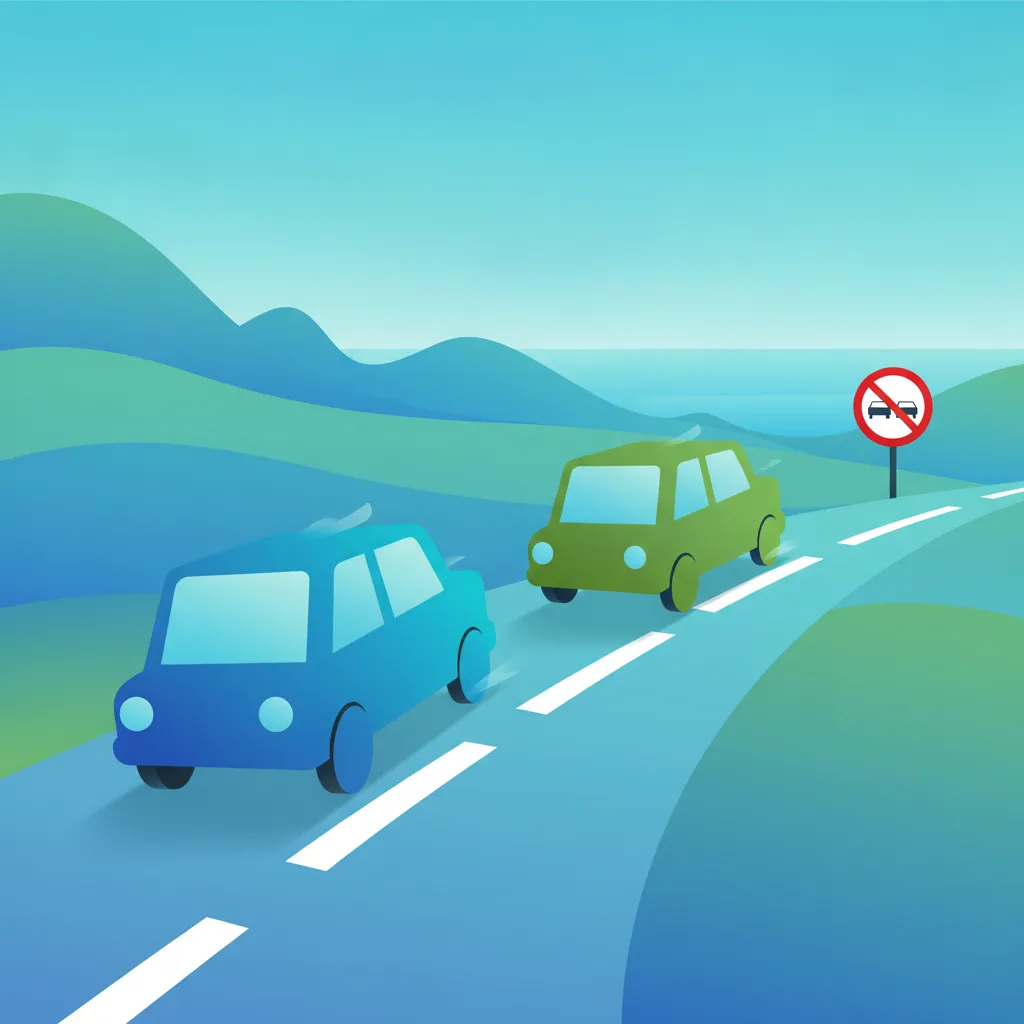
Illustration for the driving theory topic Portuguese Overtaking Rules for learners in Portugal

Theory topic content overview

Complete Driving Theory Explanation: Portuguese Overtaking Rules

Read the full theory topic guide for Portuguese Overtaking Rules with structured, easy-to-scan content built for learners in Portugal. This detailed section explains the exact rule, meaning, traffic context, comparison points, and exam logic behind this Portuguese driving theory topic so you can study faster, understand the concept more clearly, and avoid common interpretation mistakes on the theory test.

Understanding Overtaking (Ultrapassagem) in Portuguese Driving

Overtaking, known as ultrapassagem in Portuguese, is a dynamic and potentially hazardous maneuver where a vehicle passes another vehicle travelling in the same direction. Under the Código da Estrada (Portuguese Road Code), executing an ultrapassagem safely and legally requires meticulous assessment, precise judgment, and strict adherence to traffic rules. It’s a core skill for safe driving in Portugal and a common topic in the IMT driving theory exam.

Why Mastering Overtaking Rules Matters

Misunderstanding or improper execution of ultrapassagem is a significant cause of road accidents in Portugal. It directly impacts road safety, not only for the overtaking driver but also for the vehicle being overtaken and any oncoming traffic. For learners, a thorough grasp of these rules is essential for:

  • Safety: Preventing head-on collisions, side-swipes, and other incidents caused by misjudgment.
  • Legal Compliance: Avoiding fines, penalty points, and other sanctions for illegal overtaking.
  • IMT Exam Success: Questions on when and how to overtake, and when it is strictly prohibited, are frequent in the Portuguese driving theory test. Scenarios often involve road signs, markings, and specific visibility conditions.
  • Traffic Flow: Executing ultrapassagem correctly contributes to predictable and efficient traffic movement.

The Safe Overtaking Procedure in Portugal

A safe ultrapassagem is a sequence of careful steps, not a sudden action. The Código da Estrada emphasizes the driver's responsibility to ensure the maneuver can be completed without risk.

1. Observation and Assessment

Before initiating any ultrapassagem, a Portuguese driver must thoroughly assess the situation:

  • Check Mirrors and Blind Spots: Crucially, check your interior and exterior rear-view mirrors (especially the left one) and your blind spots to ensure no one is already attempting to overtake you or is too close behind.
  • Oncoming Traffic: On single carriageway roads (faixa de rodagem única) where overtaking requires using the opposing lane, assess the speed and distance of any oncoming vehicles. You must have sufficient distância de visibilidade (visibility distance) to complete the maneuver without forcing the oncoming vehicle to slow down or deviate.
  • Vehicle Ahead: Ensure the vehicle you intend to overtake is not signaling an intention to turn or move left.
  • Road Conditions: Evaluate road layout (curves, hills), road surface (wet, dry), weather conditions (fog, rain), and visibility ahead.
  • Road Markings and Signs: Crucially, check for continuous lines (linha contínua) or "No Overtaking" signs (e.g., sign B8, Proibição de Ultrapassagem), which legally prohibit the maneuver.
  • Speed Differential: Confirm your vehicle can accelerate sufficiently to complete the ultrapassagem promptly and safely.

2. Signalling Your Intention

Once you have determined it is safe to proceed, activate your left indicator to signal your intention to overtake. This warns other road users of your planned maneuver.

3. Executing the Maneuver

  • Move Out: Steer smoothly into the adjacent lane (or opposing carriageway, if safe and permitted).
  • Accelerate: Increase your speed to pass the slower vehicle quickly and efficiently, but always within the legal speed limits. Maintain a safe lateral distance from the vehicle you are overtaking.
  • Responsibility of the Overtaken: While the overtaken driver should facilitate the maneuver where possible (e.g., by maintaining speed or slightly reducing it and moving to the right), this does not relieve the overtaking driver of their primary responsibility for safety and legality.

4. Returning to Your Lane

  • Check Interior Mirror: You must only return to your original lane once you can clearly see the vehicle you have just overtaken in your interior rear-view mirror. This ensures you leave adequate space.
  • Signal Right: Activate your right indicator to signal your intention to return to the right-hand lane.
  • Smooth Return: Steer smoothly back into your lane without cutting off the overtaken vehicle.

Key Prohibitions and Conditions in Portugal

The Código da Estrada specifies numerous situations where ultrapassagem is strictly prohibited or should be avoided due to inherent danger:

  • Continuous Lines (Linha Contínua): You must never cross or straddle a continuous longitudinal line on the road. This marking explicitly forbids ultrapassagem into that lane.
  • Poor Visibility:
    • On or immediately before curves (curvas) with limited visibility.
    • On or immediately before hill crests (lombas) where visibility of the road ahead is restricted.
    • In adverse weather conditions like heavy fog, rain, or snow where visibility is significantly reduced.
  • Prohibited Zones:
    • At or immediately before pedestrian crossings (passadeiras). This is a critical rule in Portugal.
    • At intersections (cruzamentos) or road junctions where you do not have priority, or where visibility is limited.
    • Near level crossings.
    • Inside tunnels, unless there are multiple lanes in your direction and specific markings permit it.
    • When an overtaking vehicle signals its intention to return to your lane.
  • Other Vehicles:
    • When another vehicle is already overtaking the vehicle you intend to pass.
    • When the vehicle behind you has already begun an ultrapassagem on you.
    • When there is insufficient space to return to your lane safely without endangering other road users.
  • "No Overtaking" Signs: Always obey regulatory signs indicating Proibição de Ultrapassagem (B8) or Proibição de Ultrapassagem para Pesados (B9 - for lorries).

Important Distinctions and Comparisons

  • Overtaking vs. Lane Changing: On a Portuguese autoestrada (motorway) with multiple lanes in the same direction, moving from a right lane to a left lane to pass a slower vehicle is often considered a lane change rather than an ultrapassagem in the strict sense of occupying an opposing lane. However, all the principles of checking mirrors, blind spots, and signalling still apply rigorously.
  • Overtaking a queue: Overtaking a line of traffic is generally prohibited if it involves crossing a continuous line or entering an opposing lane where it's unsafe.
  • Overtaking in Slow Traffic: In very slow-moving or stationary traffic, drivers may sometimes pass on the right if traffic in the left lane is moving slower and there are clear lanes and no solid lines. This is a specific exception and requires extreme caution.

Real-World Scenarios for Portuguese Drivers

  • Rural Road (Estrada Nacional): You're on a single-carriageway Estrada Nacional behind a slow-moving trator. Before attempting ultrapassagem, you must ensure a long, clear stretch of road ahead, with no oncoming traffic, no continuous line, and no bends or hills obscuring visibility. You signal, accelerate, and return only when the trator is visible in your mirror.
  • Autoestrada (Motorway): On an autoestrada with three lanes, you want to pass a car in the middle lane. You check your left mirror for faster traffic, signal left, move to the far-left lane, accelerate, and then signal right and return to the middle or right lane once you see the overtaken vehicle.
  • Approaching a Pedestrian Crossing: You are following a car that slows down slightly as it approaches a passadeira (zebra crossing). Even if no pedestrians are visible, you must not attempt ultrapassagem at or immediately before the crossing, as visibility might be limited, and a pedestrian could step out.

Common Mistakes Made by Learners

Learners in Portugal often make critical errors regarding ultrapassagem:

  • Poor Visibility Assessment: Failing to accurately judge the speed of oncoming traffic or the distance required to complete the maneuver.
  • Ignoring Road Markings: Overtaking across a linha contínua. This is a serious offense.
  • Overtaking at Prohibited Zones: Attempting ultrapassagem at passadeiras, cruzamentos, or lombas. These are high-risk locations.
  • Not Checking Blind Spots: Relying only on mirrors and missing vehicles in the blind spot.
  • Insufficient Speed Differential: Not accelerating enough to complete the maneuver quickly, leaving the vehicle exposed in the opposing lane for too long.
  • Returning Too Soon: Cutting off the overtaken vehicle by returning to the lane too early. The rule is to see the overtaken vehicle in your interior mirror first.
  • Impatience with Pesados: Trying to rush past lorries (pesados) on multi-lane roads. Remember, lorries have speed limiters and different dynamics, so patience is key.

Practical Takeaway: The "Think - Check - Act" Approach

For any ultrapassagem in Portugal, adopt a "Think - Check - Act" mindset:

  • Think: Is it necessary? Is it legal? Is it safe?
  • Check: Mirrors, blind spots, oncoming traffic, road markings, signs, visibility.
  • Act: Signal, execute smoothly, return safely when appropriate.

Always remember that if there is any doubt about the safety or legality of an ultrapassagem, the safest and correct decision is to not overtake. Patience and caution are your best allies on Portuguese roads.

Quick Answer: Portuguese Overtaking Rules

Start with a short, direct summary of Portuguese Overtaking Rules before reading the full explanation below.

Overtaking in Portugal involves safely passing a slower vehicle by moving into an adjacent lane or the opposing carriageway when permitted. Key principles include ensuring clear visibility, checking mirrors and blind spots, signaling your intent, and executing the maneuver without forcing other vehicles to react. It is strictly prohibited in certain zones such as intersections, pedestrian crossings, and where continuous road markings are present.

Key Terms and Rule Signals for Portuguese Overtaking Rules

Review the most important terms, rule signals, and traffic concepts linked to Portuguese Overtaking Rules.

overtaking
ultrapassagem
passing rules
road safety Portugal
Código da Estrada
prohibited overtaking
safe distance
visibility for passing
IMT exam
autoestrada overtaking
road markings
continuous line
pedestrian crossing rules
maneuvers Portugal

Popular Search Queries for Portuguese Overtaking Rules

See the common search queries learners use when trying to understand Portuguese Overtaking Rules in Portugal.

overtaking rules Portugalwhen is ultrapassagem forbidden in Portugalsafe overtaking procedure Código da Estradahow to pass a car in Portuguese trafficovertaking on autoestrada Portugalsolid line overtaking rules Portugalvisibility for overtaking Portuguese driving testovertaking near pedestrian crossing Portugalovertaking by lorries rules Portugalwhat is ultrapassagem meaning
Decorative theory topics background
48 theory topics

Ready to Master Portuguese Driving Theory Concepts?

Continue your preparation for the Portuguese driving test by exploring specific theory topics in detail. Understand the Código da Estrada, review road signs, and clarify complex traffic regulations to ensure you're fully prepared for the IMT examination.

Explore Driving Theory Topics

Theory Exam Tip for Portuguese Overtaking Rules

Use this exam-focused revision tip to understand how Portuguese Overtaking Rules is likely to appear in theory questions for learners in Portugal. This section helps you identify the most testable part of the rule, avoid common traps, and remember the concept more effectively during Portuguese driving theory exam preparation.

In the Portuguese driving theory exam, pay close attention to questions involving road signs and markings that prohibit overtaking. Scenarios often test your ability to assess visibility (e.g., curves, hills) and your knowledge of specific prohibited zones like pedestrian crossings or continuous lines. Always prioritize safety and legal compliance.

Portuguese Overtaking Rules: Frequently Asked Theory Questions

Read direct answers to the most common learner questions about Portuguese Overtaking Rules in Portugal. This FAQ focuses on rule confusion, practical meaning, comparison with similar concepts, and the exact uncertainties that appear most often in Portuguese driving theory revision and exam preparation.

What is 'ultrapassagem' in Portuguese driving theory?

Ultrapassagem is the Portuguese term for overtaking, which means passing another vehicle traveling in the same direction on the road.

When is overtaking generally prohibited in Portugal?

Overtaking is prohibited in areas with limited visibility (like curves and hill crests), at intersections, pedestrian crossings, level crossings, and where continuous road markings prohibit crossing the lane.

What steps should I follow for a safe overtaking maneuver?

Always check mirrors and blind spots, signal your intention, ensure sufficient visibility and distance, accelerate past the vehicle, and return to your lane only when you can see the overtaken vehicle in your interior mirror.

Can I overtake if there is a continuous white line?

No, crossing or driving on a continuous white line (linha contínua) to overtake is strictly prohibited by the Código da Estrada and carries penalties.

Are there specific rules for overtaking on autoestradas?

On autoestradas (motorways), you should generally overtake on the left. Always maintain safe distances, check for faster vehicles in the left lane, and avoid returning to the right lane too soon.

What role does visibility distance play in overtaking?

Visibility is paramount. You must be able to see far enough ahead to complete the overtaking maneuver safely without forcing an oncoming vehicle to slow down or change its course.

Is it ever permitted to overtake on the right in Portugal?

Generally, overtaking on the right is forbidden, with rare exceptions such as when the vehicle ahead signals a left turn and leaves enough space on the right, or in heavy traffic conditions where vehicles move in parallel lanes.

How does overtaking relate to 'ângulos mortos' (blind spots)?

Before initiating an overtaking maneuver, it's critical to check your mirrors and physically look over your shoulder (the 'head check') to clear your blind spots ('ângulos mortos') and ensure no vehicle is hidden there.

Ready to Find Your Next Targeted Practice Session?

Utilize the powerful search tool to refine your Portuguese driving theory practice. Pinpoint questions related to specific traffic laws, road signs, or complex scenarios from the Código da Estrada. Begin targeted revision now to boost your understanding and confidently approach your IMT driving exam.

Search Practice Questions by Topic