
This unit covers the essential physics of driving, teaching you how speed directly impacts your stopping distance and safety margins. You will learn to apply the two-second rule and develop advanced hazard perception skills to navigate Irish roads safely. Mastering these concepts is vital for both your theory test success and your practical driving performance.
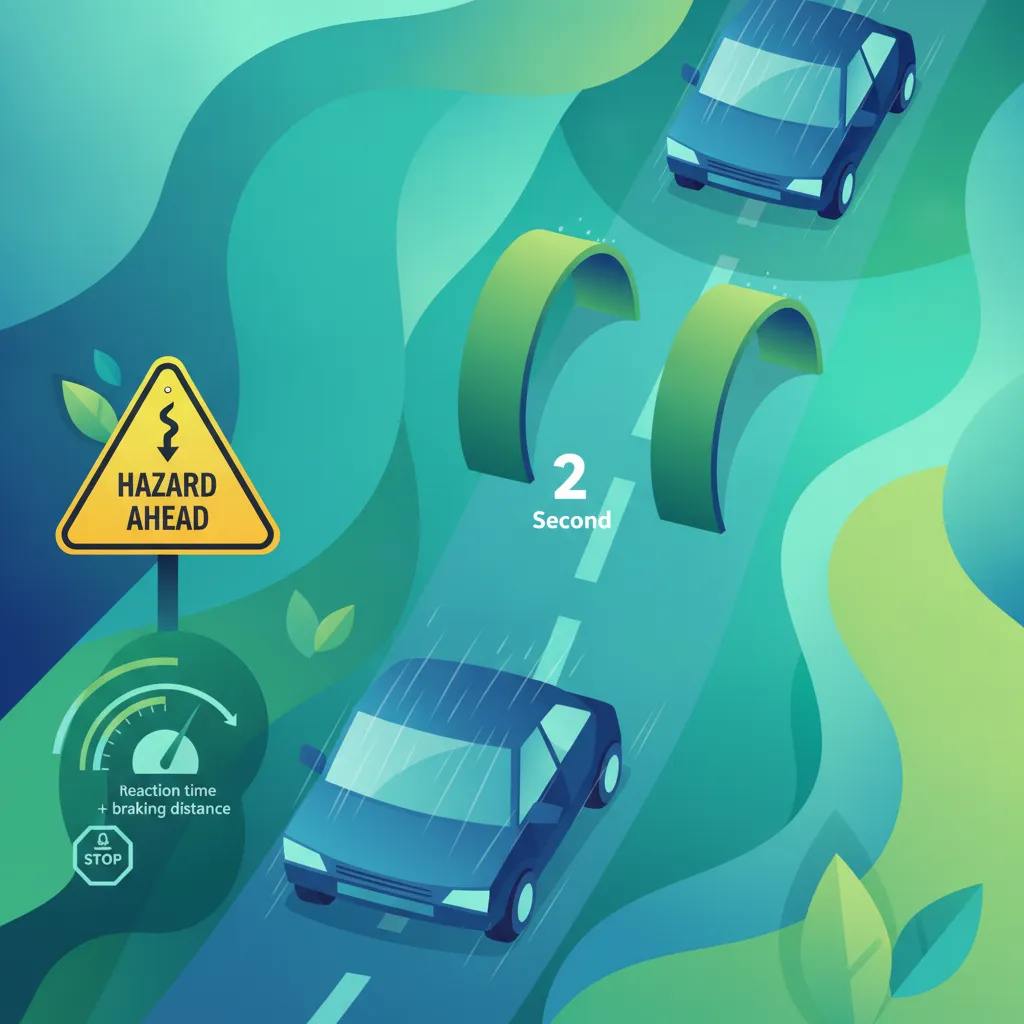
Browse all lessons that make up Speed, Following Distance, Stopping Distance and Hazard Awareness. Each lesson focuses on specific topics, learning objectives, and core concepts, helping you build essential knowledge and follow a clear, structured progression toward your study goals in Ireland.
Ireland has designated statutory speed limits ranging from 30 km/h in slow urban zones to 120 km/h on motorways. This lesson details these default limits for Category B passenger cars, the placement of speed signs, and how local authorities apply special temporary limits. You will learn that a speed limit represents the absolute maximum legal speed under ideal conditions, and must always be adjusted downwards for safety.
Maintaining an adequate following distance provides you with the crucial time and space needed to react if the leading vehicle stops suddenly. This lesson teaches the 'two-second rule' for dry road conditions, and why you must double this gap to at least four seconds on wet or greasy road surfaces. You will learn how to use stationary roadside markers to calculate this distance and avoid the severe dangers of tailgating.
A vehicle's total stopping distance is the sum of your thinking (reaction) distance and the mechanical braking distance. This lesson explains how reaction times are slowed by fatigue, distraction, or health, and how braking distance scales exponentially with your vehicle's speed. You will understand how factors like worn tyres, bad brakes, or slippery asphalt can dramatically increase your overall stopping distance.
Proactive hazard perception involves constantly scanning the road ahead to identify potential dangers before they turn into actual emergencies. This lesson covers active scanning techniques, helping you look far ahead, check mirrors regularly, and identify subtle risk clues such as exhaust smoke from parked cars or children playing near kerbs. Anticipating these developments gives you the time to adjust speed and position safely.
Adhering to legal speed limits is not always sufficient; you must continuously adapt your speed to match real-world hazards. This lesson teaches you how to reduce speed when encountering rain, fog, heavy traffic, or narrow winding rural roads with restricted visibility. You will learn the importance of matching your speed to your range of clear vision, ensuring you can stop safely within the distance you can see ahead.
Explore high-intent keywords and long-tail search topics learners use when researching Speed, Following Distance, Stopping Distance and Hazard Awareness. These terms reflect how people search for reliable study materials, structured explanations, and unit-level theory preparation support in Ireland.
Find clear answers to the most common questions learners ask about Speed, Following Distance, Stopping Distance and Hazard Awareness. Understand how the unit is organized, what learning goals it supports, and how it contributes to your study progression with structured explanations and practical guidance tailored for learners in Ireland.
The two-second rule is a simple way to maintain a safe following distance from the vehicle ahead. You pick a fixed point on the road, and when the car in front passes it, you should count two seconds before your car passes that same point. It ensures you have adequate time to react if the car in front brakes suddenly.
Stopping distance increases significantly in poor weather. On wet roads, your stopping distance can double, and in icy or snowy conditions, it can be up to ten times longer than on a dry surface. You must adjust your speed and increase your following distance accordingly.
You must know the standard national speed limits for various road types in Ireland, including motorways, national roads, and regional roads. Always remember that speed limits are the maximum allowed, not a target, and you should drive at a speed appropriate for conditions.
Hazard perception is the ability to spot potential dangers on the road early, such as pedestrians, cyclists, or junctions. In the exam, you need to show you can anticipate these events and adjust your driving behaviour safely.
All included lessons
Lessons in Speed, Following Distance, Stopping Distance and Hazard Awareness
See who benefits most from studying Speed, Following Distance, Stopping Distance and Hazard Awareness. This overview explains how the unit supports different learning needs, what level of knowledge is helpful before starting, and how it fits into the overall study path in Ireland.
This unit is designed for Category B learners preparing for the Irish Driver Theory Test who want to build a strong foundation in road safety physics. It is also ideal for learners who struggle with spatial awareness or those needing to refresh their knowledge on braking distances and defensive driving.

Begin your Irish Driver Theory Test journey today. Explore our guided curriculum, choose a structured course that fits your learning style, and start mastering every official RSA topic and rule of the road. Our approach ensures comprehensive preparation for your learner permit.
Explore Theory Test CoursesExplore all units and lessons included in this driving theory course.
Begin your Irish Driver Theory Test journey today. Explore our guided curriculum, choose a structured course that fits your learning style, and start mastering every official RSA topic and rule of the road. Our approach ensures comprehensive preparation for your learner permit.
Explore Theory Test Courses