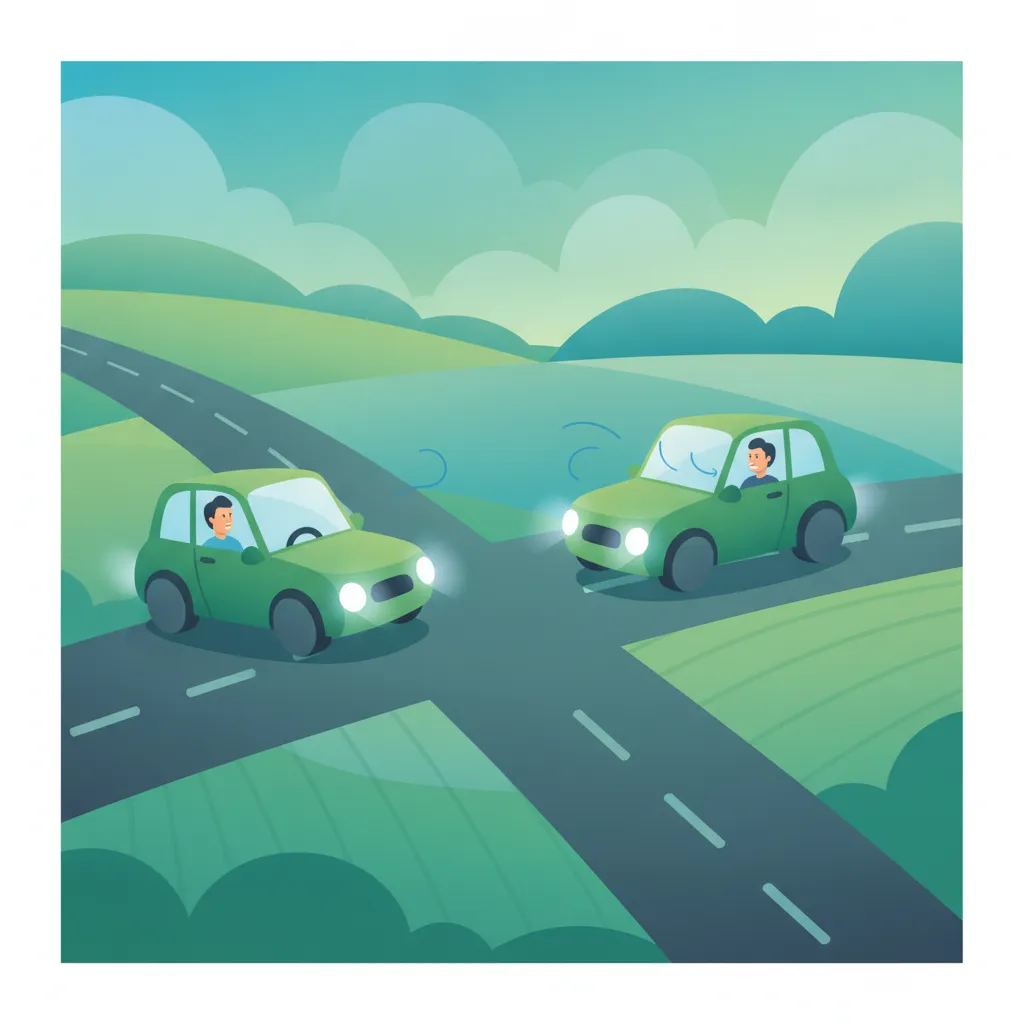
At many junctions in Ireland, there are no traffic lights, stop signs, or 'Give Way' signs to tell you who has priority. In these 'uncontrolled' situations, you must rely on general rules of the road and careful observation to determine who goes first. This page clarifies these rules, helping you navigate such intersections safely and confidently.
Theory topic content overview
Read the full theory topic guide for Uncontrolled Intersection Priority with structured, easy-to-scan content built for learners in Ireland. This detailed section explains the exact rule, meaning, traffic context, comparison points, and exam logic behind this Irish driving theory topic so you can study faster, understand the concept more clearly, and avoid common interpretation mistakes on the theory test.
Navigating junctions without clear instructions can be challenging for any driver. In Ireland, an uncontrolled intersection is a junction where there are no traffic lights, 'Stop' signs, 'Give Way' signs, or 'Major Road Ahead' signs to indicate which driver has priority or right of way. In these common scenarios, drivers must rely on a set of general Rules of the Road principles and careful observation to determine who should proceed first. Understanding these rules is vital for safe driving and a frequent topic in the Irish Driver Theory Test.
An uncontrolled intersection is essentially a crossroads or a T-junction that lacks any official signage or road markings dictating priority. Unlike controlled intersections, where signs or signals provide explicit instructions, these junctions demand proactive judgment from drivers.
Key characteristics of an uncontrolled intersection include:
In Ireland, the fundamental principle for priority at unmarked junctions is: you must give way to traffic approaching from your right. This rule applies when you are approaching an uncontrolled intersection and another vehicle is simultaneously approaching from your right-hand side. You must allow that traffic to pass before you move on.
It is critically important to understand, as outlined in the Irish Rules of the Road, that right of way is not an absolute right. Even if the rules suggest you have priority, you must always:
While "priority to the right" is the general guideline, several specific situations at uncontrolled intersections require further clarification under Irish driving law.
At a T-junction where there are no signs, the traffic already on the continuous road has priority. This means if you are on the road that is ending at the T-junction (the stem of the T), you must wait for all traffic on the main road (the top of the T) to pass before turning left or right. This rule overrides the 'priority to the right' principle in this specific context.
When turning right at a junction in Ireland, whether controlled or uncontrolled, you must generally yield to:
If you are approaching a junction with what is clearly a major road, even without explicit 'Give Way' or 'Stop' signs, the traffic on the major road generally has priority. You must yield to other traffic on the major road, allowing them to pass before you enter or join it. This requires good judgment of road layout and traffic flow.
Ireland also has "uncontrolled crossing places" or "courtesy crossings." These are often coloured, slightly raised, or patterned cobbled sections of road. It's crucial for drivers to be aware of the potential danger of pedestrians approaching or crossing on them. However, pedestrians do not have an automatic right of way on these crossings. Drivers should be vigilant, but pedestrians also need to be alert and ensure traffic is aware of their presence before crossing.
Mastering priority at uncontrolled intersections is not just about passing your Irish Driver Theory Test; it's fundamental to safe driving in Ireland.
Even with the rules, real-world situations can be complex. Several factors can influence your decision-making at an uncontrolled intersection:
Learners often make specific errors when encountering uncontrolled junctions in Ireland:
When approaching any unmarked junction in Ireland:
Mastering priority rules at uncontrolled intersections is a cornerstone of safe, confident, and legal driving on Irish roads. It's about active decision-making, not just passive rule-following.
Uncontrolled intersections in Ireland lack traffic lights, signs, or road markings, requiring drivers to apply general priority rules. The primary principle is to give way to traffic approaching from your right, though T-junctions and turning situations have specific overriding rules. Right of way is never absolute—caution, thorough observation, and defensive driving are essential at all times. Success in these scenarios requires understanding specific rules, recognising common mistakes, and developing the judgment to navigate safely when conditions are unclear.
A short set of high-value points that capture the most important ideas from this theory explanation.
At uncontrolled intersections in Ireland, you must give way to traffic approaching from your right
At T-junctions, traffic already on the continuous road has priority over traffic entering from the minor road (the T's stem)
When turning right at any junction, yield to oncoming traffic going straight through and to oncoming traffic turning left into the same road
Right of way is not an absolute right; always proceed with caution and be prepared to stop
Without explicit signs or markings, wider or busier roads do not automatically have priority—general rules apply
Priority to the right overrides other considerations at uncontrolled crossroads, but T-junction and turning rules take precedence in those specific situations
Good visibility allows you to assess priority confidently; poor visibility demands slower approach and greater vigilance
Defensive driving is essential—never assume other drivers will follow the rules correctly
Driving speed must always allow you to stop safely if you need to yield
Vulnerable road users (pedestrians, cyclists) may not understand priority rules; always give way to prevent injury
Assuming that wider or busier roads automatically have priority without signs—this is incorrect under Irish Rules of the Road
Treating 'priority to the right' as an absolute right and proceeding without due caution
Inadequate observation—failing to check thoroughly to the right, left, and ahead, and not looking far enough down the road
Not anticipating that other drivers may make mistakes or fail to follow the rules
Rushing decisions under pressure from traffic behind instead of waiting for full clarity
Start with a short, direct summary of Uncontrolled Intersection Priority before reading the full explanation below.
At uncontrolled intersections in Ireland, the primary rule is to give way to traffic approaching from your right. However, this is not an absolute right; drivers must always proceed with caution and show regard for other road users, including those at T-junctions or when turning right. Vigilance is key, as conditions like poor visibility or complex traffic can make priority less clear.
Review the most important terms, rule signals, and traffic concepts linked to Uncontrolled Intersection Priority.
Explore related theory topic pages connected to Uncontrolled Intersection Priority and continue with the next useful rule explanation.
See the common search queries learners use when trying to understand Uncontrolled Intersection Priority in Ireland.

After reviewing core Irish driving theory topics, test your understanding with comprehensive practice questions. Apply your knowledge of road rules, signs, and traffic laws to scenarios mirroring the official Driver Theory Test. Solidify your learning and prepare effectively for your exam.
Irish Driving Theory TopicsTheory topic content overview
A short set of high-value points that capture the most important ideas from this theory explanation.
At uncontrolled intersections in Ireland, you must give way to traffic approaching from your right
At T-junctions, traffic already on the continuous road has priority over traffic entering from the minor road (the T's stem)
When turning right at any junction, yield to oncoming traffic going straight through and to oncoming traffic turning left into the same road
Right of way is not an absolute right; always proceed with caution and be prepared to stop
Without explicit signs or markings, wider or busier roads do not automatically have priority—general rules apply
Priority to the right overrides other considerations at uncontrolled crossroads, but T-junction and turning rules take precedence in those specific situations
Good visibility allows you to assess priority confidently; poor visibility demands slower approach and greater vigilance
Defensive driving is essential—never assume other drivers will follow the rules correctly
Driving speed must always allow you to stop safely if you need to yield
Vulnerable road users (pedestrians, cyclists) may not understand priority rules; always give way to prevent injury
Assuming that wider or busier roads automatically have priority without signs—this is incorrect under Irish Rules of the Road
Treating 'priority to the right' as an absolute right and proceeding without due caution
Inadequate observation—failing to check thoroughly to the right, left, and ahead, and not looking far enough down the road
Not anticipating that other drivers may make mistakes or fail to follow the rules
Rushing decisions under pressure from traffic behind instead of waiting for full clarity
Start with a short, direct summary of Uncontrolled Intersection Priority before reading the full explanation below.
At uncontrolled intersections in Ireland, the primary rule is to give way to traffic approaching from your right. However, this is not an absolute right; drivers must always proceed with caution and show regard for other road users, including those at T-junctions or when turning right. Vigilance is key, as conditions like poor visibility or complex traffic can make priority less clear.
Review the most important terms, rule signals, and traffic concepts linked to Uncontrolled Intersection Priority.
Explore related theory topic pages connected to Uncontrolled Intersection Priority and continue with the next useful rule explanation.
See the common search queries learners use when trying to understand Uncontrolled Intersection Priority in Ireland.
After reviewing core Irish driving theory topics, test your understanding with comprehensive practice questions. Apply your knowledge of road rules, signs, and traffic laws to scenarios mirroring the official Driver Theory Test. Solidify your learning and prepare effectively for your exam.
Irish Driving Theory TopicsUse this exam-focused revision tip to understand how Uncontrolled Intersection Priority is likely to appear in theory questions for learners in Ireland. This section helps you identify the most testable part of the rule, avoid common traps, and remember the concept more effectively during Irish driving theory exam preparation.
Uncontrolled intersection questions often involve diagrams. Pay close attention to the direction of all vehicles and remember that 'priority to the right' is key, but always yield to traffic already on a continuous road (T-junctions) and oncoming traffic when turning right. Never assume right of way; look for explicit signs or markings.
Read direct answers to the most common learner questions about Uncontrolled Intersection Priority in Ireland. This FAQ focuses on rule confusion, practical meaning, comparison with similar concepts, and the exact uncertainties that appear most often in Irish driving theory revision and exam preparation.
An uncontrolled intersection is a junction where there are no traffic lights, 'Stop' signs, 'Give Way' signs, or 'Priority Road' signs to indicate which driver has the right of way. Drivers must rely on general rules and observation.
The general rule in Ireland is to give way to traffic approaching from your right. This means you must allow vehicles coming from your right to proceed before you do.
No, the size of the road does not automatically grant priority at an uncontrolled intersection without signs or markings. Always apply the general right-of-way rules, typically giving way to traffic from the right.
At a T-junction, traffic already on the continuous road (the 'top' of the T) has priority over traffic emerging from the road that ends (the 'leg' of the T).
If you are turning right at a junction, traffic coming straight through from the opposite direction has priority. If another vehicle from the opposite direction wants to turn into the same road and is turning left, the vehicle turning left has priority over you if you are turning right.
No, the 'priority to the right' rule is not absolute. The Road Safety Authority (RSA) states that drivers must always proceed with caution and show regard for all other road users, even when they have theoretical right of way. Safety is paramount.
When visibility is limited by obstacles, approach the intersection very slowly, be prepared to stop, and ensure you can see clearly before proceeding. Do not assume right of way if you cannot safely assess the situation.
At 'uncontrolled crossing places' (courtesy crossings), pedestrians do not have an automatic right of way in Ireland. Both pedestrians and drivers must be alert and aware of each other, with pedestrians ensuring traffic is aware of their presence before crossing.
Use the practice question search tool to pinpoint specific topics, road signs, or rules you need to master for your official Driver Theory Test. Refine your study strategy and ensure comprehensive preparation for all aspects of the Irish driving exam. Start your focused revision now and build confidence for your learner permit test.