
While legal speed limits provide a baseline, passing the CBR theory exam requires you to demonstrate that you can evaluate road conditions and react to potential hazards before they become dangerous. This guide teaches you how to recognize scenarios like heavy rain, fog, or dense cycling areas where current legal limits may be unsafe. You will learn to prioritize safety over speed to ensure you exhibit the judgement expected of a qualified driver in the Netherlands.
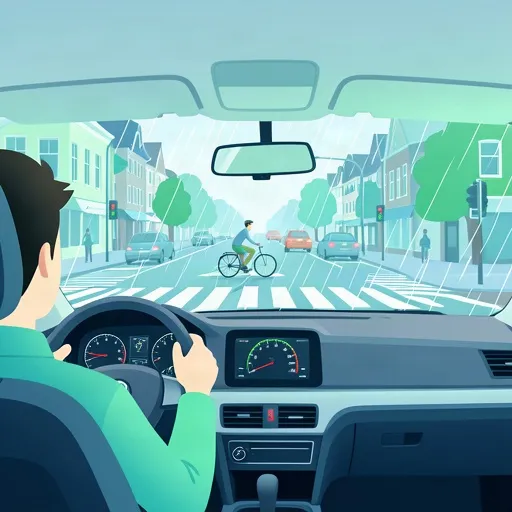
Article content overview
Passing the Dutch theory exam requires more than just memorizing the maximum speed limits posted on road signs. While knowing that the standard limit on a motorway is 100 km/h or that a built-up area generally caps speed at 50 km/h is fundamental, the CBR expects you to demonstrate superior judgment. In real-world driving, and by extension in your exam, you must prove that you can adjust your speed proactively based on environmental factors, visibility, and the presence of vulnerable road users.
A common trap for students is assuming that if the legal limit is 80 km/h, they are "allowed" to drive at that speed regardless of the situation. However, Dutch traffic legislation, specifically Article 19, dictates that a driver must at all times be able to bring their vehicle to a standstill within the distance that they can see to be clear. This is a foundational principle of the CBR theory exam. If you are driving on a narrow road or in heavy fog, maintaining the legal maximum speed is often considered an error because you cannot react in time to hazards.
Always remember that the posted speed limit is a maximum, not a target. In poor weather conditions—such as heavy rain, snow, or thick fog—the CBR expects you to reduce your speed significantly, even if you are well below the legal limit.
When you are behind the wheel, or answering a CBR hazard perception question, you must constantly evaluate the environment. Your goal is to identify risks before they manifest into dangerous situations.
The CBR theory exam tests your ability to think like a safe, experienced driver. Often, this involves multiple-choice questions where you must choose between "Maintain speed," "Release the accelerator," or "Brake." If a child is playing with a ball near the road, or if there is ice on a roundabout, the expected behavior is almost always to remove your foot from the accelerator to prepare for immediate braking. By acting early, you increase your thinking time and decrease the final stopping distance.
While judgment is key, you must still be aware of the standard limits as a baseline for your decisions.
| Vehicle Type | Built-up Area | Outside Built-up | Motorway |
|---|---|---|---|
| Passenger Car | 50 km/h | 80 km/h | 100 km/h* |
| Moped/Bromfiets | 45 km/h | 45 km/h | N/A |
| Trailer (under 3500kg) | 50 km/h | 80 km/h | 90 km/h |
*Note: Motorway speeds in the Netherlands can vary by time of day. Always obey the digital signs (matrix boards) as they override standard limits.
This article teaches you to go beyond memorizing speed limits for the CBR theory exam by understanding that safe driving requires continuous situational judgment. The core principle comes from Dutch Article 19, which mandates you stop within your visible clear distance—a rule that takes priority over posted limits when visibility or conditions deteriorate. You must learn to proactively reduce speed in scenarios involving vulnerable road users, poor visibility, junctions, and narrow roads rather than waiting for hazards to emerge. The CBR exam specifically tests whether you release the accelerator early when hazards appear, increasing thinking time and reducing stopping distance. Finally, while standard Dutch limits (50/80/100 km/h) serve as baselines, remember that matrix boards on motorways override standard limits and must always be obeyed.
A short set of high-value points that capture the most important ideas from this article.
The posted speed limit is always a maximum, not a target—you must drive slower when conditions demand it
Article 19 of Dutch traffic law requires you to be able to stop within the distance you can see to be clear
Proactive speed reduction is expected near cyclists, children, junctions, and in poor visibility—not just when hazards appear
In the CBR exam, the correct answer for emerging hazards is typically to release the accelerator early, not brake
Environmental factors like rain, fog, and dusk require independent speed judgment beyond legal limits
Standard limits: 50 km/h in built-up areas, 80 km/h outside built-up areas, 100 km/h on motorways for passenger cars
Article 19: stop within visible clear distance—this overrides legal speed when visibility is reduced
Matrix boards on motorways override standard limits and must be obeyed over posted signs
Vulnerable road users (cyclists, children) and junctions require early speed adjustment, not reactive braking
Stopping distance equals thinking distance plus braking distance—wet conditions significantly extend braking distance
Assuming that driving at the legal speed limit is always safe and acceptable
Failing to reduce speed in poor weather conditions like heavy rain or fog
Not anticipating hazards near schools, cycling areas, or narrow roads until they become immediate dangers
Waiting too long to react in hazard perception questions instead of removing foot from accelerator early
Ignoring environmental factors such as dusk, brake lights ahead, or soft shoulders when determining safe speed
Article content overview
A short set of high-value points that capture the most important ideas from this article.
The posted speed limit is always a maximum, not a target—you must drive slower when conditions demand it
Article 19 of Dutch traffic law requires you to be able to stop within the distance you can see to be clear
Proactive speed reduction is expected near cyclists, children, junctions, and in poor visibility—not just when hazards appear
In the CBR exam, the correct answer for emerging hazards is typically to release the accelerator early, not brake
Environmental factors like rain, fog, and dusk require independent speed judgment beyond legal limits
Standard limits: 50 km/h in built-up areas, 80 km/h outside built-up areas, 100 km/h on motorways for passenger cars
Article 19: stop within visible clear distance—this overrides legal speed when visibility is reduced
Matrix boards on motorways override standard limits and must be obeyed over posted signs
Vulnerable road users (cyclists, children) and junctions require early speed adjustment, not reactive braking
Stopping distance equals thinking distance plus braking distance—wet conditions significantly extend braking distance
Assuming that driving at the legal speed limit is always safe and acceptable
Failing to reduce speed in poor weather conditions like heavy rain or fog
Not anticipating hazards near schools, cycling areas, or narrow roads until they become immediate dangers
Waiting too long to react in hazard perception questions instead of removing foot from accelerator early
Ignoring environmental factors such as dusk, brake lights ahead, or soft shoulders when determining safe speed
Explore related topics, search based questions, and concepts that learners often look up when studying Speed Adjustment in Dutch Traffic. These themes reflect real search intent and help you understand how this topic connects to wider driving theory knowledge in the Netherlands.
Find clear and practical answers to common questions learners often have about Speed Adjustment in Dutch Traffic. This section helps explain difficult points, remove confusion, and reinforce the key driving theory concepts that matter for learners in the Netherlands.
No, the CBR tests your ability to adapt. If road conditions like heavy rain, fog, or dense traffic make the maximum speed unsafe, you are expected to lower your speed appropriately to maintain control.
You must anticipate potential hazards and be ready to reduce your speed or brake. In hazard perception questions, the correct response is almost always to reduce speed or release the accelerator.
You are expected to apply common sense. In conditions like thick fog or snow, you must significantly reduce your speed and increase your following distance to ensure you can stop within your field of vision.
No. While you must know the legal limits, the CBR assesses 'knowledge and insight'. You need the insight to know when these limits are too high for existing circumstances.
Start your targeted search now to explore a vast library of official Dutch driving theory articles and guides. Reinforce your understanding of specific traffic rules or road signs to ensure you are fully prepared for your upcoming CBR theory exam. Discover comprehensive explanations tailored for success.