Driving a motorcycle at night requires heightened awareness and strict adherence to Dutch traffic regulations. You will learn how to correctly manage your lighting, adjust your speed based on visibility range, and anticipate hazards signaled by road signs like the J-27 wildlife warning. This guide bridges the gap between legal requirements and practical defensive riding, helping you prepare effectively for your upcoming theory exam.
Article content overview
Operating a motorcycle after sunset or during periods of low visibility requires more than just standard riding skills; it demands a deep understanding of Dutch traffic legislation and the ability to manage increased environmental risks. In the Netherlands, the CBR theory exam places significant emphasis on the driver’s ability to adapt to changing light conditions and the potential hazards that accompany nighttime driving. Whether you are navigating unlit provincial roads or busy urban centers, your visibility to others and your ability to see potential obstacles are the foundations of safe motorcycle operation.
Under Dutch law, motorcycle lighting is not merely a convenience—it is a critical safety requirement that ensures your presence is registered by other road users. According to CBR standards, motorcyclists should ideally use dipped headlights at all times, even during the day, to improve conspicuity. Unlike daylight running lights (DRL), which may not illuminate the rear of the vehicle, dipped headlights provide a consistent profile from both the front and the rear, which is essential for defensive driving.
When visibility is significantly restricted by weather conditions such as fog, snow, or heavy rain, you are legally permitted to use front fog lamps. Furthermore, if visibility is reduced to less than 50 meters due to severe fog or snowfall, the use of rear fog lamps becomes mandatory. It is important to remember for your theory exam that high-beam headlights are only permissible when they do not dazzle oncoming traffic or drivers traveling in the same direction in front of you.
Never use high-beam headlights when there is a vehicle immediately in front of you or when traffic is approaching from the opposite direction. Doing so creates a dangerous glare that can blind other drivers, leading to potentially fatal situations.
One of the most frequent concepts tested in the CBR theory exam is the relationship between speed and the distance you can see. You must always adjust your speed so that you are able to bring your motorcycle to a complete stop within the distance you can clearly see to be clear. At night, this "visible range" is significantly shorter than in daylight because your headlights only illuminate a specific portion of the road ahead.
If you are riding on a road with no street lighting, you must anticipate that unlit obstacles, such as pedestrians, cyclists without proper lighting, or animals, may be hidden in the shadows. Your speed should be lower than it would be during the day to ensure you have adequate time to react to hazards that suddenly emerge from the darkness.
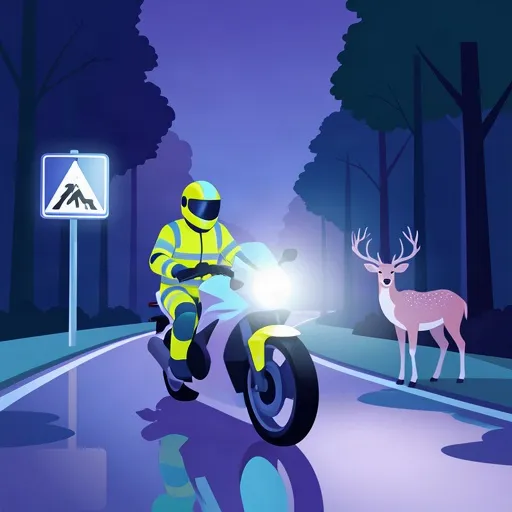
In rural areas of the Netherlands, the risk of encountering wildlife is particularly high during twilight and nighttime hours. The J-27 road sign is a crucial warning that indicates a section of road where game is likely to cross. When you encounter this sign, it is not merely a suggestion to be careful; it is a signal to proactively scan the verges of the road for movement.
Because your vision is constrained at night, you should utilize the reflection of your headlights on road signs, markings, and even the eyes of animals to gain information about the road’s course. If you are riding on a narrow road without a paved shoulder, remain closer to the middle of the lane when it is safe to do so. This position helps protect you from unexpected obstacles on the verge while maintaining your visibility to other motorists.
Understanding the specific terminology used by the CBR is essential for correctly interpreting theory questions. Use the table below to review the core concepts discussed in this guide.
The following table serves as a quick reference for the lighting requirements covered in the Dutch theory exam:
| Condition | Lighting Strategy |
|---|---|
| Normal Day | Dipped headlights recommended (especially for motorcycles). |
| Twilight/Night | Dipped headlights mandatory; high beams allowed if no traffic is nearby. |
| Poor Visibility (Rain/Fog) | Front fog lamps permitted; dipped headlights must be on. |
| Visibility < 50m | Rear fog lamps mandatory; dipped headlights/front fogs on. |
Nighttime motorcycle riding in the Netherlands requires strict adherence to lighting rules: dipped headlights provide essential front and rear conspicuity, fog lamps address severe weather conditions with specific thresholds, and high beams demand careful consideration of other traffic. Speed must always be calibrated to your visible range, which is inherently limited after dark. The J-27 wildlife warning sign demands proactive hazard scanning beyond your headlight beam, especially on unlit rural roads. Mastering these concepts prepares you for CBR theory exam questions on nighttime safety and visibility management.
A short set of high-value points that capture the most important ideas from this article.
Dipped headlights are recommended at all times for motorcycles, providing consistent front and rear visibility unlike daytime running lights.
Your speed must always allow you to stop within the distance you can clearly see, which is significantly shorter at night.
High-beam headlights may only be used when no oncoming traffic or vehicles ahead would be dazzled.
Rear fog lamps become mandatory when visibility drops below 50 meters due to fog, snow, or heavy rain.
The J-27 sign signals areas where wild animals commonly cross; you must actively scan road verges for movement.
Dipped headlights illuminate both front and rear of the motorcycle, unlike DRL which only lights the front.
Front fog lamps are permitted in poor visibility; rear fog lamps are mandatory when visibility falls below 50 meters.
In unlit areas, reduce speed to anticipate hidden pedestrians, cyclists, or animals beyond your headlight beam.
Use reflections from animal eyes, road signs, and markings to detect hazards obscured by darkness.
High beams must never be used when traffic is present in front of you or approaching from the opposite direction.
Assuming daytime running lights (DRL) provide sufficient rear visibility; they only illuminate the front of the motorcycle.
Using high-beam headlights in the presence of other traffic, creating dangerous glare that blinds other road users.
Riding at daytime speeds on unlit roads at night without accounting for the shorter visible range.
Failing to activate rear fog lamps when visibility drops below 50 meters, which is a legal requirement in the Netherlands.
Treating the J-27 wildlife sign as a mere suggestion rather than a prompt to actively scan the road verges.
Article content overview
A short set of high-value points that capture the most important ideas from this article.
Dipped headlights are recommended at all times for motorcycles, providing consistent front and rear visibility unlike daytime running lights.
Your speed must always allow you to stop within the distance you can clearly see, which is significantly shorter at night.
High-beam headlights may only be used when no oncoming traffic or vehicles ahead would be dazzled.
Rear fog lamps become mandatory when visibility drops below 50 meters due to fog, snow, or heavy rain.
The J-27 sign signals areas where wild animals commonly cross; you must actively scan road verges for movement.
Dipped headlights illuminate both front and rear of the motorcycle, unlike DRL which only lights the front.
Front fog lamps are permitted in poor visibility; rear fog lamps are mandatory when visibility falls below 50 meters.
In unlit areas, reduce speed to anticipate hidden pedestrians, cyclists, or animals beyond your headlight beam.
Use reflections from animal eyes, road signs, and markings to detect hazards obscured by darkness.
High beams must never be used when traffic is present in front of you or approaching from the opposite direction.
Assuming daytime running lights (DRL) provide sufficient rear visibility; they only illuminate the front of the motorcycle.
Using high-beam headlights in the presence of other traffic, creating dangerous glare that blinds other road users.
Riding at daytime speeds on unlit roads at night without accounting for the shorter visible range.
Failing to activate rear fog lamps when visibility drops below 50 meters, which is a legal requirement in the Netherlands.
Treating the J-27 wildlife sign as a mere suggestion rather than a prompt to actively scan the road verges.
Explore related topics, search based questions, and concepts that learners often look up when studying Nighttime Motorcycle Safety Rules. These themes reflect real search intent and help you understand how this topic connects to wider driving theory knowledge in the Netherlands.
Find clear and practical answers to common questions learners often have about Nighttime Motorcycle Safety Rules. This section helps explain difficult points, remove confusion, and reinforce the key driving theory concepts that matter for learners in the Netherlands.
Yes, in the Netherlands, it is mandatory to use dipped headlights on a motorcycle during the night and when visibility is seriously restricted during the day to ensure you are clearly visible to other road users.
You may use high beams only at night and provided there is no oncoming traffic and you are not following another vehicle closely. They must be dimmed immediately if there is a risk of blinding other road users.
The J-27 road sign warns drivers of the risk of crossing wild animals. At night, it is vital to reduce your speed and increase your attention to potential wildlife hazards.
Daytime running lights are not always required to be on, and they sometimes do not illuminate the rear of the motorcycle. Using dipped headlights provides superior visibility from both the front and the rear, which is safer for motorcyclists.
Start your targeted search now to explore a vast library of official Dutch driving theory articles and guides. Reinforce your understanding of specific traffic rules or road signs to ensure you are fully prepared for your upcoming CBR theory exam. Discover comprehensive explanations tailored for success.