Understanding how to safely navigate roads alongside cyclists in adverse weather is a core competency for any driver in the Netherlands. This guide helps learner drivers identify common risks, such as reduced visibility and blind spots, and explains how to apply the 'street lights on means bike lights on' principle to enhance road safety. You will learn the importance of anticipation and duty of care, both of which are heavily emphasized in the CBR theory exam's hazard perception scenarios.
Article content overview
The Netherlands is world-renowned for its extensive cycling infrastructure, but the autumn months introduce unique challenges that every driver must navigate. As days grow shorter and weather conditions become unpredictable, the risk to vulnerable road users increases significantly. For those preparing for the CBR theory exam, mastering hazard perception is not just about memorizing rules; it is about developing the foresight to protect yourself and others in dynamic traffic environments.
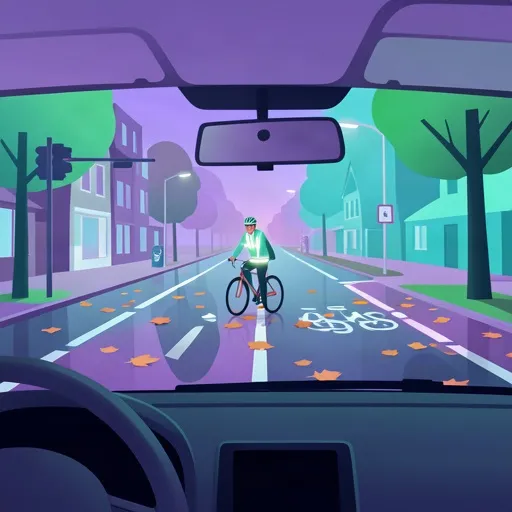
Autumn in the Netherlands brings a combination of rain, fog, and falling leaves, all of which contribute to reduced visibility and slippery road surfaces. From a driving perspective, these factors mean you must adjust your speed and scanning patterns. Cyclists, often bundled up in scarves or hoods, may have their field of vision restricted, making it even more vital for you, as the driver, to maintain an active duty of care.
Anticipation is the core competency required for the CBR hazard perception component. You must constantly scan for cyclists, especially near schools, shopping areas, and major commuting routes. When visibility is low, you should rely on the "street lights on means bike lights on" principle, anticipating that cyclists will be present even if they are difficult to spot at first glance.
Defensive driving involves assuming that other road users may make mistakes or fail to see you. Cyclists are balancing vehicles; a sudden gust of wind or a slippery patch of road can cause them to swerve unexpectedly. Maintaining a lateral distance of at least 1.5 meters when overtaking is the legal standard and a crucial safety practice to ensure you have time to react if a cyclist loses their balance.
Always perform a 'shoulder check' (kijkhoek) before turning right. The blind spot between your side mirror and your peripheral vision is where many accidents involving cyclists occur in the Netherlands.
While many Dutch cyclists are seasoned commuters, not all follow the rules regarding lighting. In the autumn, you should be prepared for the worst-case scenario: cyclists without functioning lights or reflective clothing. If you see a reflection or a sudden movement, treat it as a potential hazard.
Though helmets are not legally mandatory for all cyclists in the Netherlands, their impact on road safety is undeniable. Statistics show that wearing a bicycle helmet can reduce the risk of severe injury by 60% and the risk of fatal head or brain injury by 70%. Understanding these risks helps you develop a mature perspective on road safety, which is often reflected in how you approach hazard perception scenarios during your exam.
The legal and moral obligation of a driver to anticipate the actions of more vulnerable road users, such as cyclists and pedestrians, and to adjust their driving behavior to prevent collisions, even when the other party is not strictly following the rules.
Navigating Dutch roads requires a firm grasp of signs that indicate where cyclists are permitted or required to ride. Paying attention to these signs allows you to predict where cyclists will emerge from or transition into the main carriageway.
Article content overview
Explore related topics, search based questions, and concepts that learners often look up when studying Safe Driving Near Cyclists. These themes reflect real search intent and help you understand how this topic connects to wider driving theory knowledge in the Netherlands.
Find clear and practical answers to common questions learners often have about Safe Driving Near Cyclists. This section helps explain difficult points, remove confusion, and reinforce the key driving theory concepts that matter for learners in the Netherlands.
The unofficial but practical rule is 'street lights on means bike lights on.' As a driver, you should anticipate that cyclists will be using their lights whenever street lighting is activated or visibility is otherwise reduced.
Drivers must proactively check for cyclists, especially when turning right. Cyclists may pass on the right and can easily become hidden in a vehicle's blind spot. Always scan mirrors and shoulder check before changing direction.
No, wearing a bicycle helmet is not legally mandated for all cyclists in the Netherlands. However, it is strongly recommended for safety, as statistics show helmets significantly reduce the risk of severe head and brain injuries.
Anticipation is a core competency in the CBR theory exam because it tests your ability to predict the actions of other road users, especially vulnerable ones like cyclists, before a dangerous situation develops.
Start your targeted search now to explore a vast library of official Dutch driving theory articles and guides. Reinforce your understanding of specific traffic rules or road signs to ensure you are fully prepared for your upcoming CBR theory exam. Discover comprehensive explanations tailored for success.