
Many learner drivers mistakenly believe that a bus always has priority in traffic. This guide breaks down the official Dutch traffic legislation to help you understand exactly when you are required to yield to a bus, focusing on the specific scenario of leaving a bus stop within built-up areas. By learning the interplay between location and driver signaling, you will be better prepared to handle priority questions on your theory test with confidence.
Article content overview
Many learner drivers navigating the Dutch road network operate under the mistaken belief that a bus always has priority in traffic. This misconception is a frequent cause of errors during the CBR theory exam, as students often assume that the size or public function of the vehicle grants it an automatic right-of-way in every situation. In reality, Dutch traffic legislation is highly specific about when you must yield to a bus, and understanding these precise conditions is essential for both your safety and your success on the official exam.
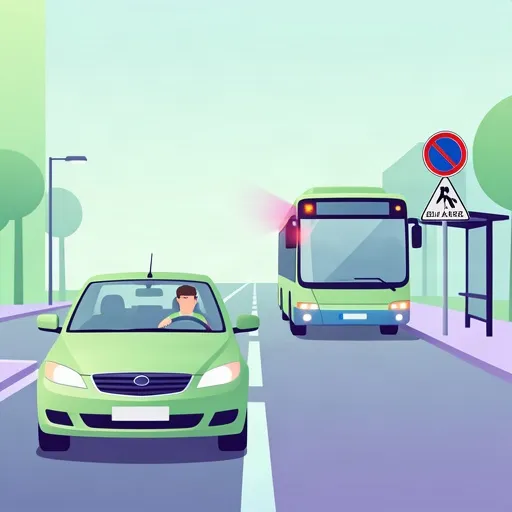
According to the RVV (Reglement verkeersregels en verkeerstekens), the rule regarding bus priority is geographically restricted. You are only required to give priority to a bus when it is attempting to pull away from a bus stop located within a built-up area. This regulation is designed to support the reliability and efficiency of public transport in busy urban environments where traffic density makes it difficult for large vehicles to merge safely.
The rule only applies when the bus is leaving a designated bus stop and the driver has clearly signaled their intention to do so. If the bus is merely moving within the flow of traffic or stopping at a traffic light, it must follow the standard priority rules applicable to all other drivers.
Outside of built-up areas, this specific priority rule does not apply. If you encounter a bus pulling away from a stop on a provincial road or a highway, the standard right-of-way rules—such as those dictated by signage or the priority of traffic from the right—take precedence. Always check your surroundings to determine if you are inside or outside of a built-up area, as this status fundamentally changes your legal obligations.
For the priority rule to be valid in a built-up area, two conditions must be met simultaneously. First, the location must be officially designated as a built-up area. Second, the bus driver must actively indicate their intention to pull away by using their turn signal. Without the active signal, the bus driver does not possess priority, and other road users are not legally required to yield.
The CBR frequently tests this knowledge by presenting scenarios that challenge your ability to distinguish between different environments. A common exam question may show a bus at a stop with a background clearly indicating an environment outside a built-up area. If you reflexively grant the bus priority simply because it is a public transport vehicle, you will likely choose the incorrect answer.
Another frequent trap involves the "passenger safety" aspect of bus or tram stops. While priority is limited to pulling away, you must always exercise caution regarding passengers. If passengers are entering or exiting a bus or tram in the middle of the road where no traffic island or central reservation exists, you are required to stop and let them cross safely. This is a separate safety requirement from the priority rule of pulling away, but it is equally critical for the theory exam.
To ensure you are fully prepared for the exam, remember that a bus is not a "priority vehicle" in the same category as emergency vehicles displaying blue lights and sirens. Trams, however, operate under a different set of complex rules, often having priority when turning even when you are driving straight. Always analyze the specific type of public transport vehicle involved in the scenario before applying your knowledge of priority.
| Condition | Built-Up Area | Outside Built-Up Area |
|---|---|---|
| Bus pulling away from stop | Must yield (if signaling) | Standard rules apply |
| General traffic movement | Standard rules apply | Standard rules apply |
| Tram turning | Priority usually applies | Priority usually applies |
This article clarifies that buses do not have automatic priority on Dutch roads; instead, they only require yielding when pulling away from a designated stop inside a built-up area while actively signaling. Two conditions must be met simultaneously for this special priority rule to apply, and outside built-up areas, standard priority rules govern all vehicles including buses. The CBR exam frequently tests the ability to distinguish between built-up and non-built-up scenarios and to recognize that bus size or public function does not grant automatic right-of-way. A separate safety rule also requires stopping for passengers crossing the road at bus or tram stops without a traffic island, independent of the priority rule.
A short set of high-value points that capture the most important ideas from this article.
Bus priority only applies when the bus is pulling away from a designated stop within a built-up area
Two conditions must be met simultaneously: the location must be a built-up area AND the bus driver must have the turn signal active
Outside built-up areas, buses follow the same standard priority rules as any other vehicle
Buses are not classified as priority vehicles like emergency vehicles displaying blue lights and sirens
The physical environment (built-up vs. outside built-up) fundamentally changes your legal obligations toward buses
The rule originates from the RVV (Reglement verkeersregels en verkeerstekens) and applies only within officially designated built-up areas
Without the active turn signal, the bus driver does not have priority even inside a built-up area
Built-up areas are marked by specific signs indicating urban density where local rules apply
Passenger safety is a separate requirement: always stop for passengers crossing where no traffic island exists, regardless of priority rules
Trams operate under different, often more complex, priority rules that usually grant them priority when turning
Assuming buses always have priority because they are large public transport vehicles
Granting bus priority in non-built-up areas where standard right-of-way rules apply
Overlooking the requirement for the active turn signal before yielding
Confusing tram priority rules with bus priority rules, as trams have their own distinct regulations
Confusing emergency vehicle priority with bus priority, as only emergency vehicles hold true priority status
Article content overview
A short set of high-value points that capture the most important ideas from this article.
Bus priority only applies when the bus is pulling away from a designated stop within a built-up area
Two conditions must be met simultaneously: the location must be a built-up area AND the bus driver must have the turn signal active
Outside built-up areas, buses follow the same standard priority rules as any other vehicle
Buses are not classified as priority vehicles like emergency vehicles displaying blue lights and sirens
The physical environment (built-up vs. outside built-up) fundamentally changes your legal obligations toward buses
The rule originates from the RVV (Reglement verkeersregels en verkeerstekens) and applies only within officially designated built-up areas
Without the active turn signal, the bus driver does not have priority even inside a built-up area
Built-up areas are marked by specific signs indicating urban density where local rules apply
Passenger safety is a separate requirement: always stop for passengers crossing where no traffic island exists, regardless of priority rules
Trams operate under different, often more complex, priority rules that usually grant them priority when turning
Assuming buses always have priority because they are large public transport vehicles
Granting bus priority in non-built-up areas where standard right-of-way rules apply
Overlooking the requirement for the active turn signal before yielding
Confusing tram priority rules with bus priority rules, as trams have their own distinct regulations
Confusing emergency vehicle priority with bus priority, as only emergency vehicles hold true priority status
Explore related topics, search based questions, and concepts that learners often look up when studying Bus Priority Rules Explained. These themes reflect real search intent and help you understand how this topic connects to wider driving theory knowledge in the Netherlands.
Find clear and practical answers to common questions learners often have about Bus Priority Rules Explained. This section helps explain difficult points, remove confusion, and reinforce the key driving theory concepts that matter for learners in the Netherlands.
No. Buses only have priority when pulling away from a bus stop located within a built-up area and provided the driver has signaled their intention to pull away.
No. The specific priority rule for buses pulling away from a stop does not apply outside of built-up areas; normal priority rules apply instead.
Yes. In built-up areas, the rule for yielding to a bus applies only if the bus driver has clearly indicated their intention to pull away from the bus stop.
Start your targeted search now to explore a vast library of official Dutch driving theory articles and guides. Reinforce your understanding of specific traffic rules or road signs to ensure you are fully prepared for your upcoming CBR theory exam. Discover comprehensive explanations tailored for success.