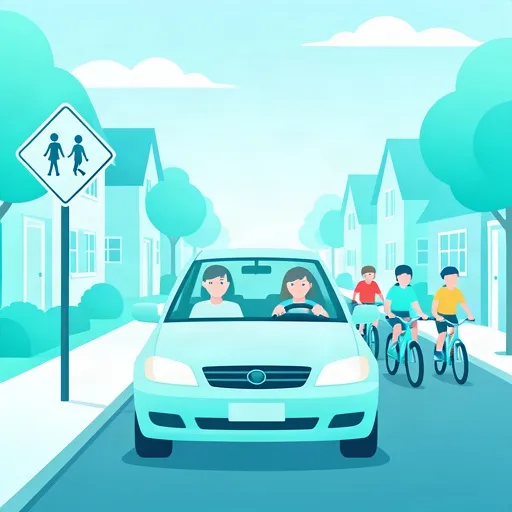
Driving near schools requires a heightened level of alertness and defensive driving to protect the most vulnerable road users. This guide helps you understand how to anticipate potential hazards around educational institutions, comply with Dutch traffic regulations, and prepare for the specific scenarios you will encounter during your CBR theory exam.
Article content overview
Navigating school zones is one of the most critical responsibilities for any driver in the Netherlands. During the CBR theory exam, you will frequently encounter hazard perception questions that focus on residential areas, school surroundings, and the presence of young, vulnerable road users. Understanding these environments is not just about passing a test; it is about protecting the most unpredictable participants in our traffic system. Children often lack the experience to correctly judge the speed and distance of approaching vehicles, and their impulsivity can lead them to cross the road suddenly or play near the carriageway.
When you enter a school zone, your primary objective should be to adopt a defensive driving style. This means adjusting your speed well in advance, even if there is no explicit sign indicating a lower limit. By lowering your speed, you increase your reaction time and significantly reduce the stopping distance of your vehicle, which is essential if a child unexpectedly steps onto the road from behind a parked car or a bush.
In recent years, many Dutch municipalities have implemented the "schoolstraat" (school street) concept to create safer environments during drop-off and pick-up times. A schoolstraat is a road or street section near an educational institution that is closed to motor vehicles during specific hours of the day. As a driver, you must be hyper-aware of road signs that indicate these temporal restrictions. Violating these rules is a common source of exam questions, as they test your ability to observe signs and adapt your route accordingly.
If you encounter a street designated as a schoolstraat, you must refrain from entering it during the restricted times. These zones are designed to give children the space to walk or cycle independently. Encouraging independent travel is a national priority, and as a driver, your role is to provide that space by choosing alternative routes and avoiding unnecessary congestion in school-dense neighborhoods.
Children are not "small adults" when it comes to traffic awareness. Their cognitive development is still ongoing, and they often cannot properly assess risks, especially when distracted by friends, mobile phones, or sports equipment. The CBR theory exam often tests your ability to spot "hidden" dangers, such as children playing near the pavement or standing behind parked vehicles.
When driving through a residential area, you should look for signs of children in the vicinity. Watch for feet visible underneath parked cars or balls rolling onto the street, which are common precursors to a child running into the path of your vehicle. Always assume that if a child is on the pavement, they might decide to cross at any moment.
Never assume a child has seen you. Even if you have made eye contact, their reaction time is slower, and they may still step out onto the road unexpectedly. Always cover your brake pedal to ensure you can stop immediately if needed.
While speed limits define the legal maximum, safe driving near schools often requires you to drive significantly slower than the posted limit. For instance, in a 30 km/h zone, driving at 30 km/h may still be too fast if there are many children crossing the road. Defensive driving requires you to balance the legal requirements with the reality of the situation on the road.
The blind spot around a vehicle where the driver cannot see other road users, such as cyclists or pedestrians, even when using mirrors. This is particularly dangerous for children near large vehicles.
The theory exam uses interactive clips to test your hazard perception. You will be asked to decide whether to "brake," "release gas," or "do nothing." When you see a school zone, the most common correct answer for a potential hazard is "brake" or "release gas" to show that you are anticipating the movement of children. If a child is visible on the sidewalk in a clip, the safest choice is almost always to prepare to stop.
Driving near schools in the Netherlands requires heightened defensive driving awareness because children lack the traffic experience to accurately assess vehicle speed and distance. Key concepts include the schoolstraat (timed vehicle restrictions near schools), the dode hoek blind spot danger, and the importance of early speed reduction to improve reaction and stopping distances. The CBR theory exam tests these skills through interactive hazard perception clips where the safest response near children is typically to brake or release gas. Understanding these principles is essential for both passing the exam and protecting vulnerable road users in real traffic situations.
A short set of high-value points that capture the most important ideas from this article.
Children cannot accurately judge vehicle speed and distance due to ongoing cognitive development, making them unpredictable road users.
The schoolstraat is a timed vehicle restriction near schools during drop-off and pick-up hours, enforced with specific road signs.
Defensive driving in school zones requires reducing speed well below posted limits when children are present, not just meeting the legal maximum.
Hidden dangers like feet under parked cars or balls rolling into the street are common precursors to children entering the roadway.
The CBR exam tests hazard perception in school zones, where the correct response is typically to brake or release gas when children are visible.
Never assume a child has seen your vehicle; always cover the brake pedal and be prepared to stop immediately.
A schoolstraat sign indicates the road is closed to all vehicles during specific school hours.
The dode hoek (blind spot) is especially dangerous for children near larger vehicles like vans and trucks.
Stopping distance equals reaction distance plus braking distance, both of which improve when you reduce speed early.
Hazard perception clips in the CBR exam expect braking or gas release when children are visible on sidewalks or near the road.
Assuming eye contact with a child means they will wait and not cross unexpectedly.
Driving at the posted speed limit without adjusting for the actual presence of children in the area.
Entering a schoolstraat during restricted hours because no other vehicles are visible.
Failing to scan the full road width including spaces between parked cars for hidden children.
Reacting too late by not reducing speed early enough to maintain adequate stopping distance.
Article content overview
A short set of high-value points that capture the most important ideas from this article.
Children cannot accurately judge vehicle speed and distance due to ongoing cognitive development, making them unpredictable road users.
The schoolstraat is a timed vehicle restriction near schools during drop-off and pick-up hours, enforced with specific road signs.
Defensive driving in school zones requires reducing speed well below posted limits when children are present, not just meeting the legal maximum.
Hidden dangers like feet under parked cars or balls rolling into the street are common precursors to children entering the roadway.
The CBR exam tests hazard perception in school zones, where the correct response is typically to brake or release gas when children are visible.
Never assume a child has seen your vehicle; always cover the brake pedal and be prepared to stop immediately.
A schoolstraat sign indicates the road is closed to all vehicles during specific school hours.
The dode hoek (blind spot) is especially dangerous for children near larger vehicles like vans and trucks.
Stopping distance equals reaction distance plus braking distance, both of which improve when you reduce speed early.
Hazard perception clips in the CBR exam expect braking or gas release when children are visible on sidewalks or near the road.
Assuming eye contact with a child means they will wait and not cross unexpectedly.
Driving at the posted speed limit without adjusting for the actual presence of children in the area.
Entering a schoolstraat during restricted hours because no other vehicles are visible.
Failing to scan the full road width including spaces between parked cars for hidden children.
Reacting too late by not reducing speed early enough to maintain adequate stopping distance.
Explore related topics, search based questions, and concepts that learners often look up when studying Driving Safely Near Schools. These themes reflect real search intent and help you understand how this topic connects to wider driving theory knowledge in the Netherlands.
Find clear and practical answers to common questions learners often have about Driving Safely Near Schools. This section helps explain difficult points, remove confusion, and reinforce the key driving theory concepts that matter for learners in the Netherlands.
A 'schoolstraat' (school street) is a street near a school that is restricted for motorized traffic during specific drop-off and pick-up times to create a safe, car-free zone for children.
Traffic intensity near schools increases significantly after the summer break. Children may also have reduced traffic experience, making it essential for drivers to be more vigilant for sudden or unpredictable behavior.
Always reduce your speed and look carefully between and under parked vehicles. You must be prepared for the possibility that children might unexpectedly step out from behind them.
The CBR expects you to recognize potential risks, such as children playing near the road or cyclists crossing, and to respond proactively by adjusting your speed and maintaining a higher level of alertness.
Start your targeted search now to explore a vast library of official Dutch driving theory articles and guides. Reinforce your understanding of specific traffic rules or road signs to ensure you are fully prepared for your upcoming CBR theory exam. Discover comprehensive explanations tailored for success.