
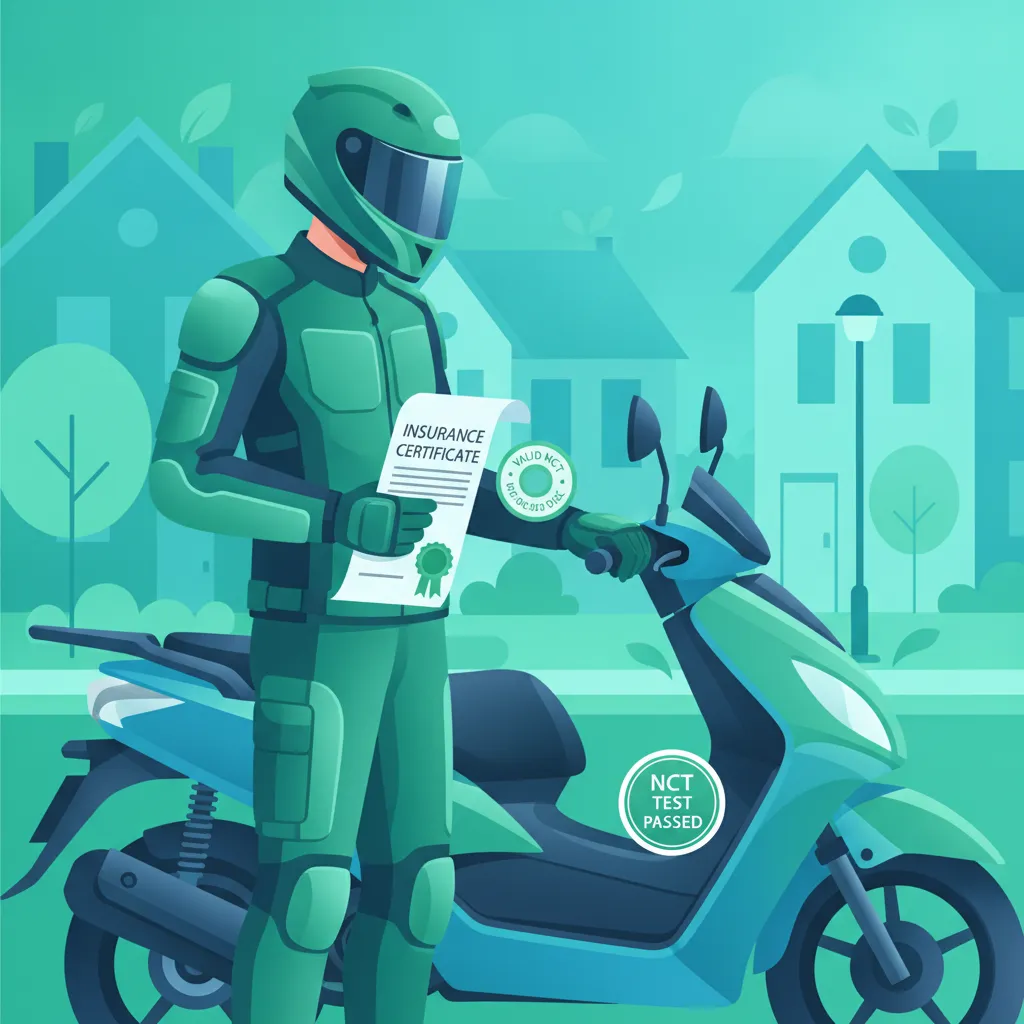
This lesson details the mandatory legal requirements for operating a moped under a Category AM licence in Ireland. You will learn about the necessity of insurance, vehicle registration, and the specific status of mopeds regarding the National Car Test, ensuring you are fully compliant before hitting the road.
Lesson content overview
Operating a moped or light quadricycle on public roads in Ireland comes with strict legal responsibilities. Just like driving a car or heavy commercial vehicle, riding a Category AM vehicle requires compliance with administrative laws. These laws are designed to ensure road safety, financial accountability, and proper vehicle identification.
This lesson covers the compulsory legal requirements for Category AM vehicles under Irish law. You will learn about mandatory third-party liability insurance, vehicle registration, motor tax, the National Car Test (NCT) exemptions, and the severe penalties for non-compliance.
In Ireland, a Category AM vehicle is defined as a moped or light quadricycle with a maximum design speed of 45 km/h and an engine capacity not exceeding 50cc (or a continuous rated power of 4kW for electric motors). Because these vehicles share public roads with larger, faster vehicles, the Road Safety Authority (RSA) and the Department of Transport enforce strict administrative rules.
Every moped used on a public road must be registered, taxed, and covered by a valid insurance policy. Even if a vehicle is only ridden for short distances, on quiet residential streets, or occasionally, there are absolutely no exemptions from these requirements. Understanding and maintaining your vehicle's legal paperwork is just as important as knowing how to ride safely.
Motor insurance is not optional; it is a strict legal requirement under the Irish Road Traffic Acts. Before you sit on your moped on any public road, you must have an active insurance policy.
The minimum statutory motor insurance required by Irish law. It covers your financial liability for bodily injury or death caused to another person (a third party), as well as damage to their property, resulting from the use of your vehicle.
When insuring a Category AM moped, riders generally choose between different tiers of cover:
While only Third-Party cover is legally mandatory, riders should carefully weigh the financial risk of losing their vehicle against the cost of comprehensive cover.
When you purchase an insurance policy, your insurer will issue an official Insurance Certificate and an insurance disc.
Under Irish road traffic legislation, you must be able to produce a valid insurance certificate when requested by a member of An Garda Síochána (the Irish police). If you do not have the certificate on your person during a roadside check, you will be required to present it at a nominated Garda station within 10 days.
Do not rely on verbal confirmations. Believing that your insurance is active because you paid over the phone is not a legal defence. You must possess the physical or official digital certificate issued by an approved insurer to prove compliance during a Garda inspection.
Every motor vehicle imported into or sold in Ireland must be recorded on the National Vehicle and Driver File (NVDF) maintained by the Department of Transport.
Upon registration, the vehicle is assigned a unique Vehicle Registration Number (VRN). This number must be displayed on a legal registration plate at the rear of your moped.
Motor tax is an annual charge levied by the government to fund public road infrastructure and maintenance. All registered mopeds must have up-to-date motor tax if they are used in a public place.
Receive the Renewal Notice: The Department of Transport will send a renewal form (RF100 or RF100A) to your registered address before your current tax expires.
Submit Payment: You can pay your motor tax online via the official Motor Tax website using the PIN provided on your renewal form, or in person at your local Motor Tax Office.
Display the Tax Disc: Once paid, you will receive a paper Motor Tax Disc. This disc must be displayed in a weatherproof, transparent holder on your moped, visible for inspection.
If you plan to take your moped off the road for a period of time, you must declare it off the road in advance using a Statutory Declaration of Non-Use (Form RF150). You cannot simply let the tax lapse and claim retroactively that the vehicle was not in use.
One of the most common points of confusion for new Category AM riders is whether their vehicle must undergo a periodic roadworthiness inspection similar to the National Car Test (NCT).
Category AM vehicles, including mopeds and certain light quadricycles, are legally exempt from the National Car Test (NCT) regime in Ireland. They do not require an NCT certificate or a windscreen test sticker.
The exemption exists because Category AM vehicles have a significantly lower weight, limited engine capacity, and a restricted maximum design speed of 45 km/h. This places them in a lower risk profile compared to heavy passenger cars and commercial vehicles.
While your moped is exempt from a formal, scheduled state inspection, this does not mean you are exempt from maintaining your vehicle in a roadworthy condition.
Under Irish road traffic law, it is a constant legal offence to operate any vehicle on a public road if it is mechanically defective or unsafe. You are personally responsible for daily safety checks.
If you are involved in an accident and it is determined that your moped had bald tyres, faulty brakes, or non-functioning lights, you face severe legal consequences:
Ireland enforces strict penalties to deter uninsured driving, tax evasion, and unregistered vehicle use. These measures protect the public and ensure that all road users contribute fairly to the road network.
Riding a moped without valid third-party insurance is a very serious criminal offence. The Gardaí have extensive powers and advanced technology (including Automatic Number Plate Recognition) to detect uninsured vehicles.
Additionally, under Section 41 of the Road Traffic Act, a Garda has the power to seize and impound your moped on the spot if they suspect it is uninsured. You will have to pay a substantial release fee and storage charges, and you must provide proof of valid insurance before the vehicle is released to you.
Failing to register your vehicle or riding with an expired motor tax disc is also heavily penalised:
Operating a moped legally requires understanding how these administrative rules apply to different real-world scenarios.
To avoid fines and court dates, be aware of these common myths:
Riding a moped safely in Ireland involves more than just physical balance and observation. It requires complete administrative compliance. Before every journey, ensure your moped is registered, your motor tax is paid and displayed, your vehicle is in roadworthy condition, and your insurance is fully active.
To expand your knowledge of moped regulations and prepare for your Irish theory test, explore the following resources:
Explore all units and lessons included in this driving theory course.
Lesson content overview
Explore all units and lessons included in this driving theory course.
Explore search topics learners often look for when studying Insurance and NCT Considerations for Mopeds. These topics reflect common questions about road rules, driving situations, safety guidance, and lesson level theory preparation for learners in Ireland.
Browse additional driving theory lessons that cover connected traffic rules, road signs, and common driving situations related to this topic. Improve your understanding of how different rules interact across everyday traffic scenarios.
Learn the comprehensive administrative rules for Category AM vehicles in Ireland. This guide covers mandatory registration processes, motor tax obligations, and the legal consequences of non-compliance to help you maintain full vehicle documentation according to the Road Safety Authority regulations.
This lesson details the legal requirements for motorcycle insurance under Irish law, emphasizing the absolute necessity of holding valid third-party cover. It outlines the rider's responsibility to maintain their motorcycle in a completely roadworthy condition, focusing on critical safety components like tyres, brakes, and lights. Learners will examine how mechanical failures and non-compliance with maintenance standards compromise legal eligibility and safety.
This lesson explains the foundational legal obligations of motorcyclists under Irish road traffic legislation and the official Rules of the Road. It covers mandatory compliance with speed limits, correct signalling protocols, and strict adherence to lane discipline and right-of-way laws. Riders will gain a comprehensive understanding of the legal consequences and safety risks associated with traffic violations.

This lesson details the statutory rules governing learner permit holders, including compulsory safety gear and vehicle roadworthiness standards. Riders must understand the requirement for high-visibility clothing, functioning warning devices, and compliance with the official Rules of the Road. Safe riding habits are established by strictly adhering to these RSA standards.

This lesson details the use of daytime running lights to raise a rider's profile during daylight hours on Irish roads. It discusses the installation guidelines, legal restrictions, and safety benefits of auxiliary lighting systems on mopeds. Special care must be taken to prevent dazzling oncoming traffic while ensuring the vehicle remains highly recognizable.
This lesson guides learners through the essential pre-ride safety checklist for mopeds and light quadricycles. It explains how to check tyre tread, brake responsiveness, functional lighting, and mirror alignment before starting any journey. Maintaining these components ensures vehicle compliance and minimizes the risk of mechanical failure on Irish roads.

This lesson details the legal consequences of non-compliance with Irish road traffic laws, focusing on fixed charge notices, fines, and court prosecutions. It explains how persistent traffic violations can lead to mandatory licence disqualification, vehicle seizure, and soaring insurance premiums. Motorcyclists will learn about the serious long-term impact that a criminal driving record has on employment.
This lesson emphasizes the critical importance of being highly visible to other road users under various lighting conditions. It reviews the legal requirements for front and rear lights on Category AM vehicles and the active use of reflective materials. Proper maintenance of lighting systems is discussed to ensure continuous operation during adverse weather.

Learner drivers in Ireland must adhere to strict operational rules, including the compulsory display of red L-plates and driving under qualified supervision. This lesson outlines your specific duties as a learner, the legal definitions of an accompanying experienced driver, and the elevated safety margins you must maintain on the road. Failing to comply with these learner regulations carries serious legal penalties and delays your progression to a full driving licence.
This lesson outlines the legal speed limits governing mopeds and light quadricycles in various Irish environments, including urban centers and school zones. It clarifies why Category AM vehicles are strictly prohibited from driving on motorways due to safety and speed disparities. Riders will also study the legal penalties, including fines and points, for speeding.

This lesson covers the legal definition of mopeds and light quadricycles in Ireland, specifying engine capacity and maximum power limits. It outlines the minimum age requirements and the specific routes where these vehicles are legally permitted to operate. Understanding these classifications is critical for compliance with Irish and EU regulations.
Understand your ongoing responsibility to keep your moped in a roadworthy condition despite NCT exemptions. This overview details essential daily safety checks, including tyre integrity, lighting systems, and brake functionality required under Irish traffic law to ensure vehicle safety and insurance validity on public roads.
This lesson guides learners through the essential pre-ride safety checklist for mopeds and light quadricycles. It explains how to check tyre tread, brake responsiveness, functional lighting, and mirror alignment before starting any journey. Maintaining these components ensures vehicle compliance and minimizes the risk of mechanical failure on Irish roads.
This lesson details the critical role of tyres in maintaining grip and vehicle stability on diverse road surfaces. It provides guidance on measuring tread depth, checking inflation levels, and identifying signs of tyre wear and damage. Additionally, it presents techniques for maintaining balance and executing tight, low-speed turns safely.
This lesson details the use of daytime running lights to raise a rider's profile during daylight hours on Irish roads. It discusses the installation guidelines, legal restrictions, and safety benefits of auxiliary lighting systems on mopeds. Special care must be taken to prevent dazzling oncoming traffic while ensuring the vehicle remains highly recognizable.

This lesson explores common surface hazards encountered on municipal and rural Irish roads, including loose gravel and wet leaves. It explains how these surface conditions rapidly reduce tyre traction and affect overall handling and braking control. Riders will learn visual scanning techniques to identify these hazards early and execute safe evasion maneuvers.

This lesson teaches riders how to actively identify and eliminate blind spots through proper mirror adjustment and physical shoulder checks. It explains the concept of a safety cushion, which represents the defensive space maintained around the moped at all times. Managing these zones ensures adequate reaction time and mitigates the impact of sudden braking.
Find clear answers to common questions learners have about Insurance and NCT Considerations for Mopeds. Learn how the lesson is structured, which driving theory objectives it supports, and how it fits into the overall learning path of units and curriculum progression in Ireland. These explanations help you understand key concepts, lesson flow, and exam focused study goals.
No, currently, mopeds and light quadricycles under Category AM are exempt from the National Car Test (NCT) in Ireland. However, you are still legally required to keep your vehicle in a roadworthy condition at all times.
Yes, third-party insurance is the minimum legal requirement to operate a moped on public roads in Ireland. It covers you for liability regarding damage or injury caused to other people or their property.
Driving without insurance is a serious offence in Ireland. It can lead to heavy fines, penalty points, court summons, and potential disqualification from driving, which will significantly impact your ability to hold a licence in the future.
Yes, you must display a valid motor tax disc on your moped at all times when it is used on public roads. Failure to do so can result in fixed charge notices and further legal complications.
Use the practice question search tool to pinpoint specific topics, road signs, or rules you need to master for your official Driver Theory Test. Refine your study strategy and ensure comprehensive preparation for all aspects of the Irish driving exam. Start your focused revision now and build confidence for your learner permit test.