
This lesson details the specific speed restrictions and legal operational boundaries for Category AM mopeds and light quadricycles in Ireland. You will learn the importance of adhering to these limits to maintain safety and avoid legal consequences, providing a foundation for your upcoming Theory Test.
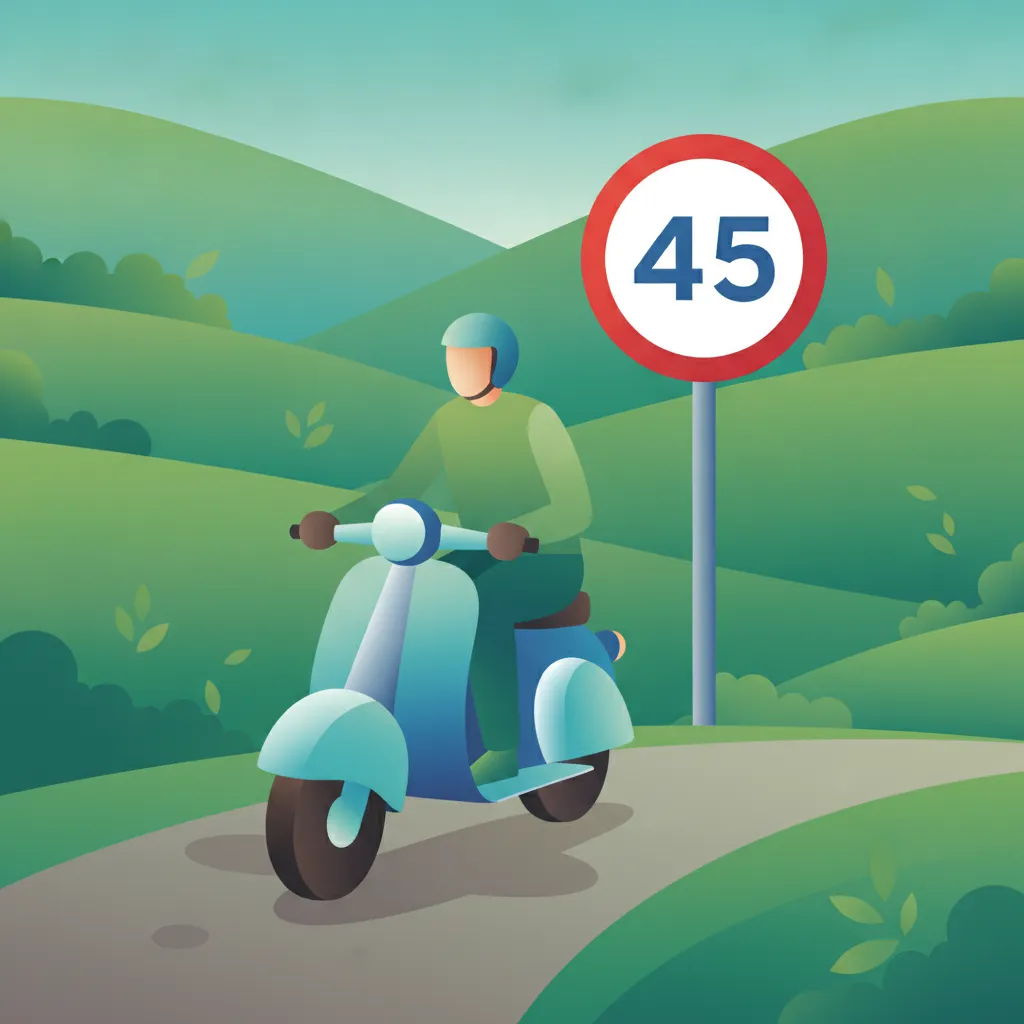
Lesson content overview
Operating a Category AM vehicle—which includes mopeds and light quadricycles—requires a precise understanding of speed limits and road dynamics. In Ireland, the Road Safety Authority (RSA) sets clear guidelines to manage the risks associated with light, low-powered vehicles.
Because Category AM vehicles have lower mass, less protective structural shielding, and smaller tyres than standard passenger cars, managing your speed is the single most important factor in maintaining control and preventing serious collisions. This lesson provides an in-depth breakdown of Irish speed limits, motorway restrictions, signage, and the legal and physical consequences of speeding.
Before examining specific legal limits, it is essential to understand why speed is regulated so strictly for Category AM vehicles. The physics of a moving vehicle dictate how it behaves during braking, cornering, and emergency manoeuvring.
Kinetic energy is the energy an object possesses due to its motion. It is calculated using the formula:
Where is the mass of the vehicle and rider, and is the velocity (speed). Because velocity is squared, any increase in speed results in an exponential increase in kinetic energy.
Your total stopping distance is comprised of two distinct phases:
Because Category AM vehicles have a smaller tyre contact patch (the physical area of rubber touching the road) and less advanced suspension systems than larger vehicles, their braking distance can increase rapidly on uneven or wet Irish road surfaces. Reducing your speed gives you the vital seconds needed to react and brings your vehicle to a halt within a safe, controlled distance.
In Ireland, speed limits are legally enforced maximums, not target speeds. You must never ride faster than the posted speed limit, and you must frequently ride slower if road, traffic, or weather conditions demand it.
Under Irish and European law, a Category AM vehicle is structurally and legally restricted.
A Category AM moped or light quadricycle must have a maximum design speed of no more than 45 km/h.
This means that even if a road has a posted speed limit of 50 km/h, 60 km/h, or 80 km/h, your vehicle is legally prohibited from exceeding 45 km/h. Attempting to modify or "derestrict" a moped to exceed this speed is a serious offence that invalidates your insurance, voids your roadworthiness, and carries severe legal penalties.
While your vehicle cannot exceed 45 km/h, you must adhere to lower local speed limits where posted.
| Road Environment | Standard Car Limit | Category AM Absolute Limit | Key Safety Considerations |
|---|---|---|---|
| School Zones | 30 km/h | 30 km/h | High pedestrian activity; children may step into the road unexpectedly. |
| Residential / Shared Zones | 30 km/h | 30 km/h | Narrow roads, parked cars, cyclists, and quiet pedestrian environments. |
| Urban Roads / Built-up Areas | 50 km/h | 45 km/h | Frequent junctions, traffic lights, and sudden pedestrian crossings. |
| Rural Roads | 80 km/h | 45 km/h | High speed differential with other traffic; watch for agricultural vehicles and hidden bends. |
| Motorways | 120 km/h | Prohibited (0 km/h) | Absolute ban due to extreme speed disparities. |
Under the Road Traffic (Control of Entry) Order, Category AM vehicles, including mopeds and light quadricycles, are strictly prohibited from entering or travelling on Irish motorways.
The standard speed limit on an Irish motorway is 120 km/h. Because a Category AM vehicle cannot exceed 45 km/h, the speed differential between a moped and surrounding traffic (such as cars, buses, and heavy goods vehicles) would be 75 km/h or more.
This massive speed gap creates extreme hazards:
Riders must plan their routes carefully to avoid motorways, utilising local, regional, or national dual-carriageway routes where slow-moving vehicles are legally permitted, while maintaining extreme caution.
Riders must recognize and instantly comprehend road signs to adjust their speed dynamically. Regulatory speed limit signs in Ireland are circular with a white background, a thick red border, and black numerals indicating the limit in kilometres per hour (km/h).
In addition to standard fixed signs, you may encounter:
An Garda Síochána (the Irish police force) strictly enforces speed limits using fixed speed cameras, mobile safety vans (GoSafe), and laser speed detection guns. Speeding while operating a Category AM vehicle is a serious legal infraction.
If you are detected driving in excess of the legal speed limit, you face a structured scale of penalty points and fixed charges. The penalty points are recorded on your driving record as follows:
In Ireland, the threshold for licence suspension depends on your licensing status:
This lower threshold means that just two minor speeding offences can result in an immediate loss of your riding privileges.
The posted speed limit is a legal maximum for perfect conditions. Under Irish road conditions, you must routinely reduce your speed below the legal limit to ensure stability and control.
Ireland's frequent rain significantly impacts road friction. When water mixes with oil, rubber residue, and dust on the road surface, it creates an incredibly slick film, particularly during the first few minutes of rainfall.
At night, during heavy downpours, or in dense fog, your ability to spot hazards is severely compromised.
Riding Out of Your Headlights: Never ride so fast that your total stopping distance exceeds the distance illuminated by your vehicle's headlight. Category AM headlights are less powerful than car headlights; adjust your speed downward accordingly at night.
Small two-wheeled vehicles and light quadricycles are highly sensitive to surface irregularities. Potholes, loose gravel, fallen leaves, and steel manhole covers present severe skidding hazards. Navigating these at 45 km/h can easily destabilise your vehicle, whereas a reduced speed of 20 to 30 km/h allows you to negotiate or bypass the hazard safely.
To pass your Irish driving theory test and remain safe on the road, you must understand these common misunderstandings and errors:
You are riding on an urban street with a standard limit of 50 km/h. As you approach a local school, you notice the warning sign and flashing amber lights indicating school hours are active.
You are riding on a local rural road with an 80 km/h speed sign. It has been raining steadily for an hour, and the road has several sharp, blind bends with farming traffic mud on the tarmac.
Adhering to speed limits and understanding vehicle dynamics are foundational to safe riding on Irish roads. Always remember:
To prepare further for your theory exam, explore how speed control directly relates to braking distances and cornering grip.
This lesson covers the mandatory speed restrictions for Category AM vehicles in Ireland, where mopeds and light quadricycles are legally capped at 45 km/h regardless of posted road limits. The content explains the physics of kinetic energy and stopping distances specific to small vehicles, outlines speed limits by road environment in a detailed table, and provides the critical reason for the absolute motorway ban based on dangerous speed disparities. Learners will also find the graded penalty points system with specific thresholds for both novice and full licence holders, guidance on adjusting speed for wet conditions and poor visibility, and real-world scenarios demonstrating correct and incorrect responses to hazards. The lesson includes identification of Irish speed limit signage and clarifies that variable and periodic speed limits are legally binding.
A short set of high-value points that capture the most important learning from this lesson.
Category AM mopeds and light quadricycles are legally restricted to a maximum design speed of 45 km/h under Irish and European law
Motorway use is absolutely prohibited for Category AM vehicles due to extreme speed disparities that create dangerous conditions
School zones and residential areas impose mandatory 30 km/h limits that you must observe even when the standard urban limit is 50 km/h
Speed limits are legally enforced maximums, not target speeds; always adjust downward for road, weather, or traffic conditions
Learner and novice Category AM riders face a reduced penalty point threshold of 7 points within any 3-year period before licence suspension
Explore all units and lessons included in this driving theory course.
The 45 km/h absolute limit applies everywhere, even on roads posted at 50, 80, or 120 km/h
Exceeding the speed limit by more than 20 km/h can result in 7 penalty points and potential immediate court disqualification
Flashing amber lights indicate active school zone timing, but you must also use judgment when children are visibly present
Variable speed limit signs on major routes are legally binding and must be obeyed if they fall below 45 km/h
Derestricting a moped to exceed 45 km/h reclassifies it as a higher motorcycle category, invalidating your licence and insurance
Assuming the 45 km/h vehicle limit means you can ride at 45 km/h in all conditions without adjusting for weather, surface, or traffic
Believing speed cameras only target cars on motorways when mobile safety vans frequently operate in urban 30 and 50 km/h zones
Continuing at 45 km/h through school zones because flashing amber lights are not currently active when children are present
Modifying a moped to go faster, thinking it reclassifies the vehicle; in reality it invalidates your licence and insurance
Treating the posted speed limit as a target speed rather than a maximum that conditions may require you to fall below
Lesson content overview
A short set of high-value points that capture the most important learning from this lesson.
Category AM mopeds and light quadricycles are legally restricted to a maximum design speed of 45 km/h under Irish and European law
Motorway use is absolutely prohibited for Category AM vehicles due to extreme speed disparities that create dangerous conditions
School zones and residential areas impose mandatory 30 km/h limits that you must observe even when the standard urban limit is 50 km/h
Speed limits are legally enforced maximums, not target speeds; always adjust downward for road, weather, or traffic conditions
Learner and novice Category AM riders face a reduced penalty point threshold of 7 points within any 3-year period before licence suspension
Explore all units and lessons included in this driving theory course.
The 45 km/h absolute limit applies everywhere, even on roads posted at 50, 80, or 120 km/h
Exceeding the speed limit by more than 20 km/h can result in 7 penalty points and potential immediate court disqualification
Flashing amber lights indicate active school zone timing, but you must also use judgment when children are visibly present
Variable speed limit signs on major routes are legally binding and must be obeyed if they fall below 45 km/h
Derestricting a moped to exceed 45 km/h reclassifies it as a higher motorcycle category, invalidating your licence and insurance
Assuming the 45 km/h vehicle limit means you can ride at 45 km/h in all conditions without adjusting for weather, surface, or traffic
Believing speed cameras only target cars on motorways when mobile safety vans frequently operate in urban 30 and 50 km/h zones
Continuing at 45 km/h through school zones because flashing amber lights are not currently active when children are present
Modifying a moped to go faster, thinking it reclassifies the vehicle; in reality it invalidates your licence and insurance
Treating the posted speed limit as a target speed rather than a maximum that conditions may require you to fall below
Explore search topics learners often look for when studying Speed Limits for Category AM Vehicles. These topics reflect common questions about road rules, driving situations, safety guidance, and lesson level theory preparation for learners in Ireland.
Browse additional driving theory lessons that cover connected traffic rules, road signs, and common driving situations related to this topic. Improve your understanding of how different rules interact across everyday traffic scenarios.
Understand the relationship between speed, vehicle mass, and stopping distances on Irish roads. This explanation covers why Category AM vehicles have specific braking requirements and how environmental conditions like wet surfaces impact vehicle control and road safety for small motorcycles and mopeds.
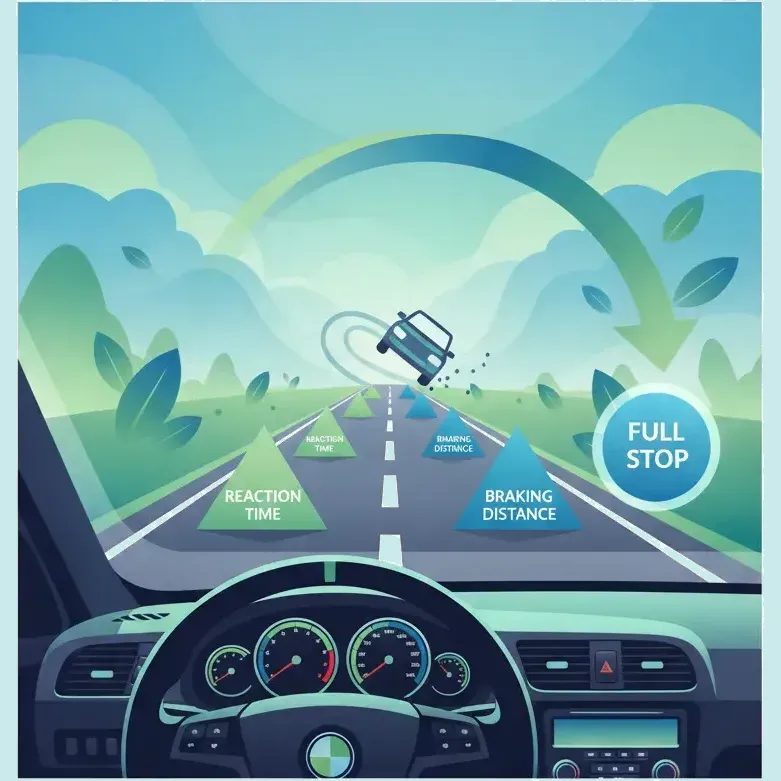
This lesson describes the physics of stopping a motorcycle, analyzing the distinct roles of the front and rear brakes during deceleration. It details how speed, road surface conditions, and vehicle weight distribution affect overall stopping distance and reaction times. Riders will learn how Anti-lock Braking Systems function and how to maximize braking force without locking the wheels.
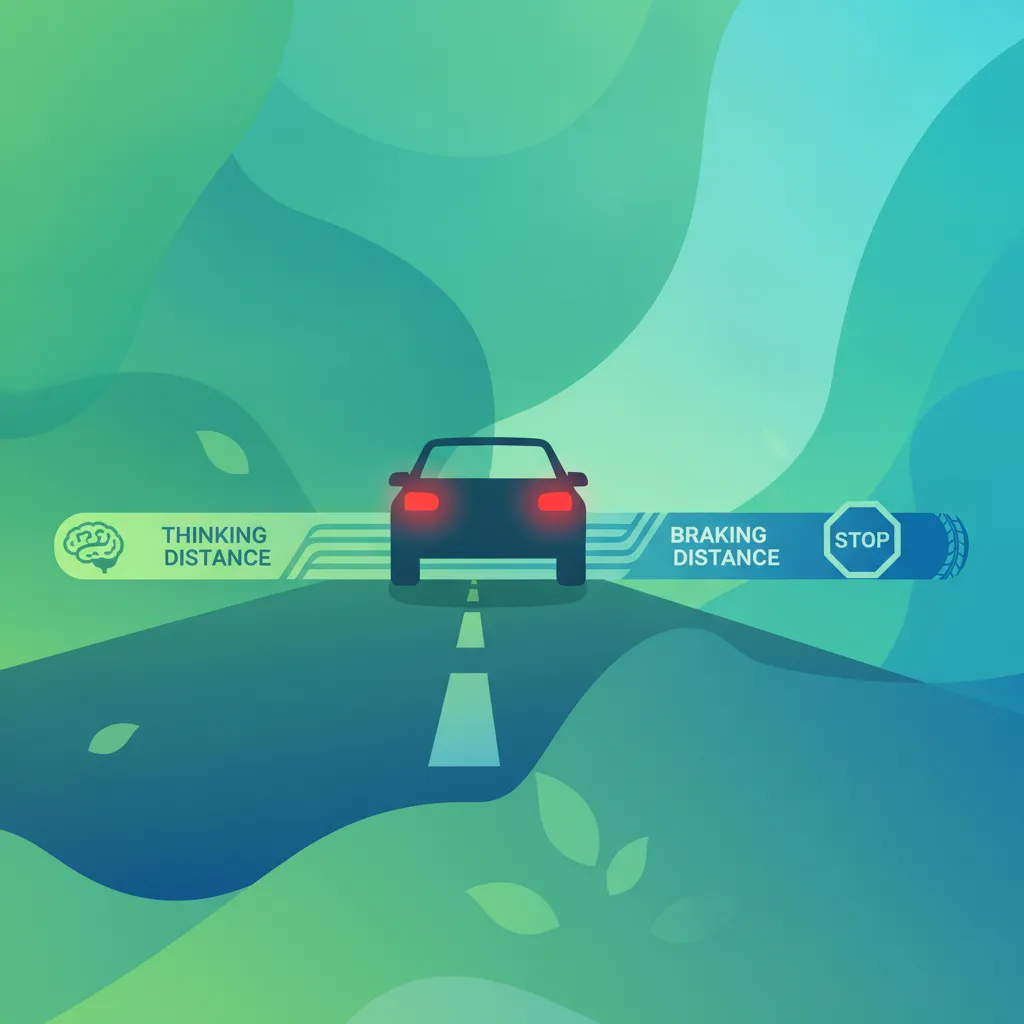
This lesson instructs riders on the correct application of the front and rear brakes to achieve smooth, controlled stopping. It explains how factors such as speed, reaction time, and tyre traction combine to determine total stopping distance. Learners will also study methods to prevent dangerous wheel lock-ups and skidding, especially in wet conditions.
Learn the defensive riding techniques required to navigate urban environments and school zones safely. This guide explains how to anticipate hazards, interact with larger road users, and adjust your riding position when sharing narrow roads and city infrastructure while complying with Irish Rules of the Road.

This lesson highlights the importance of smooth throttle adjustments for maintaining traction and stability on a moped. It teaches riders how to anticipate potential road hazards early, reducing the need for sudden emergency braking. Developing strong observation habits allows riders to adjust their speed smoothly and respond safely to traffic changes.

This lesson teaches riders how to actively identify and eliminate blind spots through proper mirror adjustment and physical shoulder checks. It explains the concept of a safety cushion, which represents the defensive space maintained around the moped at all times. Managing these zones ensures adequate reaction time and mitigates the impact of sudden braking.

This lesson explores common surface hazards encountered on municipal and rural Irish roads, including loose gravel and wet leaves. It explains how these surface conditions rapidly reduce tyre traction and affect overall handling and braking control. Riders will learn visual scanning techniques to identify these hazards early and execute safe evasion maneuvers.
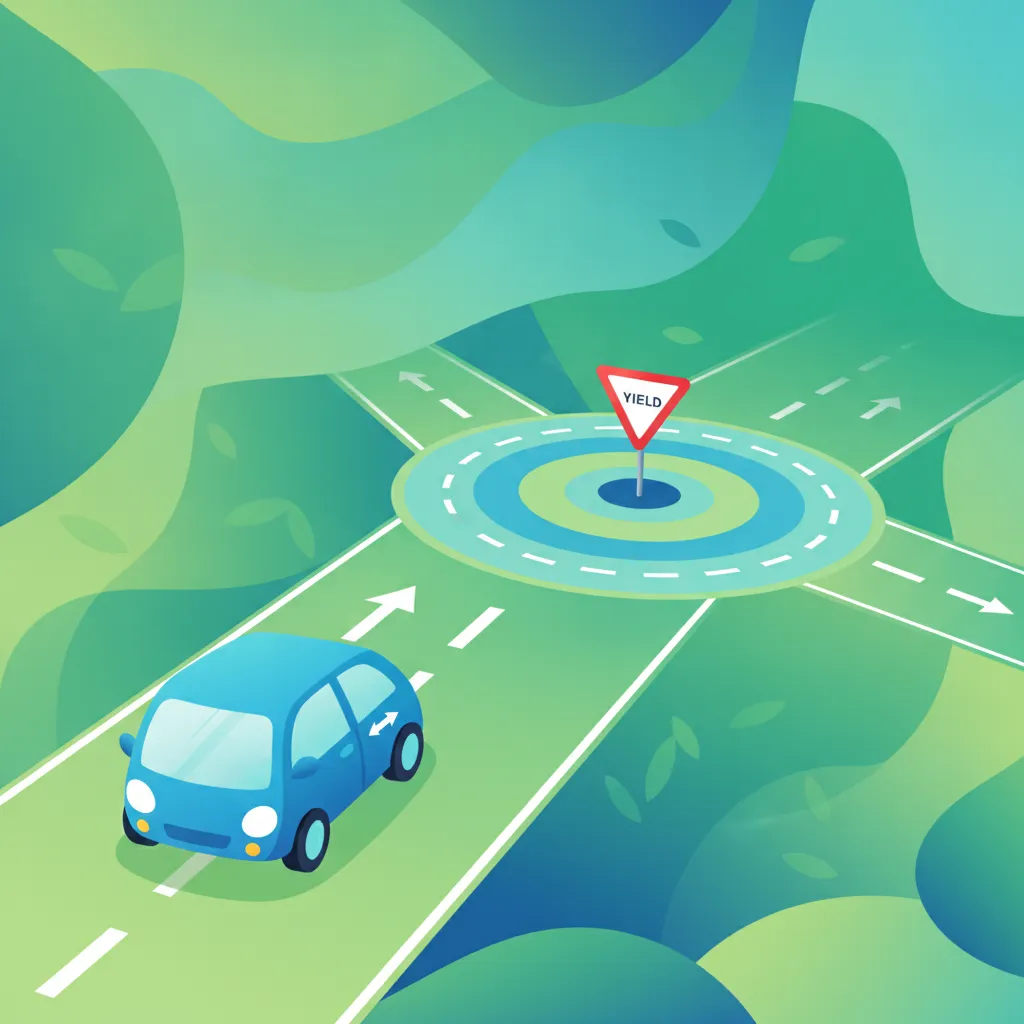
This lesson covers correct procedures for navigating roundabouts, which present significant risks for Category AM riders. It details lane selection rules, timely indicator signals for exiting, and the importance of checking blind spots before shifting lanes. Riders will learn to safely share the roundabout with large vehicles and vulnerable road users.

This lesson provides actionable strategies for Category AM riders to remain visible, focusing on lane positioning and eye contact. It teaches how to avoid riding in the blind spots of larger vehicles and how to signal early and clearly. Cultivating a proactive attitude toward road visibility helps prevent collisions and builds mutual respect on Irish roads.

This lesson analyzes traffic flow characteristics in dense municipal areas and teaches safe riding methods for congested gridlock situations. It covers the maintenance of adequate safety cushions, scanning for opening car doors, and monitoring pedestrians stepping from between parked cars. Riders will learn to manage frequent stopping, constant clutch wear, and the stress of urban commuting.

This lesson explains the extensive blind spots of heavy goods vehicles, buses, and other large trucks on Irish roads. It teaches Category AM riders how to maintain safe following distances and position themselves where truck drivers can see them. Proper space cushion management is emphasized to protect riders from the wind turbulence of passing trucks.
This lesson covers the strategic aspects of journey management, emphasizing the safety benefits of proactive route planning and weather checks. It teaches riders how to select safer roads, avoid high-congestion zones during rush hour, and schedule regular rest intervals. Motorcyclists will learn to pack essential tools, emergency contacts, and spare safety gear to remain prepared for any roadside situation.

This lesson details the sequential steps required to approach and exit junctions safely under the Irish driving rules. It teaches riders how to select the correct lane, utilize mirrors, apply early signals, and reduce speed appropriately. Effective observation strategies are highlighted to help riders identify crossing pedestrians or approaching side traffic.
This lesson details the use of daytime running lights to raise a rider's profile during daylight hours on Irish roads. It discusses the installation guidelines, legal restrictions, and safety benefits of auxiliary lighting systems on mopeds. Special care must be taken to prevent dazzling oncoming traffic while ensuring the vehicle remains highly recognizable.
Find clear answers to common questions learners have about Speed Limits for Category AM Vehicles. Learn how the lesson is structured, which driving theory objectives it supports, and how it fits into the overall learning path of units and curriculum progression in Ireland. These explanations help you understand key concepts, lesson flow, and exam focused study goals.
No. Category AM vehicles are strictly prohibited from driving on motorways. Their design speed is generally insufficient to safely match the flow of motorway traffic, creating a severe hazard to both the rider and other road users.
Exceeding the speed limit on a moped results in the same legal consequences as any other vehicle, including fixed charge penalty notices, fines, and the addition of penalty points to your driving licence.
While you must obey the signed speed limits applicable to all traffic, your vehicle's mechanical capabilities may naturally restrict you to lower speeds. You must always adhere to the posted limit while ensuring your speed is safe for the current road and weather conditions.
Use the practice question search tool to pinpoint specific topics, road signs, or rules you need to master for your official Driver Theory Test. Refine your study strategy and ensure comprehensive preparation for all aspects of the Irish driving exam. Start your focused revision now and build confidence for your learner permit test.