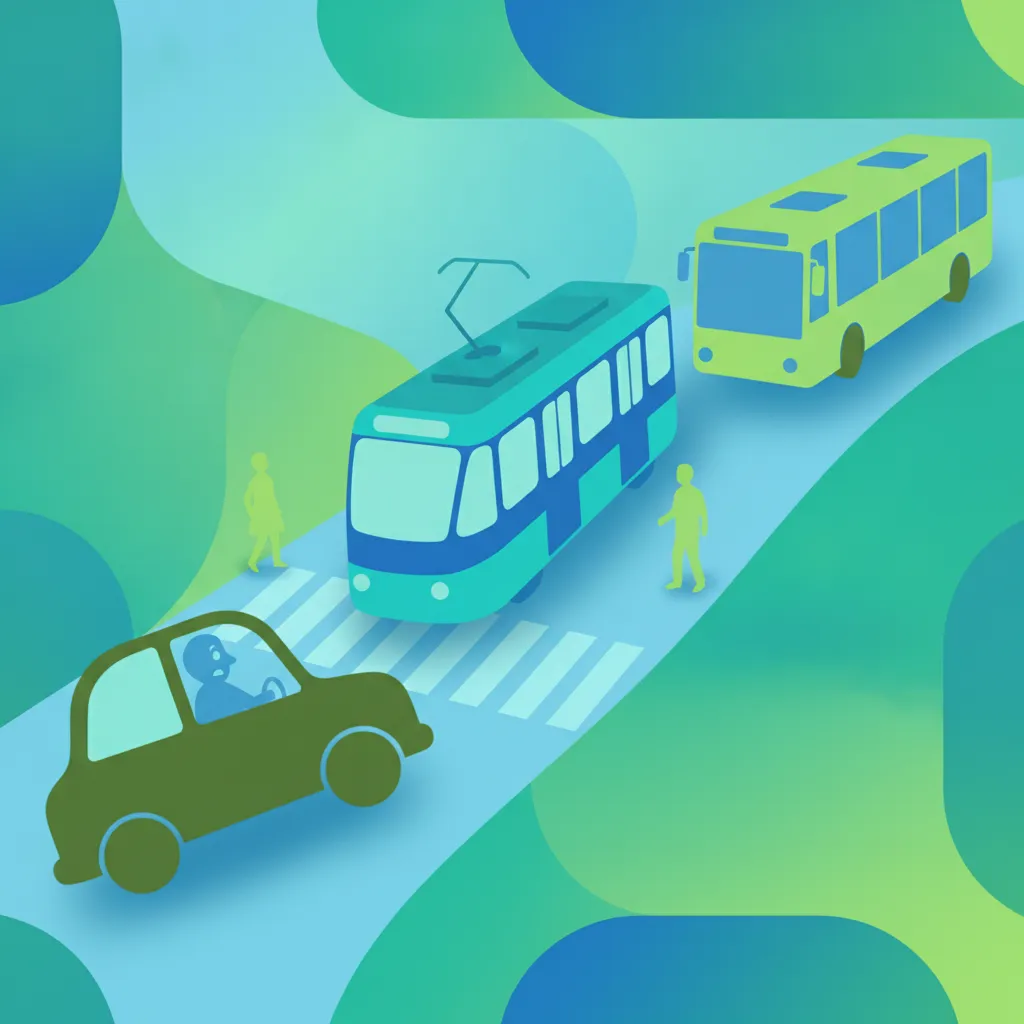
Trams and designated public transport vehicles often operate under specific priority rules in urban traffic. This is primarily due to their fixed routes, size, and limited ability to maneuver or stop quickly. As an Irish driver, it's vital to understand these rules to ensure safety for all road users and to navigate urban areas correctly.
Theory topic content overview
Read the full theory topic guide for Tram & Public Transport Priority with structured, easy-to-scan content built for learners in Ireland. This detailed section explains the exact rule, meaning, traffic context, comparison points, and exam logic behind this Irish driving theory topic so you can study faster, understand the concept more clearly, and avoid common interpretation mistakes on the theory test.
In Ireland, particularly in urban centres like Dublin with its Luas tram system, understanding the priority rules for trams and certain public transport vehicles is fundamental for every driver. Unlike other road users, trams operate on fixed tracks and have significantly limited manoeuvrability and longer braking distances. These physical realities are why the Irish Rules of the Road grant them specific priority in many situations, an essential concept for both safety and your Irish Driver Theory Test.
This page explains why these priority rules exist, how they apply to drivers, and what specific actions you must take to ensure safe interaction with trams and designated public transport vehicles across Ireland.
The core reason trams are given priority lies in their design and operation:
Understanding these reasons helps you anticipate tram movements and apply the rules correctly, which is vital for the Driver Theory Test Ireland.
Drivers must adjust their behaviour significantly when driving near tram lines or in areas where trams operate.
Trams generally have priority at junctions and crossings unless specific traffic lights or signs indicate otherwise. This is a critical point for the Irish Driver Theory Test.
When driving parallel to or near tram tracks, maintain a safe distance and be aware of your vehicle's position relative to the tracks.
When driving past tram stops, be particularly alert:
While trams have a more absolute form of priority due to their fixed rails, certain other public transport vehicles, like buses, may also be granted priority in specific scenarios in Ireland:
The distinction is crucial: a bus's priority is generally conditional (e.g., in its designated lane), whereas a tram's priority is more inherent due to its physical limitations.
A key aspect of excelling in the Irish driving theory test is distinguishing between different types of priority situations and avoiding common pitfalls.
Consider these practical scenarios to reinforce your understanding:
Remember the mantra: Fixed Path, Fixed Priority. Trams operate on a predetermined route and cannot swerve or stop quickly. As an Irish driver, your responsibility is to anticipate their movements, respect their priority, and always be prepared to yield. When you see tram tracks, think safety first, slow down, observe carefully, and never compromise the tram's right of way. This approach is not just about passing your Irish Driving Theory Test; it's about ensuring safety for everyone on Ireland's roads.
Start with a short, direct summary of Tram & Public Transport Priority before reading the full explanation below.
In Ireland, trams generally have priority over other road users due to their fixed tracks and significant stopping distances. Drivers must always yield to trams and be particularly cautious around tram lines and stops. Similarly, certain public transport vehicles like buses may also have priority in specific marked situations, requiring drivers to adjust their behaviour accordingly for safety and traffic flow.
Review the most important terms, rule signals, and traffic concepts linked to Tram & Public Transport Priority.
Explore related theory topic pages connected to Tram & Public Transport Priority and continue with the next useful rule explanation.
See the common search queries learners use when trying to understand Tram & Public Transport Priority in Ireland.

After reviewing core Irish driving theory topics, test your understanding with comprehensive practice questions. Apply your knowledge of road rules, signs, and traffic laws to scenarios mirroring the official Driver Theory Test. Solidify your learning and prepare effectively for your exam.
Irish Driving Theory TopicsTheory topic content overview
Start with a short, direct summary of Tram & Public Transport Priority before reading the full explanation below.
In Ireland, trams generally have priority over other road users due to their fixed tracks and significant stopping distances. Drivers must always yield to trams and be particularly cautious around tram lines and stops. Similarly, certain public transport vehicles like buses may also have priority in specific marked situations, requiring drivers to adjust their behaviour accordingly for safety and traffic flow.
Review the most important terms, rule signals, and traffic concepts linked to Tram & Public Transport Priority.
Explore related theory topic pages connected to Tram & Public Transport Priority and continue with the next useful rule explanation.
See the common search queries learners use when trying to understand Tram & Public Transport Priority in Ireland.
After reviewing core Irish driving theory topics, test your understanding with comprehensive practice questions. Apply your knowledge of road rules, signs, and traffic laws to scenarios mirroring the official Driver Theory Test. Solidify your learning and prepare effectively for your exam.
Irish Driving Theory TopicsUse this exam-focused revision tip to understand how Tram & Public Transport Priority is likely to appear in theory questions for learners in Ireland. This section helps you identify the most testable part of the rule, avoid common traps, and remember the concept more effectively during Irish driving theory exam preparation.
Remember that trams cannot deviate from their path and require long stopping distances. In Driver Theory Test questions, always prioritise the tram's safety and movement at junctions and crossings, as failure to yield is a common mistake that leads to dangerous situations.
Read direct answers to the most common learner questions about Tram & Public Transport Priority in Ireland. This FAQ focuses on rule confusion, practical meaning, comparison with similar concepts, and the exact uncertainties that appear most often in Irish driving theory revision and exam preparation.
Yes, generally, trams in Ireland (like the Luas) have priority due to their fixed tracks and inability to swerve. Drivers must yield to them, even at junctions where other rules might typically apply.
Always obey traffic lights, keep yellow junction boxes clear, and be highly attentive to trams, pedestrians, and cyclists. Expect trams to have right of way and be prepared to stop.
A yellow junction box is a road marking that must be kept clear at all times. When present at tram lines, it ensures trams can pass through junctions without obstruction, preventing gridlock. You must not enter it unless your exit is clear.
Buses may have priority in specific situations, such as when signalling to pull out from a designated stop in a built-up area. However, this is not absolute and depends on specific road markings and signage.
Trams operate on fixed tracks, are very heavy, and have long stopping distances. They cannot maneuver to avoid obstacles, making consistent priority essential for their safe and efficient operation.
Yes, signs like 'Except Trams and Access' indicate specific road usage. Pedestrian crossing points for tramways also feature a tram symbol and warnings like 'Féach gach treo - LOOK BOTH WAYS'.
Pedestrians should only cross at designated points, obey signs, and look both ways. Drivers must be extra vigilant for pedestrians who may not be fully aware of approaching trams, especially near stops.
Use the practice question search tool to pinpoint specific topics, road signs, or rules you need to master for your official Driver Theory Test. Refine your study strategy and ensure comprehensive preparation for all aspects of the Irish driving exam. Start your focused revision now and build confidence for your learner permit test.