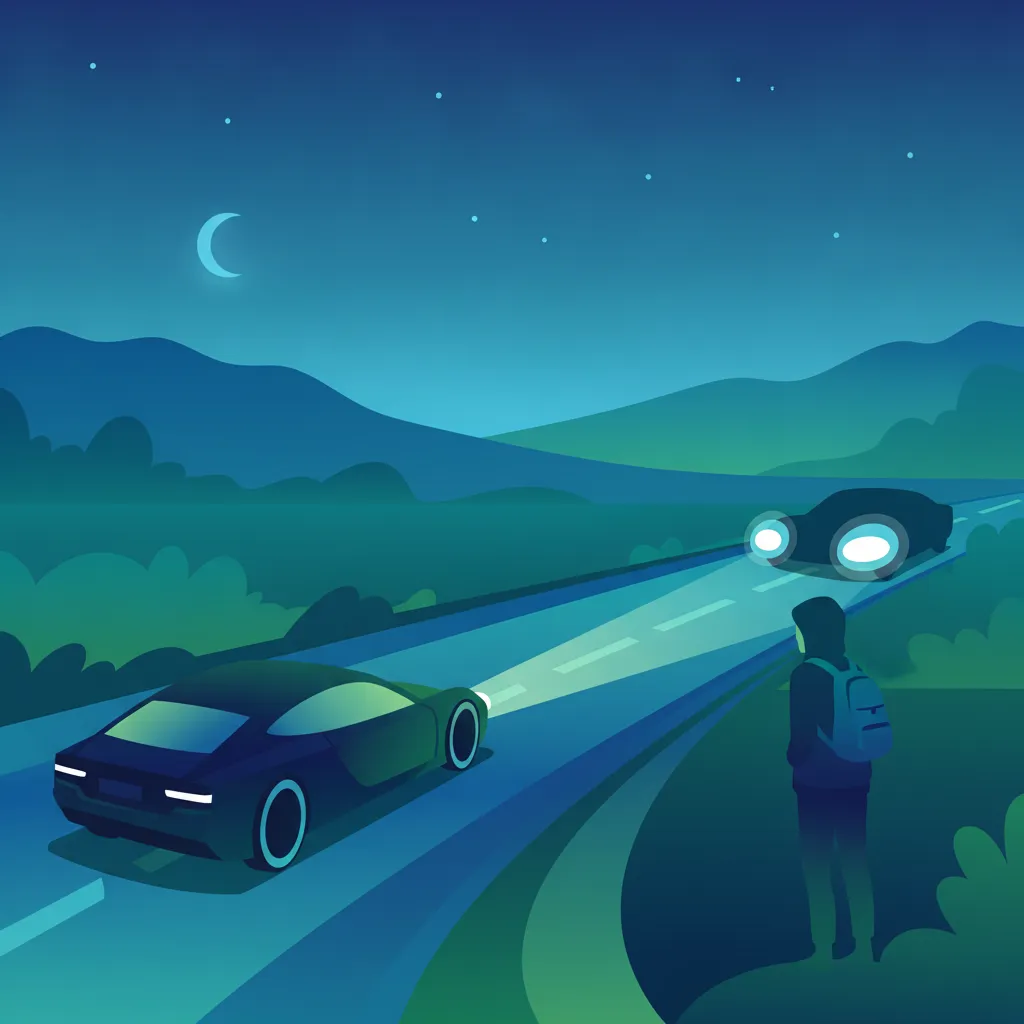
Driving at night presents a unique set of challenges due to significantly reduced visibility and altered perception. In Austria, understanding these conditions is crucial for safe driving and passing your theory exam. This section outlines the key risks, such as headlight glare and difficulty spotting pedestrians, and explains how to adapt your driving behavior.
Theory topic content overview
Read the full theory topic guide for Night Driving Safety with structured, easy-to-scan content built for learners in Austria. This detailed section explains the exact rule, meaning, traffic context, comparison points, and exam logic behind this Austrian driving theory topic so you can study faster, understand the concept more clearly, and avoid common interpretation mistakes on the theory test.
Driving at night presents a unique and demanding set of challenges for any driver, particularly on Austrian roads where conditions can range from well-lit urban areas to dark, winding alpine routes. The fundamental problem is significantly reduced visibility, which directly impacts your ability to detect hazards, judge distances, and react safely. Mastering night driving in Austria requires a proactive approach to speed, observation, and vehicle preparation.
When driving in darkness, your vision is dramatically compromised. Headlights, even on full beam, only illuminate a limited distance ahead, creating a tunnel-like perception. This makes it far harder to spot potential dangers, such as:
The human eye also takes longer to adapt to changing light conditions at night, for instance, when transitioning from a brightly lit town to an unlit country road, or after being exposed to headlight glare.
Understanding the specific risks of night driving is not only vital for your safety but also a critical component of the Austrian driving theory test. Exam questions frequently focus on how darkness affects hazard perception, reaction times, and the absolute necessity to adjust your driving behavior.
Misjudging these conditions can lead to severe consequences, including:
For drivers in Austria, this means acknowledging the unique characteristics of Bundesstraßen (rural roads) and Gemeindestraßen (municipal roads) at night, which are often unlit and may feature sharp bends or sudden changes in gradient common in mountainous regions.
The most fundamental rule for driving at night in Austria, and a key point for your theory exam, is this: Your driving speed must always be chosen so that you can stop your vehicle in time, even before poorly recognizable obstacles within the illuminated area of your headlights.
This means:
This principle emphasizes that the posted speed limit is a maximum, not a target, and safe speed is always dictated by current conditions and your ability to see and react.
Several factors combine to make driving at night more hazardous:
As discussed, the lack of ambient light means relying entirely on your vehicle's lighting. This severely limits the "information input" your brain receives, requiring more effort to process less information. Poorly lit objects blend into the background, making them extremely difficult to spot.
One of the most disruptive aspects of night driving is glare from oncoming vehicles' headlights. This bright light can temporarily blind you, creating a momentary "whiteout" effect that further reduces your ability to see the road ahead.
Managing Glare:
Darkness, especially during typical sleep hours, naturally promotes fatigue. Tired drivers exhibit:
The effectiveness of your headlights is paramount. Ensure your headlights are:
A clean windshield, free from streaks or dirt, is equally important to minimize glare and maximize visual clarity.
This is a critical distinction for your Austrian theory test. The legal speed limit (e.g., 50 km/h in urban areas, 100 km/h on Bundesstraßen, 130 km/h on Autobahnen) is the absolute maximum allowed under ideal conditions. At night, especially on unlit roads, conditions are rarely ideal. Therefore, your safe speed will almost always be lower than the legal maximum. You must constantly reassess your safe speed based on visible distance.
While the physiological reaction time (the time it takes your brain to process a stimulus) might not change, the time it takes to perceive a hazard definitely increases at night. This extended "perception time" effectively lengthens your overall reaction distance, demanding an even greater reduction in speed to maintain a safe stopping distance.
An interesting point raised in Austrian theory questions is how the presence of a passenger can affect your perception of the road at night. While a passenger doesn't change the physical illumination of the road, it highlights that factors beyond just light can influence a driver's focus and perceived workload. You might subconsciously feel less isolated but must remain equally vigilant.
Learners and experienced drivers alike often make these mistakes when driving after dark:
The Austrian driving theory test places strong emphasis on understanding the dangers of night driving and knowing how to mitigate them. Expect questions that test your knowledge on:
Remember the rule from the official catalogue: "I should never look into the headlights of an oncoming vehicle." and "I must always choose my driving speed so that I can stop in time even before poorly recognizable obstacles." These are direct reflections of practical safe driving in Austria.
When the sun sets in Austria, your driving approach must fundamentally change. Always prioritize safety over speed. Reduce your speed to match the distance you can clearly see ahead with your headlights. Be proactive in spotting hazards, managing glare, and ensuring your vehicle is prepared. Drive defensively, anticipate the unexpected, and respect the profound impact of darkness on your perception and reaction capabilities.
Start with a short, direct summary of Night Driving Safety before reading the full explanation below.
Driving at night significantly reduces visibility, making it harder to spot hazards like pedestrians, cyclists, or obstacles. Drivers must adapt by reducing speed to ensure they can stop within the illuminated area of their headlights. Avoiding direct gaze into oncoming headlights and maintaining a clean windshield are crucial for safety in Austrian traffic conditions.
Review the most important terms, rule signals, and traffic concepts linked to Night Driving Safety.
Explore related theory topic pages connected to Night Driving Safety and continue with the next useful rule explanation.
See the common search queries learners use when trying to understand Night Driving Safety in Austria.

Ready to delve deeper into specific theory topics? Continue exploring detailed explanations of Austrian road signs, traffic rules, and critical driving situations. Solidify your knowledge, clarify any doubts, and ensure you're fully prepared for every aspect of your official driving licence theory exam.
Austrian Driving Theory TopicsTheory topic content overview
Start with a short, direct summary of Night Driving Safety before reading the full explanation below.
Driving at night significantly reduces visibility, making it harder to spot hazards like pedestrians, cyclists, or obstacles. Drivers must adapt by reducing speed to ensure they can stop within the illuminated area of their headlights. Avoiding direct gaze into oncoming headlights and maintaining a clean windshield are crucial for safety in Austrian traffic conditions.
Review the most important terms, rule signals, and traffic concepts linked to Night Driving Safety.
Explore related theory topic pages connected to Night Driving Safety and continue with the next useful rule explanation.
See the common search queries learners use when trying to understand Night Driving Safety in Austria.
Ready to delve deeper into specific theory topics? Continue exploring detailed explanations of Austrian road signs, traffic rules, and critical driving situations. Solidify your knowledge, clarify any doubts, and ensure you're fully prepared for every aspect of your official driving licence theory exam.
Austrian Driving Theory TopicsUse this exam-focused revision tip to understand how Night Driving Safety is likely to appear in theory questions for learners in Austria. This section helps you identify the most testable part of the rule, avoid common traps, and remember the concept more effectively during Austrian driving theory exam preparation.
Remember for your Austrian theory test that speed must always be adjusted to the visible distance. A common mistake is assuming headlights illuminate far enough for normal daytime speeds. Also, be aware of questions related to detecting poorly lit objects and managing glare from other vehicles.
Read direct answers to the most common learner questions about Night Driving Safety in Austria. This FAQ focuses on rule confusion, practical meaning, comparison with similar concepts, and the exact uncertainties that appear most often in Austrian driving theory revision and exam preparation.
The primary risks include significantly reduced visibility, making it difficult to detect hazards, and glare from oncoming headlights.
You must reduce your speed so that you can always stop within the distance illuminated by your headlights, especially on unlit roads.
Avoid looking directly into oncoming headlights. Instead, focus your gaze slightly towards the right edge of your lane to maintain orientation and vision.
Pedestrians and cyclists are less visible against dark backgrounds. Their clothing may not be reflective, and their own lights might be dim or absent, making early detection challenging.
Clean headlights ensure maximum illumination of the road, while a clean windshield prevents light from scattering and causing additional glare, both critical for clear vision in Austrian night traffic.
Yes, fatigue is more common at night, which can slow down your reaction time and reduce overall concentration, increasing accident risk.
Refine your study plan by searching for specific Austrian driving theory practice sets. Pinpoint questions related to particular road rules, signs, or challenge levels, and begin practicing immediately to reinforce your knowledge and excel in your official exam with confidence. Get started with focused revision today.