
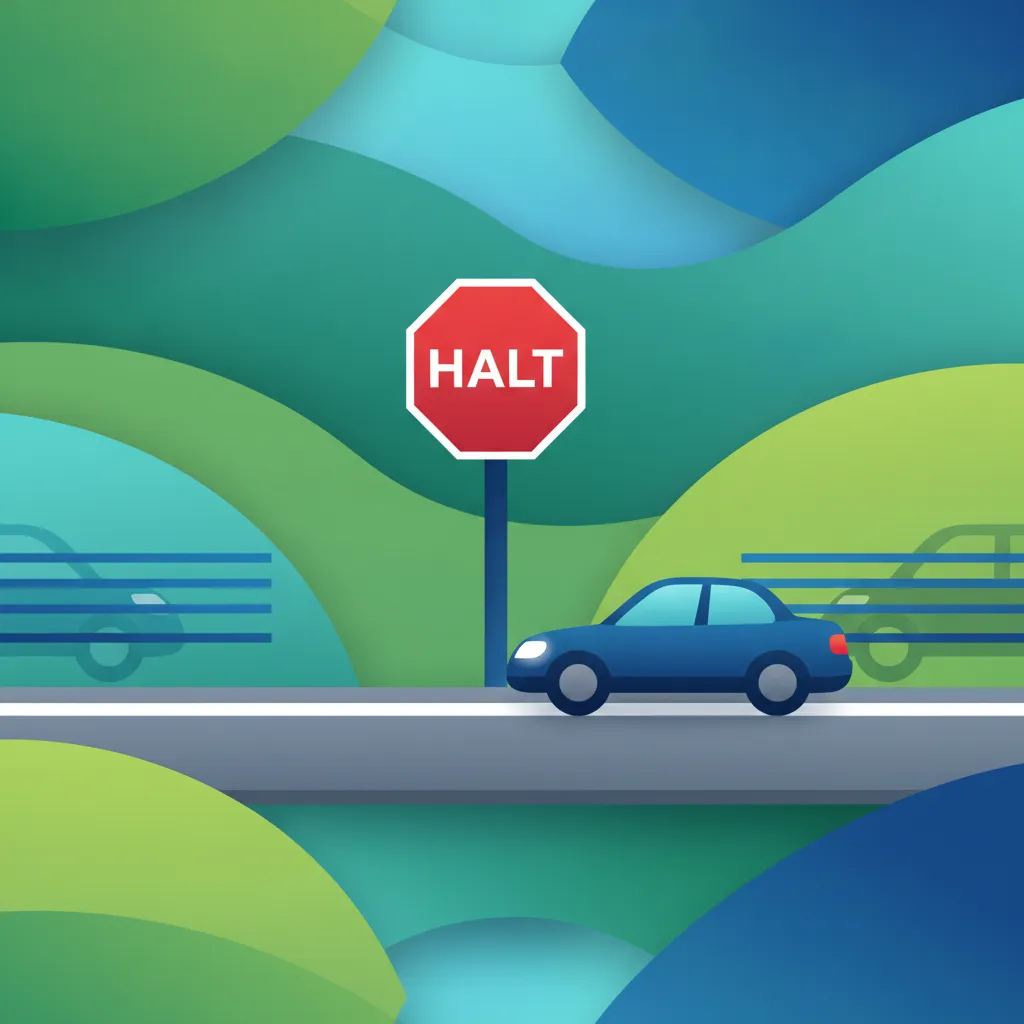
The Stop Sign, officially known as 'Halt-Tafel' in Austria, is one of the most vital regulatory traffic signs. It dictates that drivers must bring their vehicle to a complete standstill before entering an intersection or crossing traffic. This rule is absolute, regardless of whether traffic appears clear, and is fundamental for safe driving and passing your Austrian theory exam.
Theory topic content overview
Read the full theory topic guide for Stop Sign (Halt-Tafel) Rules with structured, easy-to-scan content built for learners in Austria. This detailed section explains the exact rule, meaning, traffic context, comparison points, and exam logic behind this Austrian driving theory topic so you can study faster, understand the concept more clearly, and avoid common interpretation mistakes on the theory test.
The Halt-Tafel, or Stop Sign, is a critically important regulatory sign (Vorschriftszeichen) in Austrian traffic. It stands as an absolute directive: you must bring your vehicle to a complete and full stop before proceeding. This rule is non-negotiable and designed to prevent collisions at high-risk intersections where visibility may be poor or traffic heavy.
Understanding the Halt-Tafel is fundamental for safe driving and passing your Austrian driving theory exam. Its purpose is to ensure drivers pause, assess the entire traffic situation, and yield priority to all other road users before entering the intersection.
The Stop Sign in Austria serves several vital functions:
Navigating a Halt-Tafel requires a precise sequence of actions to ensure safety and compliance with Austrian law:
gute Übersicht) of the intersecting road. This typically means stopping before the intersection itself, but far enough forward to see clearly without impeding others.This is one of the most crucial differentiations for Austrian driving theory and practical application. Many learners confuse the two, leading to serious errors.
| Feature | Halt-Tafel (Stop Sign) | Vorrang geben (Yield Sign) |
|---|---|---|
| Shape | Octagonal (eight-sided) | Inverted triangular (point down) |
| Core Requirement | Mandatory complete stop at the Haltelinie or point of good visibility. | Give way/yield priority. Stop only if necessary to avoid obstructing traffic. |
| Priority | You always yield to all other traffic. | You yield to traffic on the priority road. |
| Consequence of Rolling Stop | Traffic violation, potential exam failure. | Generally acceptable if safe and priority is yielded. |
Remember, the Halt-Tafel demands an absolute stop, even if the road appears empty. The Vorrang geben sign allows you to continue moving if you can clearly yield priority without stopping.
Austrian driving students often make these errors regarding the Halt-Tafel:
To master the Halt-Tafel in Austria, internalize this simple sequence:
This discipline ensures you meet the legal requirements of the Austrian Halt-Tafel and contributes significantly to road safety.
The Halt-Tafel (Stop Sign) is a mandatory regulatory sign in Austria requiring drivers to bring their vehicle to a complete standstill at the Haltelinie or at a point of clear visibility before proceeding. After stopping, drivers must yield priority to all road users on the intersecting road—including vehicles, cyclists, and pedestrians—before continuing. This sign is distinct from the Vorrang geben (Yield Sign), which does not require a mandatory stop. The correct procedure follows the Stop-Look-Yield-Go principle, and failing to perform an absolute stop, even on an empty road, constitutes a traffic violation under Austrian law.
A short set of high-value points that capture the most important ideas from this theory explanation.
The Halt-Tafel requires an absolute complete stop at the Haltelinie or at a point of clear visibility, regardless of whether traffic is present
After stopping, you must yield priority to ALL road users on the intersecting road before proceeding
The stop rule applies at all Halt-Tafel locations including urban intersections, rural junctions, and railway crossings
This sign is legally non-negotiable under StVO § 19 Abs. 4 and § 52 No. 24, and non-compliance is a traffic violation
The Halt-Tafel is fundamentally different from Vorrang geben (Yield Sign), which only requires yielding without mandatory stopping
If a Haltelinie (white stop line) is present, stop before it; if absent, stop at the point offering clear visibility of the intersecting road
A rolling stop or merely slowing down is insufficient and constitutes a traffic violation in Austria
After stopping, scan all directions: left, right, oncoming traffic, plus pedestrians and cyclists
Even when the road appears completely empty, the absolute stop is still legally required
Once a safe gap is confirmed, proceed confidently without prolonged hesitation to avoid obstructing following traffic
Performing a rolling stop instead of bringing the vehicle to a complete standstill before the Haltelinie
Treating the Halt-Tafel like a Vorrang geben sign by only slowing down and proceeding without stopping
Stopping in the wrong position: either after the Haltelinie or so far back that visibility is impaired
Stopping correctly but failing to thoroughly check all directions including cyclists and pedestrians
Hesitating too long after a safe gap appears, causing confusion for following traffic
Start with a short, direct summary of Stop Sign (Halt-Tafel) Rules before reading the full explanation below.
A Stop Sign (Halt-Tafel) in Austria requires you to bring your vehicle to a complete stop before a designated stop line, or at a point offering clear visibility if no line is present. After stopping, you must yield priority to all other road users, including vehicles from left, right, and oncoming traffic, only proceeding when it is safe and your movement will not obstruct anyone.
Review the most important terms, rule signals, and traffic concepts linked to Stop Sign (Halt-Tafel) Rules.
Explore related theory topic pages connected to Stop Sign (Halt-Tafel) Rules and continue with the next useful rule explanation.
See the common search queries learners use when trying to understand Stop Sign (Halt-Tafel) Rules in Austria.

Ready to delve deeper into specific theory topics? Continue exploring detailed explanations of Austrian road signs, traffic rules, and critical driving situations. Solidify your knowledge, clarify any doubts, and ensure you're fully prepared for every aspect of your official driving licence theory exam.
Austrian Driving Theory TopicsTheory topic content overview
A short set of high-value points that capture the most important ideas from this theory explanation.
The Halt-Tafel requires an absolute complete stop at the Haltelinie or at a point of clear visibility, regardless of whether traffic is present
After stopping, you must yield priority to ALL road users on the intersecting road before proceeding
The stop rule applies at all Halt-Tafel locations including urban intersections, rural junctions, and railway crossings
This sign is legally non-negotiable under StVO § 19 Abs. 4 and § 52 No. 24, and non-compliance is a traffic violation
The Halt-Tafel is fundamentally different from Vorrang geben (Yield Sign), which only requires yielding without mandatory stopping
If a Haltelinie (white stop line) is present, stop before it; if absent, stop at the point offering clear visibility of the intersecting road
A rolling stop or merely slowing down is insufficient and constitutes a traffic violation in Austria
After stopping, scan all directions: left, right, oncoming traffic, plus pedestrians and cyclists
Even when the road appears completely empty, the absolute stop is still legally required
Once a safe gap is confirmed, proceed confidently without prolonged hesitation to avoid obstructing following traffic
Performing a rolling stop instead of bringing the vehicle to a complete standstill before the Haltelinie
Treating the Halt-Tafel like a Vorrang geben sign by only slowing down and proceeding without stopping
Stopping in the wrong position: either after the Haltelinie or so far back that visibility is impaired
Stopping correctly but failing to thoroughly check all directions including cyclists and pedestrians
Hesitating too long after a safe gap appears, causing confusion for following traffic
Start with a short, direct summary of Stop Sign (Halt-Tafel) Rules before reading the full explanation below.
A Stop Sign (Halt-Tafel) in Austria requires you to bring your vehicle to a complete stop before a designated stop line, or at a point offering clear visibility if no line is present. After stopping, you must yield priority to all other road users, including vehicles from left, right, and oncoming traffic, only proceeding when it is safe and your movement will not obstruct anyone.
Review the most important terms, rule signals, and traffic concepts linked to Stop Sign (Halt-Tafel) Rules.
Explore related theory topic pages connected to Stop Sign (Halt-Tafel) Rules and continue with the next useful rule explanation.
See the common search queries learners use when trying to understand Stop Sign (Halt-Tafel) Rules in Austria.
Ready to delve deeper into specific theory topics? Continue exploring detailed explanations of Austrian road signs, traffic rules, and critical driving situations. Solidify your knowledge, clarify any doubts, and ensure you're fully prepared for every aspect of your official driving licence theory exam.
Austrian Driving Theory TopicsUse this exam-focused revision tip to understand how Stop Sign (Halt-Tafel) Rules is likely to appear in theory questions for learners in Austria. This section helps you identify the most testable part of the rule, avoid common traps, and remember the concept more effectively during Austrian driving theory exam preparation.
In the Austrian theory exam, pay close attention to questions distinguishing between the 'Halt-Tafel' (Stop Sign) and the 'Vorrang geben' (Yield Sign). Remember, a Stop Sign always means a *complete* stop, even if the road seems clear, followed by yielding to *all* traffic. A common mistake is treating it like a Yield Sign, which is incorrect and can lead to immediate failure.
Read direct answers to the most common learner questions about Stop Sign (Halt-Tafel) Rules in Austria. This FAQ focuses on rule confusion, practical meaning, comparison with similar concepts, and the exact uncertainties that appear most often in Austrian driving theory revision and exam preparation.
The primary requirement is to bring your vehicle to a complete and full stop before the stop line, or at a point where you have a clear view of the intersecting road if no line is marked. This stop must occur regardless of whether you perceive immediate traffic.
If a stop line (Haltelinie) is absent or obscured, you must stop at a point from which you have the best possible clear view of the intersecting traffic, ensuring safe assessment before proceeding.
A Stop Sign (Halt-Tafel) mandates a complete stop, always. A Yield Sign (Vorrang geben) requires you to give priority to other traffic, but you may proceed without stopping if the road is clear and safe to do so without hindering anyone.
After stopping at a Halt-Tafel, all other traffic, including vehicles coming from your left, right, and any oncoming traffic you might cross paths with, has priority. You must only proceed when the intersection is completely clear and safe.
Yes, failing to stop at a Halt-Tafel is considered a serious traffic violation in Austria, as it poses a high risk of collision and disregards fundamental priority rules.
The Stop Sign (Halt-Tafel) overrides most general priority rules at an intersection, explicitly assigning priority to all other road users on the intersecting road, making your vehicle the lowest priority at that point.
Refine your study plan by searching for specific Austrian driving theory practice sets. Pinpoint questions related to particular road rules, signs, or challenge levels, and begin practicing immediately to reinforce your knowledge and excel in your official exam with confidence. Get started with focused revision today.