
Driving safely requires a clear understanding of how quickly your vehicle can stop. This concept explains the direct link between your speed and the total distance required, breaking it down into reaction distance and braking distance. Master this fundamental principle to improve your hazard perception and ensure safer driving in all Austrian traffic conditions.
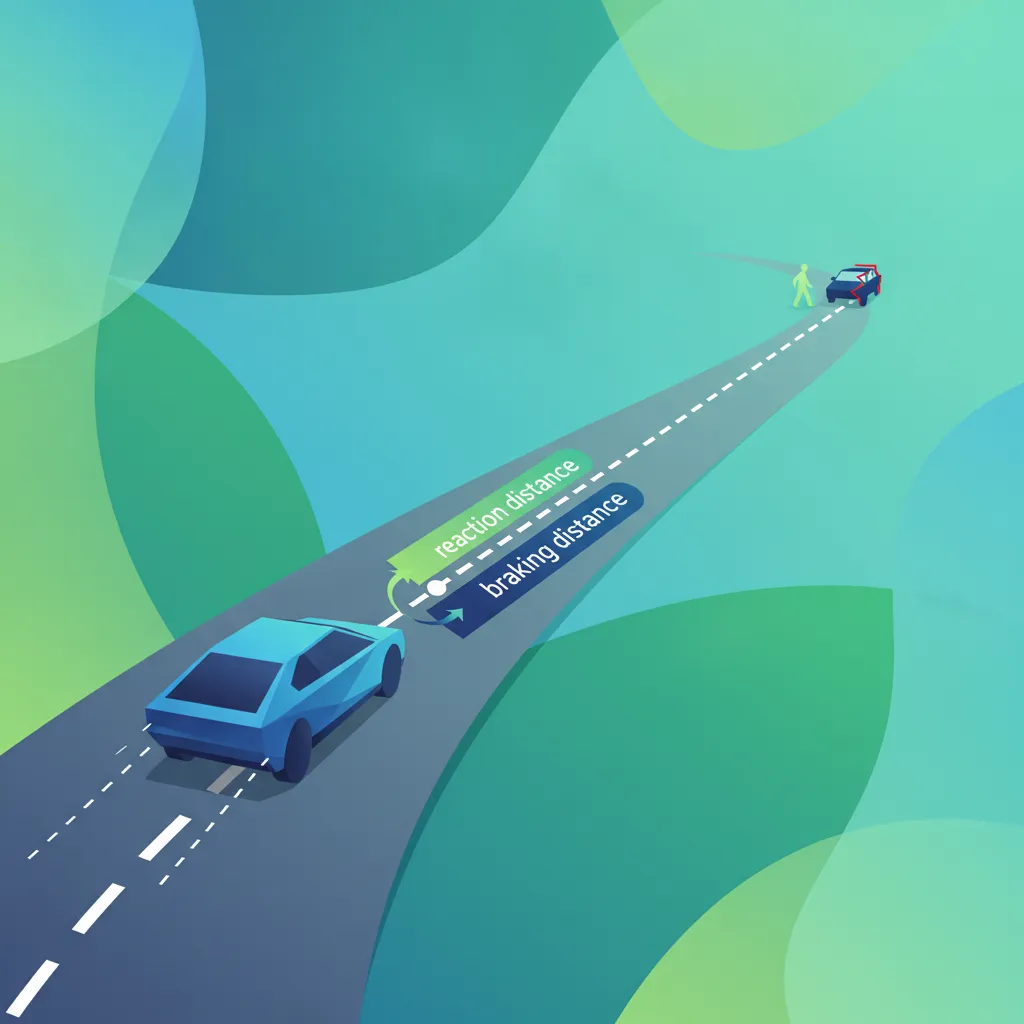
Theory topic content overview
Read the full theory topic guide for Speed & Stopping Distance with structured, easy-to-scan content built for learners in Austria. This detailed section explains the exact rule, meaning, traffic context, comparison points, and exam logic behind this Austrian driving theory topic so you can study faster, understand the concept more clearly, and avoid common interpretation mistakes on the theory test.
The relationship between your vehicle's speed and the distance it takes to stop is one of the most fundamental principles of safe driving in Austria and globally. Understanding this connection is not just theoretical; it directly impacts your ability to react to hazards, avoid collisions, and pass your Austrian driving theory exam.
Total stopping distance is the entire distance your vehicle travels from the precise moment you perceive a hazard until your vehicle comes to a complete halt. It is a critical safety margin that determines whether you can stop in time to avoid an obstruction, pedestrian, or other vehicles on an Austrian road.
This total distance is comprised of two distinct parts:
The most critical takeaway for Austrian drivers is that stopping distance does not increase proportionally with speed. Due to the physics of kinetic energy, even small increases in speed lead to a significantly larger increase in the total distance required to stop.
Your reaction time is influenced by factors like alertness, fatigue, alcohol, and distractions. While an average reaction time is often considered to be around one second, it can vary greatly.
This is where the non-linear relationship becomes extremely significant. The braking distance is directly related to the vehicle's kinetic energy, which increases with the square of its speed.
Because both reaction distance and braking distance increase with speed, and braking distance increases exponentially, the total stopping distance grows dramatically as your speed increases. This drastically reduces your safety margin and increases the risk and severity of a collision on Austrian roads, whether in urban areas or on the Autobahn.
While speed is the primary factor, several other conditions can significantly extend your stopping distance:
Austrian driving theory often tests the nuanced understanding of these concepts:
Reaktionsweg.exam tip highlights this critical point.Consider these common scenarios for an Austrian driver:
Autobahn in Austria, maintaining sufficient distance (Sicherheitsabstand) is paramount due to high speeds.Gefahrenbremsung (emergency braking) skills are vital.Winterreifenpflicht (winter tyre requirement) helps, but doesn't eliminate the challenge.Learners frequently make these errors regarding speed and stopping distance:
Sicherheitsabstand), especially on the Autobahn or Schnellstraße, which leaves no room for the increased stopping distance.Always drive at a speed that allows you to stop safely within the distance you can clearly see ahead. Remember the compounding effect of speed: doubling your speed dramatically more than doubles your total stopping distance. This principle is not just for your Austrian theory exam; it's the foundation of proactive hazard perception and collision avoidance in real Austrian traffic conditions. Prioritise safety over speed, especially when conditions are less than ideal.
Total stopping distance comprises reaction distance (distance during your reaction time) plus braking distance (distance while decelerating to a stop). Reaction distance scales linearly with speed, but braking distance scales with the square of speed due to kinetic energy—so at double the speed, braking distance becomes four times longer. This non-linear relationship means that even small increases in speed dramatically reduce your safety margin and increase collision severity. Austrian drivers must always adjust their speed to ensure they can stop within the visible distance ahead, accounting for road conditions, weather, tyre condition, and driver alertness, particularly on high-speed routes like the Autobahn and in challenging winter conditions.
A short set of high-value points that capture the most important ideas from this theory explanation.
Stopping distance is the sum of reaction distance and braking distance, not just braking distance alone.
Reaction distance increases linearly with speed, while braking distance increases with the square of speed.
Doubled speed quadruples braking distance, making small speed increases far more dangerous than they appear.
Always drive at a speed that allows you to stop within the visible distance ahead, regardless of posted limits.
Road conditions, tyre condition, driver alertness, and vehicle load all significantly extend stopping distances beyond calculations for ideal conditions.
Reaction distance (Reaktionsweg) = distance traveled during your ~1 second reaction time, scales linearly with speed.
Braking distance (Bremsweg) = distance after brakes applied, scales with the square of speed due to kinetic energy.
A speed increase from 30 to 60 km/h makes braking distance roughly four times greater, not double.
Posted speed limits are maximum legal speeds, not necessarily safe speeds—adjust for conditions.
Black ice, wet roads, worn tyres, and driver fatigue all dramatically increase stopping distance beyond calculations.
Assuming doubling speed merely doubles stopping distance, when it actually quadruples braking distance.
Driving at the posted speed limit without adjusting for rain, fog, snow, or slippery conditions.
Following too closely on the Autobahn or Schnellstraße, leaving insufficient space for increased stopping distances at high speeds.
Believing that good tyres alone compensate for excessive speed on wet or icy Austrian roads.
Confusing reaction distance with braking distance or treating them as a single concept.
Start with a short, direct summary of Speed & Stopping Distance before reading the full explanation below.
Stopping distance is the total distance your vehicle travels from perceiving a hazard until coming to a complete stop. It consists of reaction distance (distance traveled during reaction time) and braking distance (distance traveled while braking). Critically, while reaction distance increases proportionally with speed, braking distance increases with the square of the speed. This means doubling your speed quadruples your braking distance, dramatically increasing the total stopping distance and reducing safety margins.
Review the most important terms, rule signals, and traffic concepts linked to Speed & Stopping Distance.
Explore related theory topic pages connected to Speed & Stopping Distance and continue with the next useful rule explanation.
See the common search queries learners use when trying to understand Speed & Stopping Distance in Austria.

Ready to delve deeper into specific theory topics? Continue exploring detailed explanations of Austrian road signs, traffic rules, and critical driving situations. Solidify your knowledge, clarify any doubts, and ensure you're fully prepared for every aspect of your official driving licence theory exam.
Austrian Driving Theory TopicsTheory topic content overview
A short set of high-value points that capture the most important ideas from this theory explanation.
Stopping distance is the sum of reaction distance and braking distance, not just braking distance alone.
Reaction distance increases linearly with speed, while braking distance increases with the square of speed.
Doubled speed quadruples braking distance, making small speed increases far more dangerous than they appear.
Always drive at a speed that allows you to stop within the visible distance ahead, regardless of posted limits.
Road conditions, tyre condition, driver alertness, and vehicle load all significantly extend stopping distances beyond calculations for ideal conditions.
Reaction distance (Reaktionsweg) = distance traveled during your ~1 second reaction time, scales linearly with speed.
Braking distance (Bremsweg) = distance after brakes applied, scales with the square of speed due to kinetic energy.
A speed increase from 30 to 60 km/h makes braking distance roughly four times greater, not double.
Posted speed limits are maximum legal speeds, not necessarily safe speeds—adjust for conditions.
Black ice, wet roads, worn tyres, and driver fatigue all dramatically increase stopping distance beyond calculations.
Assuming doubling speed merely doubles stopping distance, when it actually quadruples braking distance.
Driving at the posted speed limit without adjusting for rain, fog, snow, or slippery conditions.
Following too closely on the Autobahn or Schnellstraße, leaving insufficient space for increased stopping distances at high speeds.
Believing that good tyres alone compensate for excessive speed on wet or icy Austrian roads.
Confusing reaction distance with braking distance or treating them as a single concept.
Start with a short, direct summary of Speed & Stopping Distance before reading the full explanation below.
Stopping distance is the total distance your vehicle travels from perceiving a hazard until coming to a complete stop. It consists of reaction distance (distance traveled during reaction time) and braking distance (distance traveled while braking). Critically, while reaction distance increases proportionally with speed, braking distance increases with the square of the speed. This means doubling your speed quadruples your braking distance, dramatically increasing the total stopping distance and reducing safety margins.
Review the most important terms, rule signals, and traffic concepts linked to Speed & Stopping Distance.
Explore related theory topic pages connected to Speed & Stopping Distance and continue with the next useful rule explanation.
See the common search queries learners use when trying to understand Speed & Stopping Distance in Austria.
Ready to delve deeper into specific theory topics? Continue exploring detailed explanations of Austrian road signs, traffic rules, and critical driving situations. Solidify your knowledge, clarify any doubts, and ensure you're fully prepared for every aspect of your official driving licence theory exam.
Austrian Driving Theory TopicsUse this exam-focused revision tip to understand how Speed & Stopping Distance is likely to appear in theory questions for learners in Austria. This section helps you identify the most testable part of the rule, avoid common traps, and remember the concept more effectively during Austrian driving theory exam preparation.
Remember that doubling your speed does not merely double your stopping distance. Due to kinetic energy, doubling your speed quadruples your braking distance. Many Austrian theory exam questions test this non-linear relationship, emphasizing that a seemingly small increase in speed can lead to a dangerously large increase in the distance required to stop.
Read direct answers to the most common learner questions about Speed & Stopping Distance in Austria. This FAQ focuses on rule confusion, practical meaning, comparison with similar concepts, and the exact uncertainties that appear most often in Austrian driving theory revision and exam preparation.
Reaction distance is the distance your vehicle travels during the time it takes for you to react to a hazard. Braking distance is the additional distance traveled from when you apply the brakes until the vehicle comes to a complete stop.
Doubling your speed quadruples your braking distance because kinetic energy (which must be dissipated) increases with the square of the velocity.
Yes, adverse weather conditions like rain, snow, or ice significantly increase braking distance by reducing tire grip and road friction, requiring drivers to reduce speed even further.
The Austrian driving test frequently assesses your understanding of this concept to ensure you can make safe speed choices and anticipate hazards, especially regarding the non-linear increase in stopping distance with speed.
A common guideline is the two-second rule (or three seconds in adverse conditions), ensuring you have enough time to react and stop if the vehicle ahead brakes suddenly. This distance must be adjusted based on speed and road conditions.
Heavier vehicles (like trucks) and vehicles with worn tires or faulty brakes generally require a longer stopping distance than lighter vehicles with well-maintained components, even at the same speed.
Kinetic energy is the energy of motion. When you brake, this energy is converted into heat. The higher your speed, the more kinetic energy your vehicle has, and thus more energy needs to be dissipated, requiring a longer braking distance.
On high-speed roads like Autobahns and Schnellstraßen, it's crucial to maintain a much greater following distance and adjust your speed to conditions, as the stopping distance will be significantly longer than at lower speeds, demanding more time and space to react to sudden events.
Refine your study plan by searching for specific Austrian driving theory practice sets. Pinpoint questions related to particular road rules, signs, or challenge levels, and begin practicing immediately to reinforce your knowledge and excel in your official exam with confidence. Get started with focused revision today.