
Learn the essential rules for Austrian level crossings (Eisenbahnkreuzungen) as mandated by StVO §19a. This guide details the types of crossings, from guarded to unguarded, and clarifies your obligations, especially when encountering flashing lights or if your vehicle stalls. Mastering these safety protocols is vital for your theory exam and safe driving on Austrian roads.
Article content overview
Crossing railway tracks in Austria, known as Eisenbahnkreuzungen or Bahnübergänge, requires heightened awareness and strict adherence to traffic laws to ensure safety for yourself and the efficient operation of rail traffic. The Austrian Road Traffic Act (Straßenverkehrsordnung or StVO), particularly §19a, along with guidelines from the Austrian Federal Railways (Österreichische Bundesbahnen or ÖBB), dictates the rules and behaviours expected of all road users. Understanding these regulations is not only critical for safe driving but is also a fundamental requirement for successfully passing your Austrian driving theory examination. This comprehensive guide will explore the different types of level crossings you may encounter and the mandatory safety protocols you must follow.
Austrian level crossings are designed and regulated to manage the intersection of road and rail traffic. They are broadly categorized based on their level of active guarding, which dictates the driver's responsibilities. Each type is clearly marked and signalled to alert drivers well in advance, allowing ample time to react appropriately. It is imperative to recognise these distinctions as they inform the specific actions you must take to safely navigate them.
The ÖBB, responsible for much of Austria's rail infrastructure, invests significantly in safety measures, including reducing the number of level crossings through overpasses and underpasses. Nevertheless, over a thousand active crossings remain, making driver vigilance paramount. These crossings are equipped with varying warning systems, from simple visual cues to comprehensive barrier and light systems, all designed to prevent collisions and ensure the safety of all parties involved in the road-rail interface.
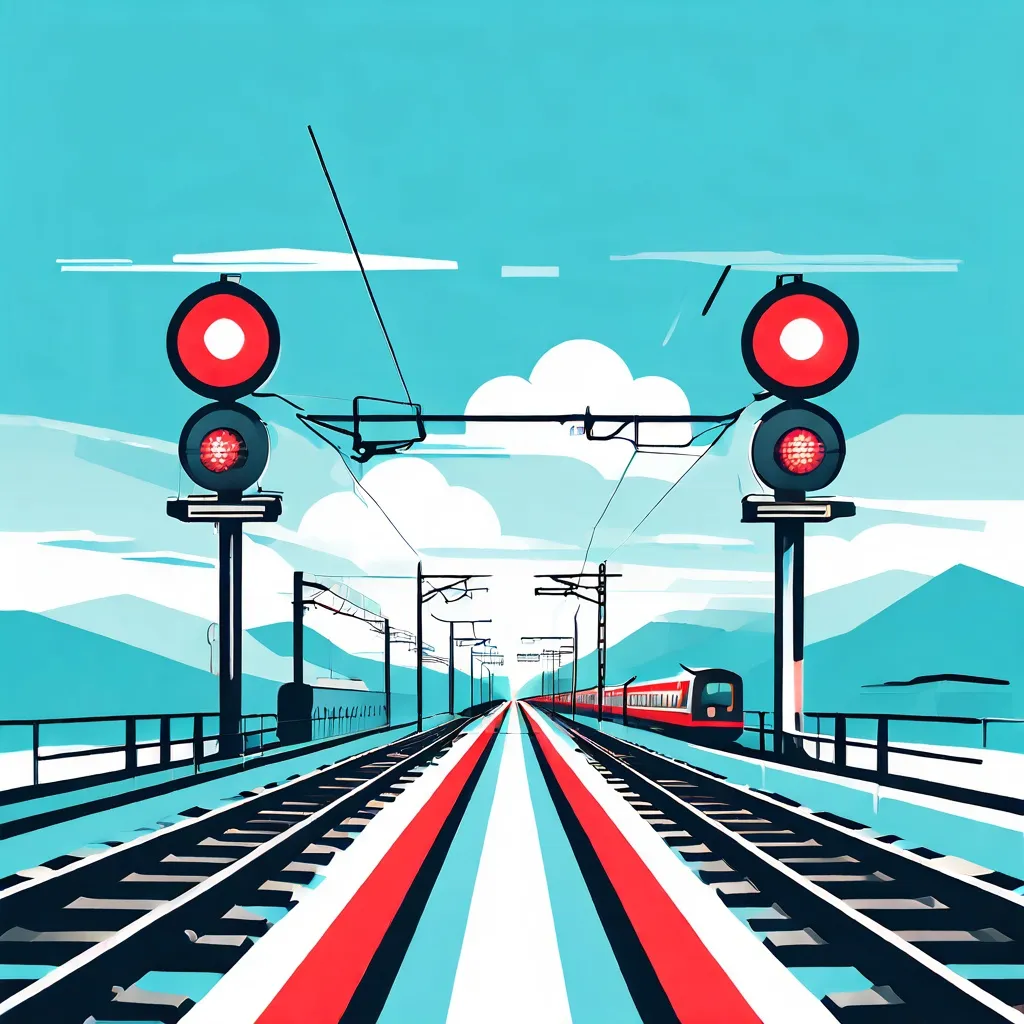
Guarded level crossings are the most common type equipped with active safety mechanisms to physically block road traffic when a train is approaching. These can feature either full barriers (Schranken) or half-barriers (Halbschranken). Full barriers extend across the entire width of the carriageway, completely preventing passage. Half-barriers, a design seen in Austria, block only the right half of each approaching lane, meaning drivers in the left lane might still have a clear path even if the right is blocked. Regardless of the barrier type, these crossings are invariably accompanied by flashing red lights and often audible warnings.
It is absolutely crucial to understand that the presence of barriers is secondary to the visual and auditory warnings. Even if the barriers have not yet descended, the flashing red lights are an immediate signal to stop. Drivers must always obey these signals and never attempt to bypass or circumvent barriers, as this constitutes a severe traffic violation with potentially fatal consequences.
Unguarded level crossings rely on advance warning signs and driver attentiveness rather than physical barriers. The primary marking for these crossings is the Andreas-Kreuz (St. Andrew's Cross), a white 'X' shape on a red background. This sign signifies that a railway line crosses the road and that you must be prepared to stop. In addition to the Andreas-Kreuz, there may be a Stopptafel (Stop sign) or additional warning signs indicating the distance to the crossing.
At an unguarded level crossing, the responsibility falls entirely on the driver to ascertain whether a train is approaching before proceeding. This involves stopping at the designated point, looking carefully in both directions along the railway tracks, and listening for any sounds of an approaching train. Only when you are absolutely certain that no train is coming should you proceed cautiously.
The rules governing behaviour at Austrian level crossings are stringent and designed to prevent accidents in a highly dangerous environment. Trains cannot deviate from their tracks, and their stopping distances are considerable, making driver error at these points particularly catastrophic. Understanding and applying these rules is paramount for your safety and legal compliance.
At any level crossing equipped with flashing red lights, these signals are the definitive indication that you must stop. This rule applies universally, regardless of whether barriers are present or have started to descend. The flashing red lights are a direct alert that a train is imminent, and proceeding when they are active is extremely dangerous and strictly prohibited. Austrian law is clear: a driver must stop at the stop line or, if none is present, before the crossing itself, and wait until the lights have stopped flashing and any barriers are fully raised.
Attempting to cross when the red lights are flashing is considered a serious offence. This is not a discretionary rule; it is an absolute requirement. Even if a train has just passed and the lights are still flashing, or if the barriers are still partially lowered, you must wait for the signal to clear. Failing to do so can result in severe penalties, including substantial fines and potential points on your driving license.
To enhance safety and prevent drivers from misjudging speeds or distances near railway lines, Austrian traffic law imposes specific overtaking prohibitions. Section 16 of the StVO, concerning overtaking, states that overtaking is forbidden at railway crossings. This prohibition extends to a significant distance before and after the crossing, particularly for multi-lane vehicles. For multi-lane motor vehicles, overtaking is prohibited for 80 metres before and immediately after a railway crossing. This rule is in place to ensure that drivers approaching or leaving a crossing are not distracted by or attempting to overtake other vehicles, thus maintaining full concentration on the potential hazards of the railway line.
One of the most critical, albeit thankfully rare, situations a driver might face is becoming trapped or stalling a vehicle on a level crossing. In such an emergency, immediate and decisive action is required. The primary objective is to clear the tracks as quickly as possible to avoid a collision with an approaching train.
If your vehicle stalls or you find yourself trapped by descending barriers, and a train is approaching or imminent, the absolute priority is to exit the vehicle immediately. Do not waste time trying to restart the engine if doing so would delay your escape. If possible, and without endangering yourself, you may attempt to push the vehicle off the tracks. If this is not feasible or too time-consuming, focus solely on evacuating yourself and any passengers to a safe distance away from the tracks.
For guarded crossings, there may be an emergency release handle on the barrier post, often coloured orange or red, which can be used to lift the barrier. In some cases, particularly at busier crossings, an emergency telephone (Notruf) might be available on the barrier post, allowing you to directly contact the railway operator. The ÖBB's emergency number is 05-1717, which should be called if you encounter any issues or witness a dangerous situation at a railway crossing, after ensuring your immediate safety.
The specific scenario at a level crossing dictates the precise behaviour expected of a driver. Being prepared for each type of crossing and understanding the implications of various signals and signs will ensure you navigate these points correctly and safely, both in real-world driving and during your theory test.
As previously emphasized, flashing red lights at a railway crossing are an absolute stop signal. This applies irrespective of whether there are barriers present. The lights are activated by the approaching train, and their illumination signifies immediate danger. You must bring your vehicle to a complete stop at the stop line, or before the crossing if no line is marked. Continue to wait until the lights cease flashing and the barriers, if present, are fully raised. Do not attempt to second-guess the system or assume a train has already passed if the lights are still flashing.
When approaching an unguarded level crossing marked with an Andreas-Kreuz, the procedure is one of caution and verification. First, identify the warning signs indicating the proximity of the crossing. As you reach the Andreas-Kreuz, you must stop. From this vantage point, carefully look left and right along the railway line for any signs of an approaching train. Listen intently for the sound of a train's horn or the rumble of its passage. If there are any doubts whatsoever about whether a train is approaching, you must remain stopped. Only when you are unequivocally certain that the tracks are clear should you proceed across.
If you are caught between descending barriers, or if you are on the wrong side of closed barriers when a train approaches, the situation is critical. The design of Austrian barriers typically allows them to break or yield if a vehicle applies force. Therefore, if you are in danger of being trapped or are already trapped, your instinct should be to accelerate and break through the barrier. This is a last resort, but it is preferable to being hit by a train. After safely clearing the crossing, it is advisable to report the incident to the authorities or the ÖBB to ensure the barrier is repaired and to make them aware of the situation.
Questions relating to Eisenbahnkreuzungen are a staple of the Austrian driving theory test. These questions are designed to assess your understanding of the hierarchy of signals, the specific rules for different crossing types, and your knowledge of emergency procedures. Expect to encounter scenarios that test your ability to correctly interpret flashing lights, the function of barriers, and the critical stop requirements at unguarded crossings.
Common exam traps include questions that try to trick you into believing barriers take precedence over flashing lights, or that it's permissible to cross if only one side of the crossing is blocked by a half-barrier and the path seems clear. The correct answer in such cases will always prioritize the flashing red lights as the definitive signal to stop. Furthermore, questions about emergency situations will assess whether you understand the immediate priority of personal safety and the correct steps to take if your vehicle stalls.
By familiarizing yourself with these types, rules, and emergency procedures, you will be well-prepared to handle any situation at an Austrian level crossing. Remember, safety is paramount, and understanding these regulations is a crucial step towards becoming a responsible and competent driver in Austria.
Austrian level crossings (Eisenbahnkreuzungen) are categorised as guarded or unguarded, with guarded crossings featuring flashing lights and barriers while unguarded crossings rely on the Andreas-Kreuz sign and driver vigilance. StVO §19a establishes the core rules: flashing red lights always demand an immediate stop, and at unguarded crossings drivers must stop, look, and listen before proceeding. Half-barriers block only the right lane, so drivers must never assume clearance from lights when any signal is active. Emergency procedures prioritise personal evacuation if trapped, with breaking through barriers permitted as a last resort. These rules are frequently tested in the Austrian driving theory exam, with common traps involving barrier precedence and half-barrier interpretation.
A short set of high-value points that capture the most important ideas from this article.
Flashing red lights at any level crossing are an absolute stop signal, regardless of whether barriers are present or descending
At unguarded crossings marked with an Andreas-Kreuz, you must stop, look both directions, and listen for trains before proceeding
Half-barriers block only the right lane—never assume it is safe to cross when lights are flashing just because one side appears clear
Overtaking is prohibited for 80 metres before and after a level crossing for multi-lane motor vehicles
If trapped by descending barriers with a train approaching, breaking through the barrier is legally acceptable as a last resort
StVO §19a governs behaviour at Eisenbahnkreuzungen; StVO §16 restricts overtaking near railway crossings
Full barriers (Schranken) block the entire carriageway; half-barriers (Halbschranken) block only the right half of each lane
Andreas-Kreuz (St. Andrew's Cross) marks unguarded crossings and always requires a complete stop and verification
The ÖBB emergency number is 05-1717 for reporting dangerous situations at crossings
In emergencies, personal safety and evacuation take absolute priority over vehicle preservation
Believing barriers take priority over flashing lights—flashing red lights are always the definitive stop signal
Assuming a half-barrier blocking only the right lane means the left lane is safe to cross when lights are flashing
Attempting to cross if the lights have stopped flashing but barriers are still lowering
At unguarded crossings, slowing down but not fully stopping before checking for trains
Wasting time trying to restart a stalled vehicle on the tracks instead of evacuating immediately
Article content overview
A short set of high-value points that capture the most important ideas from this article.
Flashing red lights at any level crossing are an absolute stop signal, regardless of whether barriers are present or descending
At unguarded crossings marked with an Andreas-Kreuz, you must stop, look both directions, and listen for trains before proceeding
Half-barriers block only the right lane—never assume it is safe to cross when lights are flashing just because one side appears clear
Overtaking is prohibited for 80 metres before and after a level crossing for multi-lane motor vehicles
If trapped by descending barriers with a train approaching, breaking through the barrier is legally acceptable as a last resort
StVO §19a governs behaviour at Eisenbahnkreuzungen; StVO §16 restricts overtaking near railway crossings
Full barriers (Schranken) block the entire carriageway; half-barriers (Halbschranken) block only the right half of each lane
Andreas-Kreuz (St. Andrew's Cross) marks unguarded crossings and always requires a complete stop and verification
The ÖBB emergency number is 05-1717 for reporting dangerous situations at crossings
In emergencies, personal safety and evacuation take absolute priority over vehicle preservation
Believing barriers take priority over flashing lights—flashing red lights are always the definitive stop signal
Assuming a half-barrier blocking only the right lane means the left lane is safe to cross when lights are flashing
Attempting to cross if the lights have stopped flashing but barriers are still lowering
At unguarded crossings, slowing down but not fully stopping before checking for trains
Wasting time trying to restart a stalled vehicle on the tracks instead of evacuating immediately
Explore related topics, search based questions, and concepts that learners often look up when studying Austrian Level Crossing Rules. These themes reflect real search intent and help you understand how this topic connects to wider driving theory knowledge in Austria.
Find clear and practical answers to common questions learners often have about Austrian Level Crossing Rules. This section helps explain difficult points, remove confusion, and reinforce the key driving theory concepts that matter for learners in Austria.
Austrian level crossings (Eisenbahnkreuzungen) are categorized by their safety features: fully guarded with barriers (Schranken), partially guarded with half-barriers (Halbschranken), and unguarded crossings marked by an Andreas-Kreuz (St. Andrew's cross).
You must always stop before an Austrian level crossing when the red flashing lights are active, regardless of whether the barriers are down. This is a strict legal requirement.
Immediately exit the vehicle and, if safe, push it off the tracks. Use the emergency release handle on barriers or the 'Notruf' telephone at guarded crossings to alert the railway operator. The ÖBB emergency number is 05-1717.
No, overtaking is prohibited for multi-track vehicles within 80 meters before and up to immediately after an unguarded level crossing, and is forbidden on any level crossing itself.
The Andreas-Kreuz (a white X on a red background) signifies an unguarded railway crossing. Drivers must stop, look and listen for approaching trains, and only proceed when it is safe to do so.
Use the search bar above to delve deeper into any Austrian road rule, traffic sign, or specific driving procedure. Refine your understanding of complex theory concepts and fully prepare for your official driving licence examination. Start your targeted study now.