
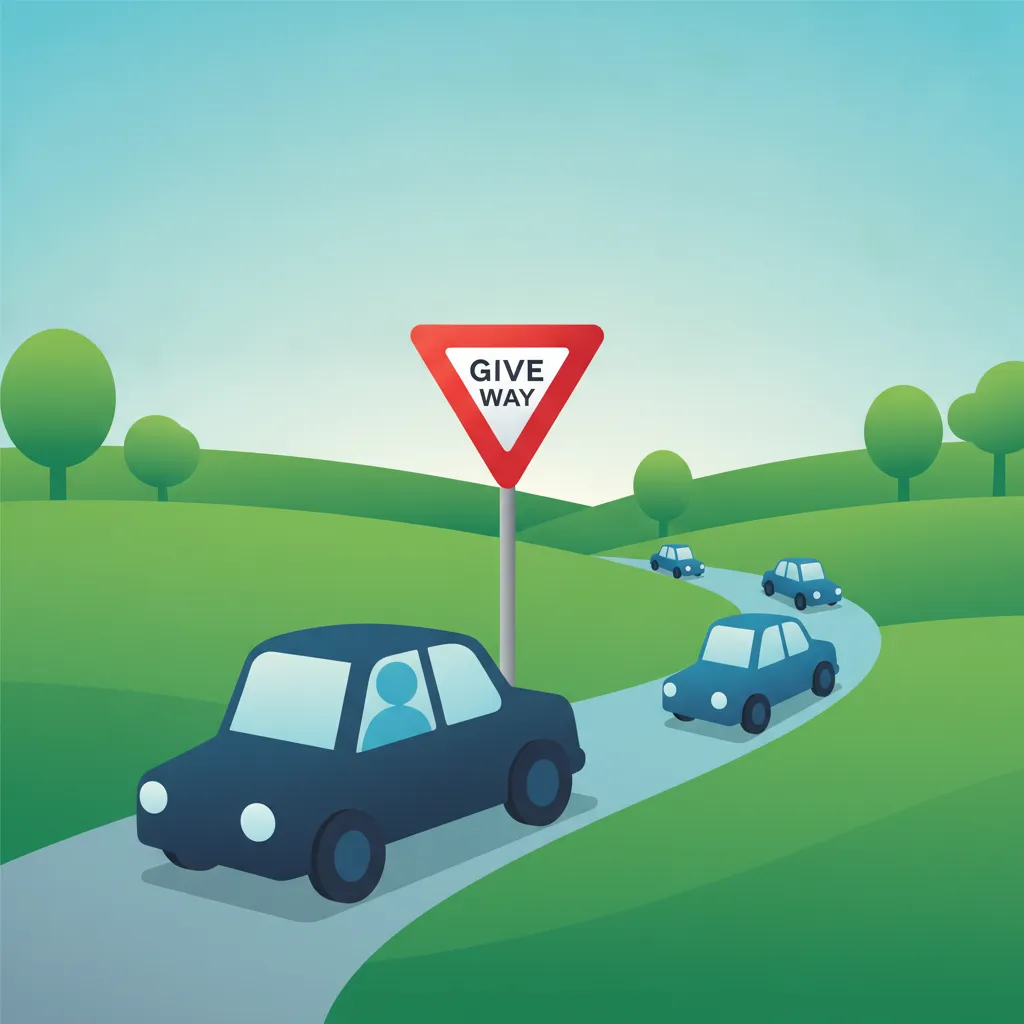
The Give Way sign is an inverted triangular sign that indicates you must give priority to traffic on the road you are joining or crossing. Unlike a Stop sign, you don't always need to stop completely, but you must slow down and be ready to stop if necessary. Your primary responsibility is to ensure that vehicles on the priority road do not have to slow down or change direction because of your actions.
Theory topic content overview
Read the full theory topic guide for Give Way Sign with structured, easy-to-scan content built for learners in Great Britain. This detailed section explains the exact rule, meaning, traffic context, comparison points, and exam logic behind this British driving theory topic so you can study faster, understand the concept more clearly, and avoid common interpretation mistakes on the theory test.
The Give Way sign is one of the most fundamental and frequently encountered road signs in Great Britain, crucial for safe navigation and understanding priority at junctions. Represented by a distinctive inverted triangle (red border, white background), this sign instructs drivers to yield priority to other road users, particularly traffic on the main road you are joining or crossing.
Unlike a Stop sign, which demands a complete halt regardless of traffic, a Give Way sign indicates that you must be prepared to stop if necessary, but only proceed when it is genuinely safe and will not cause other vehicles to slow down or change their course.
Understanding the Give Way sign and its accompanying rules is paramount for both safety on Great Britain's roads and success in the DVSA driving theory test.
Approaching a Give Way sign requires a systematic process of observation, assessment, and action. Your primary goal is to avoid causing other road users on the main road to take avoiding action (slow down or steer around you).
In Great Britain, the Give Way sign is almost always accompanied by a broken white line painted across the road at the junction. This line indicates where you should stop if required. In some cases, you might also see "GIVE WAY" painted on the road surface.
These signs and markings are typically found where:
This distinction is critical for UK learners and a common point of confusion.
Give Way Sign (Inverted Triangle):
Stop Sign (Octagonal):
The fundamental difference lies in the mandatory stop for the Stop sign versus the conditional stop for the Give Way sign. Never treat a Give Way sign as a mandatory stop unless the situation demands it.
The principle of giving way extends beyond just the inverted triangle sign. You might need to give way in other situations:
Learners often make specific errors related to Give Way signs:
The Give Way sign is more than just a symbol; it represents a core principle of road safety and cooperation in Great Britain. To master it:
By understanding and correctly applying the Give Way rules, you contribute to safer and more efficient roads for everyone in Great Britain.
The Give Way sign in Great Britain is an inverted red-bordered triangle requiring drivers to yield priority to traffic on the main road they are joining or crossing. Unlike the Stop sign, a full halt is conditional - you must slow significantly, be prepared to stop, and only proceed when it is genuinely safe and will not cause other vehicles to adjust their speed or direction. The accompanying broken white line marks where you should stop if needed, and at roundabouts specifically, you must give way to traffic from your immediate right already on the roundabout (Highway Code Rule 185). Understanding this distinction between conditional and mandatory stops, along with systematic observation and assessment, is essential for both road safety and passing the DVSA theory test.
A short set of high-value points that capture the most important ideas from this theory explanation.
The Give Way sign (inverted red triangle on white) means you must yield priority to all traffic on the main road before proceeding
A full stop is not mandatory at a Give Way sign if the way is clear - slow down and proceed only when it is safe to do so
You must be prepared to stop completely if required, keeping your foot ready over the brake pedal
At roundabouts, you must give way to traffic already on the roundabout approaching from your right (Highway Code Rule 185)
Your primary responsibility is ensuring traffic on the priority road does not have to slow down or change direction because of your actions
Give Way uses a broken white line road marking; Stop uses a solid white line - the marking distinguishes them
Give Way = conditional stop (only if necessary); Stop = mandatory complete halt regardless of traffic
Always check mirrors and blind spots before moving, especially for cyclists and motorcyclists alongside you
Give way to pedestrians who have already started crossing and to cyclists when turning
At unmarked junctions, priority is less clear - drive defensively and be prepared to give way
Not slowing down enough when approaching - reduces time to observe and react safely
Stopping unnecessarily when the way is clear - this holds up traffic behind you unnecessarily
Only checking one direction for traffic and missing pedestrians, cyclists, or vehicles from other angles
Confusing Give Way with Stop - either stopping fully at Give Way or failing to stop when visibility is poor at a Stop sign
Misjudging the speed of fast-approaching traffic or overestimating the available gap, especially on faster roads
Start with a short, direct summary of Give Way Sign before reading the full explanation below.
The Give Way sign in Great Britain instructs drivers to yield to traffic on the main road before proceeding. This means you must slow down, observe traffic, and only enter or cross the road when it is safe and will not cause other drivers to take avoiding action. You must be prepared to stop if required, but a full stop is not mandatory if the way is clear.
Review the most important terms, rule signals, and traffic concepts linked to Give Way Sign.
Explore related theory topic pages connected to Give Way Sign and continue with the next useful rule explanation.
See the common search queries learners use when trying to understand Give Way Sign in Great Britain.

Continue your journey to a successful Great Britain driving theory test by delving deeper into specific topics. Enhance your understanding of complex rules, review detailed explanations, and solidify your knowledge of the Highway Code, preparing you thoroughly for all aspects of the official DVSA exam. Start mastering key concepts today.
Great Britain Driving Theory TopicsTheory topic content overview
A short set of high-value points that capture the most important ideas from this theory explanation.
The Give Way sign (inverted red triangle on white) means you must yield priority to all traffic on the main road before proceeding
A full stop is not mandatory at a Give Way sign if the way is clear - slow down and proceed only when it is safe to do so
You must be prepared to stop completely if required, keeping your foot ready over the brake pedal
At roundabouts, you must give way to traffic already on the roundabout approaching from your right (Highway Code Rule 185)
Your primary responsibility is ensuring traffic on the priority road does not have to slow down or change direction because of your actions
Give Way uses a broken white line road marking; Stop uses a solid white line - the marking distinguishes them
Give Way = conditional stop (only if necessary); Stop = mandatory complete halt regardless of traffic
Always check mirrors and blind spots before moving, especially for cyclists and motorcyclists alongside you
Give way to pedestrians who have already started crossing and to cyclists when turning
At unmarked junctions, priority is less clear - drive defensively and be prepared to give way
Not slowing down enough when approaching - reduces time to observe and react safely
Stopping unnecessarily when the way is clear - this holds up traffic behind you unnecessarily
Only checking one direction for traffic and missing pedestrians, cyclists, or vehicles from other angles
Confusing Give Way with Stop - either stopping fully at Give Way or failing to stop when visibility is poor at a Stop sign
Misjudging the speed of fast-approaching traffic or overestimating the available gap, especially on faster roads
Start with a short, direct summary of Give Way Sign before reading the full explanation below.
The Give Way sign in Great Britain instructs drivers to yield to traffic on the main road before proceeding. This means you must slow down, observe traffic, and only enter or cross the road when it is safe and will not cause other drivers to take avoiding action. You must be prepared to stop if required, but a full stop is not mandatory if the way is clear.
Review the most important terms, rule signals, and traffic concepts linked to Give Way Sign.
Explore related theory topic pages connected to Give Way Sign and continue with the next useful rule explanation.
See the common search queries learners use when trying to understand Give Way Sign in Great Britain.
Continue your journey to a successful Great Britain driving theory test by delving deeper into specific topics. Enhance your understanding of complex rules, review detailed explanations, and solidify your knowledge of the Highway Code, preparing you thoroughly for all aspects of the official DVSA exam. Start mastering key concepts today.
Great Britain Driving Theory TopicsUse this exam-focused revision tip to understand how Give Way Sign is likely to appear in theory questions for learners in Great Britain. This section helps you identify the most testable part of the rule, avoid common traps, and remember the concept more effectively during British driving theory exam preparation.
A common mistake in the theory test and on the road is treating a Give Way sign like a Stop sign, or conversely, not slowing down enough. Remember, 'Give Way' means to yield; you must assess the situation and only proceed if it's genuinely clear. Don't stop if it's unnecessary, but don't force your way either. Always be prepared to stop.
Read direct answers to the most common learner questions about Give Way Sign in Great Britain. This FAQ focuses on rule confusion, practical meaning, comparison with similar concepts, and the exact uncertainties that appear most often in British driving theory revision and exam preparation.
In Great Britain, a Give Way sign (inverted red triangle) means you must give priority to traffic on the road you are about to enter or cross. You should slow down and be prepared to stop, proceeding only when it is safe to do so without interrupting other traffic.
No, you do not always have to come to a complete stop at a Give Way sign. You must slow down significantly and be ready to stop, but if the road is clear and you can proceed safely without affecting other traffic, you may do so without stopping.
A Give Way sign requires you to yield to other traffic but does not demand a full stop if the way is clear. A Stop sign, however, requires you to come to a complete halt at the stop line, regardless of whether there is approaching traffic, before proceeding safely.
You must give way to all traffic approaching from the road you are entering or crossing, including pedestrians, cyclists, and vehicles. Essentially, you must ensure your manoeuvre does not cause anyone on the main road to slow down or change their direction.
Give Way signs are typically placed at minor road junctions joining a major road, at mini-roundabouts, or where a slip road merges with a main carriageway. They ensure the smooth flow of traffic on the priority route.
The Give Way sign enforces priority rules as outlined in the Highway Code. Ignoring a Give Way sign by failing to yield is a serious offence that can lead to collisions, points on your licence, and failing your driving test.
A Give Way sign is usually accompanied by a broken white line painted across the road, known as a 'Give Way line'. This line marks where you should ideally stop or slow down to check for traffic.
Yes, failing to give way when required can result in a penalty for 'failing to conform to a road sign' or 'driving without due care and attention'. It is a serious driving fault in a driving test and can lead to immediate failure.
Yes, while the sign primarily governs vehicle-to-vehicle priority, you must always be aware of and give way to pedestrians who are already crossing or waiting to cross at the junction you are entering, especially if they are already on the road.
While you have priority, always be prepared for other drivers' mistakes. Proceed cautiously, even when you have the right of way, to prevent accidents. Defensive driving is key in all situations.
Dive into our comprehensive question bank to find exactly what you need for your Great Britain theory test. Use our advanced filters to pinpoint specific subjects or test your knowledge on challenging areas, ensuring you're fully prepared for success.