
Driving in Great Britain means sharing the road with a diverse range of users, each with unique needs and vulnerabilities. This section explains the essential rules and best practices for interacting safely with pedestrians, cyclists, motorcyclists, and larger vehicles. Mastering these principles is vital for enhancing road safety for everyone and successfully navigating your DVSA theory test.
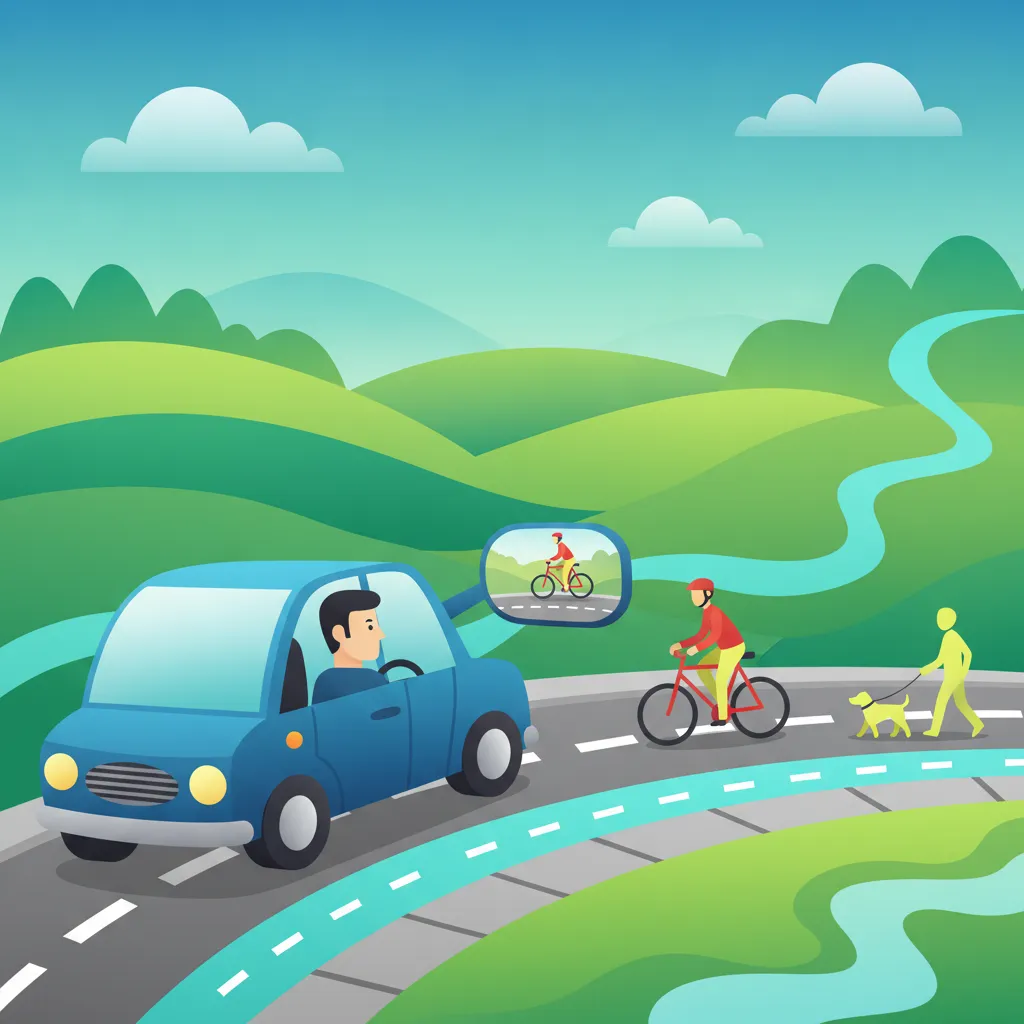
Theory topic content overview
Read the full theory topic guide for Road User Safety with structured, easy-to-scan content built for learners in Great Britain. This detailed section explains the exact rule, meaning, traffic context, comparison points, and exam logic behind this British driving theory topic so you can study faster, understand the concept more clearly, and avoid common interpretation mistakes on the theory test.
Driving in Great Britain means continuously sharing the road with a diverse range of users, from those in powerful vehicles to the most vulnerable. For all drivers in England, Scotland, and Wales, understanding how to interact safely and responsibly with everyone else is not just a matter of courtesy but a fundamental requirement of the Highway Code and the DVSA theory test.
Sharing the road safely is about proactively adapting your driving behaviour to ensure the safety of all road users. In Great Britain, this concept is underscored by a crucial principle: the Hierarchy of Road Users. Introduced into the Highway Code, this hierarchy states that those who can cause the greatest harm bear the greatest responsibility to reduce the danger or threat they pose to others.
This means that drivers of cars, vans, and lorries have a greater responsibility towards protecting pedestrians, cyclists, horse riders, and motorcyclists, as these groups are the most vulnerable in the event of a collision. It's a shift from simply 'sharing' to actively taking on a higher level of responsibility based on the potential impact of your vehicle.
Understanding and applying safe road sharing principles is vital for several reasons:
Certain road users are particularly susceptible to harm in a collision due to their lack of physical protection. As a driver, you must be acutely aware of their unique characteristics and needs. The Highway Code in Great Britain specifically highlights:
Pedestrians, especially children, older adults, and disabled people, are among the most vulnerable. They can be unpredictable.
Cycling is popular across the UK, and cyclists are often less visible than cars.
Motorcyclists are fast-moving and can be harder to judge due to their smaller profile.
Horses can be easily startled, requiring drivers to exercise extreme caution.
While not vulnerable in the same way as pedestrians, large vehicles have their own operational challenges that other drivers must understand for mutual safety.
Safe road sharing in Great Britain is an active process that requires constant vigilance and adaptation.
The revised Highway Code (Rules 1 to 8) explicitly outlines the Hierarchy of Road Users and its implications:
This framework influences specific rules, such as:
Learners often struggle with:
To excel in your DVSA theory test and become a safe driver on Great Britain's roads, always remember the core principle: responsibility increases with potential harm.
Adopt a mindset of constant anticipation and observation. Assume vulnerable road users might act unexpectedly. Give everyone, especially the most vulnerable, ample space and time. By consistently applying the Highway Code's guidance on the Hierarchy of Road Users and adopting proactive awareness, you contribute to a safer environment for everyone sharing the road in Great Britain.
This topic teaches the Highway Code's Hierarchy of Road Users principle, which places the greatest responsibility on those who can cause the most harm—meaning car, van, and lorry drivers must actively protect pedestrians, cyclists, motorcyclists, and horse riders. Key rules include maintaining at least 1.5 metres when passing cyclists, slowing to 10 mph with 2 metres clearance for horses, and always checking mirrors and blind spots before manoeuvring. The content covers specific vulnerable user groups with practical guidance for real-world scenarios in Great Britain, making it directly relevant for DVSA theory test preparation and building safe driving habits.
A short set of high-value points that capture the most important ideas from this theory explanation.
The Highway Code's Hierarchy of Road Users means drivers of larger vehicles bear greater responsibility to protect vulnerable users like pedestrians, cyclists, and motorcyclists
Cyclists may ride in the centre of their lane for safety and visibility, which is permitted by the Highway Code
Drivers must leave at least 1.5 metres (5 feet) when passing cyclists at speeds up to 30mph
When approaching horses, drivers must slow to a maximum of 10 mph and pass with at least 2 metres (6.5 feet) of space
Large vehicles have significant blind spots ('no-zones'); if you cannot see their mirrors, they cannot see you
Drivers must give way to pedestrians already crossing or waiting to cross when turning into or out of a junction
Never overtake a cyclist immediately before turning left as you risk cutting across their path
Comprehensive mirror and blind spot checks are critical before any lane change, turn, or manoeuvre to spot motorcycles and cycles
Motorcyclists may filter through slow or stationary traffic, so always anticipate their presence in urban queues
At crossings (zebra, pelican, puffin, toucan), be prepared to stop for pedestrians waiting to cross even before they step onto the road
Failing to perform proper head-check blind spot assessments before changing lanes or turning, missing motorcyclists or cyclists
Assuming cyclists always stay close to the kerb or misjudging their speed, leading to close passes or cutting them off
Not giving way to pedestrians waiting to cross at junctions when turning, violating the Highway Code hierarchy rules
Lingering alongside large vehicles in their blind spots where the driver cannot see your vehicle
Underestimating the unpredictability of children near schools, parks, or residential areas who may step into the road without looking
Start with a short, direct summary of Road User Safety before reading the full explanation below.
Sharing the road safely means actively adapting your driving behaviour to account for the presence and vulnerability of all other road users, particularly pedestrians, cyclists, and motorcyclists. In Great Britain, the Highway Code stresses that those who can cause the greatest harm bear the greatest responsibility to reduce danger. This involves maintaining safe distances, anticipating actions, and checking blind spots diligently to ensure mutual safety on UK roads.
Review the most important terms, rule signals, and traffic concepts linked to Road User Safety.
Explore related theory topic pages connected to Road User Safety and continue with the next useful rule explanation.
See the common search queries learners use when trying to understand Road User Safety in Great Britain.

Continue your journey to a successful Great Britain driving theory test by delving deeper into specific topics. Enhance your understanding of complex rules, review detailed explanations, and solidify your knowledge of the Highway Code, preparing you thoroughly for all aspects of the official DVSA exam. Start mastering key concepts today.
Great Britain Driving Theory TopicsTheory topic content overview
A short set of high-value points that capture the most important ideas from this theory explanation.
The Highway Code's Hierarchy of Road Users means drivers of larger vehicles bear greater responsibility to protect vulnerable users like pedestrians, cyclists, and motorcyclists
Cyclists may ride in the centre of their lane for safety and visibility, which is permitted by the Highway Code
Drivers must leave at least 1.5 metres (5 feet) when passing cyclists at speeds up to 30mph
When approaching horses, drivers must slow to a maximum of 10 mph and pass with at least 2 metres (6.5 feet) of space
Large vehicles have significant blind spots ('no-zones'); if you cannot see their mirrors, they cannot see you
Drivers must give way to pedestrians already crossing or waiting to cross when turning into or out of a junction
Never overtake a cyclist immediately before turning left as you risk cutting across their path
Comprehensive mirror and blind spot checks are critical before any lane change, turn, or manoeuvre to spot motorcycles and cycles
Motorcyclists may filter through slow or stationary traffic, so always anticipate their presence in urban queues
At crossings (zebra, pelican, puffin, toucan), be prepared to stop for pedestrians waiting to cross even before they step onto the road
Failing to perform proper head-check blind spot assessments before changing lanes or turning, missing motorcyclists or cyclists
Assuming cyclists always stay close to the kerb or misjudging their speed, leading to close passes or cutting them off
Not giving way to pedestrians waiting to cross at junctions when turning, violating the Highway Code hierarchy rules
Lingering alongside large vehicles in their blind spots where the driver cannot see your vehicle
Underestimating the unpredictability of children near schools, parks, or residential areas who may step into the road without looking
Start with a short, direct summary of Road User Safety before reading the full explanation below.
Sharing the road safely means actively adapting your driving behaviour to account for the presence and vulnerability of all other road users, particularly pedestrians, cyclists, and motorcyclists. In Great Britain, the Highway Code stresses that those who can cause the greatest harm bear the greatest responsibility to reduce danger. This involves maintaining safe distances, anticipating actions, and checking blind spots diligently to ensure mutual safety on UK roads.
Review the most important terms, rule signals, and traffic concepts linked to Road User Safety.
Explore related theory topic pages connected to Road User Safety and continue with the next useful rule explanation.
See the common search queries learners use when trying to understand Road User Safety in Great Britain.
Continue your journey to a successful Great Britain driving theory test by delving deeper into specific topics. Enhance your understanding of complex rules, review detailed explanations, and solidify your knowledge of the Highway Code, preparing you thoroughly for all aspects of the official DVSA exam. Start mastering key concepts today.
Great Britain Driving Theory TopicsUse this exam-focused revision tip to understand how Road User Safety is likely to appear in theory questions for learners in Great Britain. This section helps you identify the most testable part of the rule, avoid common traps, and remember the concept more effectively during British driving theory exam preparation.
The DVSA theory test often includes scenarios involving vulnerable road users, particularly cyclists and pedestrians. Remember the Highway Code's hierarchy of road users: those who can cause the most harm have the greatest responsibility. Always think from the perspective of the most vulnerable user in any given situation to help you choose the safest answer.
Read direct answers to the most common learner questions about Road User Safety in Great Britain. This FAQ focuses on rule confusion, practical meaning, comparison with similar concepts, and the exact uncertainties that appear most often in British driving theory revision and exam preparation.
In Great Britain, vulnerable road users include pedestrians, cyclists, horse riders, and motorcyclists. The Highway Code also highlights children, older adults, and disabled people, as well as learner and inexperienced drivers/riders, as requiring extra care.
The Highway Code establishes a hierarchy where those who can cause the greatest harm (typically drivers of larger vehicles) have the greatest responsibility to reduce danger to others. This means drivers of cars, vans, lorries, and buses have a responsibility to look out for cyclists, pedestrians, and horse riders.
Always give cyclists at least 1.5 metres of space when overtaking at speeds up to 30mph, and more at higher speeds. Be aware they may swerve to avoid potholes and that they can be hard to spot, especially at junctions. Wait behind them at traffic lights if they are in an Advanced Stop Line box.
Drive slowly and be prepared to stop, especially near schools, residential areas, or bus stops where children or other vulnerable pedestrians may step out unexpectedly. Give way to pedestrians waiting to cross at zebra crossings, and those on a parallel crossing or at a junction when you are turning.
Motorcyclists are less visible and have less physical protection than car drivers. Always check your mirrors and blind spots carefully before manoeuvres, as motorcyclists can be easily hidden. Assume they are closer or travelling faster than they appear, and give them ample space.
Large vehicles have significant blind spots, especially down their sides and directly behind them. Avoid driving in these areas. Give them extra room for turning as they need more space, and be patient if they are manoeuvring at junctions or roundabouts.
Dive into our comprehensive question bank to find exactly what you need for your Great Britain theory test. Use our advanced filters to pinpoint specific subjects or test your knowledge on challenging areas, ensuring you're fully prepared for success.