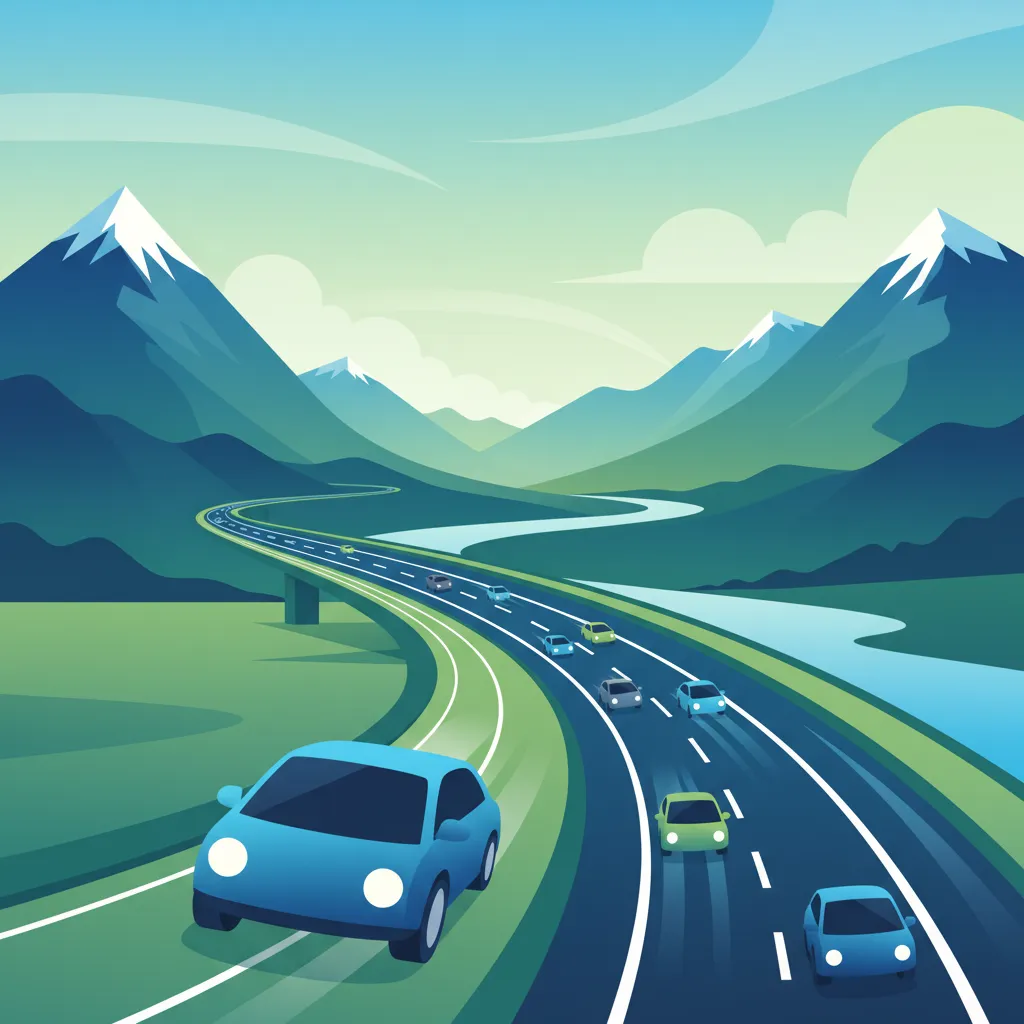
Entering a motorway requires a careful transition from a slower environment to fast-moving traffic. This page explains how to use acceleration lanes effectively, match the speed of existing traffic, and observe for safe gaps. Understanding these techniques is vital for integrating smoothly and safely into high-speed traffic flow on Icelandic roads.
Theory topic content overview
Read the full theory topic guide for Motorway Entry & Merging with structured, easy-to-scan content built for learners in Iceland. This detailed section explains the exact rule, meaning, traffic context, comparison points, and exam logic behind this Icelandic driving theory topic so you can study faster, understand the concept more clearly, and avoid common interpretation mistakes on the theory test.
Entering a high-speed road, often referred to as a motorway or a main road with fast-moving traffic in Iceland, is a critical driving maneuver. It requires a precise understanding of vehicle control, observation, and traffic dynamics to integrate safely and smoothly into the flow of traffic already traveling at higher speeds. The core concept is a seamless transition, minimizing disruption to other road users and ensuring your own safety.
Safe motorway entry is not just a technical skill; it's a fundamental aspect of defensive driving and a common focus in the Icelandic driving theory test.
Samgöngustofa) places significant emphasis on understanding priority rules, acceleration lane usage, and observation techniques for high-speed road entry. You will likely encounter questions on these topics in your theory test.Most motorway entrances or high-speed road on-ramps in Iceland feature an acceleration lane. This dedicated lane is designed to allow you to increase your speed to match the traffic already on the main carriageway before merging.
Follow these critical steps for a safe and effective merge:
Several factors influence the safety and ease of entering a motorway:
Understanding these distinctions is vital for safe and legal motorway entry on Icelandic roads:
Consider these common scenarios for safe motorway entry in Iceland:
Hringvegurinn (Route 1) from a shorter acceleration lane during peak hours. Traffic is dense and fast. Instead of rushing, you might need to adjust your acceleration, possibly slowing slightly at the very end of the acceleration lane to allow one or two vehicles to pass, creating a larger, safer gap for you to merge into without forcing others to brake. Patience and precise timing are paramount.Þjóðvegur 1 (Route 1) outside a major town during a snow flurry. Visibility is reduced, and the road surface is slick. In this scenario, you must significantly reduce your target merging speed to match the slower, cautious speed of other drivers. You'll need an even larger gap than usual to account for reduced braking ability and reaction times for all road users. Use your headlights for visibility.Learners and even experienced drivers often make these mistakes when entering high-speed roads:
Mastering motorway entry on Icelandic roads boils down to a key mental framework: "Accelerate, Observe, Adjust, Merge."
Always prioritize safety and never force your way into traffic. A confident, well-executed merge is a hallmark of a skilled and safe driver, contributing to smoother and safer journeys across Iceland.
Start with a short, direct summary of Motorway Entry & Merging before reading the full explanation below.
To enter a motorway safely, drivers must first use the acceleration lane to increase their speed until it matches that of the traffic already on the motorway. While accelerating, it is critical to observe the traffic flow using mirrors and quick glances, identifying a safe and adequate gap. Only merge when a clear space allows for smooth entry without forcing other vehicles to brake or swerve.
Review the most important terms, rule signals, and traffic concepts linked to Motorway Entry & Merging.
Explore related theory topic pages connected to Motorway Entry & Merging and continue with the next useful rule explanation.
See the common search queries learners use when trying to understand Motorway Entry & Merging in Iceland.

Ready to master Icelandic driving theory? Explore our comprehensive sections. Review road rules, traffic signs, and critical concepts. Build essential knowledge for confident and safe driving in Iceland. Start studying today.
Explore Icelandic Driving TheoryTheory topic content overview
Start with a short, direct summary of Motorway Entry & Merging before reading the full explanation below.
To enter a motorway safely, drivers must first use the acceleration lane to increase their speed until it matches that of the traffic already on the motorway. While accelerating, it is critical to observe the traffic flow using mirrors and quick glances, identifying a safe and adequate gap. Only merge when a clear space allows for smooth entry without forcing other vehicles to brake or swerve.
Review the most important terms, rule signals, and traffic concepts linked to Motorway Entry & Merging.
Explore related theory topic pages connected to Motorway Entry & Merging and continue with the next useful rule explanation.
See the common search queries learners use when trying to understand Motorway Entry & Merging in Iceland.
Ready to master Icelandic driving theory? Explore our comprehensive sections. Review road rules, traffic signs, and critical concepts. Build essential knowledge for confident and safe driving in Iceland. Start studying today.
Explore Icelandic Driving TheoryUse this exam-focused revision tip to understand how Motorway Entry & Merging is likely to appear in theory questions for learners in Iceland. This section helps you identify the most testable part of the rule, avoid common traps, and remember the concept more effectively during Icelandic driving theory exam preparation.
In the Icelandic theory test, pay close attention to questions about acceleration lanes and mirror usage. Remember that you must adjust your speed to match motorway traffic and find a safe gap; you do not have priority over vehicles already on the motorway. Never stop unnecessarily on an acceleration lane unless traffic is completely halted.
Read direct answers to the most common learner questions about Motorway Entry & Merging in Iceland. This FAQ focuses on rule confusion, practical meaning, comparison with similar concepts, and the exact uncertainties that appear most often in Icelandic driving theory revision and exam preparation.
An acceleration lane is designed to give you space to increase your vehicle's speed to match the speed of traffic already on the motorway before merging, ensuring a smooth and safe transition.
It is safe to merge when you have matched the speed of motorway traffic and can identify a gap large enough for your vehicle to enter without causing other drivers to brake or change lanes suddenly. Use your mirrors and quick head checks.
Ideally, you should not stop at the end of an acceleration lane, as this can be extremely dangerous. However, if traffic is completely stopped or there is absolutely no safe gap, you may have to stop. Your primary goal is to maintain momentum and merge safely.
You should aim to match the speed of the traffic already on the motorway. This often means accelerating to near the posted speed limit (e.g., 90 km/h) before merging, depending on conditions and traffic flow.
Drivers on the motorway should be aware of vehicles attempting to merge. If safe and possible, they should maintain a steady speed or move over to an adjacent lane to create space for merging vehicles, although merging vehicles do not have automatic right of way.
Common mistakes include entering too slowly, failing to check mirrors and blind spots adequately, not using the entire acceleration lane, and forcing your way into an unsafe gap. These can all lead to dangerous situations and are often tested in theory exams.
Utilize our advanced practice set search to pinpoint the exact Icelandic driving theory topics you need to review. Filter by subject, difficulty, or question type to create a highly effective study plan and ensure you are fully prepared for your official driving licence test in Iceland.