Performing a turn safely is a systematic process that requires careful planning and execution. In Iceland, drivers must coordinate their actions with all other road users, including vehicles, cyclists, and pedestrians, especially at intersections and roundabouts. This guide outlines the critical steps to ensure your turning maneuvers are smooth, predictable, and secure.
Theory topic content overview
Read the full theory topic guide for Safe Turning with structured, easy-to-scan content built for learners in Iceland. This detailed section explains the exact rule, meaning, traffic context, comparison points, and exam logic behind this Icelandic driving theory topic so you can study faster, understand the concept more clearly, and avoid common interpretation mistakes on the theory test.
Safe turning, or örugg beygja in Icelandic, is a fundamental driving skill that goes beyond simply changing direction. It encompasses a sequence of careful observations, clear communication, precise vehicle control, and adherence to priority rules, particularly crucial for preventing conflicts with vulnerable road users such as pedestrians and cyclists in Iceland. Mastering this maneuver is essential for your safety, the safety of others, and for success in the Icelandic driving exam (ökuskírteinispróf).
In Iceland, road conditions can change rapidly, and urban intersections, especially in areas like Reykjavík, can be complex. The Icelandic Transport Authority (Samgöngustofa) places significant emphasis on driver responsibility, particularly towards vulnerable road users. Misjudging a turn can lead to severe accidents, especially given the presence of snow, ice, gravel, or water that often affect road grip in different seasons across the country.
Executing a safe turn is a sequential process that demands your full attention. Here's a breakdown of the key steps for safe turning in Icelandic traffic:
Aðgæslu)Before you even think about turning, you must have a complete picture of your surroundings. This is the first and most critical step.
blindur blettur) to ensure no vehicle, motorcycle, or cyclist is alongside you. This is especially vital when preparing to turn right, as a cyclist may have overtaken you or be approaching on your left.Straummerki)Communicate your intentions clearly and well in advance using your direction indicators.
stefnuljós) once the turn is complete. Forgetting to do so can confuse other drivers and is a common driving test error.Akstursstaða)Your position on the road communicates your intent and prepares you for the turn.
Hraðastýring)Enter and execute the turn at a speed that allows for control and safe yielding.
Forgangsréttur)This is a critical aspect of safe turning and a major focus in Icelandic driving education.
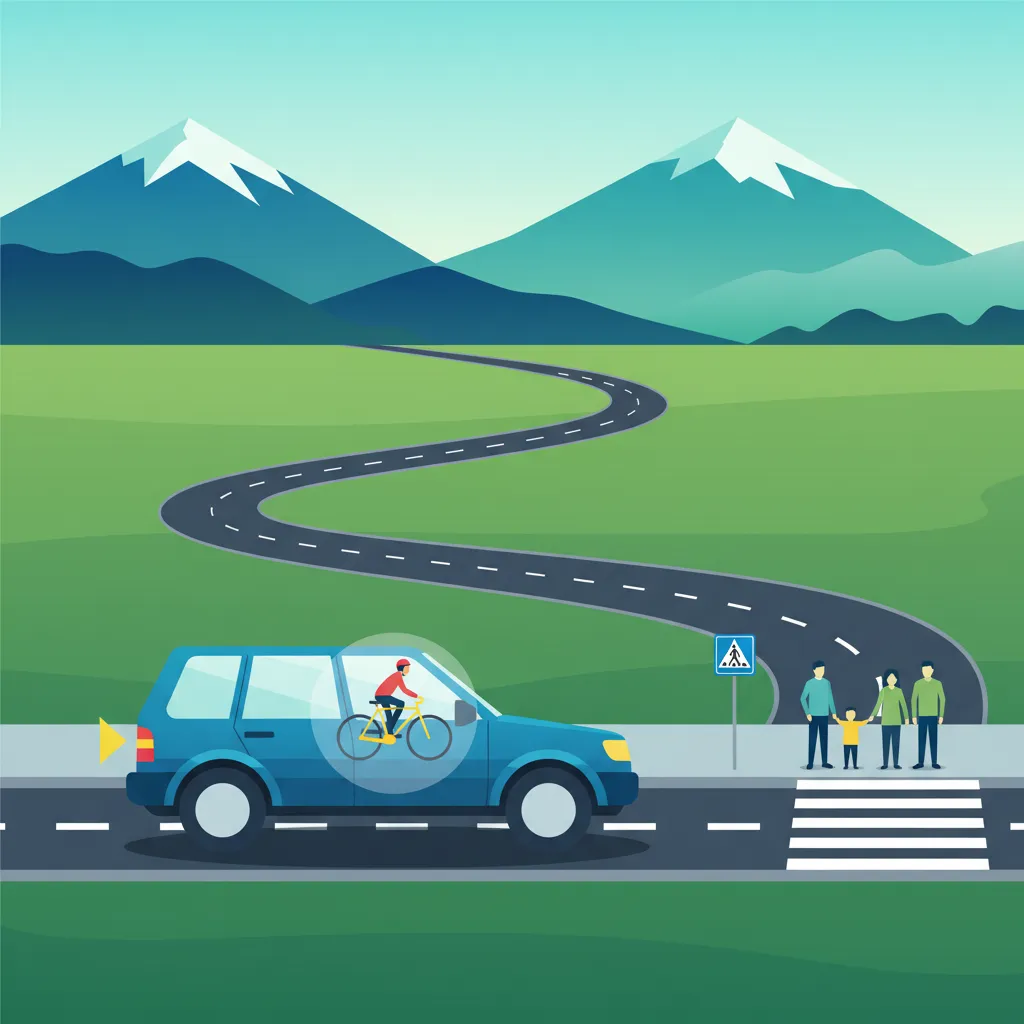
Víkur án undanþágu (Yield) signs and road markings, giving way to traffic on the road you are joining.You are approaching a right turn on a busy street. You observe your mirrors, signal right early, and position close to the curb. Just as you begin to turn, a cyclist, previously in your blind spot, moves to continue straight on the bicycle path alongside the road. You must yield to the cyclist, even if they were briefly out of sight. This scenario tests your observation, blind spot check, and understanding of priority to vulnerable road users (umferð hjólreiðamanna og gangandi vegfarenda).
You're driving on the Hringvegur and need to turn left onto a side road. You check mirrors, signal left, and slow down. You observe oncoming traffic. Before turning, you also scan the gravel shoulder for any pedestrians or slow-moving farm vehicles. You wait for a safe gap in oncoming traffic, ensuring you can complete the turn without sudden braking or obstructing the main road. The turn itself might involve a slightly looser surface, requiring even more speed control.
Hringtorg)While not a simple turn, roundabouts are common in Iceland. When exiting a roundabout, it's crucial to signal your intention before the exit you plan to take. Forgetting to signal right as you approach your exit point can confuse other drivers entering the roundabout and those waiting to join.
Learners often make these mistakes related to safe turning, leading to deductions in their ökuskírteinispróf:
For every turn you make in Iceland, adopt a systematic approach to ensure safety and compliance:
"Look, Signal, Position, Slow, Look Again, Yield, Turn, Off."
This mantra reminds you to continuously observe, clearly communicate, prepare your vehicle, control your speed, re-check for hazards (especially vulnerable users), prioritize correctly, execute smoothly, and then reset your vehicle's signals. This consistent practice is key to becoming a safe and responsible driver in Iceland.
Safe turning in Iceland requires executing a systematic five-step process: thorough observation (including blind spots), timely signalling (early and throughout), correct lane positioning (curb for right, center for left), appropriate speed reduction, and proper yielding to other road users—especially vulnerable pedestrians and cyclists who have priority when you turn right. Iceland's seasonal road conditions such as gravel, ice, sand, or water must always be considered as they significantly affect grip and control during turning maneuvers. The Icelandic driving exam closely assesses correct observation, signalling sequence, and yielding discipline. Adopting the systematic mantra 'Look, Signal, Position, Slow, Look Again, Yield, Turn, Off' helps ensure consistent safe practice.
A short set of high-value points that capture the most important ideas from this theory explanation.
Safe turning requires complete 360-degree observation before initiating, including blind spot checks for cyclists alongside your vehicle
In Iceland, drivers must yield priority to pedestrians and cyclists when turning right at intersections
Signal early (30–50 meters in urban areas), keep the signal on throughout the maneuver, and cancel it after completing the turn
Lane positioning differs by turn direction: position close to the curb for right turns and near the center line for left turns
Speed control is critical in Iceland—always account for seasonal hazards like gravel, ice, or water on road surfaces
The turning mantra: Look, Signal, Position, Slow, Look Again, Yield, Turn, Off
Observe road surface for conditions like loose gravel, sand, oil, water, ice, or snow that reduce grip during turns
When turning left, yield to all oncoming traffic proceeding straight or turning right, not just vehicles also turning left
Forgetting to cancel your turn signal after completing the maneuver is a common test error in Iceland
Signalling alone does not replace blind spot checks—always physically verify before executing the turn
Insufficient observation: failing to check blind spots or adequately scan for pedestrians and cyclists before and during the turn
Late or missing signals: signalling too late or forgetting to signal at all, depriving other road users of vital information
Incorrect lane positioning: approaching a turn from the wrong part of the lane, making the turn dangerously wide or narrow
Failing to yield: especially not yielding to pedestrians or cyclists when turning right at intersections
Inappropriate speed: entering turns too fast for current road conditions or turning too slowly and disrupting traffic flow
Start with a short, direct summary of Safe Turning before reading the full explanation below.
Safe turning involves a clear sequence of actions: first, observe your surroundings thoroughly, checking mirrors and blind spots for all road users. Second, signal your intentions well in advance. Third, position your vehicle correctly in the lane. Finally, execute the turn at an appropriate speed, yielding to anyone with priority, especially pedestrians and cyclists, and then switch off your indicator.
Review the most important terms, rule signals, and traffic concepts linked to Safe Turning.
Explore related theory topic pages connected to Safe Turning and continue with the next useful rule explanation.
See the common search queries learners use when trying to understand Safe Turning in Iceland.

Ready to master Icelandic driving theory? Explore our comprehensive sections. Review road rules, traffic signs, and critical concepts. Build essential knowledge for confident and safe driving in Iceland. Start studying today.
Explore Icelandic Driving TheoryTheory topic content overview
A short set of high-value points that capture the most important ideas from this theory explanation.
Safe turning requires complete 360-degree observation before initiating, including blind spot checks for cyclists alongside your vehicle
In Iceland, drivers must yield priority to pedestrians and cyclists when turning right at intersections
Signal early (30–50 meters in urban areas), keep the signal on throughout the maneuver, and cancel it after completing the turn
Lane positioning differs by turn direction: position close to the curb for right turns and near the center line for left turns
Speed control is critical in Iceland—always account for seasonal hazards like gravel, ice, or water on road surfaces
The turning mantra: Look, Signal, Position, Slow, Look Again, Yield, Turn, Off
Observe road surface for conditions like loose gravel, sand, oil, water, ice, or snow that reduce grip during turns
When turning left, yield to all oncoming traffic proceeding straight or turning right, not just vehicles also turning left
Forgetting to cancel your turn signal after completing the maneuver is a common test error in Iceland
Signalling alone does not replace blind spot checks—always physically verify before executing the turn
Insufficient observation: failing to check blind spots or adequately scan for pedestrians and cyclists before and during the turn
Late or missing signals: signalling too late or forgetting to signal at all, depriving other road users of vital information
Incorrect lane positioning: approaching a turn from the wrong part of the lane, making the turn dangerously wide or narrow
Failing to yield: especially not yielding to pedestrians or cyclists when turning right at intersections
Inappropriate speed: entering turns too fast for current road conditions or turning too slowly and disrupting traffic flow
Start with a short, direct summary of Safe Turning before reading the full explanation below.
Safe turning involves a clear sequence of actions: first, observe your surroundings thoroughly, checking mirrors and blind spots for all road users. Second, signal your intentions well in advance. Third, position your vehicle correctly in the lane. Finally, execute the turn at an appropriate speed, yielding to anyone with priority, especially pedestrians and cyclists, and then switch off your indicator.
Review the most important terms, rule signals, and traffic concepts linked to Safe Turning.
Explore related theory topic pages connected to Safe Turning and continue with the next useful rule explanation.
See the common search queries learners use when trying to understand Safe Turning in Iceland.
Ready to master Icelandic driving theory? Explore our comprehensive sections. Review road rules, traffic signs, and critical concepts. Build essential knowledge for confident and safe driving in Iceland. Start studying today.
Explore Icelandic Driving TheoryUse this exam-focused revision tip to understand how Safe Turning is likely to appear in theory questions for learners in Iceland. This section helps you identify the most testable part of the rule, avoid common traps, and remember the concept more effectively during Icelandic driving theory exam preparation.
A frequent exam trap involves scenarios where drivers fail to yield to vulnerable road users when turning. Always assume pedestrians and cyclists might be present and visible. Remember the sequence: Look, Signal, Position, Speed, Look again, and Yield. This systematic approach is key to earning points and demonstrating full awareness during your driving test.
Read direct answers to the most common learner questions about Safe Turning in Iceland. This FAQ focuses on rule confusion, practical meaning, comparison with similar concepts, and the exact uncertainties that appear most often in Icelandic driving theory revision and exam preparation.
The basic steps include observing the road environment, signaling your intentions, positioning your vehicle correctly, checking for vulnerable road users, executing the turn smoothly, and then canceling your indicator.
Timely signalling is crucial because it communicates your intentions to other road users, allowing them to anticipate your maneuver and adjust their speed or position accordingly, preventing misunderstandings and potential collisions.
When turning right at intersections in Iceland, you must always give priority to traffic of cyclists and pedestrians who are crossing the road you intend to enter.
Before a left turn, you should position your vehicle closer to the center line (if safe and permitted) or the left side of your lane. This clarifies your intention and helps prevent others from trying to overtake you on the left.
Common hazards include failing to see pedestrians or cyclists, misjudging the speed of oncoming traffic, turning too wide or too sharply, and not checking blind spots adequately, especially when turning right.
Inclement weather in Iceland, such as rain, snow, or ice, significantly reduces tire grip, making turns more hazardous. Drivers must reduce speed further and perform turns with extreme caution to maintain control and prevent skidding.
You should turn off your direction indicator as soon as the turning maneuver is completed and your vehicle is straightened in the new lane. Forgetting to do so can confuse other drivers.
In Iceland, be aware of hazards like sand, gravel, ice, or water on the road, especially in turns, as these can drastically reduce grip. Surface markings at pedestrian crossings and intersections can also be more slippery than asphalt.
Utilize our advanced practice set search to pinpoint the exact Icelandic driving theory topics you need to review. Filter by subject, difficulty, or question type to create a highly effective study plan and ensure you are fully prepared for your official driving licence test in Iceland.