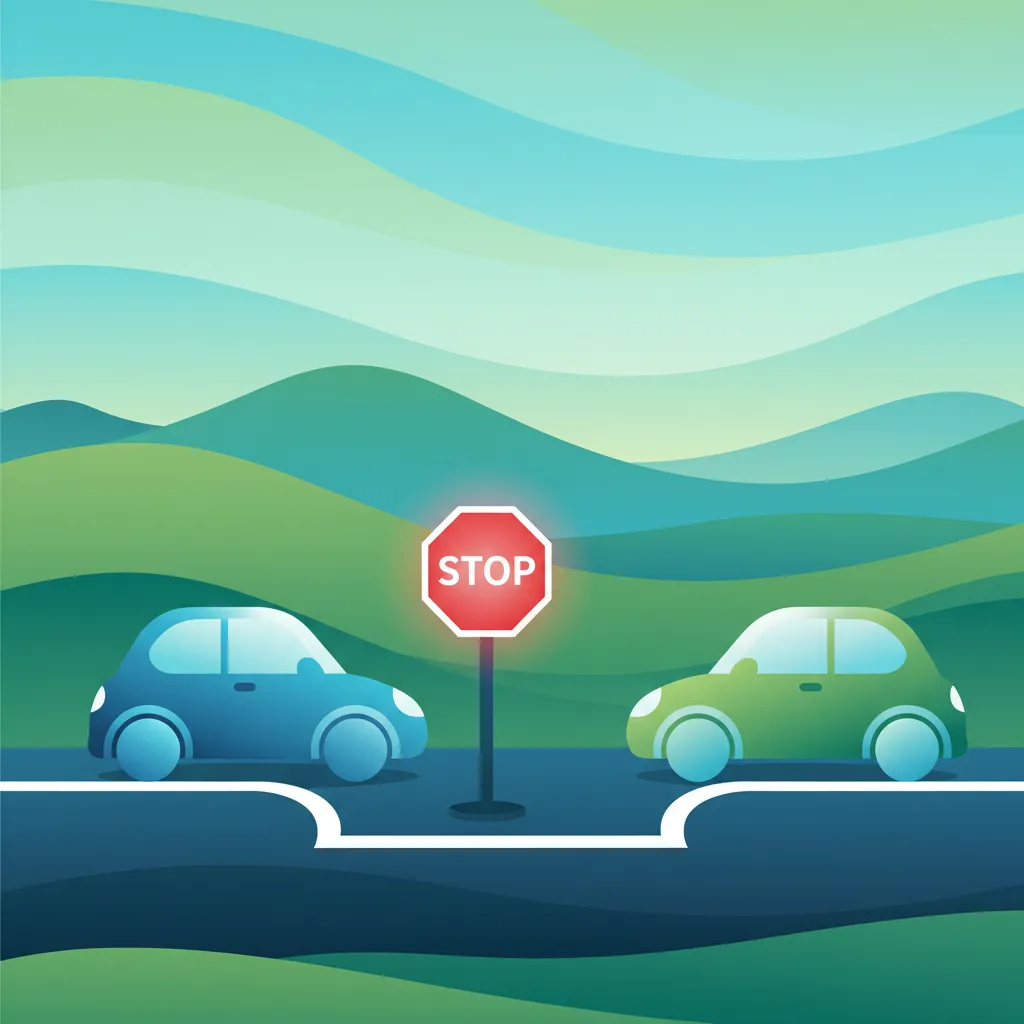
A stop sign (Stöðvunarskylda) is one of Iceland's most critical regulatory traffic signs, requiring drivers to bring their vehicle to a complete halt before proceeding. Unlike a yield sign, which allows for continuous movement if the path is clear, a stop sign mandates a full stop irrespective of traffic conditions. This rule ensures drivers pause to thoroughly assess the situation, especially at intersections with limited visibility or complex traffic flows, aligning with standards set by the Icelandic Transport Authority (Samgöngustofa).
Theory topic content overview
Read the full theory topic guide for Stop Sign Rules with structured, easy-to-scan content built for learners in Iceland. This detailed section explains the exact rule, meaning, traffic context, comparison points, and exam logic behind this Icelandic driving theory topic so you can study faster, understand the concept more clearly, and avoid common interpretation mistakes on the theory test.
A stop sign, known as Stöðvunarskylda in Icelandic traffic regulations, is one of the most critical regulatory traffic signs you will encounter. Its purpose is unambiguous: it demands that drivers bring their vehicle to a complete and full stop before proceeding. This is an absolute requirement, fundamental for road safety, particularly at intersections and road junctions in Iceland where visibility might be limited or complex traffic flows exist.
The core concept is to create a mandatory pause, giving you sufficient time to thoroughly assess the traffic situation before entering or crossing an intersection. This pause is not optional and must be performed regardless of whether the intersection appears clear or not.
Understanding and correctly obeying stop signs is vital for several reasons:
Stöðvunarskylda sign is a serious traffic violation in Iceland. It can result in fines, penalty points, and is considered a significant fault during a driving test.Stöðvunarskylda and its strict requirements, often contrasting it with the Vegurinn gefur leið (yield) sign.The act of stopping at a stop sign involves more than just bringing your vehicle to a halt; it requires a specific sequence of actions to ensure maximum safety and compliance with Icelandic traffic law.
Several factors can influence how you approach and execute a stop at a Stöðvunarskylda in Iceland:
One of the most common areas of confusion for driving learners in Iceland is the difference between a stop sign (Stöðvunarskylda) and a yield sign (Vegurinn gefur leið). Understanding this distinction is paramount for both passing the theory exam and safe driving.
| Feature | Stop Sign (Stöðvunarskylda) | Yield Sign (Vegurinn gefur leið) |
|---|---|---|
| Mandate | Mandatory complete stop regardless of traffic. | Yield right of way, stop only if necessary. |
| Vehicle Motion | Must come to a full, absolute halt. | Can continue moving if path is clear, typically slowing down. |
| Priority | No priority over any other road user. | Must yield to traffic on the priority road, then can proceed. |
| Purpose | High-risk intersections, poor visibility. | Less critical junctions, merging lanes, roundabouts. |
| Road Marking | Often accompanied by a solid white stop line. | Often accompanied by a dashed white yield line or no line. |
Remember: A Stöðvunarskylda is absolute. A Vegurinn gefur leið is conditional – you give way, but you might not need to stop if there's no cross-traffic to yield to.
Let's look at how the stop sign rule applies in typical Icelandic driving situations:
Stöðvunarskylda at a T-junction on an unpaved rural road in Iceland. High snowbanks or dense vegetation might block your view of the main road. You must stop completely at the stop line (or edge of the intersection) first. Only after this full stop, if you still can't see, creep slowly forward until you have a clear view, ready to stop again immediately if needed, before joining the main road.Stöðvunarskylda sign, you must come to a complete stop. Even if the main road appears clear initially, a vehicle could be approaching quickly, especially on roads outside urban areas where speeds are higher. Take your time to assess the speed and distance of any oncoming traffic before pulling out.Learners frequently make specific errors when encountering Stöðvunarskylda signs during their driving lessons and tests in Iceland:
The Stöðvunarskylda (stop sign) is not just a suggestion; it's a mandatory command designed to maximize safety on Icelandic roads. Always remember the "complete stop, then assess, then proceed safely" mantra. This rule is a cornerstone of responsible driving in Iceland and a non-negotiable requirement for your driving licence. Prioritize safety and compliance to navigate Icelandic intersections confidently and legally.
The stop sign (Stöðvunarskylda) is one of Iceland's most critical regulatory traffic signs, demanding an absolute and complete stop before proceeding at intersections. This mandatory pause gives drivers time to assess traffic conditions, yield to all road users, and proceed only when completely safe. The key distinction from a yield sign (Vegurinn gefur leið) is that no amount of apparent traffic clarity can excuse a full stop at a stop sign. Failure to comply is a serious traffic violation in Iceland, potentially resulting in fines, penalty points, and test failure. Always approach with caution, stop before the line or intersection edge, check thoroughly in all directions, and only proceed when you will not impede any other road user.
A short set of high-value points that capture the most important ideas from this theory explanation.
A stop sign (Stöðvunarskylda) requires a complete and absolute halt, regardless of whether traffic is visible or not
At a stop sign you have no priority over any road user: vehicles, cyclists, or pedestrians
The correct stopping position is before the stop line, or if none exists, before entering the intersection where you can see clearly
Weather, road conditions, and vehicle type all affect how you should approach and execute a stop sign
The stop sign vs yield sign distinction is a heavily tested concept on the Icelandic theory exam
Stöðvunarskylda means mandatory complete stop; Vegurinn gefur leið means yield only if needed
Your vehicle wheels must cease all movement completely before the stop line or intersection entry point
After stopping, check all directions: left, right, and ahead before proceeding
Yield to all traffic already in or approaching the intersection, including pedestrians on crosswalks
A rolling stop is illegal and will result in a fail on the driving test
Performing a rolling stop instead of a complete halt, which is illegal and unsafe
Stopping past the stop line or crosswalk, meaning the vehicle has entered the intersection illegally
Stopping too far back from the intersection, preventing clear visibility of crossing traffic
Confusing a stop sign with a yield sign and slowing down instead of stopping completely
Only checking one direction of traffic and missing vehicles, cyclists, or pedestrians from other angles
Start with a short, direct summary of Stop Sign Rules before reading the full explanation below.
In Iceland, a stop sign means you must bring your vehicle to a complete and full stop before the stop line or, if no line exists, before entering the intersection where you have clear visibility of crossing traffic. After stopping, you must yield to all other road users and only proceed when it is completely safe and you will not impede traffic flow. This absolute stop is fundamental for preventing accidents, particularly at dangerous crossings.
Review the most important terms, rule signals, and traffic concepts linked to Stop Sign Rules.
Explore related theory topic pages connected to Stop Sign Rules and continue with the next useful rule explanation.
See the common search queries learners use when trying to understand Stop Sign Rules in Iceland.

Ready to master Icelandic driving theory? Explore our comprehensive sections. Review road rules, traffic signs, and critical concepts. Build essential knowledge for confident and safe driving in Iceland. Start studying today.
Explore Icelandic Driving TheoryTheory topic content overview
A short set of high-value points that capture the most important ideas from this theory explanation.
A stop sign (Stöðvunarskylda) requires a complete and absolute halt, regardless of whether traffic is visible or not
At a stop sign you have no priority over any road user: vehicles, cyclists, or pedestrians
The correct stopping position is before the stop line, or if none exists, before entering the intersection where you can see clearly
Weather, road conditions, and vehicle type all affect how you should approach and execute a stop sign
The stop sign vs yield sign distinction is a heavily tested concept on the Icelandic theory exam
Stöðvunarskylda means mandatory complete stop; Vegurinn gefur leið means yield only if needed
Your vehicle wheels must cease all movement completely before the stop line or intersection entry point
After stopping, check all directions: left, right, and ahead before proceeding
Yield to all traffic already in or approaching the intersection, including pedestrians on crosswalks
A rolling stop is illegal and will result in a fail on the driving test
Performing a rolling stop instead of a complete halt, which is illegal and unsafe
Stopping past the stop line or crosswalk, meaning the vehicle has entered the intersection illegally
Stopping too far back from the intersection, preventing clear visibility of crossing traffic
Confusing a stop sign with a yield sign and slowing down instead of stopping completely
Only checking one direction of traffic and missing vehicles, cyclists, or pedestrians from other angles
Start with a short, direct summary of Stop Sign Rules before reading the full explanation below.
In Iceland, a stop sign means you must bring your vehicle to a complete and full stop before the stop line or, if no line exists, before entering the intersection where you have clear visibility of crossing traffic. After stopping, you must yield to all other road users and only proceed when it is completely safe and you will not impede traffic flow. This absolute stop is fundamental for preventing accidents, particularly at dangerous crossings.
Review the most important terms, rule signals, and traffic concepts linked to Stop Sign Rules.
Explore related theory topic pages connected to Stop Sign Rules and continue with the next useful rule explanation.
See the common search queries learners use when trying to understand Stop Sign Rules in Iceland.
Ready to master Icelandic driving theory? Explore our comprehensive sections. Review road rules, traffic signs, and critical concepts. Build essential knowledge for confident and safe driving in Iceland. Start studying today.
Explore Icelandic Driving TheoryUse this exam-focused revision tip to understand how Stop Sign Rules is likely to appear in theory questions for learners in Iceland. This section helps you identify the most testable part of the rule, avoid common traps, and remember the concept more effectively during Icelandic driving theory exam preparation.
In the Icelandic driving theory exam, pay close attention to questions comparing stop signs and yield signs. The crucial distinction is the 'complete stop' requirement for a stop sign, even if the intersection appears clear. Many learners lose points by mistaking a stop sign's strict mandate for the less restrictive 'give way' rule of a yield sign. Always assume a full stop is needed unless it's explicitly a yield scenario.
Read direct answers to the most common learner questions about Stop Sign Rules in Iceland. This FAQ focuses on rule confusion, practical meaning, comparison with similar concepts, and the exact uncertainties that appear most often in Icelandic driving theory revision and exam preparation.
In Iceland, a stop sign requires you to bring your vehicle to a complete, full, and absolute stop. This means your wheels must cease all movement before the stop line, or at a point where you have a clear view of crossing traffic without obstructing it.
The key difference in Iceland is that a stop sign mandates a complete stop regardless of traffic, while a yield sign requires you to give way to crossing traffic, but you may proceed without stopping if the road is clear and it's safe to do so.
You should stop before the solid white stop line painted on the road. If there is no stop line, stop before the crosswalk. If neither is present, stop at a point where you have the best possible view of crossing traffic without entering the intersection or interfering with other road users.
No, a 'rolling stop' where the vehicle only slows down but does not come to a complete halt is illegal and a serious traffic violation in Iceland. The requirement is for a full, absolute stop.
After stopping completely, you must check for all approaching vehicles, cyclists, and pedestrians on the intersecting road. You may only proceed when it is safe to do so, and your action will not force anyone else to brake or swerve.
Yes, stop signs can be found in both urban and rural areas of Iceland, especially at intersections with poor visibility, high traffic volume, or where merging traffic requires explicit priority control to ensure safety.
No, your obligation to make a complete stop at a stop sign in Iceland remains constant regardless of weather conditions. In fact, adverse weather like heavy rain, snow, or fog often demands even greater caution and a more prolonged stop to ensure safety.
Utilize our advanced practice set search to pinpoint the exact Icelandic driving theory topics you need to review. Filter by subject, difficulty, or question type to create a highly effective study plan and ensure you are fully prepared for your official driving licence test in Iceland.