
Stopping distance is the total ground a vehicle covers from the moment a driver identifies a hazard until the vehicle comes to a complete halt. It is a critical concept in safe driving, particularly on Icelandic roads which can present diverse and challenging conditions. This concept helps you understand why maintaining a safe following distance is non-negotiable and how various factors profoundly influence the time and space needed to stop.
Theory topic content overview
Read the full theory topic guide for Stopping Distance Basics with structured, easy-to-scan content built for learners in Iceland. This detailed section explains the exact rule, meaning, traffic context, comparison points, and exam logic behind this Icelandic driving theory topic so you can study faster, understand the concept more clearly, and avoid common interpretation mistakes on the theory test.
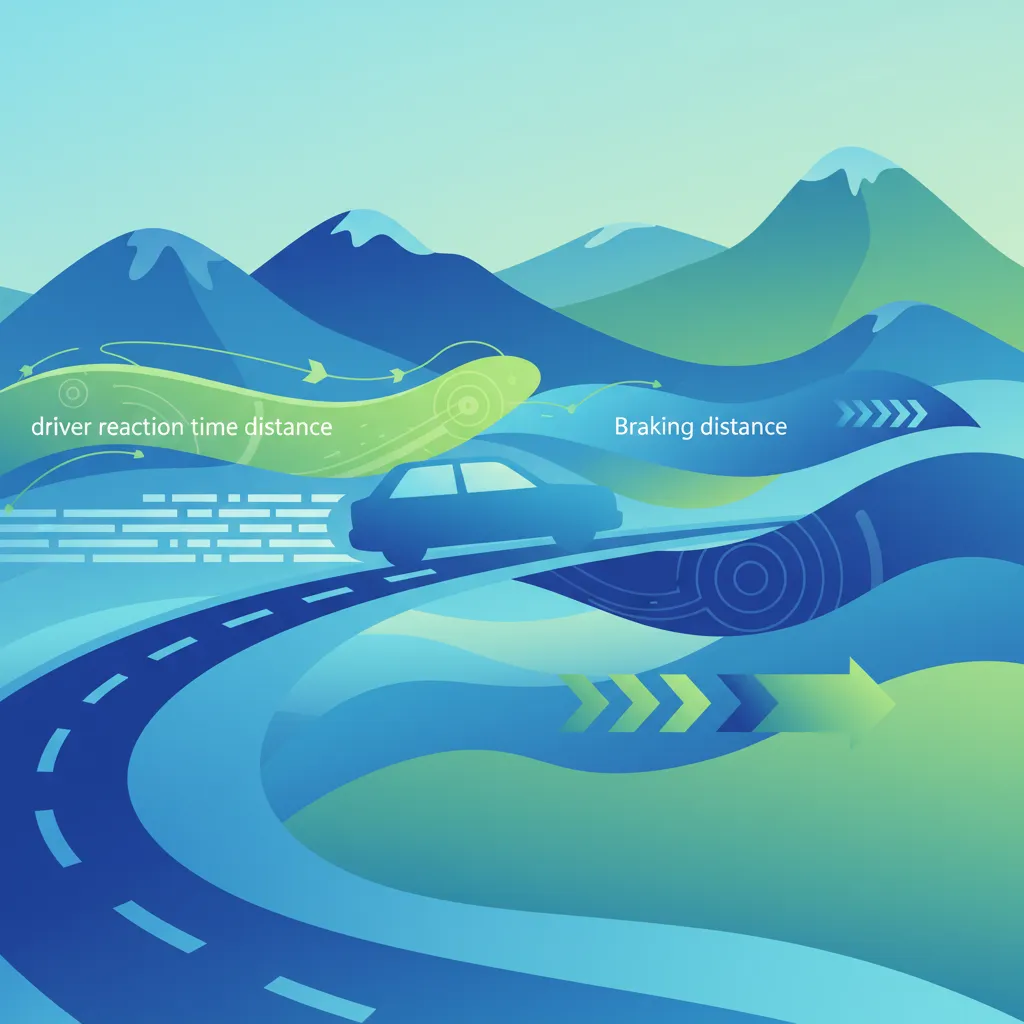
Stopping distance is the total ground a vehicle covers from the precise moment a driver identifies a hazard to the point where the vehicle comes to a complete halt. This critical measurement is fundamental to road safety and a key concept in the Icelandic driving theory exam. It's not a single fixed value but a dynamic sum of two distinct phases: reaction distance and braking distance.
Understanding stopping distance is about more than just numbers; it's about appreciating the vital link between speed, driver behaviour, vehicle capability, and the ever-changing Icelandic road environment. It underpins why maintaining a safe following distance (örugg fjarlægð) is non-negotiable for collision avoidance.
To truly grasp stopping distance, we must separate its two contributing factors:
This is the distance your vehicle travels during the time it takes for you, the driver, to:
During this period, the vehicle is still travelling at its original speed. Reaction distance increases directly in proportion to your speed – double your speed, and you double the reaction distance for the same reaction time.
Factors that increase reaction time and thus reaction distance:
This is the distance your vehicle travels from the moment you apply the brakes until it comes to a complete stop. Unlike reaction distance, braking distance does not increase linearly with speed. Instead, it increases roughly with the square of your speed.
This non-linear relationship is due to kinetic energy. Doubling your speed quadruples your kinetic energy, which means your brakes need to do four times the work to bring the vehicle to a halt, covering a significantly greater distance.
Factors that increase braking distance:
malbikslausir vegir): Much less grip than asphalt, especially when loose.ís) or Snow (snjór): Drastically reduces grip, leading to extremely long braking distances. Black ice (svartís) is particularly treacherous as it's often invisible.vetrardekk) are essential for safety in Icelandic winters.Mastering the concept of stopping distance is not just an academic exercise for your Icelandic driving theory exam; it's a fundamental skill for survival on Icelandic roads.
Imagine you double your speed from 40 km/h to 80 km/h. Your reaction distance roughly doubles. However, your braking distance will increase by a factor of four. So, your total stopping distance will increase significantly more than just doubling. This exponential increase is why small increments in speed can have a catastrophic impact on your ability to stop safely.
This principle is a cornerstone of safe driving in Iceland, where high speeds on rural roads, combined with unexpected hazards like crossing sheep, gravel patches, or sudden weather fronts, can quickly turn a manageable situation into an emergency.
Drivers often make key errors when thinking about stopping distance:
hraðatakmark) vs. Safe Speed: The posted speed limit is the maximum legal speed under ideal conditions. On Icelandic roads, especially outside urban areas, a safe speed is often much lower than the posted limit due to weather, road surface, visibility, and traffic. Always drive at a speed that allows you to stop within the visible, clear distance ahead.Consider these situations and how stopping distance applies:
fáfarnar vegir). As you approach a blind crest, your visibility is limited. A safe driver reduces speed significantly before the crest, knowing that a slow speed will drastically reduce the stopping distance needed if an obstacle (like another vehicle, a hiker, or a flock of sheep) appears suddenly on the other side.svartís) on a Winter Morning: You're driving from a heated garage on a cold, clear winter morning. The roads seem dry, but as you cross a bridge or enter a shaded area, you hit invisible black ice. Your reaction time is normal, but your braking distance can become many times longer than on dry asphalt. This is where a very cautious speed, especially in winter, becomes your most vital safety measure.To drive safely in Iceland and confidently pass your theory exam, always remember:
hraðatakmark).By internalizing the principles of stopping distance, you equip yourself with the knowledge to make informed, safe driving decisions, preparing you for both the Icelandic theory test and the diverse challenges of the road.
Stopping distance combines reaction distance (determined by driver perception and decision time) and braking distance (determined by vehicle speed and road conditions). Braking distance grows exponentially with speed, meaning small increases in speed cause disproportionately large increases in total stopping distance. On Icelandic roads, varying surfaces such as wet asphalt, gravel, ice, or snow can dramatically extend braking distance beyond what drivers might expect. Understanding this concept helps you maintain safe following distances, anticipate hazards early, and adapt your speed to current conditions rather than relying solely on posted speed limits.
A short set of high-value points that capture the most important ideas from this theory explanation.
Stopping distance equals reaction distance plus braking distance—always include the time before brakes engage.
Braking distance grows with the square of speed, not linearly—a small speed increase causes a much larger stopping distance increase.
Driver state (fatigue, distraction, impairment) directly increases reaction distance by slowing perception and decision time.
Road conditions in Iceland—wet asphalt, gravel, ice, or snow—can drastically extend braking distance beyond what dry conditions would require.
Anticipating hazards and scanning far ahead is safer than reacting only when a hazard becomes immediate.
Reaction distance increases in direct proportion to speed; braking distance increases roughly with the square of speed.
Black ice (svartís) is often invisible but dramatically reduces tyre grip, extending braking distance significantly.
ABS prevents wheel lockup and maintains steering but does not reduce stopping distance on loose surfaces like gravel or snow.
Following distance must be extended on wet, icy, snowy, or gravel roads beyond the standard minimum.
A speed limit is the maximum legal speed under ideal conditions; safe speed adapts to weather, visibility, and road surface.
Treating stopping distance as just braking distance, forgetting the reaction phase before brakes engage.
Assuming stopping distance doubles linearly when speed doubles, without accounting for the quadratic braking factor.
Treating the posted speed limit as automatically safe regardless of weather conditions or road surface.
Not extending following distance sufficiently on Icelandic gravel roads where braking distance is much longer than on asphalt.
Failing to scan far enough ahead, which reduces available reaction time and distance.
Start with a short, direct summary of Stopping Distance Basics before reading the full explanation below.
Stopping distance is the sum of reaction distance (the distance traveled while the driver reacts) and braking distance (the distance traveled while the vehicle brakes). This total distance increases dramatically with speed and is heavily influenced by road conditions, vehicle maintenance, and driver alertness. On Iceland's diverse roads, understanding this concept is vital for anticipating hazards and stopping safely.
Review the most important terms, rule signals, and traffic concepts linked to Stopping Distance Basics.
Explore related theory topic pages connected to Stopping Distance Basics and continue with the next useful rule explanation.
See the common search queries learners use when trying to understand Stopping Distance Basics in Iceland.

Ready to master Icelandic driving theory? Explore our comprehensive sections. Review road rules, traffic signs, and critical concepts. Build essential knowledge for confident and safe driving in Iceland. Start studying today.
Explore Icelandic Driving TheoryTheory topic content overview
A short set of high-value points that capture the most important ideas from this theory explanation.
Stopping distance equals reaction distance plus braking distance—always include the time before brakes engage.
Braking distance grows with the square of speed, not linearly—a small speed increase causes a much larger stopping distance increase.
Driver state (fatigue, distraction, impairment) directly increases reaction distance by slowing perception and decision time.
Road conditions in Iceland—wet asphalt, gravel, ice, or snow—can drastically extend braking distance beyond what dry conditions would require.
Anticipating hazards and scanning far ahead is safer than reacting only when a hazard becomes immediate.
Reaction distance increases in direct proportion to speed; braking distance increases roughly with the square of speed.
Black ice (svartís) is often invisible but dramatically reduces tyre grip, extending braking distance significantly.
ABS prevents wheel lockup and maintains steering but does not reduce stopping distance on loose surfaces like gravel or snow.
Following distance must be extended on wet, icy, snowy, or gravel roads beyond the standard minimum.
A speed limit is the maximum legal speed under ideal conditions; safe speed adapts to weather, visibility, and road surface.
Treating stopping distance as just braking distance, forgetting the reaction phase before brakes engage.
Assuming stopping distance doubles linearly when speed doubles, without accounting for the quadratic braking factor.
Treating the posted speed limit as automatically safe regardless of weather conditions or road surface.
Not extending following distance sufficiently on Icelandic gravel roads where braking distance is much longer than on asphalt.
Failing to scan far enough ahead, which reduces available reaction time and distance.
Start with a short, direct summary of Stopping Distance Basics before reading the full explanation below.
Stopping distance is the sum of reaction distance (the distance traveled while the driver reacts) and braking distance (the distance traveled while the vehicle brakes). This total distance increases dramatically with speed and is heavily influenced by road conditions, vehicle maintenance, and driver alertness. On Iceland's diverse roads, understanding this concept is vital for anticipating hazards and stopping safely.
Review the most important terms, rule signals, and traffic concepts linked to Stopping Distance Basics.
Explore related theory topic pages connected to Stopping Distance Basics and continue with the next useful rule explanation.
See the common search queries learners use when trying to understand Stopping Distance Basics in Iceland.
Ready to master Icelandic driving theory? Explore our comprehensive sections. Review road rules, traffic signs, and critical concepts. Build essential knowledge for confident and safe driving in Iceland. Start studying today.
Explore Icelandic Driving TheoryUse this exam-focused revision tip to understand how Stopping Distance Basics is likely to appear in theory questions for learners in Iceland. This section helps you identify the most testable part of the rule, avoid common traps, and remember the concept more effectively during Icelandic driving theory exam preparation.
A common mistake in the Icelandic theory exam is underestimating how much stopping distance increases with speed. Remember that braking distance grows exponentially with speed, not linearly. Pay close attention to questions distinguishing between reaction distance and braking distance, and consider how different road conditions (like ice or gravel) affect these components.
Read direct answers to the most common learner questions about Stopping Distance Basics in Iceland. This FAQ focuses on rule confusion, practical meaning, comparison with similar concepts, and the exact uncertainties that appear most often in Icelandic driving theory revision and exam preparation.
Stopping distance is the total distance your vehicle travels from the moment you recognize a hazard and decide to stop, until your vehicle comes to a complete standstill. It includes both your reaction time and the vehicle's braking performance.
Reaction distance is the distance your vehicle covers from the moment you perceive a hazard until you physically apply the brakes. Braking distance is the distance your vehicle travels from the moment the brakes are applied until the vehicle stops completely.
Speed has a disproportionate effect on stopping distance. While reaction distance increases linearly with speed, braking distance increases roughly with the square of your speed. This means doubling your speed can roughly quadruple your braking distance, significantly increasing total stopping distance.
Many factors influence stopping distance, especially in Iceland. These include road conditions (wet, icy, snowy, gravel), tire condition and pressure, vehicle weight, brake efficiency, and driver factors like fatigue, distraction, or alcohol impairment.
Maintaining a safe following distance ensures you have enough space to cover your full stopping distance if the vehicle ahead suddenly stops. This is essential for preventing rear-end collisions, particularly on roads with varying grip or limited visibility, common in Iceland.
While exact formulas or distance tables are less critical, the Icelandic driving theory exam often tests your understanding of the relationship between speed, reaction time, and braking capability. Focus on the principles of how these factors combine and affect safety rather than specific numbers.
ABS helps maintain steering control during hard braking by preventing wheel lock-up, which can be crucial on slippery Icelandic roads. However, it doesn't always shorten the actual stopping distance; its primary benefit is controlled braking, not necessarily shorter distances, especially on loose surfaces like gravel or snow.
Utilize our advanced practice set search to pinpoint the exact Icelandic driving theory topics you need to review. Filter by subject, difficulty, or question type to create a highly effective study plan and ensure you are fully prepared for your official driving licence test in Iceland.