
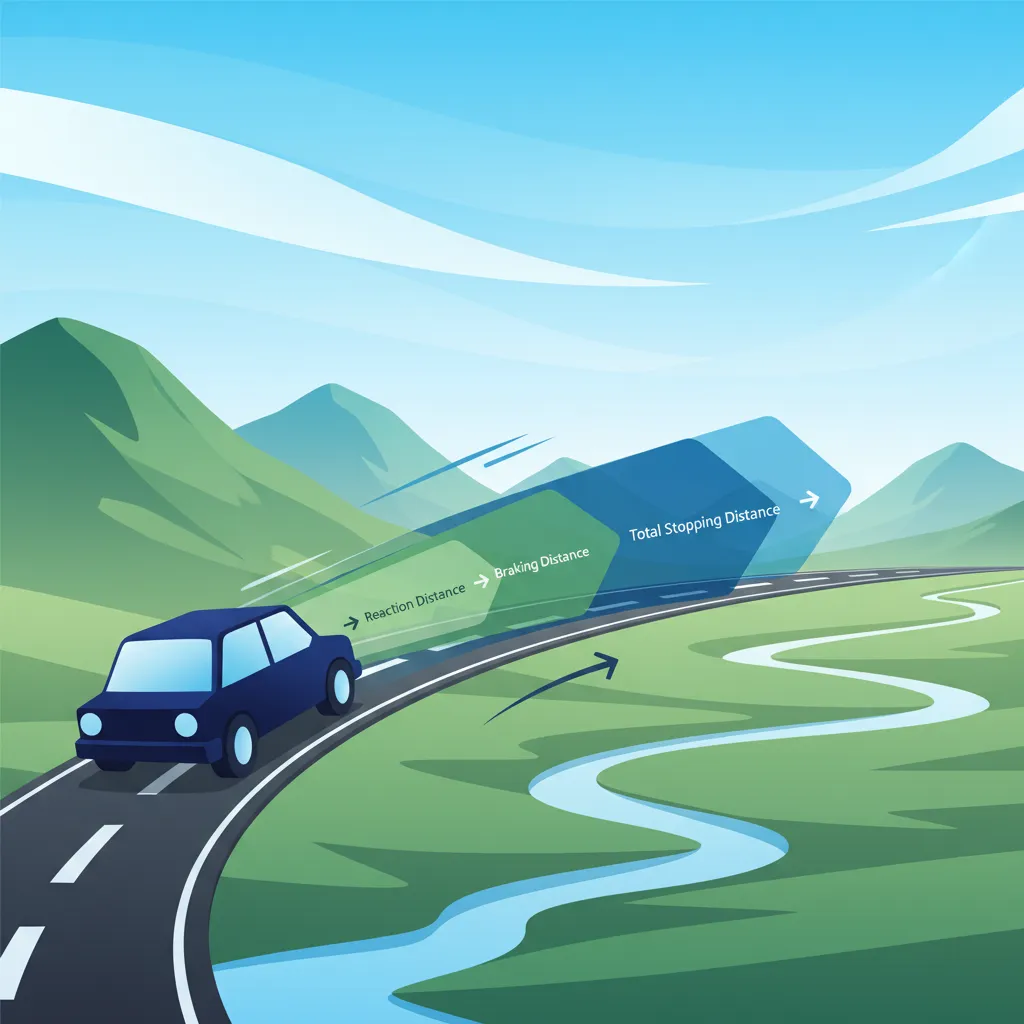
The total distance a vehicle travels from the moment a driver detects a hazard to when the vehicle comes to a complete stop is called stopping distance. This distance is made up of two main parts: reaction distance and braking distance. It's vital to understand how these distances change with speed, as even small increases in velocity can significantly extend the overall stopping distance and reduce your ability to react safely to unexpected situations on Icelandic roads.
Theory topic content overview
Read the full theory topic guide for Speed & Stopping Distance with structured, easy-to-scan content built for learners in Iceland. This detailed section explains the exact rule, meaning, traffic context, comparison points, and exam logic behind this Icelandic driving theory topic so you can study faster, understand the concept more clearly, and avoid common interpretation mistakes on the theory test.
The relationship between a vehicle's speed and the distance it takes to stop is one of the most critical concepts in driving theory and practical road safety in Iceland. Understanding this connection is not just about passing the Icelandic driving theory exam; it's fundamental to preventing accidents and driving safely on varied Icelandic roads, from urban streets to remote rural routes, often facing unpredictable weather.
Stopping distance is the total distance your vehicle travels from the moment you first perceive a hazard to the point where your vehicle comes to a complete halt. It is not a single, fixed value, but rather the sum of two distinct phases:
The core reason speed is so crucial is that it dramatically lengthens both the reaction and braking distances. On Icelandic roads, where conditions can change rapidly from dry asphalt to wet, icy, or gravel surfaces, having sufficient stopping distance is often the difference between avoiding an accident and being involved in one. Higher speeds mean you have significantly less time and space to react to sudden hazards like an unexpected animal on the road, a sharp turn, or a sudden change in grip due to weather.
Moreover, if a collision does occur, the severity of the impact increases exponentially with speed due to kinetic energy. Doubling your speed doesn't just double the impact; it quadruples the energy involved, leading to far more severe consequences for occupants and pedestrians.
Understanding how speed affects each component separately is key to grasping the overall impact on safe driving in Iceland.
Your reaction time is fairly constant (typically around 1 to 1.5 seconds for an alert driver, though it varies greatly). However, the distance your vehicle covers during this time increases directly and proportionally with your speed.
This shows that for the same reaction time, a faster vehicle covers more ground before braking even begins.
This is where speed's impact becomes most dramatic. Braking distance is not linear; it increases roughly with the square of your speed. This is due to the physics of kinetic energy. To double your speed, you need four times the braking force, or four times the distance, to shed that energy.
This exponential increase in braking distance is the primary reason why even small increases in speed have such a profound impact on your ability to stop safely.
When you combine the linear increase of reaction distance with the exponential increase of braking distance, the total stopping distance grows rapidly with speed. This means that driving just a little faster than necessary can significantly reduce your safety margin.
Consider driving on a dry road in Iceland:
This dramatic increase means that at higher speeds, you might not be able to stop in time for a hazard that was perfectly avoidable at a slightly lower speed. This is a critical factor for Icelandic drivers, particularly given the varying speed limits and conditions found across the country.
While speed is the primary factor, several other conditions prevalent in Iceland significantly influence your stopping distance:
Learners in Iceland often make critical errors regarding speed and stopping distance:
To drive safely and effectively manage the relationship between speed and stopping distance in Iceland:
Stopping distance is the sum of reaction distance (which increases linearly with speed) and braking distance (which increases exponentially with the square of speed). This means even small increases in speed dramatically lengthen your total stopping distance and reduce your safety margin. In Iceland's variable conditions—ice, wet roads, gravel, limited visibility—stopping distances can be many times longer than on dry asphalt. The key principle is to always travel at a speed allowing you to stop within your visible distance ahead, not just the posted speed limit.
A short set of high-value points that capture the most important ideas from this theory explanation.
Braking distance increases with the square of your speed, not proportionally—doubling your speed quadruples braking distance.
Reaction distance increases linearly with speed, but braking distance grows exponentially, so the total stopping distance increases rapidly at higher speeds.
The posted speed limit is the maximum allowed under ideal conditions, not a recommendation for safe speed in actual driving conditions.
Road surface conditions in Iceland (ice, wet asphalt, gravel) dramatically increase braking distance beyond what drivers might expect.
Always ensure you can stop within the distance you can see ahead—your visible distance is your maximum safe travel distance.
Braking distance quadruples when speed doubles—this exponential effect is the key to understanding stopping distances.
At 60 km/h, braking distance is roughly four times what it is at 30 km/h, not double.
Reaction time remains fairly constant (1–1.5 seconds for alert drivers), but the distance covered during that time scales with speed.
Wet, icy, or gravel surfaces can increase braking distance by a factor of 10 or more compared to dry asphalt.
The four-second rule for following distance gives you enough space to react and brake effectively.
Assuming stopping distance doubles when speed doubles, when in reality it increases much more sharply due to the exponential braking relationship.
Treating the speed limit as a 'safe speed' regardless of weather, visibility, or road surface conditions.
Not reducing speed sufficiently for Iceland's varied conditions, particularly black ice on rural roads or reduced grip on gravel surfaces.
Failing to maintain adequate following distance, not accounting for the time needed to perceive, react, and brake.
Start with a short, direct summary of Speed & Stopping Distance before reading the full explanation below.
Stopping distance is the sum of reaction distance (distance traveled during driver reaction time) and braking distance (distance traveled while braking). Vehicle speed has a direct and significant impact on both. Reaction distance increases proportionally with speed, while braking distance increases exponentially (roughly with the square of the speed). This means that higher speeds dramatically increase the total distance needed to stop, requiring greater foresight and caution, especially given varied Icelandic road conditions.
Review the most important terms, rule signals, and traffic concepts linked to Speed & Stopping Distance.
Explore related theory topic pages connected to Speed & Stopping Distance and continue with the next useful rule explanation.
See the common search queries learners use when trying to understand Speed & Stopping Distance in Iceland.

Ready to master Icelandic driving theory? Explore our comprehensive sections. Review road rules, traffic signs, and critical concepts. Build essential knowledge for confident and safe driving in Iceland. Start studying today.
Explore Icelandic Driving TheoryTheory topic content overview
A short set of high-value points that capture the most important ideas from this theory explanation.
Braking distance increases with the square of your speed, not proportionally—doubling your speed quadruples braking distance.
Reaction distance increases linearly with speed, but braking distance grows exponentially, so the total stopping distance increases rapidly at higher speeds.
The posted speed limit is the maximum allowed under ideal conditions, not a recommendation for safe speed in actual driving conditions.
Road surface conditions in Iceland (ice, wet asphalt, gravel) dramatically increase braking distance beyond what drivers might expect.
Always ensure you can stop within the distance you can see ahead—your visible distance is your maximum safe travel distance.
Braking distance quadruples when speed doubles—this exponential effect is the key to understanding stopping distances.
At 60 km/h, braking distance is roughly four times what it is at 30 km/h, not double.
Reaction time remains fairly constant (1–1.5 seconds for alert drivers), but the distance covered during that time scales with speed.
Wet, icy, or gravel surfaces can increase braking distance by a factor of 10 or more compared to dry asphalt.
The four-second rule for following distance gives you enough space to react and brake effectively.
Assuming stopping distance doubles when speed doubles, when in reality it increases much more sharply due to the exponential braking relationship.
Treating the speed limit as a 'safe speed' regardless of weather, visibility, or road surface conditions.
Not reducing speed sufficiently for Iceland's varied conditions, particularly black ice on rural roads or reduced grip on gravel surfaces.
Failing to maintain adequate following distance, not accounting for the time needed to perceive, react, and brake.
Start with a short, direct summary of Speed & Stopping Distance before reading the full explanation below.
Stopping distance is the sum of reaction distance (distance traveled during driver reaction time) and braking distance (distance traveled while braking). Vehicle speed has a direct and significant impact on both. Reaction distance increases proportionally with speed, while braking distance increases exponentially (roughly with the square of the speed). This means that higher speeds dramatically increase the total distance needed to stop, requiring greater foresight and caution, especially given varied Icelandic road conditions.
Review the most important terms, rule signals, and traffic concepts linked to Speed & Stopping Distance.
Explore related theory topic pages connected to Speed & Stopping Distance and continue with the next useful rule explanation.
See the common search queries learners use when trying to understand Speed & Stopping Distance in Iceland.
Ready to master Icelandic driving theory? Explore our comprehensive sections. Review road rules, traffic signs, and critical concepts. Build essential knowledge for confident and safe driving in Iceland. Start studying today.
Explore Icelandic Driving TheoryUse this exam-focused revision tip to understand how Speed & Stopping Distance is likely to appear in theory questions for learners in Iceland. This section helps you identify the most testable part of the rule, avoid common traps, and remember the concept more effectively during Icelandic driving theory exam preparation.
A common mistake in the Icelandic theory exam is underestimating the impact of speed on stopping distance. Remember that braking distance doesn't just double when speed doubles; it roughly quadruples. Always consider the exponential effect of speed on your ability to stop to avoid common traps in exam questions related to hazard response.
Read direct answers to the most common learner questions about Speed & Stopping Distance in Iceland. This FAQ focuses on rule confusion, practical meaning, comparison with similar concepts, and the exact uncertainties that appear most often in Icelandic driving theory revision and exam preparation.
Stopping distance is composed of reaction distance, which is the distance covered while the driver reacts to a hazard, and braking distance, which is the distance covered from when the brakes are applied until the vehicle stops.
Reaction distance increases directly with speed. If you take a fixed amount of time to react (e.g., one second), a faster vehicle will travel a greater distance during that reaction time before you even begin to brake.
Braking distance increases dramatically because of physics: kinetic energy, which must be dissipated by the brakes, increases with the square of the vehicle's speed. Doubling your speed roughly quadruples your braking distance under similar conditions.
No, doubling your speed does not merely double your stopping distance. While reaction distance doubles, braking distance increases by approximately four times, meaning the total stopping distance increases significantly more than just doubling.
Iceland often has challenging road conditions due to weather (ice, snow, rain) and varying road surfaces (gravel, asphalt). These factors can further extend stopping distances, making a thorough understanding of the speed-to-stopping-distance relationship even more critical for safety.
Understanding how speed affects stopping distance is fundamental to maintaining a safe following distance. You must always ensure there is enough space to stop if the vehicle ahead brakes suddenly, a distance that increases significantly with your own speed.
Utilize our advanced practice set search to pinpoint the exact Icelandic driving theory topics you need to review. Filter by subject, difficulty, or question type to create a highly effective study plan and ensure you are fully prepared for your official driving licence test in Iceland.