
Effective mirror checks are a cornerstone of defensive driving, especially given Iceland's varied road conditions and traffic flows. This guide explains how to properly use your vehicle's mirrors to observe traffic behind and beside you, anticipate other drivers' actions, and ensure safer maneuvers. Understanding these techniques is vital for both your theory exam and practical driving safety.
Theory topic content overview
Read the full theory topic guide for Mirror Checks with structured, easy-to-scan content built for learners in Iceland. This detailed section explains the exact rule, meaning, traffic context, comparison points, and exam logic behind this Icelandic driving theory topic so you can study faster, understand the concept more clearly, and avoid common interpretation mistakes on the theory test.
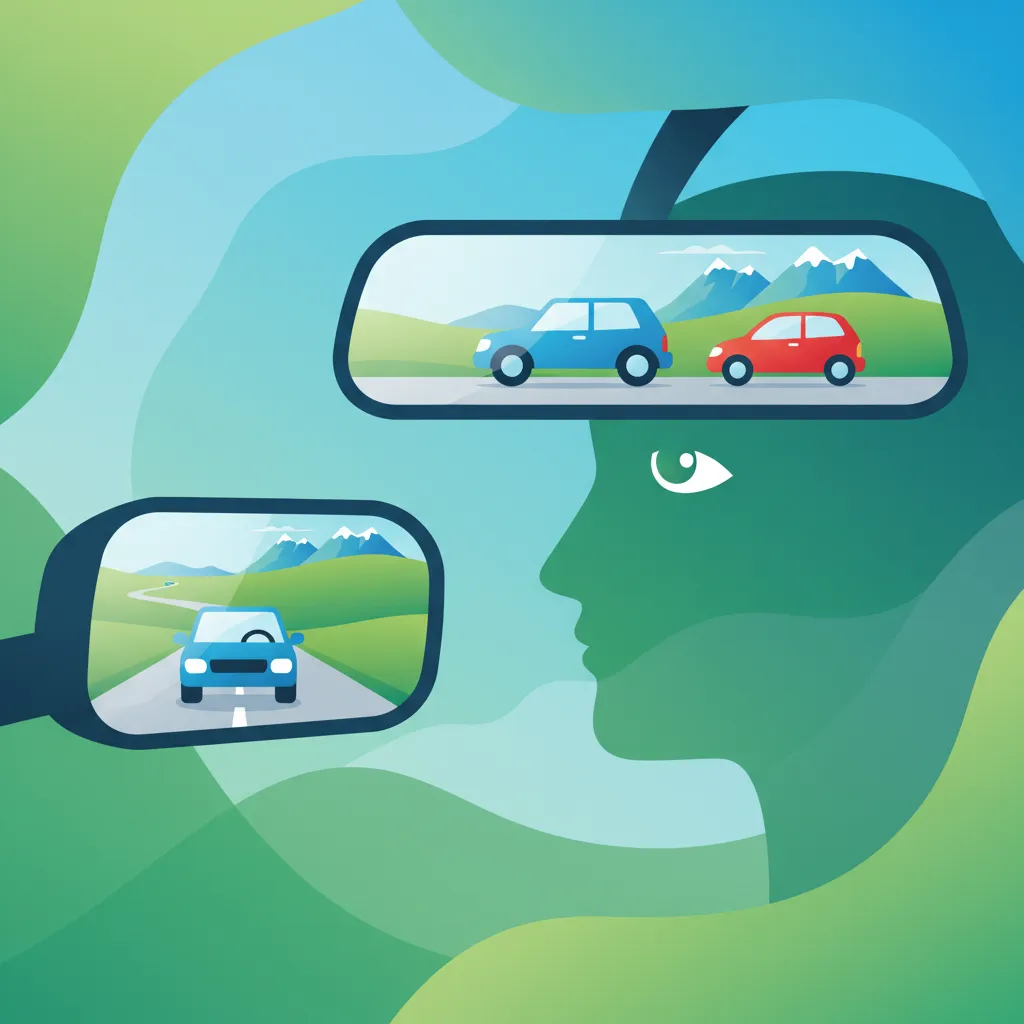
Mirror checks are the continuous, systematic use of your vehicle's rear-view and side mirrors to monitor the traffic environment behind and to the sides of your car. Far from being a mere glance, effective mirror checks are a fundamental observation routine that allows drivers to maintain crucial situational awareness, anticipate potential hazards, and execute maneuvers safely. In Icelandic driving, where conditions can change rapidly and roads vary from urban streets to open rural routes, consistent and effective mirror checks are non-negotiable for safe driving.
Mastering mirror checks is essential for several reasons, impacting both your safety and your success in the Icelandic driving exam:
Your vehicle is equipped with three primary mirrors, each serving a distinct purpose:
Mirror checks should be a continuous part of your driving, not just an occasional action. Aim for a quick glance in your mirrors approximately every 5-8 seconds when driving straight. Beyond this continuous awareness, specific situations demand explicit mirror checks:
While mirrors provide an extensive view, they do not show everything. Every vehicle has blind spots – areas around the car that are not visible in any mirror. These are typically to the rear-quarter of the vehicle, particularly the area directly alongside your back bumper that you can't see without turning your head.
Distinction:
You must perform a blind spot check in addition to mirror checks whenever you change lanes, merge, or make significant lateral movements. Failing to do so is a common cause of side-swipe collisions, especially with smaller vehicles like motorcycles or bicycles that can easily be hidden in these zones.
Consider these situations to understand the practical application of mirror checks:
Learners often underestimate the importance of active mirror checking, leading to common errors:
Think of mirror checks as part of a continuous "observation loop" where your eyes are constantly scanning: ahead, mirrors, blind spots, instruments, then back to the road ahead. This isn't just a requirement for the Icelandic driving exam; it's a habit that transforms a reactive driver into a proactive, safer one. By consistently knowing what's happening around your vehicle, you equip yourself to react intelligently and prevent situations from becoming dangerous, no matter the challenges of Icelandic driving conditions.
Mirror checks are a continuous observation routine involving the rear-view and side mirrors to monitor surrounding traffic, essential before any change in speed or direction. The Mirror-Signal-Maneuver (MSM) sequence must always be followed: check mirrors, then signal, then maneuver. Each mirror serves a distinct purpose, and blind spot checks are mandatory supplements to eliminate hidden zones that mirrors cannot cover. In Iceland's varied conditions - from the Ring Road to Reykjavík city traffic - regular mirror checks every 5-8 seconds help detect fast-approaching vehicles, cyclists, and motorcyclists. Common learner errors include checking mirrors too late in the sequence, forgetting blind spot checks, mirror staring, and failing to register smaller road users.
A short set of high-value points that capture the most important ideas from this theory explanation.
Mirror checks are a continuous observation routine, not occasional glances - aim for checks every 5-8 seconds when driving straight
The Mirror-Signal-Maneuver (MSM) sequence must always be followed in order: mirrors first, then signal, then maneuver
Each of the three mirrors serves a distinct purpose - interior rear-view monitors traffic behind, exterior side mirrors cover adjacent lanes and overtaking vehicles
Blind spot checks are mandatory supplements to mirror checks for any lane change, merge, or significant lateral movement
On Icelandic roads, mirror checks are especially critical for spotting fast-approaching vehicles on rural routes and cyclists in urban areas
Keep mirror glances quick and frequent - checks should be brief glances, not long stares
Always check mirrors before braking, turning, changing lanes, merging, overtaking, or opening a vehicle door
Icelandic regulations require extended side mirrors when a trailer exceeds vehicle width and obstructs rearward vision
Check mirrors after passing any hazard to confirm you are clear and traffic behind is responding appropriately
The observation loop is: mirrors, blind spots, instruments, then back to the road ahead - repeat continuously
Checking mirrors too late - after signaling or starting a maneuver instead of before, disrupting the correct MSM sequence
Relying solely on mirrors for lane changes and skipping the essential blind spot over-the-shoulder check
Mirror staring - gazing at mirrors for too long, causing eyes to leave the road ahead for unsafe periods
Failing to register smaller road users like motorcycles, cyclists, and scooters who can appear quickly in mirrors
Incorrect mirror adjustment that leaves unnecessary blind spots, reducing overall situational awareness
Start with a short, direct summary of Mirror Checks before reading the full explanation below.
Mirror checks are a continuous observation routine involving the rear-view and side mirrors to monitor surrounding traffic. They are critical before any change in speed or direction, such as braking, turning, or changing lanes, and also for maintaining general awareness. In Iceland, consistent mirror use helps drivers react proactively to traffic dynamics, including potential fast-approaching vehicles or cyclists.
Review the most important terms, rule signals, and traffic concepts linked to Mirror Checks.
Explore related theory topic pages connected to Mirror Checks and continue with the next useful rule explanation.
See the common search queries learners use when trying to understand Mirror Checks in Iceland.

Ready to master Icelandic driving theory? Explore our comprehensive sections. Review road rules, traffic signs, and critical concepts. Build essential knowledge for confident and safe driving in Iceland. Start studying today.
Explore Icelandic Driving TheoryTheory topic content overview
A short set of high-value points that capture the most important ideas from this theory explanation.
Mirror checks are a continuous observation routine, not occasional glances - aim for checks every 5-8 seconds when driving straight
The Mirror-Signal-Maneuver (MSM) sequence must always be followed in order: mirrors first, then signal, then maneuver
Each of the three mirrors serves a distinct purpose - interior rear-view monitors traffic behind, exterior side mirrors cover adjacent lanes and overtaking vehicles
Blind spot checks are mandatory supplements to mirror checks for any lane change, merge, or significant lateral movement
On Icelandic roads, mirror checks are especially critical for spotting fast-approaching vehicles on rural routes and cyclists in urban areas
Keep mirror glances quick and frequent - checks should be brief glances, not long stares
Always check mirrors before braking, turning, changing lanes, merging, overtaking, or opening a vehicle door
Icelandic regulations require extended side mirrors when a trailer exceeds vehicle width and obstructs rearward vision
Check mirrors after passing any hazard to confirm you are clear and traffic behind is responding appropriately
The observation loop is: mirrors, blind spots, instruments, then back to the road ahead - repeat continuously
Checking mirrors too late - after signaling or starting a maneuver instead of before, disrupting the correct MSM sequence
Relying solely on mirrors for lane changes and skipping the essential blind spot over-the-shoulder check
Mirror staring - gazing at mirrors for too long, causing eyes to leave the road ahead for unsafe periods
Failing to register smaller road users like motorcycles, cyclists, and scooters who can appear quickly in mirrors
Incorrect mirror adjustment that leaves unnecessary blind spots, reducing overall situational awareness
Start with a short, direct summary of Mirror Checks before reading the full explanation below.
Mirror checks are a continuous observation routine involving the rear-view and side mirrors to monitor surrounding traffic. They are critical before any change in speed or direction, such as braking, turning, or changing lanes, and also for maintaining general awareness. In Iceland, consistent mirror use helps drivers react proactively to traffic dynamics, including potential fast-approaching vehicles or cyclists.
Review the most important terms, rule signals, and traffic concepts linked to Mirror Checks.
Explore related theory topic pages connected to Mirror Checks and continue with the next useful rule explanation.
See the common search queries learners use when trying to understand Mirror Checks in Iceland.
Ready to master Icelandic driving theory? Explore our comprehensive sections. Review road rules, traffic signs, and critical concepts. Build essential knowledge for confident and safe driving in Iceland. Start studying today.
Explore Icelandic Driving TheoryUse this exam-focused revision tip to understand how Mirror Checks is likely to appear in theory questions for learners in Iceland. This section helps you identify the most testable part of the rule, avoid common traps, and remember the concept more effectively during Icelandic driving theory exam preparation.
Many Icelandic driving theory exam questions test your understanding of observation routines. Remember that mirror checks should always precede any maneuver, signal, or change in speed. Pay close attention to questions about the order of actions (e.g., Mirror-Signal-Maneuver) and situations where blind spot checks are vital.
Read direct answers to the most common learner questions about Mirror Checks in Iceland. This FAQ focuses on rule confusion, practical meaning, comparison with similar concepts, and the exact uncertainties that appear most often in Icelandic driving theory revision and exam preparation.
Mirror checks are crucial in Iceland to maintain continuous awareness of traffic, especially with varying speeds on rural roads and urban intersections. They help you anticipate actions from other vehicles, cyclists, and pedestrians, significantly reducing the risk of collisions.
You should use your interior rear-view mirror to see directly behind you and your two exterior side mirrors for traffic to your sides and in blind spots. Regular checks should involve all three, particularly before changing lanes, braking, or turning.
This routine emphasizes checking your mirrors first, then signaling your intention, and only then executing the maneuver. It ensures you are aware of surrounding traffic before committing to a change in direction or speed, preventing sudden actions that could surprise other drivers.
Blind spots are areas not visible in your mirrors. To check for them, quickly glance over your shoulder in the direction you intend to move, after checking your mirrors. This is particularly important before changing lanes or merging on Icelandic motorways.
Yes, it is essential to regularly scan your mirrors even when driving straight. This helps you monitor following distances, identify potential hazards approaching from behind, and stay aware of any vehicles traveling in your blind spots.
If a trailer obstructs your view in the standard side mirrors, Icelandic regulations (Samgöngustofa standards) require you to extend your vehicle's side mirrors on both sides to ensure you can see adequately along the sides of the car and the trailer.
Utilize our advanced practice set search to pinpoint the exact Icelandic driving theory topics you need to review. Filter by subject, difficulty, or question type to create a highly effective study plan and ensure you are fully prepared for your official driving licence test in Iceland.