
Driving after dark in rural Ireland requires heightened awareness and adherence to specific safety rules found in the RSA’s Rules of the Road. This guide explains how to identify potential hazards like livestock and vulnerable road users, while offering practical advice on managing your vehicle’s lighting for maximum visibility and safety. Mastering these techniques is vital for both your practical driving skills and your performance in the Driver Theory Test.
Article content overview
Driving on Irish country roads after dark presents unique challenges that every learner must master. Unlike urban environments, rural routes in Ireland are frequently unlit, narrow, and winding, often hiding potential hazards such as stray animals, pedestrians, or slow-moving agricultural machinery. Mastering these conditions is not only a vital practical skill for your safety but a core requirement for the RSA Driver Theory Test. By understanding how to manage your visibility and respond to environmental changes, you can ensure that you are prepared for the hazards encountered in the Irish countryside.
The most critical factor in night driving is the limitation of your own vehicle's lighting. Under the Rules of the Road, you are legally required to drive at a speed that allows you to stop within the distance you can clearly see to be empty. In standard, dry conditions on an unlit road, dipped headlights typically illuminate about 30 metres ahead. If you are travelling at 100km/h, you cover this distance in roughly one second, leaving almost no room for error if an obstruction appears.
Never "outdrive your lights." If you cannot stop within the distance illuminated by your headlights, your speed is excessive for the conditions. Always adjust your speed based on visibility, especially in heavy rain or fog.
To ensure maximum effectiveness, your lights, indicators, and reflectors must be clean and fully operational. A dirty windscreen can catch the glare of oncoming lights, creating a "starburst" effect that severely limits your vision. Regularly check that your headlight aim is correct; misaligned lights reduce your visibility and can dangerously dazzle other road users, which is a common scenario tested in the theory exam.
Country roads are shared spaces. You must be prepared to encounter hazards that are rarely seen in city driving. Vulnerable road users, such as pedestrians walking on the edge of the road without reflective gear, are extremely difficult to spot until you are very close. Similarly, agricultural vehicles often lack high-intensity lighting or have irregular widths, making them unpredictable when encountered on narrow, winding bends.
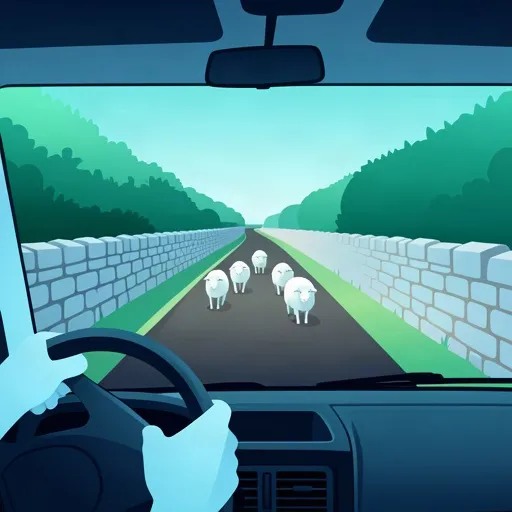
When driving on rural roads, keep your eyes scanning for movement beyond the immediate reach of your beam. If you see signs of livestock, such as gates left open or tracks on the road, anticipate animals on the carriageway. If you encounter animals, slow down significantly and be prepared to stop completely until they have safely cleared the road.
Correct use of lights is essential when approaching or following other traffic. You must dip your headlights when you are following another vehicle closely to avoid dazzling the driver through their rear-view mirrors. Similarly, when meeting oncoming traffic, switch to dipped beams well in advance.
To succeed in the Driver Theory Test, you must be familiar with the specific terminology used by the RSA regarding lighting and road safety.
Night driving on Irish country roads requires careful speed management to match your limited visibility—dipped headlights typically reveal only about 30 metres ahead, and at 100km/h you cover this distance in roughly one second. You must always dip your headlights when following or meeting other vehicles and look toward the left road edge if dazzled. Rural roads present unique hazards including pedestrians, animals, and agricultural machinery, so continuously scan beyond the immediate beam reach and be prepared to stop. These practices, grounded in the RSA Rules of the Road, are essential for both safe driving and the hazard perception elements of the Driver Theory Test.
A short set of high-value points that capture the most important ideas from this article.
On unlit rural roads, dipped headlights typically illuminate only about 30 metres ahead, so always adjust your speed to match visibility
You are legally required under the Rules of the Road to drive at a speed that allows you to stop within the distance you can clearly see is empty
Rural roads may hide hazards such as pedestrians without reflective gear, stray animals, and slow-moving agricultural vehicles
Always dip your headlights when following another vehicle or meeting oncoming traffic to avoid dazzling other drivers
A clean windscreen and properly aimed headlights are essential for maximising visibility and safety at night
At 100km/h, you cover 30 metres in roughly one second, leaving almost no room for error if an obstruction appears
Dirty lights, indicators, and reflectors reduce visibility and can dangerously dazzle other road users
If dazzled by oncoming lights, look toward the left kerb or road edge to maintain orientation
When encountering animals on the road, slow significantly and be prepared to stop until they clear
Anticipate hazards beyond the immediate reach of your headlight beam by continuously scanning the road ahead
Outdriving your lights by travelling faster than the distance your headlights illuminate
Failing to dip headlights when following another vehicle, causing dazzle through rear-view mirrors
Not reducing speed in heavy rain or fog when visibility is further reduced
Overlooking signs of livestock such as open gates or tracks on the road surface
Using main beam when oncoming traffic is present, creating dangerous dazzle for other drivers
Article content overview
A short set of high-value points that capture the most important ideas from this article.
On unlit rural roads, dipped headlights typically illuminate only about 30 metres ahead, so always adjust your speed to match visibility
You are legally required under the Rules of the Road to drive at a speed that allows you to stop within the distance you can clearly see is empty
Rural roads may hide hazards such as pedestrians without reflective gear, stray animals, and slow-moving agricultural vehicles
Always dip your headlights when following another vehicle or meeting oncoming traffic to avoid dazzling other drivers
A clean windscreen and properly aimed headlights are essential for maximising visibility and safety at night
At 100km/h, you cover 30 metres in roughly one second, leaving almost no room for error if an obstruction appears
Dirty lights, indicators, and reflectors reduce visibility and can dangerously dazzle other road users
If dazzled by oncoming lights, look toward the left kerb or road edge to maintain orientation
When encountering animals on the road, slow significantly and be prepared to stop until they clear
Anticipate hazards beyond the immediate reach of your headlight beam by continuously scanning the road ahead
Outdriving your lights by travelling faster than the distance your headlights illuminate
Failing to dip headlights when following another vehicle, causing dazzle through rear-view mirrors
Not reducing speed in heavy rain or fog when visibility is further reduced
Overlooking signs of livestock such as open gates or tracks on the road surface
Using main beam when oncoming traffic is present, creating dangerous dazzle for other drivers
Explore related topics, search based questions, and concepts that learners often look up when studying Night Driving on Irish Rural Roads. These themes reflect real search intent and help you understand how this topic connects to wider driving theory knowledge in Ireland.
Find clear and practical answers to common questions learners often have about Night Driving on Irish Rural Roads. This section helps explain difficult points, remove confusion, and reinforce the key driving theory concepts that matter for learners in Ireland.
You must drive at a speed that allows you to stop safely within the distance covered by your vehicle's headlights.
Under good conditions, dipped headlights typically allow you to see for about 30 metres, which requires careful speed management.
A clean windscreen is critical because dirt, streaks, or smears can scatter light from oncoming vehicles, significantly reducing your visibility and causing glare.
Headlights must be properly adjusted; if they are out of line, they provide less effective light for you and can dazzle oncoming drivers, even when dipped.
After searching, continue your DTT preparation by exploring related articles, practicing questions, or reviewing specific road sign categories. Deepen your understanding of Irish road rules and ensure you're fully prepared for your Driver Theory Test.