
Understanding how to react when a vehicle breaks down on rural roads is a vital skill for every driver in Ireland. This article explains the correct safety steps to take when you cannot pull over to a hard shoulder, focusing on maximizing visibility to other road users and ensuring the safety of all passengers. You will learn how to align with official RSA guidance to minimize risks from agricultural traffic and hidden hazards on narrow, winding routes.
Article content overview
Driving on Irish rural roads presents a unique set of challenges that differ significantly from motorway or urban driving. Narrow carriageways, high hedges, blind bends, and the frequent presence of slow-moving agricultural machinery create an environment where a vehicle breakdown can quickly escalate into a dangerous situation. According to the Rules of the Road, your primary objective when you encounter a mechanical issue in these environments is to protect yourself, your passengers, and other road users by ensuring your vehicle is as visible and as far removed from the flow of traffic as possible.
Unlike on motorways where you have the relative safety of a hard shoulder, many Irish rural routes are narrow and lack dedicated emergency areas. If your vehicle breaks down, your first priority is to move the car off the carriageway completely if at all possible. If you cannot reach a wide verge or a field entrance, you must park as close to the left-hand side of the road as possible.
Once your vehicle is stationary, you must ensure that other road users are alerted to your presence immediately. Switch on your hazard warning lights to indicate that you have a problem. If the breakdown occurs in low-light, dusk, or nighttime conditions, you should leave your sidelights on to further improve your vehicle's visibility to approaching motorists.
The safety of your passengers is paramount during a breakdown. If your vehicle is in a position where it might be struck by passing traffic—such as near a blind bend or on a narrow stretch where two vehicles can barely pass—everyone should exit the vehicle. You must ensure that all passengers exit through the doors furthest from the passing traffic and move to a safe position behind a hedge, fence, or stone wall.
When exiting the vehicle, especially in rural areas where large agricultural vehicles may be traveling, wearing a high-visibility vest is a crucial safety measure. It is a recommended practice to keep a high-visibility vest accessible within the cabin of your car at all times. By wearing one, you significantly increase your chances of being seen by drivers, particularly in weather conditions like fog or heavy rain, which are common in Ireland.
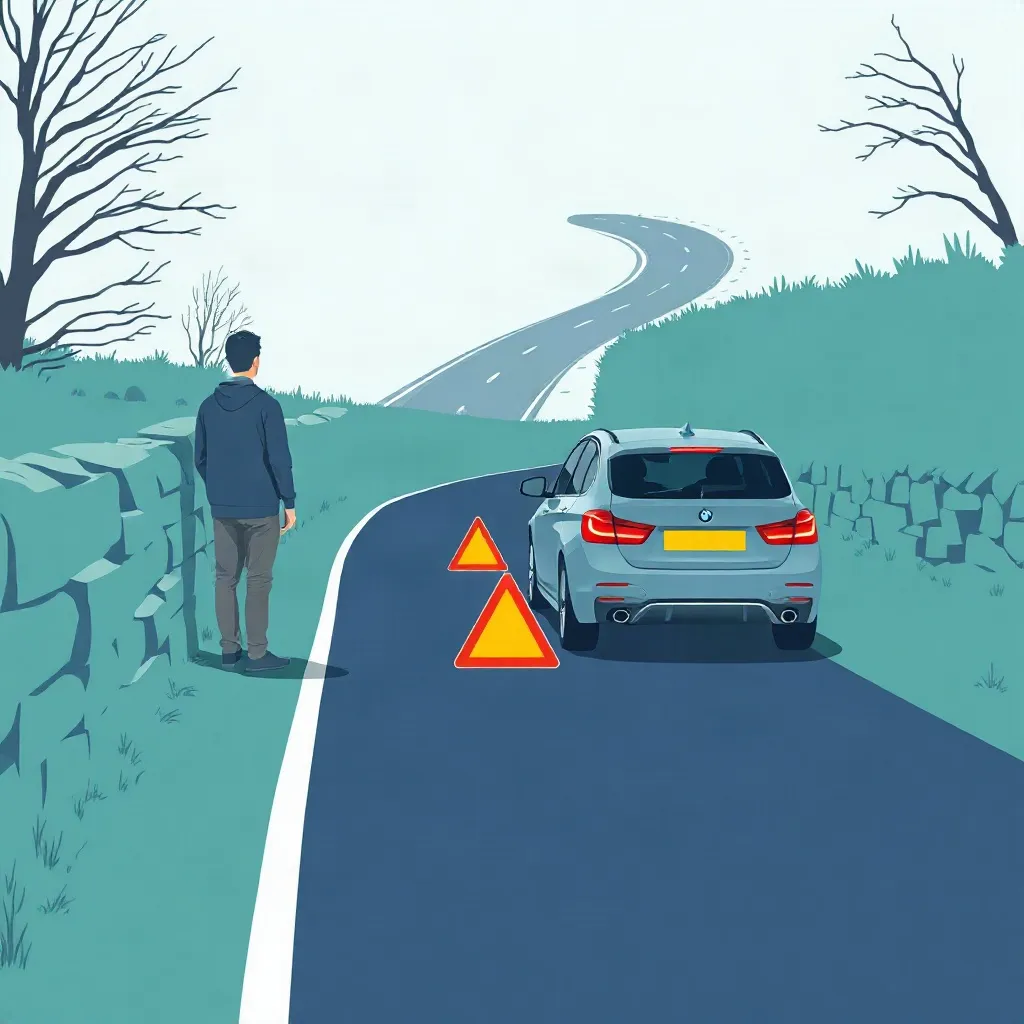
In the Irish Driver Theory Test, you may be presented with scenarios involving breakdowns on narrow roads. A common mistake candidates make is assuming that they should place a warning triangle behind their vehicle, as one might do on wider roads or in other jurisdictions. However, on narrow rural roads with blind bends and high speeds, the risk of being struck while attempting to place a warning triangle is often higher than the benefit it provides. The official RSA advice prioritizes getting people to a place of safety over the use of warning devices.
Additionally, always remember that you should never leave your vehicle parked in a way that blocks a road or creates a bottleneck, unless it is physically impossible to move it further to the left. If you are in a location with limited visibility, such as a sharp turn, try to move your passengers to a safe area before you worry about the vehicle itself.
When a vehicle breaks down on Irish rural roads, the absence of hard shoulders means drivers must prioritize positioning the car as far left as possible and immediately alerting other road users through hazard lights. Passenger safety is paramount; everyone should exit through the doors furthest from traffic and move to a safe position behind a physical barrier such as a hedge or wall. The RSA advises against using warning triangles on narrow roads where the risk of being struck while placing one exceeds its protective value. High-visibility vests and contacting breakdown services with precise location details are essential components of safe rural breakdown management.
A short set of high-value points that capture the most important ideas from this article.
Move the vehicle as far left as possible, ideally onto a wide verge or gateway, removing it from the traffic flow.
Activate hazard warning lights immediately and leave sidelights on in low-light conditions to maximize visibility.
All passengers should exit through doors furthest from oncoming traffic and move to a safe position behind a hedge, fence, or wall.
Wear a high-visibility vest whenever you need to move outside the vehicle in rural areas.
Contact emergency or breakdown services with your exact location using nearby road signs or landmarks.
Rural roads lack hard shoulders, so positioning the vehicle to the left and away from traffic is the primary safety objective.
Warning triangles may create greater danger on narrow roads with blind bends where you risk being struck while placing them.
Passenger safety takes priority over vehicle positioning when the vehicle is in a high-risk location near blind bends.
High-visibility vests should be kept accessible within the cabin at all times for rapid use.
Never attempt mechanical repairs on the side of a busy rural road due to the risk from agricultural machinery and narrow lanes.
Assuming warning triangles should always be used - on narrow rural roads the risk of being struck while placing one often outweighs the benefit.
Leaving passengers inside the vehicle when it is positioned dangerously near passing traffic or blind bends.
Parking in a way that blocks the road or creates a bottleneck when the vehicle could be moved further left.
Not wearing a high-visibility vest when exiting the vehicle in conditions of reduced visibility such as fog or rain.
Exiting through doors on the side nearest to oncoming traffic instead of the protected side.
Article content overview
A short set of high-value points that capture the most important ideas from this article.
Move the vehicle as far left as possible, ideally onto a wide verge or gateway, removing it from the traffic flow.
Activate hazard warning lights immediately and leave sidelights on in low-light conditions to maximize visibility.
All passengers should exit through doors furthest from oncoming traffic and move to a safe position behind a hedge, fence, or wall.
Wear a high-visibility vest whenever you need to move outside the vehicle in rural areas.
Contact emergency or breakdown services with your exact location using nearby road signs or landmarks.
Rural roads lack hard shoulders, so positioning the vehicle to the left and away from traffic is the primary safety objective.
Warning triangles may create greater danger on narrow roads with blind bends where you risk being struck while placing them.
Passenger safety takes priority over vehicle positioning when the vehicle is in a high-risk location near blind bends.
High-visibility vests should be kept accessible within the cabin at all times for rapid use.
Never attempt mechanical repairs on the side of a busy rural road due to the risk from agricultural machinery and narrow lanes.
Assuming warning triangles should always be used - on narrow rural roads the risk of being struck while placing one often outweighs the benefit.
Leaving passengers inside the vehicle when it is positioned dangerously near passing traffic or blind bends.
Parking in a way that blocks the road or creates a bottleneck when the vehicle could be moved further left.
Not wearing a high-visibility vest when exiting the vehicle in conditions of reduced visibility such as fog or rain.
Exiting through doors on the side nearest to oncoming traffic instead of the protected side.
Explore related topics, search based questions, and concepts that learners often look up when studying Breakdown Safety on Rural Roads. These themes reflect real search intent and help you understand how this topic connects to wider driving theory knowledge in Ireland.
Find clear and practical answers to common questions learners often have about Breakdown Safety on Rural Roads. This section helps explain difficult points, remove confusion, and reinforce the key driving theory concepts that matter for learners in Ireland.
Your first priority is the safety of yourself and your passengers. Immediately move everyone to a safe position off the road, away from traffic, especially near blind bends or narrow sections.
No, placing a warning triangle on a narrow or high-speed rural road is generally discouraged as it puts you at significant risk of being struck by traffic while trying to position the device.
You should switch on your hazard warning lights immediately to alert other drivers. Ensure that you and any passengers are wearing high-visibility vests if exiting the vehicle in low light or poor visibility conditions.
You should generally avoid attempting any repairs yourself, especially on narrow or busy rural roads where there is no space to work safely away from passing agricultural machinery or other traffic.
After searching, continue your DTT preparation by exploring related articles, practicing questions, or reviewing specific road sign categories. Deepen your understanding of Irish road rules and ensure you're fully prepared for your Driver Theory Test.