
Understanding the specific risks associated with rural driving is a critical component of the Irish Driver Theory Test. This article explains how to spot hidden dangers before they become critical and how to properly react when you see standard warning signage. Mastering these skills will prepare you to handle the unpredictable nature of the Irish countryside safely and confidently.
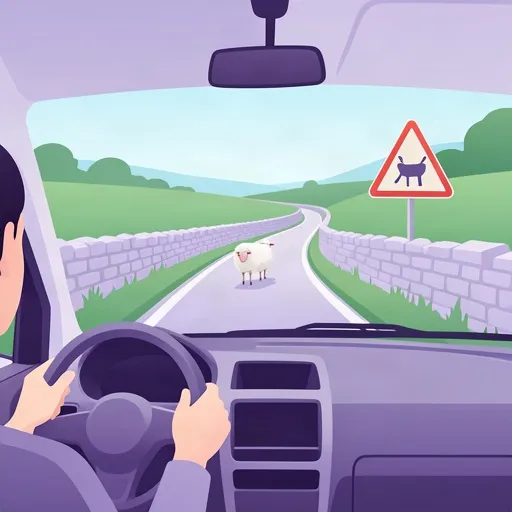
Article content overview
This guide covers how to identify and respond to hidden hazards on rural Irish roads, with emphasis on RSA warning sign recognition. Standard warning signs feature yellow backgrounds with black borders and symbols, while orange signs indicate temporary roadwork conditions requiring heightened attention. Beyond formal signs, learners must develop situational awareness for non-obvious hazards like farm animals, cyclists, and obscured junctions caused by high hedges or stone walls. Effective hazard perception involves scanning ahead, adjusting speed proactively, and assuming hidden dangers exist where visibility is limited. The Driver Theory Test assesses your ability to interpret these signs and demonstrate appropriate defensive driving responses.
A short set of high-value points that capture the most important ideas from this article.
RSA warning signs are diamond or rectangular with a yellow background, black border, and black symbol to alert drivers to permanent road hazards ahead.
When you see a warning sign, you must adjust your speed well before reaching the hazard to maintain full vehicle control.
Rural roads require proactive hazard perception because high hedges, stone walls, and winding lanes frequently restrict visibility.
Always assume a hidden hazard exists when the road narrows or you approach a hill crest where you cannot see beyond.
The Driver Theory Test evaluates your ability to interpret warning signs and demonstrate correct defensive driving maneuvers, not just knowledge recall.
Standard warning signs have yellow backgrounds; roadwork signs have orange backgrounds—this is a key visual distinction.
Warning signs are mounted on posts at the roadside to inform you of hazards before you reach them.
Farm machinery, stray animals, and cyclists are common unexpected obstacles on Irish rural roads.
Adjust your speed to match the visibility available, especially on winding country lanes.
Hazard perception means reading the road ahead and anticipating dangers you cannot yet see.
Confusing orange roadwork signs with yellow standard warning signs, leading to incorrect hazard categorization.
Failing to slow down early when approaching a warning sign, instead of adjusting speed well in advance.
Not anticipating hidden hazards at hill crests or around bends where visibility is compromised.
Ignoring the environmental context (hedges, walls) that suggests restricted sightlines on rural roads.
Focusing only on memorizing sign meanings without understanding the defensive driving response expected.
Article content overview
A short set of high-value points that capture the most important ideas from this article.
RSA warning signs are diamond or rectangular with a yellow background, black border, and black symbol to alert drivers to permanent road hazards ahead.
When you see a warning sign, you must adjust your speed well before reaching the hazard to maintain full vehicle control.
Rural roads require proactive hazard perception because high hedges, stone walls, and winding lanes frequently restrict visibility.
Always assume a hidden hazard exists when the road narrows or you approach a hill crest where you cannot see beyond.
The Driver Theory Test evaluates your ability to interpret warning signs and demonstrate correct defensive driving maneuvers, not just knowledge recall.
Standard warning signs have yellow backgrounds; roadwork signs have orange backgrounds—this is a key visual distinction.
Warning signs are mounted on posts at the roadside to inform you of hazards before you reach them.
Farm machinery, stray animals, and cyclists are common unexpected obstacles on Irish rural roads.
Adjust your speed to match the visibility available, especially on winding country lanes.
Hazard perception means reading the road ahead and anticipating dangers you cannot yet see.
Confusing orange roadwork signs with yellow standard warning signs, leading to incorrect hazard categorization.
Failing to slow down early when approaching a warning sign, instead of adjusting speed well in advance.
Not anticipating hidden hazards at hill crests or around bends where visibility is compromised.
Ignoring the environmental context (hedges, walls) that suggests restricted sightlines on rural roads.
Focusing only on memorizing sign meanings without understanding the defensive driving response expected.
Explore related topics, search based questions, and concepts that learners often look up when studying Identifying Rural Road Hazards. These themes reflect real search intent and help you understand how this topic connects to wider driving theory knowledge in Ireland.
Find clear and practical answers to common questions learners often have about Identifying Rural Road Hazards. This section helps explain difficult points, remove confusion, and reinforce the key driving theory concepts that matter for learners in Ireland.
Standard warning signs in Ireland are diamond or rectangular in shape, featuring a yellow background with a black border and a black symbol to represent the hazard.
Roadwork signs are orange with a black border and black symbols or words, whereas standard warning signs use a yellow background. You should always reduce speed when encountering roadwork signs.
Rural roads often have restricted visibility, unpredictable junctions, and potential for animals on the road; identifying hazards early gives you sufficient time to react safely.
You should always take special care, reduce your speed, and scan the road ahead to prepare for the hazard indicated by the sign.
After searching, continue your DTT preparation by exploring related articles, practicing questions, or reviewing specific road sign categories. Deepen your understanding of Irish road rules and ensure you're fully prepared for your Driver Theory Test.