
Navigating signal-controlled junctions requires a clear understanding of the legal sequence of lights and the specific responsibilities of the driver at the stop line. This guide provides a detailed breakdown of the Irish Rules of the Road regarding traffic lights and clarifies the correct procedure when a green filter arrow is present. By learning these distinctions, you will be better prepared to make safe decisions at junctions and answer critical questions on your theory exam.
Article content overview
Navigating signal-controlled junctions is a foundational skill for any learner driver in Ireland. To pass the RSA Driver Theory Test, you must have a precise, technical understanding of how traffic light sequences function and the legal responsibilities they impose on you as a motorist. Traffic lights are designed to regulate flow and maintain safety, but they are frequently the source of "trick" questions in the theory exam, particularly concerning the exact moment you must stop or when you are permitted to proceed.
The standard traffic light sequence in Ireland is green, amber, red, and back to green. This sequence is strictly regulated, and failing to understand the specific obligations at each stage can lead to penalty points and, more importantly, dangerous incidents at busy urban junctions.
A green light indicates that you may proceed, provided the way is clear. However, the RSA emphasizes that a green light does not grant you absolute priority. Before entering a junction, you must ensure that no pedestrians are crossing and that your path is clear of other road users. This is particularly critical when turning left or right, where you must remain vigilant for vulnerable road users such as cyclists and pedestrians who may be in your blind spot.
An amber light is a frequent point of confusion for learners. Legally, an amber light means you must not go beyond the stop line or the light itself. The only exception to this rule is if you are so close to the stop line when the amber light appears that stopping would be considered dangerous or would cause a collision. For the theory test, remember that the default requirement is to stop; you should only proceed through an amber light if it is physically impossible or unsafe to come to a halt in time.
The white line painted on the road at a signal-controlled junction. You must not cross this line when the light is red or, in most cases, when the light is amber.
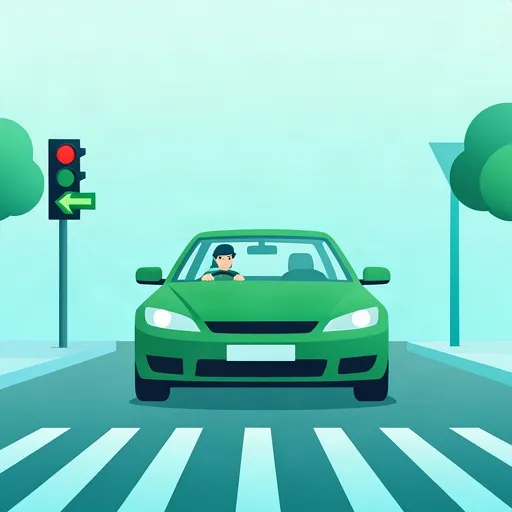
A green filter arrow is a specialized signal that provides controlled movement for specific traffic flows, such as turning right at a busy junction. If you see a green arrow, it signifies that you may move in the direction the arrow indicates, assuming it is safe to do so. A crucial piece of information for the theory test is that you may proceed in the direction of a green filter arrow even if the main traffic lights are showing a red signal for your lane.
Always treat a green filter arrow with caution. While it gives you the legal permission to move, it does not absolve you of the duty of care. You must constantly monitor your surroundings for emergency vehicles that may be responding to an incident, as these vehicles may be using blue lights and sirens that require you to yield immediately, regardless of the signals currently displayed.
In addition to standard traffic lights, Irish roads feature specific pedestrian-controlled crossings that require specialized knowledge. A Pelican crossing, for example, features a flashing amber light for drivers after the red light. When this amber light is flashing, you must give priority to any pedestrians still on the crossing.
Toucan crossings are similarly important to identify. These are wider, signal-controlled crossings designed to accommodate both pedestrians and cyclists. They are controlled by traffic lights that display green signals for both groups, and some modern installations include sensors to adjust signal timing based on real-time movement. Understanding these systems ensures that you do not inadvertently block a crossing or fail to yield to a cyclist or pedestrian, both of which are common areas for errors in the theory exam.
Never assume that a green light means you have an automatic right of way. Always check for pedestrians or cyclists who may have stepped onto the road while the light was changing, as they are often the most vulnerable users at signal-controlled junctions.
The Irish Driver Theory Test often tests your ability to apply these rules in hypothetical scenarios. One common trap involves asking what to do when a light turns amber at high speed or if you are allowed to pass through an amber light under specific conditions. Remember that the "danger" test is key: if you can stop safely, you must.
Another area of confusion is the distinction between a flashing amber arrow and a green filter arrow. A flashing amber arrow essentially means "proceed with caution," whereas a green filter arrow provides a more explicit clearance for your movement. Always read the question carefully to identify whether the light is steady or flashing, as this changes your legal requirement at the junction.
Mastering Irish traffic light sequences requires understanding that each signal stage—green, amber, and red—carries distinct legal obligations, not just permissions. A green light demands vigilance for pedestrians and cyclists before proceeding, while an amber light legally requires stopping unless the danger test applies. Green filter arrows permit specific directional movement even during a red main signal, but this clearance does not override the duty to watch for emergency vehicles or vulnerable road users. The exam frequently tests the amber light danger test and the distinction between different arrow types and crossing signals, making precise understanding essential for both safe driving and test success.
A short set of high-value points that capture the most important ideas from this article.
The standard traffic light sequence in Ireland is green, amber, red, then back to green, with each signal imposing specific legal obligations
A green light permits you to proceed only when the way is clear, and you must always yield to pedestrians and cyclists before entering the junction
An amber light legally requires you to stop unless you are so close to the stop line that stopping would cause a collision
A green filter arrow allows you to move in its indicated direction even when the main traffic light shows red for your lane
Emergency vehicles with blue lights and sirens always have priority, and you must yield to them regardless of any signal displayed
The stop line is the white line at signal-controlled junctions - you must not cross it on red or amber
The 'danger test' determines whether you can proceed on amber: proceed only if stopping would be dangerous or cause a collision
A green filter arrow provides directional permission but does not remove your duty of care or vigilance
Pelican crossings have flashing amber phases where you must give way to pedestrians still on the crossing
Toucan crossings are designed for both pedestrians and cyclists and are controlled by shared traffic lights
Assuming that a green light automatically grants right of way and entering the junction without checking for vulnerable users
Proceeding through an amber light when it was safe to stop, forgetting that the default requirement is to stop
Confusing a flashing amber arrow (proceed with caution) with a steady green filter arrow (explicit clearance)
Failing to check for pedestrians or cyclists in blind spots when turning at a green light
Not yielding to emergency vehicles responding with blue lights and sirens, regardless of the signals showing
Article content overview
A short set of high-value points that capture the most important ideas from this article.
The standard traffic light sequence in Ireland is green, amber, red, then back to green, with each signal imposing specific legal obligations
A green light permits you to proceed only when the way is clear, and you must always yield to pedestrians and cyclists before entering the junction
An amber light legally requires you to stop unless you are so close to the stop line that stopping would cause a collision
A green filter arrow allows you to move in its indicated direction even when the main traffic light shows red for your lane
Emergency vehicles with blue lights and sirens always have priority, and you must yield to them regardless of any signal displayed
The stop line is the white line at signal-controlled junctions - you must not cross it on red or amber
The 'danger test' determines whether you can proceed on amber: proceed only if stopping would be dangerous or cause a collision
A green filter arrow provides directional permission but does not remove your duty of care or vigilance
Pelican crossings have flashing amber phases where you must give way to pedestrians still on the crossing
Toucan crossings are designed for both pedestrians and cyclists and are controlled by shared traffic lights
Assuming that a green light automatically grants right of way and entering the junction without checking for vulnerable users
Proceeding through an amber light when it was safe to stop, forgetting that the default requirement is to stop
Confusing a flashing amber arrow (proceed with caution) with a steady green filter arrow (explicit clearance)
Failing to check for pedestrians or cyclists in blind spots when turning at a green light
Not yielding to emergency vehicles responding with blue lights and sirens, regardless of the signals showing
Explore related topics, search based questions, and concepts that learners often look up when studying Traffic Lights and Filter Arrows. These themes reflect real search intent and help you understand how this topic connects to wider driving theory knowledge in Ireland.
Find clear and practical answers to common questions learners often have about Traffic Lights and Filter Arrows. This section helps explain difficult points, remove confusion, and reinforce the key driving theory concepts that matter for learners in Ireland.
A green filter arrow means you may proceed in the direction of the arrow, provided the way is clear and it is safe to do so, even if the main traffic light is showing red.
Yes, you must not go beyond the stop line when an amber light appears, unless you are so close to the line that stopping would be dangerous.
The standard sequence in Ireland is green, then amber, then red, and back to green.
Yes, even when the light is green, you must take special care and give way to pedestrians who are crossing at the junction.
After searching, continue your DTT preparation by exploring related articles, practicing questions, or reviewing specific road sign categories. Deepen your understanding of Irish road rules and ensure you're fully prepared for your Driver Theory Test.