
Understanding how to safely navigate junctions is a fundamental skill for every driver in Ireland, yet it remains a frequent source of errors in the theory exam. This guide breaks down the legal requirements for right of way, the correct approach to mini-roundabouts, and how to identify road priorities at unmarked village junctions. Developing a clear grasp of these rules is vital for both passing your test and ensuring safety on the road.
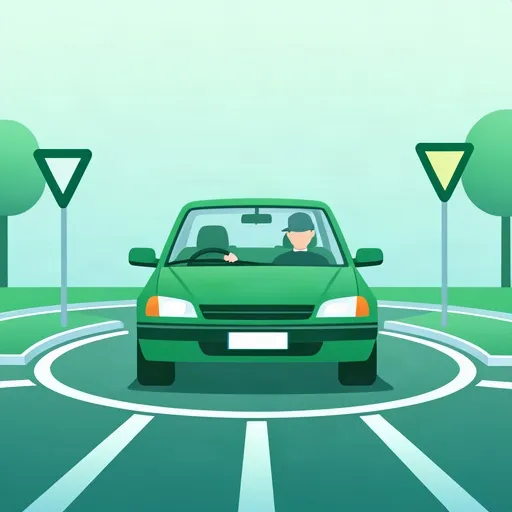
Article content overview
This guide covers the essential RSA priority rules for navigating small junctions and mini-roundabouts in Ireland, key concepts for the Driver Theory Test. The core principle is that traffic on a major road has priority over minor road traffic, while unmarked junctions of equal importance require giving way to the right. At mini-roundabouts, always yield to traffic from your right and signal your intentions clearly. Crucially, right of way is never absolute—drivers must always be prepared to yield to avoid collisions, even when another road user is in the wrong.
A short set of high-value points that capture the most important ideas from this article.
Right of way is not absolute; always be prepared to yield even when you technically have priority
Traffic on a major road has priority over vehicles emerging from a minor road
At unmarked junctions where two roads of equal importance meet, give way to traffic approaching from your right
Mini-roundabouts require you to yield to traffic coming from your right, just like larger roundabouts
Stop signs mandate a complete stop at the stop line or junction edge regardless of road conditions
Stop sign: you must stop completely and give way to all traffic on the major road
Yield sign: slow down and be prepared to stop, but you do not need to stop if the way is clear
At unmarked junctions, scan right-left-right and only proceed when the intersection is confirmed clear
Signal early at mini-roundabouts: left signal for first exit, maintain position and signal left after passing the exit before your intended one
The RSA defines right of way as a legal entitlement that is never absolute—you must avoid collisions even if the other driver is wrong
Assuming that having right of way means you can proceed without caution—other drivers may ignore signs
Confusing Yield signs with Stop signs and coming to a complete halt when not required
Forgetting that unmarked junctions require giving way to the right, not the left
Treating mini-roundabouts like standard crossroads and failing to yield to traffic from the right
Failing to slow down sufficiently before reaching an unmarked junction, reducing observation time
Article content overview
A short set of high-value points that capture the most important ideas from this article.
Right of way is not absolute; always be prepared to yield even when you technically have priority
Traffic on a major road has priority over vehicles emerging from a minor road
At unmarked junctions where two roads of equal importance meet, give way to traffic approaching from your right
Mini-roundabouts require you to yield to traffic coming from your right, just like larger roundabouts
Stop signs mandate a complete stop at the stop line or junction edge regardless of road conditions
Stop sign: you must stop completely and give way to all traffic on the major road
Yield sign: slow down and be prepared to stop, but you do not need to stop if the way is clear
At unmarked junctions, scan right-left-right and only proceed when the intersection is confirmed clear
Signal early at mini-roundabouts: left signal for first exit, maintain position and signal left after passing the exit before your intended one
The RSA defines right of way as a legal entitlement that is never absolute—you must avoid collisions even if the other driver is wrong
Assuming that having right of way means you can proceed without caution—other drivers may ignore signs
Confusing Yield signs with Stop signs and coming to a complete halt when not required
Forgetting that unmarked junctions require giving way to the right, not the left
Treating mini-roundabouts like standard crossroads and failing to yield to traffic from the right
Failing to slow down sufficiently before reaching an unmarked junction, reducing observation time
Explore related topics, search based questions, and concepts that learners often look up when studying Junctions and Mini-Roundabouts Rules. These themes reflect real search intent and help you understand how this topic connects to wider driving theory knowledge in Ireland.
Find clear and practical answers to common questions learners often have about Junctions and Mini-Roundabouts Rules. This section helps explain difficult points, remove confusion, and reinforce the key driving theory concepts that matter for learners in Ireland.
At a junction where roads are of equal importance, you must give right of way to traffic coming from your right.
No, right of way is not an absolute right. You must always exercise caution, observe other road users, and be prepared to stop if necessary to avoid a collision.
Approach a mini-roundabout with the same caution as a normal roundabout, indicating your exit clearly and giving priority to traffic already on the roundabout or approaching from your right.
A 'Stop' sign requires a complete halt at the line or sign regardless of traffic, while a 'Yield' sign only requires you to slow down and stop if there is oncoming traffic that you must give way to.
After searching, continue your DTT preparation by exploring related articles, practicing questions, or reviewing specific road sign categories. Deepen your understanding of Irish road rules and ensure you're fully prepared for your Driver Theory Test.