
Driving on dark, rural roads in Ireland requires a heightened sense of awareness and strict adherence to RSA lighting standards. This guide explains how to appropriately use your headlights to maximize visibility and how to adjust your speed to remain within your safe stopping distance. Mastering these techniques is essential for both your practical safety and for correctly answering hazard perception questions in your theory exam.
Article content overview
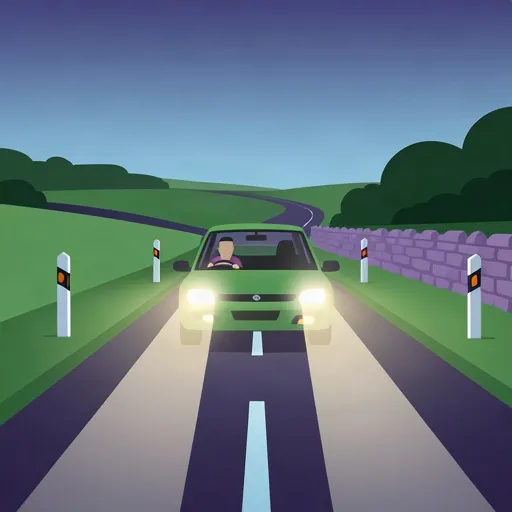
Driving on Irish rural roads after dark presents unique challenges that every learner must master to ensure their safety and pass the Driver Theory Test. Unlike urban environments with consistent street lighting, rural routes often lack illumination, leaving you entirely dependent on your vehicle’s lighting system. According to the RSA Rules of the Road, the core principle of night driving is that you must be able to stop your vehicle within the distance that you can see to be clear, which is defined by your headlight range.
Visibility at night is severely reduced compared to daylight conditions, even with high-quality headlights. A fundamental rule for Irish drivers is that speed must be moderated to match your visibility range. On a standard unlit road, your main beam headlights might illuminate the path for approximately 100 metres, whereas dipped headlights typically offer visibility for only 30 metres. If you are travelling at 100 km/h, your vehicle will cover that 30-metre distance in roughly one second, leaving almost no time to react to hazards like stray livestock, mud on the road, or sharp, unannounced bends.
The distance your vehicle travels from the moment you perceive a hazard to the moment the vehicle comes to a complete halt, accounting for both reaction time and braking distance, while remaining within the range of your headlights.
Knowing when to switch between main beam and dipped headlights is a critical skill for both practical driving and theory exam success. You must use your main beam headlights on unlit rural roads to gain maximum visibility; however, you are legally and morally required to switch to dipped headlights the moment you encounter oncoming traffic or follow another vehicle closely. This prevents dazzling other road users, which could lead to accidents.
Failing to dip your headlights when meeting oncoming traffic is a common cause of accidents on narrow Irish country roads. Always prioritize the vision of other drivers to ensure everyone remains safe.
Irish rural roads are often narrow, winding, and prone to unexpected hazards such as agricultural machinery, mud tracked from fields, and wandering animals. At night, these hazards are significantly harder to spot until they are right in front of you. You should anticipate that a blind bend might conceal a slow-moving tractor or a group of pedestrians walking on the road, especially in areas with few footpaths.
| Light Setting | Visibility Range | Use Case |
|---|---|---|
| Main Beam | ~100 metres | Unlit roads with no other traffic present. |
| Dipped Beam | ~30 metres | In towns, when meeting oncoming traffic, or following vehicles. |
Learners often struggle with questions regarding night driving because they rely on assumptions rather than the specific RSA guidelines. A common exam trap involves scenarios where a driver is asked if they can maintain the national speed limit on a dark, winding road. The correct answer is rarely to maintain the maximum speed; instead, the correct approach focuses on speed management based on the illuminated stopping distance. Always remember that the "safe" speed is often lower than the "legal" speed limit when road conditions are poor or visibility is low.
Night driving on unlit Irish rural roads demands that you match your speed to the range your headlights provide, ensuring you can always stop within what you can see. Main beam headlights offer approximately 100 metres of visibility while dipped beam provides only around 30 metres, so understanding when to use each setting is critical. You must switch to dipped headlights whenever you encounter oncoming traffic or follow another vehicle closely to avoid dazzling other road users. Rural roads at night conceal hazards like agricultural machinery, wandering animals, and pedestrians, so continuous scanning and reduced speed are essential. Theory test questions often trap learners who assume maximum speed is always acceptable; the correct approach prioritises speed management based on actual visibility and road conditions.
A short set of high-value points that capture the most important ideas from this article.
Speed must always be managed so you can stop within the distance your headlights illuminate the road ahead.
Main beam headlights provide approximately 100 metres of visibility on unlit roads; dipped beam provides only around 30 metres.
Switch from main beam to dipped headlights immediately when meeting oncoming traffic or following another vehicle.
Reduce speed on dark rural roads below the posted limit when visibility is restricted by curves, weather, or road geometry.
Anticipate hidden hazards on rural roads at night such as tractors, pedestrians, and wandering animals, especially around blind bends.
The core night driving principle: you must be able to stop within your illuminated range.
Dipped beam is required in towns, when meeting oncoming traffic, and when following another vehicle.
At 100 km/h, a vehicle covers 30 metres in roughly one second, leaving almost no reaction time.
Clean windscreens and light lenses are essential as dirt significantly reduces headlight effectiveness.
The safe speed is often lower than the legal speed limit when visibility is poor.
Maintaining maximum speed on dark, winding roads because the road is unlit rather than slowing to match visibility.
Failing to dip headlights when meeting oncoming traffic, causing dangerous dazzle for other road users.
Assuming that unlit rural roads require main beam only, without understanding when dipped beam is legally required.
Not increasing following distance at night, reducing the ability to react to hazards ahead.
Relying on assumptions instead of RSA guidelines when answering theory test questions about night driving scenarios.
Article content overview
A short set of high-value points that capture the most important ideas from this article.
Speed must always be managed so you can stop within the distance your headlights illuminate the road ahead.
Main beam headlights provide approximately 100 metres of visibility on unlit roads; dipped beam provides only around 30 metres.
Switch from main beam to dipped headlights immediately when meeting oncoming traffic or following another vehicle.
Reduce speed on dark rural roads below the posted limit when visibility is restricted by curves, weather, or road geometry.
Anticipate hidden hazards on rural roads at night such as tractors, pedestrians, and wandering animals, especially around blind bends.
The core night driving principle: you must be able to stop within your illuminated range.
Dipped beam is required in towns, when meeting oncoming traffic, and when following another vehicle.
At 100 km/h, a vehicle covers 30 metres in roughly one second, leaving almost no reaction time.
Clean windscreens and light lenses are essential as dirt significantly reduces headlight effectiveness.
The safe speed is often lower than the legal speed limit when visibility is poor.
Maintaining maximum speed on dark, winding roads because the road is unlit rather than slowing to match visibility.
Failing to dip headlights when meeting oncoming traffic, causing dangerous dazzle for other road users.
Assuming that unlit rural roads require main beam only, without understanding when dipped beam is legally required.
Not increasing following distance at night, reducing the ability to react to hazards ahead.
Relying on assumptions instead of RSA guidelines when answering theory test questions about night driving scenarios.
Explore related topics, search based questions, and concepts that learners often look up when studying Night Driving on Rural Roads. These themes reflect real search intent and help you understand how this topic connects to wider driving theory knowledge in Ireland.
Find clear and practical answers to common questions learners often have about Night Driving on Rural Roads. This section helps explain difficult points, remove confusion, and reinforce the key driving theory concepts that matter for learners in Ireland.
You must always drive at a speed that allows you to stop within the distance illuminated by your headlights.
According to the RSA, a typical car's headlights in good condition allow you to see for about 100 metres on an unlit road.
Dipped headlights typically provide visibility for about 30 metres, which requires a significant reduction in speed to ensure safe stopping.
Clean and properly aligned headlights are crucial for maximum illumination and to avoid dazzling oncoming drivers, even when using dipped lights.
After searching, continue your DTT preparation by exploring related articles, practicing questions, or reviewing specific road sign categories. Deepen your understanding of Irish road rules and ensure you're fully prepared for your Driver Theory Test.