
Navigating roadworks requires strict adherence to traffic control measures to prevent accidents and maintain the flow of traffic. This article details the legal requirements regarding 'Stop' and 'Go' signage, providing the knowledge needed to handle these zones safely and correctly during your theory test and in real-world driving situations.
Article content overview
Roadworks are an unavoidable part of driving, appearing frequently on Irish roads to facilitate essential maintenance, infrastructure improvements, and safety upgrades. For a learner driver, encountering these zones can be intimidating; however, understanding the legal framework governing them is vital for both your practical safety and your success in the Driver Theory Test. The Road Safety Authority (RSA) enforces strict regulations to ensure that temporary traffic management systems are obeyed, as these systems protect both road users and the crews working on the carriageway.
When you are driving through an area marked for roadworks, you are legally required to adhere to all temporary traffic signs and signals. These signs are placed to manage the flow of traffic in environments where the standard rules of the road may be temporarily altered. Ignoring these signs is not just a safety hazard; it is a serious offence that can lead to penalty points, fines, and, most importantly, a high risk of collisions.
Whenever you see signs indicating roadworks, you must immediately adjust your driving behavior. This includes increasing your following distance, scanning for site personnel, and being prepared for sudden stops. The signage is designed to give you sufficient warning to decelerate gradually, avoiding harsh braking that could surprise drivers behind you.
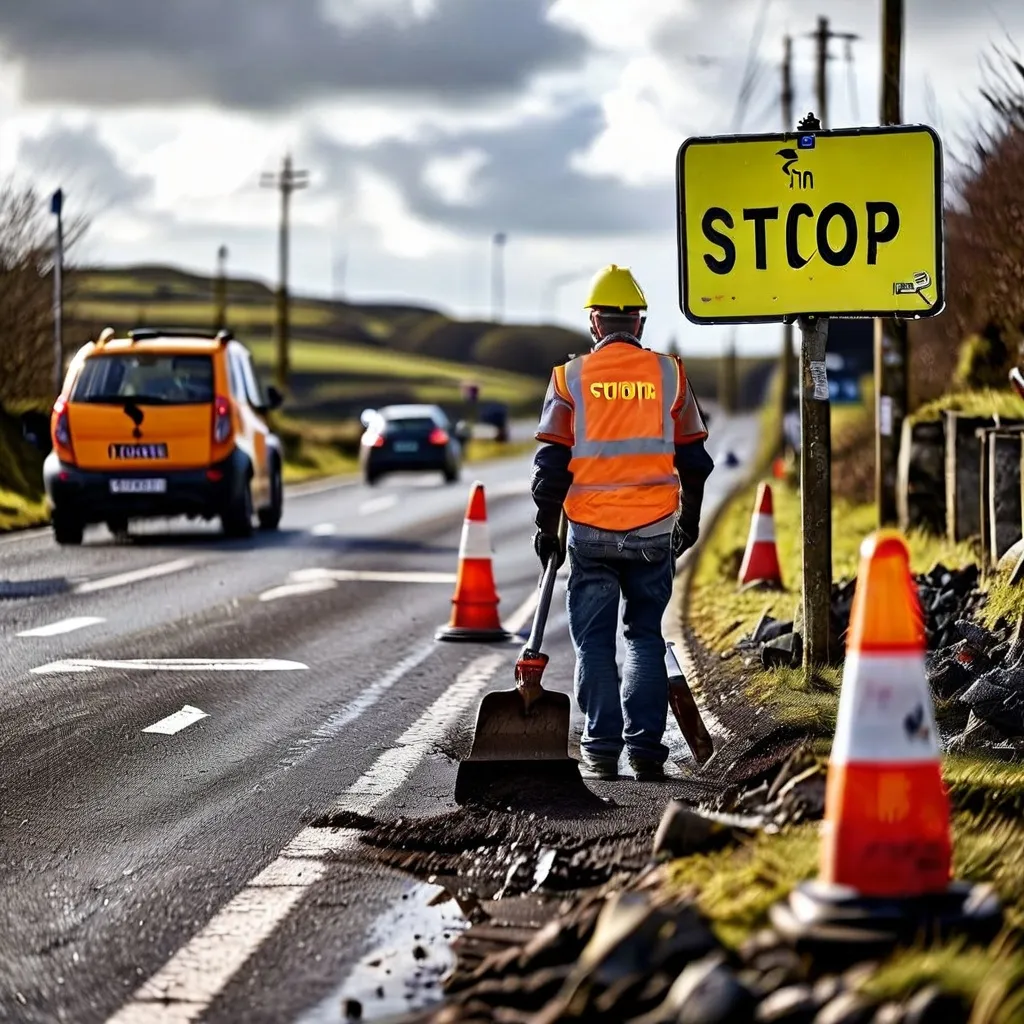
One of the most common methods of managing traffic through narrow sections of roadworks is the manual "Stop" and "Go" system. This system is often used when road space is restricted, allowing only one lane of traffic to pass at a time. The "Stop" sign is a clear command that you must bring your vehicle to a complete halt before the designated point. You are only permitted to proceed when the "Go" sign—sometimes displayed as 'Téigh'—is clearly shown by the operator or the mechanical signal.
It is a serious traffic offence to proceed past a manual "Stop" sign or a temporary "Stop" signal at roadworks. Always wait for the "Go" sign, even if the road appears clear, as machinery or personnel may be moving in your blind spot.
In the Driver Theory Test, you will likely encounter questions regarding temporary traffic control and your responsibilities in hazardous road conditions. The RSA often tests your knowledge of the priority rules when faced with temporary obstacles. A common exam trap involves failing to recognize that temporary signs carry the same legal weight as permanent road signs. You should always treat a manual traffic controller's sign as a priority over standard lane markings.
Beyond the legal requirements, there are practical defensive driving habits you should adopt when passing through roadworks. Always be mindful of the "buffer zones" created by cones; these areas are there for a reason, and you should never drive within them. Furthermore, be aware that the road surface through roadworks might be uneven, covered in loose chippings, or have sudden changes in grip.
In the event that you encounter a temporary traffic light sequence that is not functioning correctly, treat the intersection with extreme caution, assume that other drivers may be confused, and proceed only when it is absolutely safe to do so.
This guide covers the legal framework for navigating temporary roadworks in Ireland as enforced by the RSA. When encountering roadworks, you must immediately adjust your driving by reducing speed, increasing following distance, and scanning for personnel. The manual Stop and Go system is used to alternate single-lane traffic through narrow sections - you must stop completely at the designated point and only proceed when the Go or Téigh signal is displayed. Temporary signs carry the same legal weight as permanent road signs and take priority over standard lane markings. Beyond compliance, drivers should be aware of uneven road surfaces, buffer zones marked by cones, and exercise extreme caution when temporary signals malfunction.
A short set of high-value points that capture the most important ideas from this article.
You are legally required to obey all temporary traffic signs at roadworks, as they carry the same legal weight as permanent road signs
Manual Stop and Go signs manage single-lane alternating traffic through narrow roadwork sections
Always stop completely at the designated stop line when a Stop sign is displayed and wait for the Go or Téigh signal before proceeding
Adjust your speed well in advance of roadworks and increase your following distance to allow for smooth transitions
Temporary signs override standard lane markings and right-of-way rules at roadwork zones
A Stop sign at roadworks means complete cessation - do not proceed until Go or Téigh is shown
The carriageway through roadworks may be uneven or covered in loose chippings requiring reduced speed
Buffer zones created by cones should never be driven through
If temporary traffic lights malfunction, treat the intersection with extreme caution and proceed only when safe
Flagmen and handheld signs constitute manual traffic control and must be obeyed immediately
Proceeding past a Stop sign assuming the road looks clear, not realizing workers or machinery may be in blind spots
Treating temporary roadwork signs as less authoritative than permanent signs
Creeping forward past the stop line while waiting at a manual control point
Failing to adjust speed early enough, causing harsh braking that surprises following drivers
Ignoring buffer zones or driving within areas marked by cones at roadwork sites
Article content overview
A short set of high-value points that capture the most important ideas from this article.
You are legally required to obey all temporary traffic signs at roadworks, as they carry the same legal weight as permanent road signs
Manual Stop and Go signs manage single-lane alternating traffic through narrow roadwork sections
Always stop completely at the designated stop line when a Stop sign is displayed and wait for the Go or Téigh signal before proceeding
Adjust your speed well in advance of roadworks and increase your following distance to allow for smooth transitions
Temporary signs override standard lane markings and right-of-way rules at roadwork zones
A Stop sign at roadworks means complete cessation - do not proceed until Go or Téigh is shown
The carriageway through roadworks may be uneven or covered in loose chippings requiring reduced speed
Buffer zones created by cones should never be driven through
If temporary traffic lights malfunction, treat the intersection with extreme caution and proceed only when safe
Flagmen and handheld signs constitute manual traffic control and must be obeyed immediately
Proceeding past a Stop sign assuming the road looks clear, not realizing workers or machinery may be in blind spots
Treating temporary roadwork signs as less authoritative than permanent signs
Creeping forward past the stop line while waiting at a manual control point
Failing to adjust speed early enough, causing harsh braking that surprises following drivers
Ignoring buffer zones or driving within areas marked by cones at roadwork sites
Explore related topics, search based questions, and concepts that learners often look up when studying Roadworks and Traffic Control. These themes reflect real search intent and help you understand how this topic connects to wider driving theory knowledge in Ireland.
Find clear and practical answers to common questions learners often have about Roadworks and Traffic Control. This section helps explain difficult points, remove confusion, and reinforce the key driving theory concepts that matter for learners in Ireland.
You must come to a complete stop and remain stopped until the 'Go' or 'Téigh' sign is displayed or the authorized person signals you to proceed.
Yes, the movement of vehicles at or near roadworks is controlled by law. Failing to obey these signs is a punishable offence.
Yes, if you see a 'Stop' sign being used to control traffic for crossing plant or machinery, you must stop regardless of your direction of approach.
Yes, traffic control at roadworks can be operated by either mechanical means, such as temporary traffic lights, or manual means using 'Stop' and 'Go' signs.
After searching, continue your DTT preparation by exploring related articles, practicing questions, or reviewing specific road sign categories. Deepen your understanding of Irish road rules and ensure you're fully prepared for your Driver Theory Test.